Skip to content

Posts tagged ‘London’

Art in London (Part 2): The Goya Portraits

When I first saw the grand lofty gallery in the Prado filled with Goya’s portraits, and indeed upon subsequent visits, I admit that I was not overly won over. It was not so much that the portraits were bad, just that by comparison with the dramatic visions of the 2nd and 3rd May 1808 in the adjacent room, or of the even more terrifying and enthralling Black Paintings alongside that, the portraits of Francisco de Goya y Lucientes (1746-1828) always felt a little…bland. It also occurred to me that they all looked a little samey, with their piercing round black eyes sparkling like the glass eyes of teddy bears, and this led me to the perhaps premature conclusion that Goya had painted his sitters more idealistically, rather than realistically.

But the current Goya exhibition at London’s National Gallery sheds new light on this important epoch of the artist’s work, and seen within a narrative of their rich historical context, and with the ability to compare and contrast a magnificent set of some of Goya’s best, suddenly these portraits seem just as compelling as the magnificent sombre works which followed.

Carlos IV of Spain and His Family, 1800

Carlos IV of Spain and His Family, 1800

Charles IV in Hunting Dress, 1799

Charles IV in Hunting Dress, 1799

Maria Luisa wearing a Mantilla, 1799

Maria Luisa wearing a Mantilla, 1799

The Duke and Duchess of Osuna and their Children, 1788

The Duke and Duchess of Osuna and their Children, 1788

The portraits of Goya cannot be deemed the most technically adept in the world. I could not help but notice that on this head or that, the shading was wrong, or the head-piece look flattened and oddly two-dimensional. And I was interested to read that Goya’s was mostly self-trained, a fact which was to me, a likewise self-taught painter, obvious in the gradual improvement of his portraits from early attempts through to his magnificent depictions of the family of Charles IV of Spain. However, his greatest skill was psychological insight, and this was evident in a series of portraits which seemed to penetrate the sitter through to the core. The result was a series of rooms which felt as though they were occupied by the living shadows of history, almost like the paintings in Harry Potter’s Hogwarts, whose sitter would come alive within the frame.

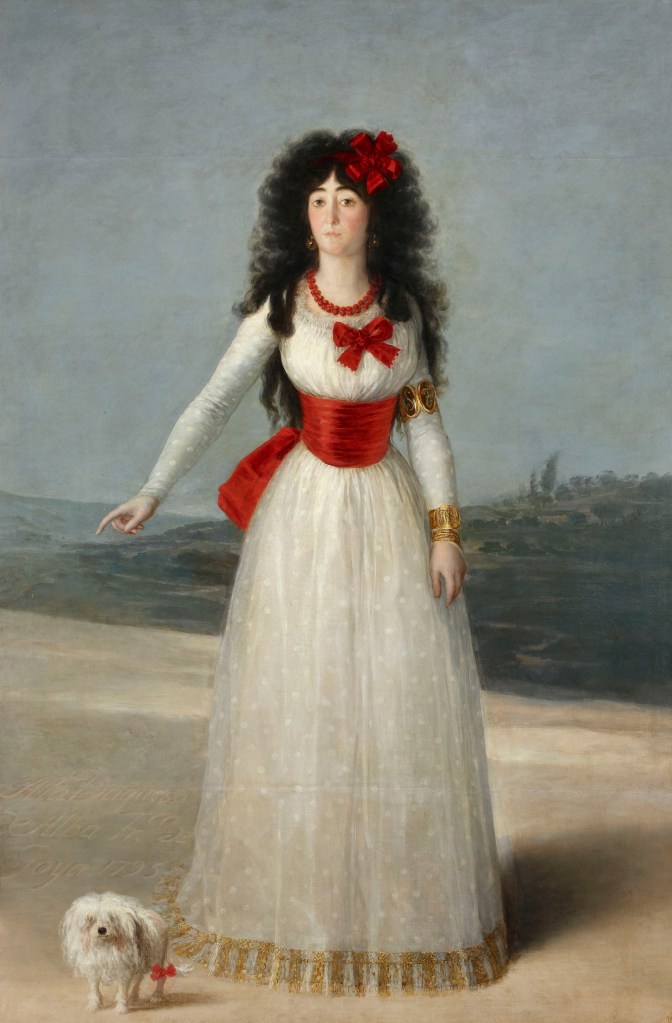
This all makes for a thoroughly enthralling exhibition whose sitters literally leap off the walls to introduce us to the historical periods which characterise the works; from the more informal portraits of the Spanish royals, painted with a view to pacifying the public in the aftermath of the French Revolution, to the somewhat obsequious depictions of French generals after the Napoleonic invasion of Spain. However of all the works, my favourites were of the aristocratic stars of the time, full of bold gestures and extravagant swagger, each competing with the other to afford the more exquisite portrait, and with it, the greater standing in society.

Portrait of the Duchess of Alba, 1797
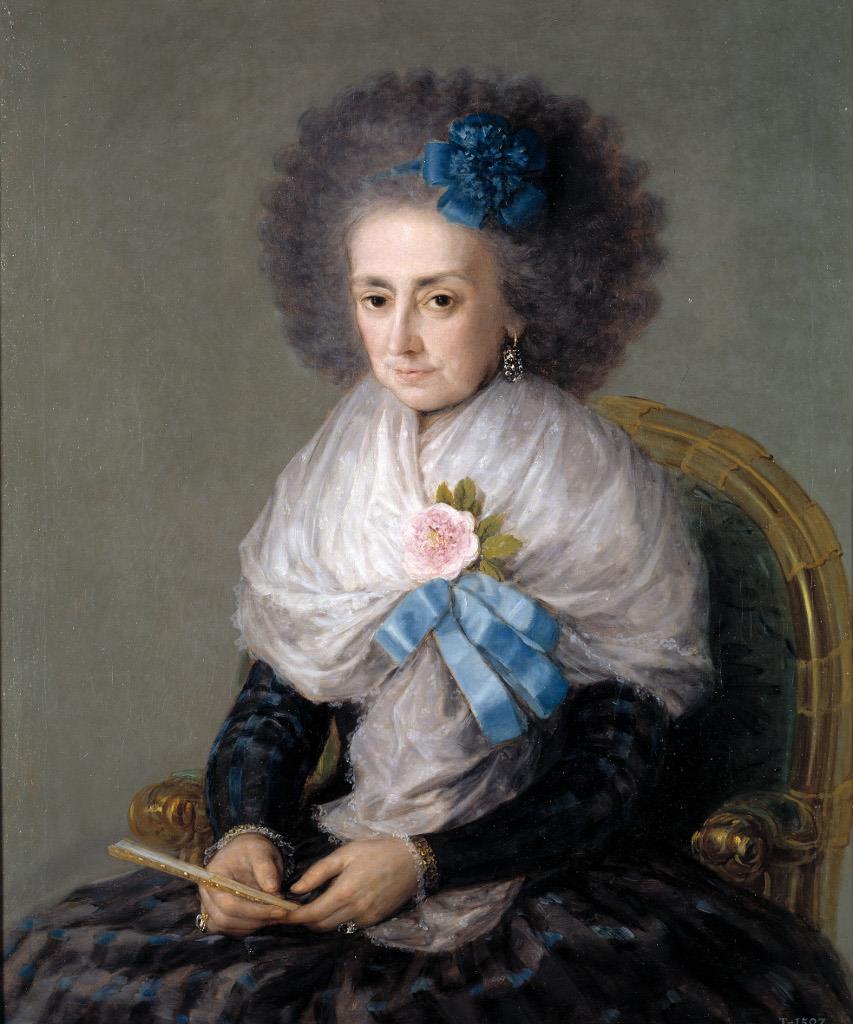
Portrait of the Duchess of Alba, 1797

The Dowager Marchioness of Villafranca, 1796

The Dowager Marchioness of Villafranca, 1796

The Marquis of Villafranca and Duke of Alba, 1795
The Marquis of Villafranca and Duke of Alba, 1795

The White Duchess (Duchess of Alba), 1795

The White Duchess (Duchess of Alba), 1795

Goya’s portraits are a window on a long past world of aristocratic dominance, and regal fancy, and of a time caught between the birth of the enlightenment and the trauma of invasion and turbulent changes of power. And while many of the sitters exhibited those same teddy-bear black eyes which had caught my intention at the Prado years before, it is the intensity behind the gaze in those eyes which left a lasting impression on me as I left this superb London show.

Goya: The Portraits is on at The National Gallery in London until 10 January 2016… so get there quick!

Art in London (Part 1): Calder’s Mobiles

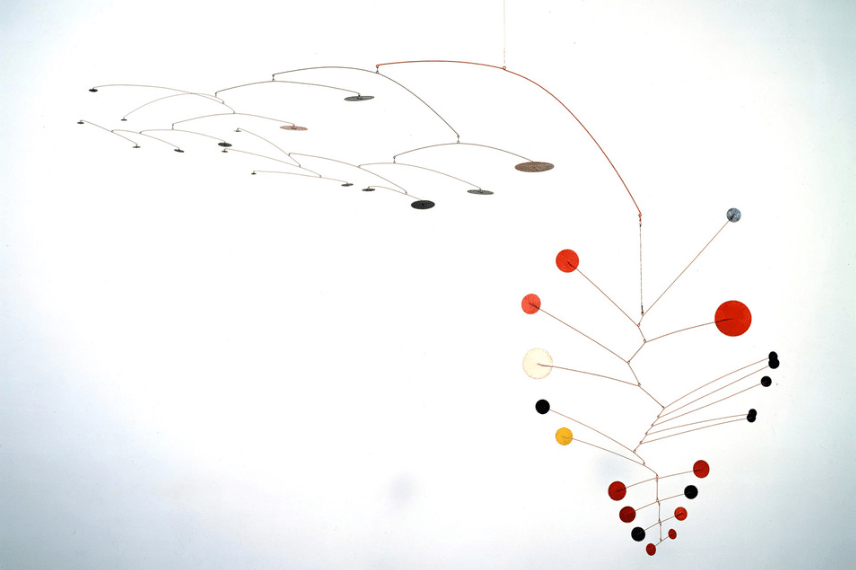
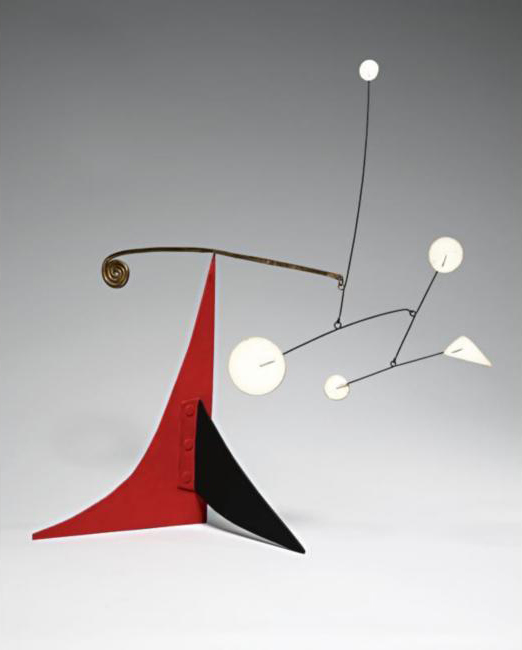
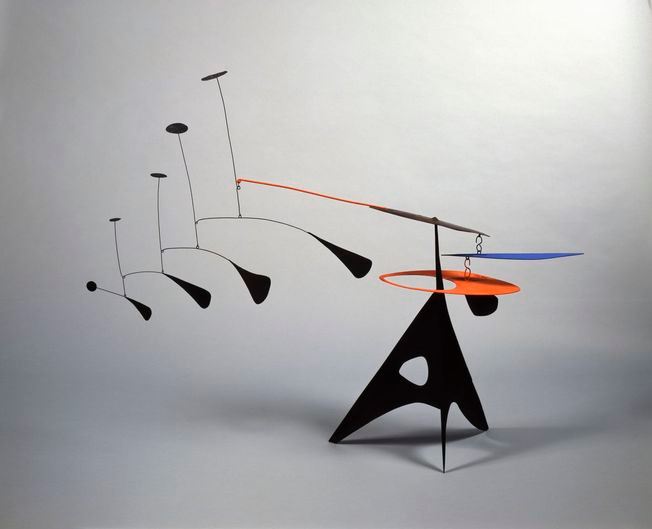
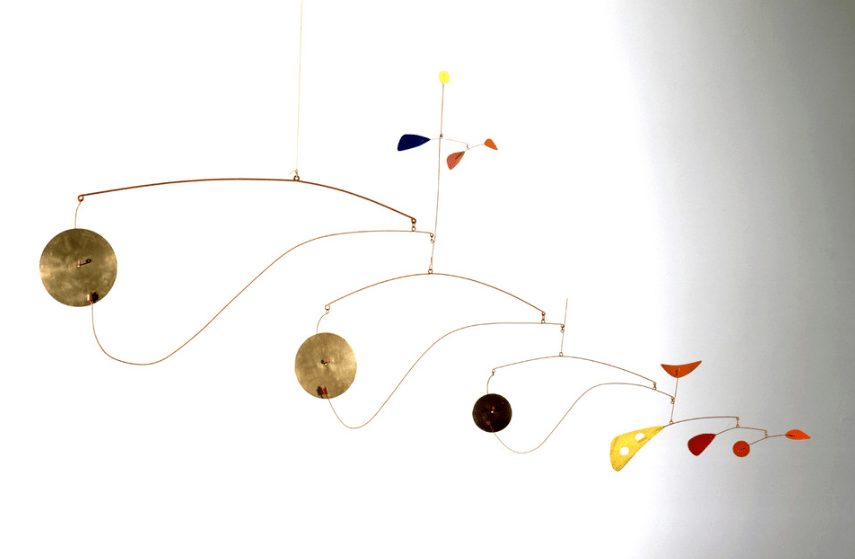
London is alive with some truly exciting artist retrospectives at the moment, each of them tending to focus on a particular aspect of their creative output. In the National Gallery, the portraiture of Goya is the focus of a major show, and likewise in the National Portrait Gallery where Giacometti and his drawings are the stars. Meanwhile, over the river in Tate Modern, a retrospective of Alexander Calder focuses on the works which surely made him famous…sculptures which dance, perform and are always on the move: his mobiles. 

It’s strange to imagine a world where the mobile, that innocuous moving collection of animals and stars hanging above every respectable baby cot, did not exist. But it was Calder who actually invented this type of sculpture, long before it ever became a favourite of the child’s bedroom, and in doing so Calder showed himself to be one of the first ever proponents of performance art, something which is now such a staple of contemporary art spaces across the world.

Mobile2

Triple Gong, 1948 (© 2015 Calder Foundation, New York / DACS, London)

Untitled

Untitled, 1963

Mobile3

Gamma, 1947 (© 2015 Calder Foundation, New York / DACS, London)

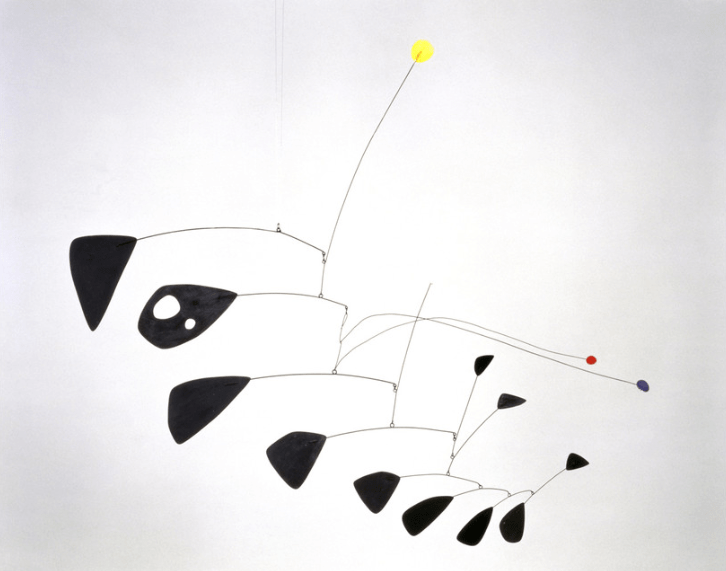
In creating the mobile, Calder was looking for a work which moved, and evolved. At first his moving sculptures were controlled, either in the form of puppets which would perform in his own Calder Circus Shows (the likes of which were visited in Paris by some of the biggest names of the 20th century art world), or those carefully choreographed by a series of connected motors and pulleys. But the true mobile, the freely moving construction based on a series of shapes, wires and strings, was created in response to Calder’s desire to free abstraction, and for the bold shapes and colours which he had seen in the likes of Mondrian’s tightly structured geometric works to move about without constraint.

And so were born the sculptures for which Calder became synonymous, and which have cropped up in some of the most culturally enriched open public spaces in the world, including here in Palma de Mallorca, and of course that sensational mobile left by Calder himself by the poolside at the Colombe d’Or Hotel in St. Paul de Vence.

Calder5WhiteBrassSpiralalexandercalder12Standing mobile

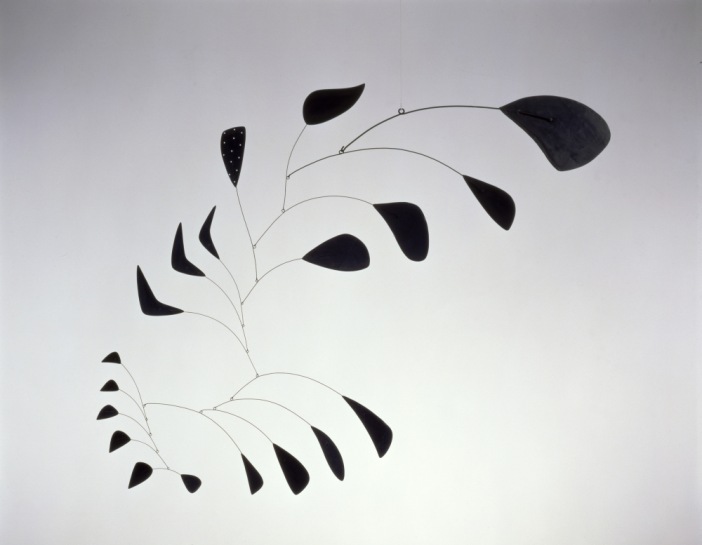
For me, ever so fascinated by the mobiles of Calder, this was truly an exquisite show. I wandered between the mobiles entranced by the poetry in their movements; by the constant slow flow and turns of the wire arms whose many delicate branches create an ever changing and unpredictable dance. And beyond the mobiles, the secondary most beautiful vision were the shadows created on the walls, themselves moving, creating the most beautiful abstract art, albeit free and transitory as Calder would have wished.

It’s a unique opportunity to see so many of Calder’s greatest works in one place, and to understand the revolutionary journey, from canvas to moving mobiles, which prompted him to create these most oscillatory of sculptures.

calderverticalfoliage

Vertical Foliage 1941(© 2015 Calder Foundation, New York / DACS, London)

Mobile 4

Mobile1

Antennae with Red and Blue Dots, 1953 (© 2015 Calder Foundation, New York / DACS, London)

Alexander Calder, Performing Sculpture is on at Tate Modern, London, until 3 April 2016.

Festival of colour: The Summer Exhibition 2015

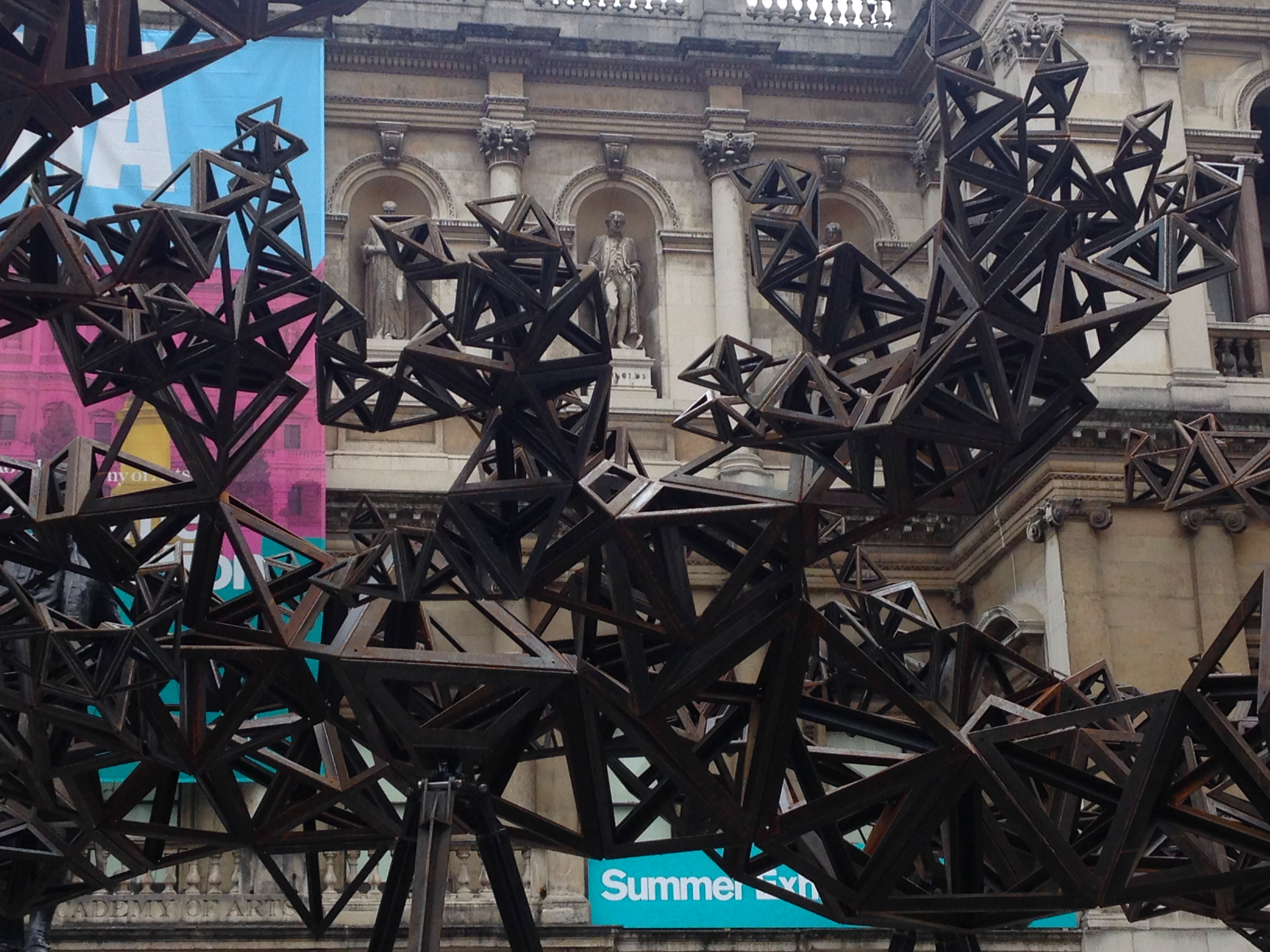
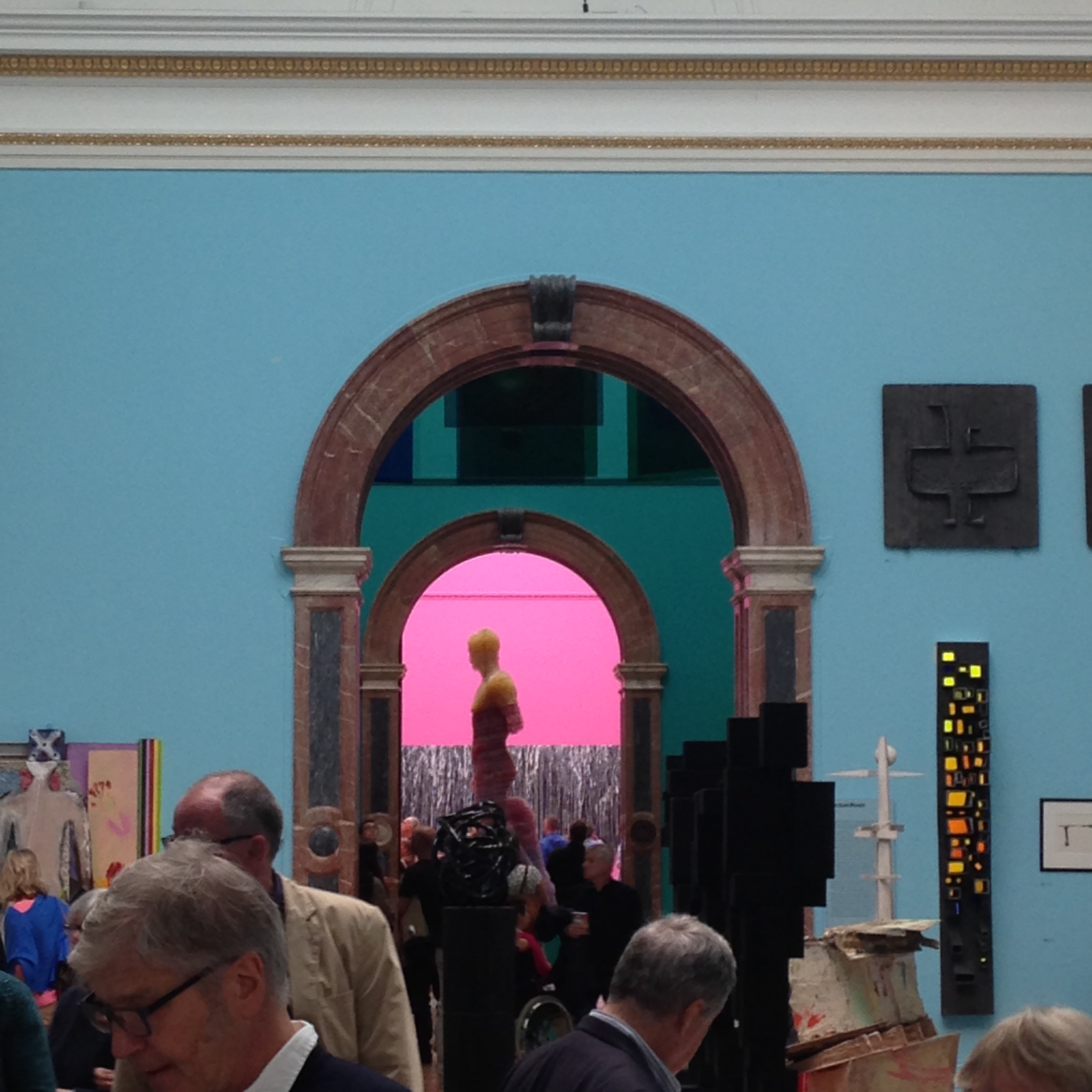
There’s nothing quite like the rejuvenating power of bright, unapologetic colour to lift the spirits amidst an atmosphere of grey, and this is no more so than in London where, on a recent visit, the skies were characteristically gloomy and very un-summery. Heading therefore towards this year’s Summer Exhibition at the Royal Academy of Arts therefore brought with it the promise of some element of seasonal rejuvenation, even if it could not improve the weather. But this year’s show, the 247th in the Academy’s history, did not just flush us with the spirit of summer, but with a festival of colour, never before seen at the annual show in such quantities.

IMG_3977

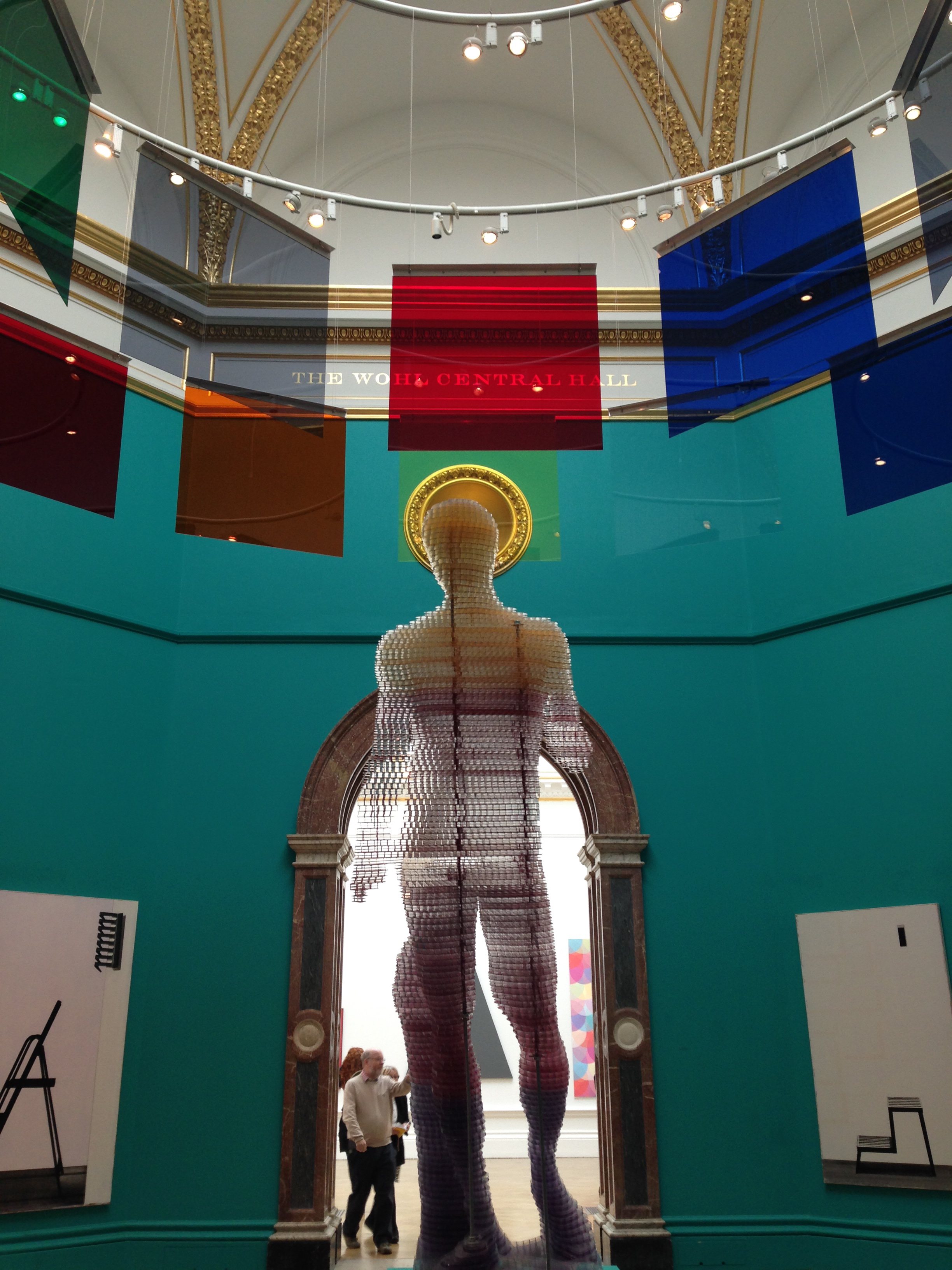
The reason for this panoply of colour is surely its chief curator, Michael Craig-Martin RA, whose work is famous for its blocky poster-print colours with exact outlines and pop-art motifs. With such an artist in charge, there was no way this show was going to be boring, and any doubts as to the fact were quickly swept away at the entrance to the RA, whose usually beige monochrome staircase had been transformed into a riot of multicoloured stripes in an installation by Jim Lambie.

IMG_3979 IMG_3982 IMG_3973 IMG_4010

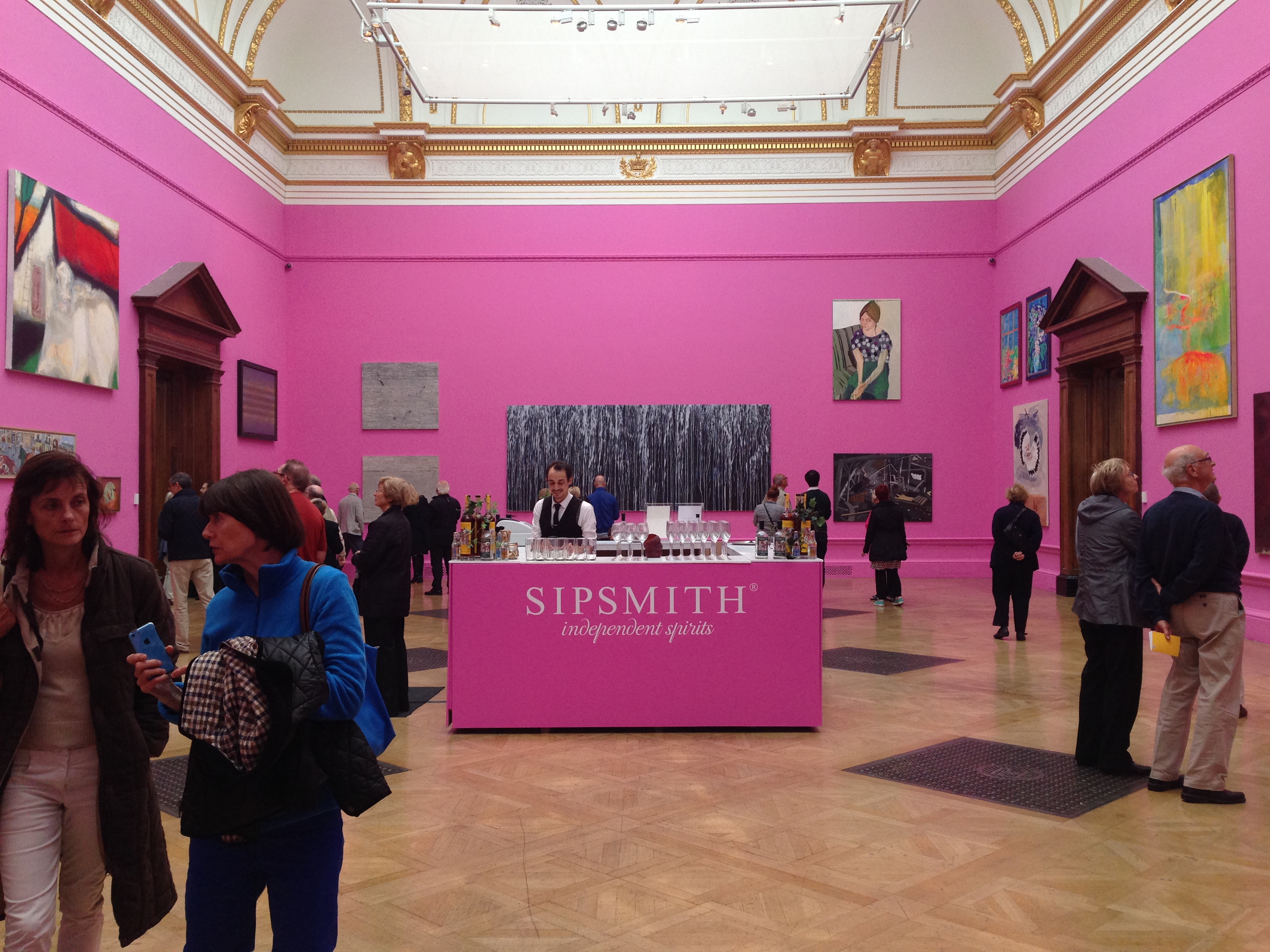
For those who dared climb what felt like a staircase of moving molten colour, a further punch of colour lay in wait in the form of the first three galleries, painted in bold magenta, blue and turquoise as a magnificently energised backdrop to a surprisingly fantastic selection of works. I never saw those lofty galleries look so rejuvenated, nor did I ever enjoy a Summer Exhibition with as much enthusiasm and high praise. For after years of continuous disappointment and what always seemed to be a relentless recycle of the RA cronies, at last we were presented with a show crammed with unapologetically figurative works, with paintings which exhibited actual talent (Tracey Emin’s usual crappy scrawls excepted), where superb print works were given a rightfully more prominent hang, and architectural models were actually interesting.

IMG_3983 IMG_3990IMG_3989IMG_3992

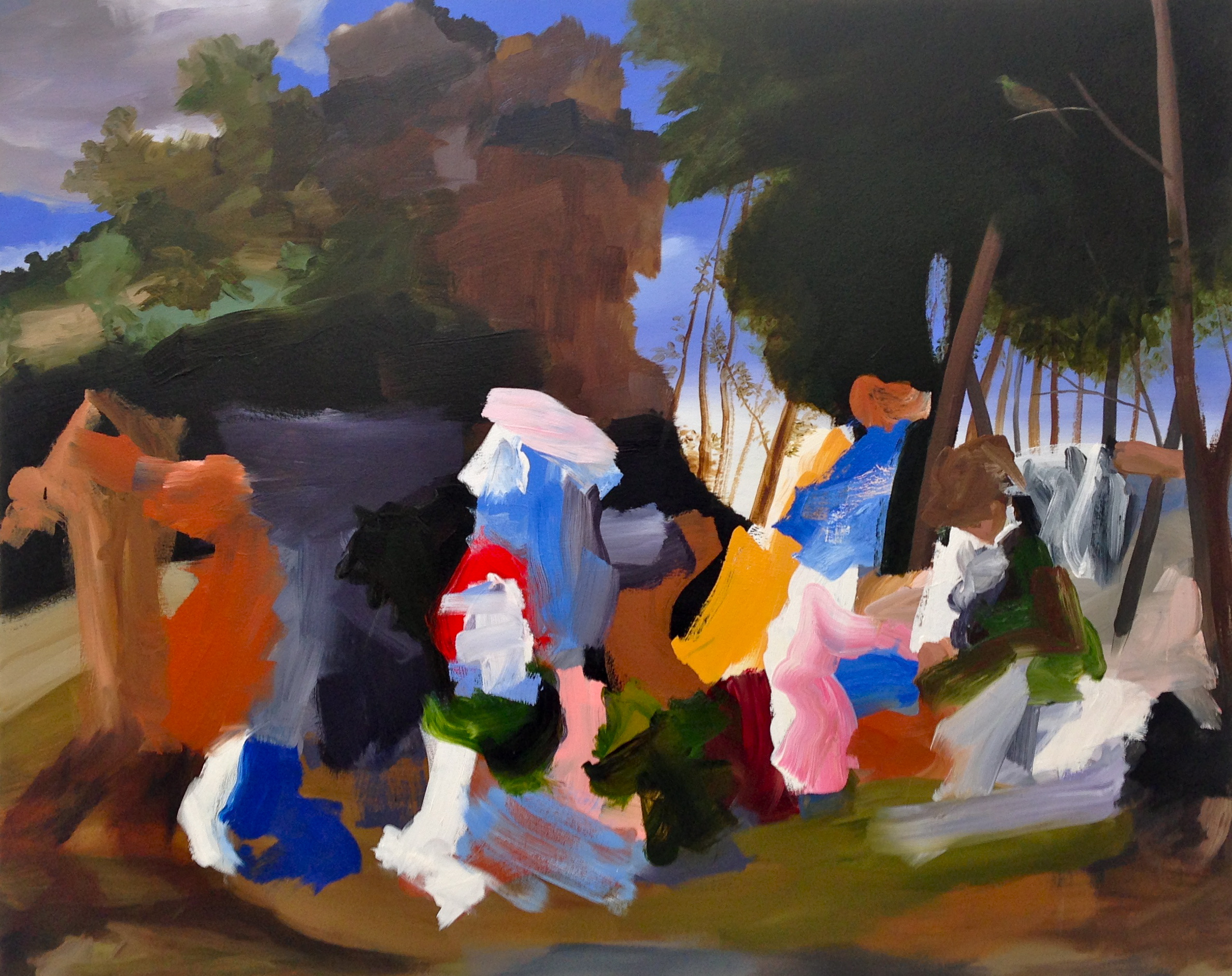
Here we had paintings of places and cities, of streets you could walk in, of portraits you could empathise with, and where there was abstract, it was playful and bold – accessible and expertly conceived. In one room, a superb tapestry portrait by Grayson Perry (Julie and Rob) could have stolen the show, but was well accompanied by a gallery of moving, inspirational works such as Elise Ansel’s brilliant take on Bellini and Titian (Feast of the Gods II) – another riot of colour (above, top).

IMG_4025

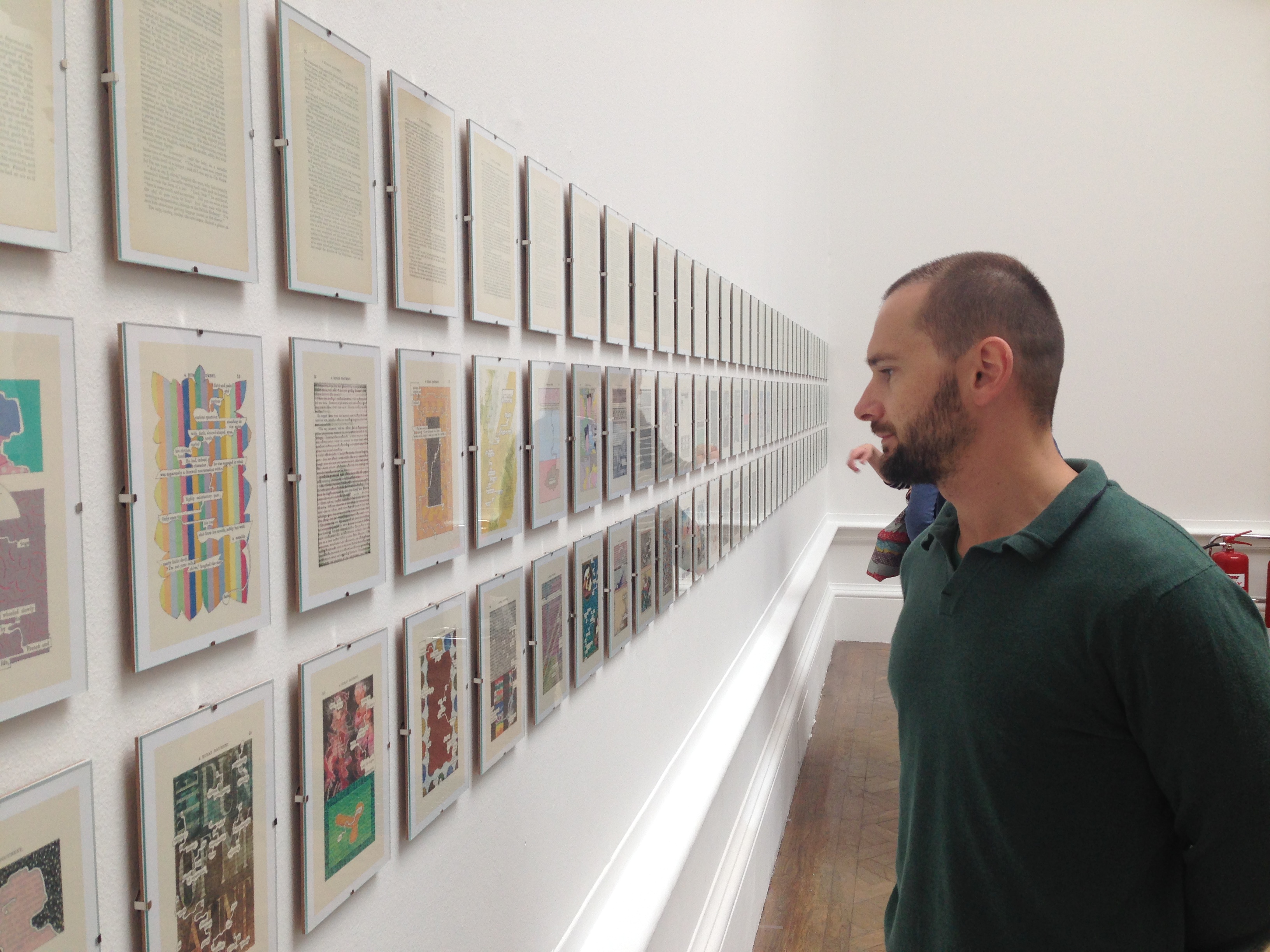
Considering the multiple works in Tom Phillips’ “A Humument”

So many works pronounced that the arrogant age of contemporary art installations and badly conceived “paintings” is dead, from the many offerings of an RA favourite, Stephen Chambers, to the last gallery entirely devoted to the doodles of Tom Phillips, whose work A Humument, involves the almost total recreation of a long lost novel thanks to his reillustration and reinterpretation of every page. And by way of confirmation that this new re-emergence of a classical pictorial style is both correct, and beloved, an already abundant array of red dots was already evident, despite the early days of the exhibition’s season.

IMG_4018 IMG_4016 IMG_4011 IMG_4020

For those disappointed by past Summer Exhibitions, this one is not to be missed – it will change your mind for sure. The Summer Exhibition shows at the Royal Academy, London until 16th August 2015.

London Calling

2014 was full of novel, exciting and previously unexplored experiences, the likes of which I was able to reflect on when recently looking through my photos of the year. And while the most significant of my year’s experiences is undoubtedly the total change which came about when I left London and moved to Mallorca, I was also given the opportunity to live out yet another novel change as the year drew to a close. I became a tourist in London.

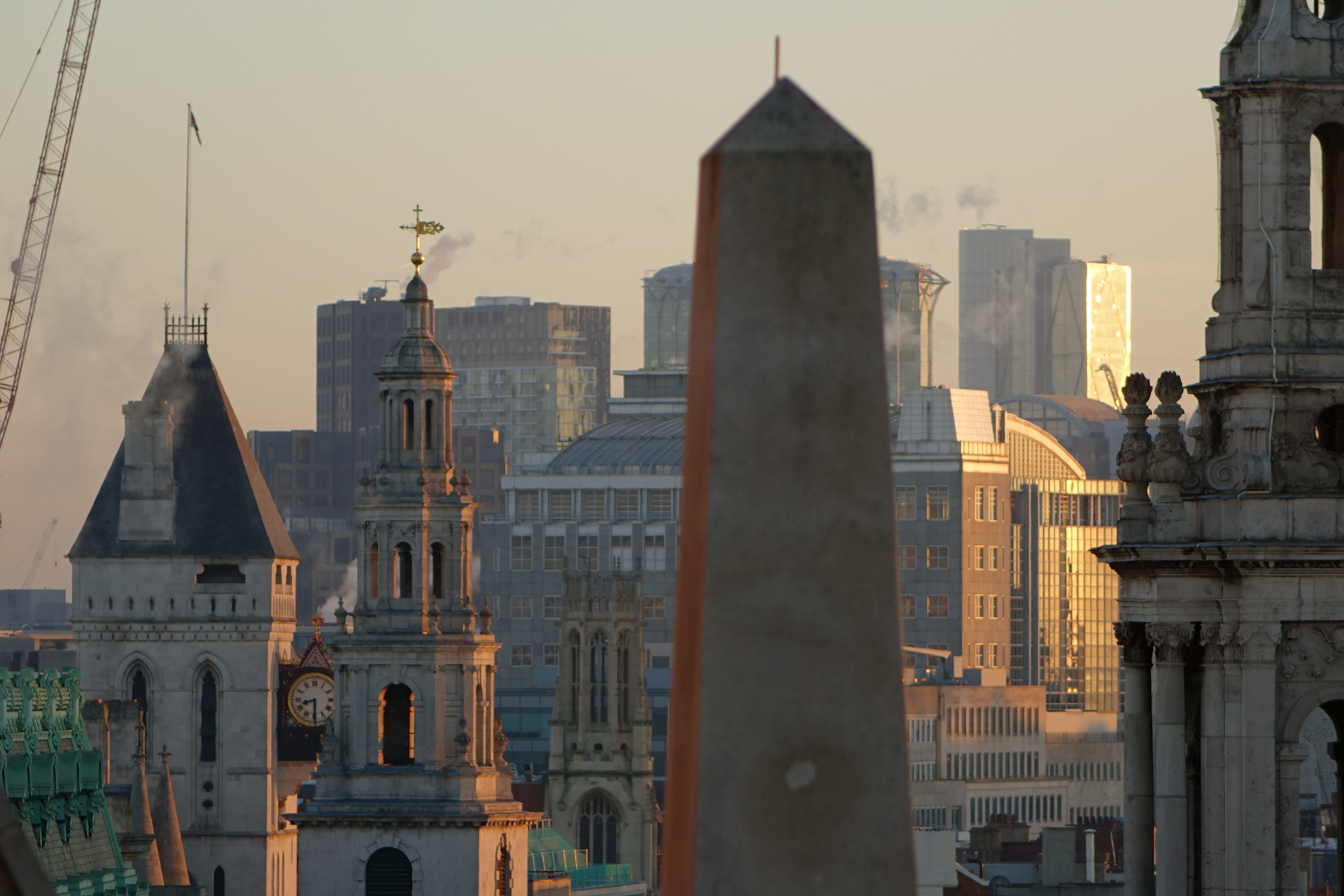
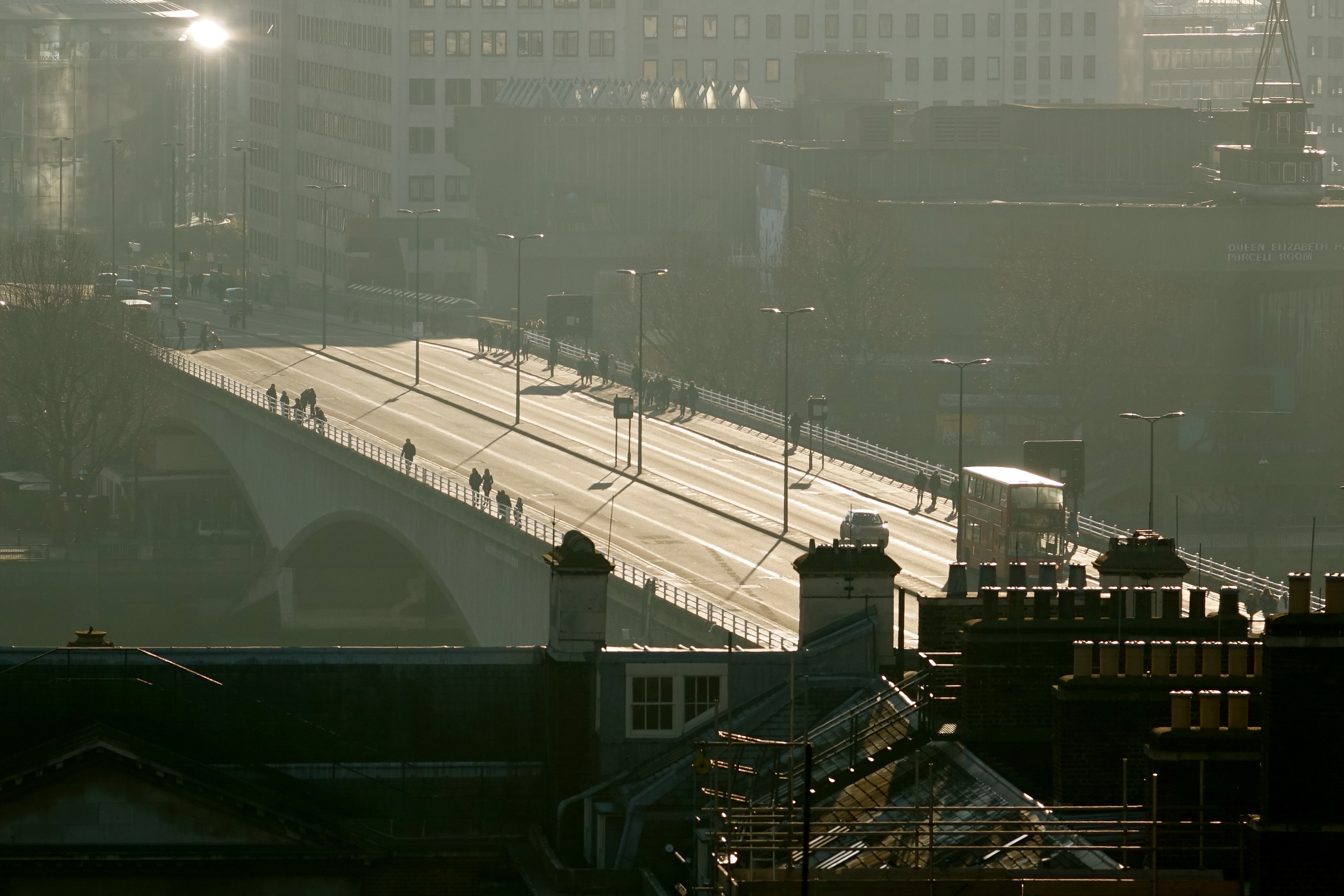
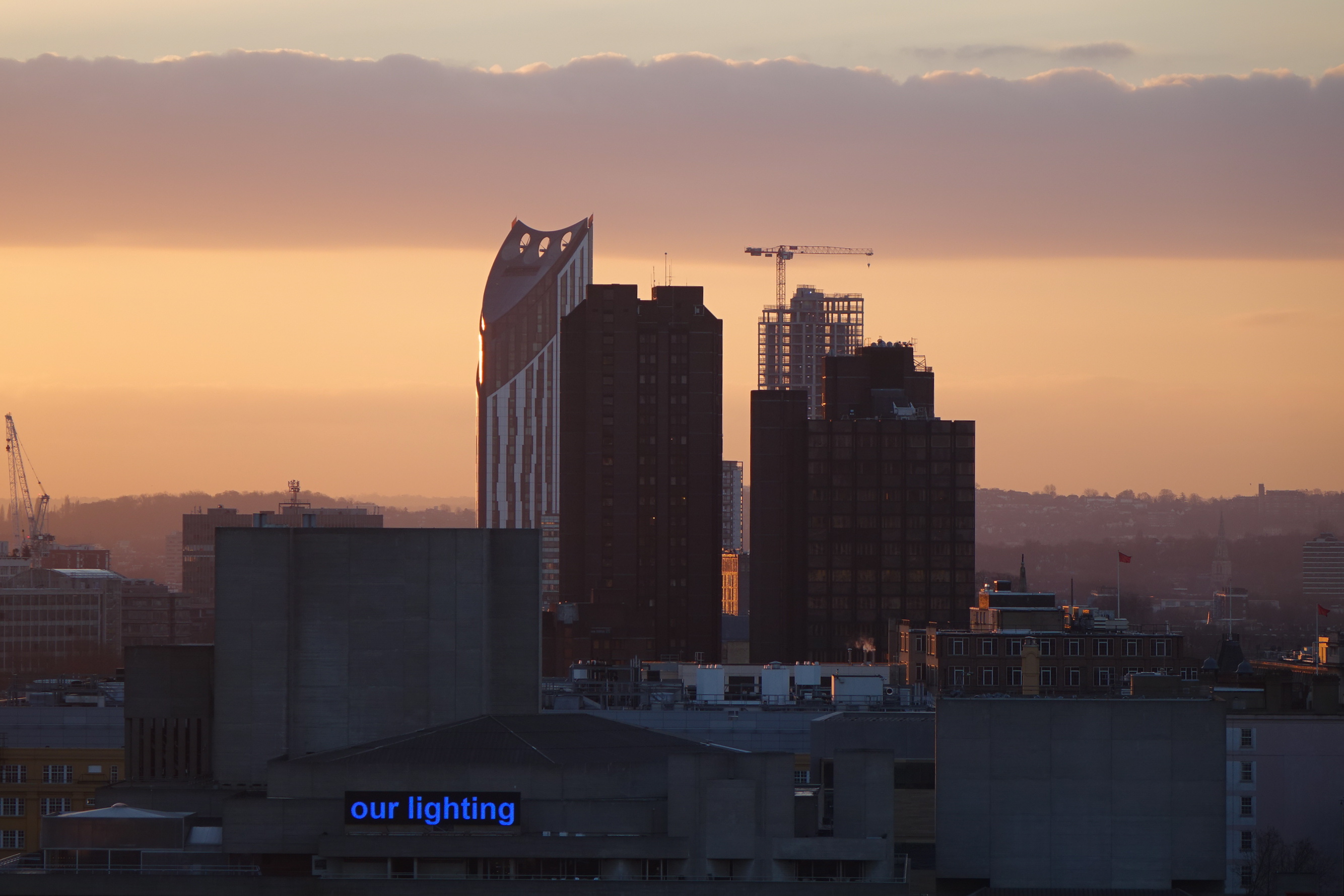
After 12 years living in the city, I never thought it would be possible to see London as a tourist destination, and to discover it afresh in the way I would a new holiday location. Yet when I headed to London for two nights this Christmas, I suddenly felt like a stranger in my previous home city. The change was almost undoubtedly brought about by the accomodation: being able to stay in a hotel in the centre made all the difference, not least because it cut out the ghastly return tube journey which was an inevitable accompaniment of every trip to the centre when I lived in the suburbs. The hotel (we stayed at the new “Me” hotel on the Aldwych) also enabled us to see London from a new literal perspective too – our room was on the 9th floor and provided us with the most stunning of bird’s eye views. Suddenly I realised that atop buildings I thought I knew inside-out was a secret roof terrace full of plants; and from this viewpoint, the cluster of shiny new skyscrapers in the City finally made sense.

London viewed from the “Me”

DSC03431 DSC03321 DSC03441 DSC03434 DSC03457 DSC03234 DSC03189 DSC03232 DSC03443

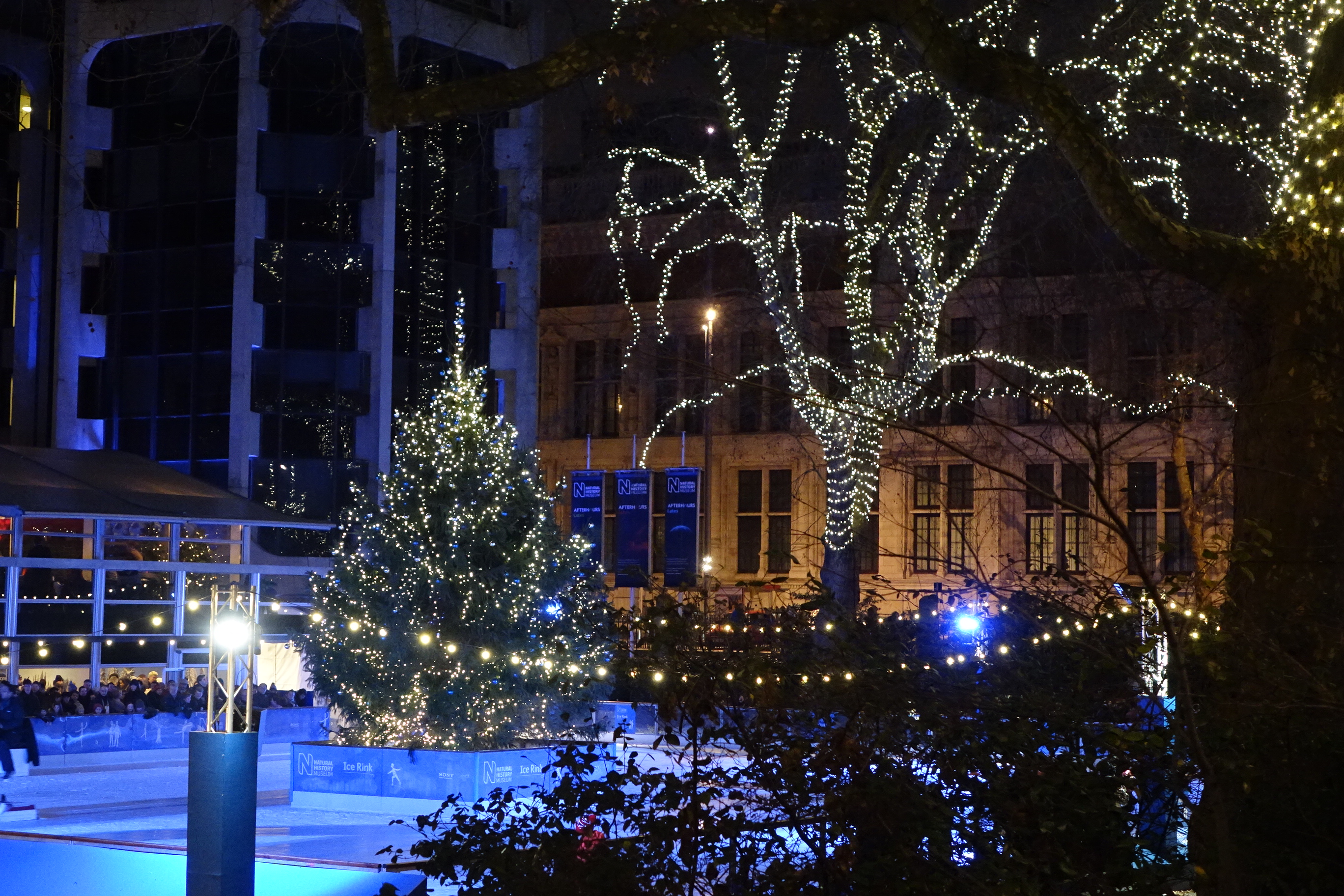
We also felt like tourists because suddenly we had time on our side. With no work to get to or no reason to rush home, we could indulge in many of the treats the city has to offer: We went to see the stunning musical Miss Saigon, we visited the British Museum (with what appeared to be thousands of other tourists) we drank mulled wine in Covent Garden, and we even went ice skating at the Natural History Museum – a first for my leg post-2008 accident.

A tourist in London – ice skating, Covent Garden and the British Museum

DSC03373 DSC03366 DSC03380 DSC03404 DSC03402 DSC03320 DSC03338 DSC03396 DSC03248 DSC03392 DSC03317 DSC03276 DSC03309 DSC03254

But of course being a tourist also brought with it the inescapable frustrations of London: the eye-watering expense, the unfriendly customer service, the rushed restaurant sittings, the 12.5% “discretionary” service charge, the packed tube, and the horrible, horrible cold. So for all of the excitement of being a tourist in London, I suddenly found myself relieved to be leaving again, and full of joy to return to my new home in Mallorca. I needed nothing further to confirm that in swapping London for Palma, we have truly made a change for the better.

All photos and written content are strictly the copyright of Nicholas de Lacy-Brown © 2015 and The Daily Norm. All rights are reserved. Unauthorized use and/or duplication of the material, whether written work, photography or artwork, included within The Daily Norm without express and written permission from The Daily Norm’s author and/or owner is strictly prohibited.

The Barbican Triptych

It was around 16 months ago when, following a work social function held within the Barbican Estate in the City of London, my colleague, who also lives there, commissioned me to depict the Barbican on canvas. 

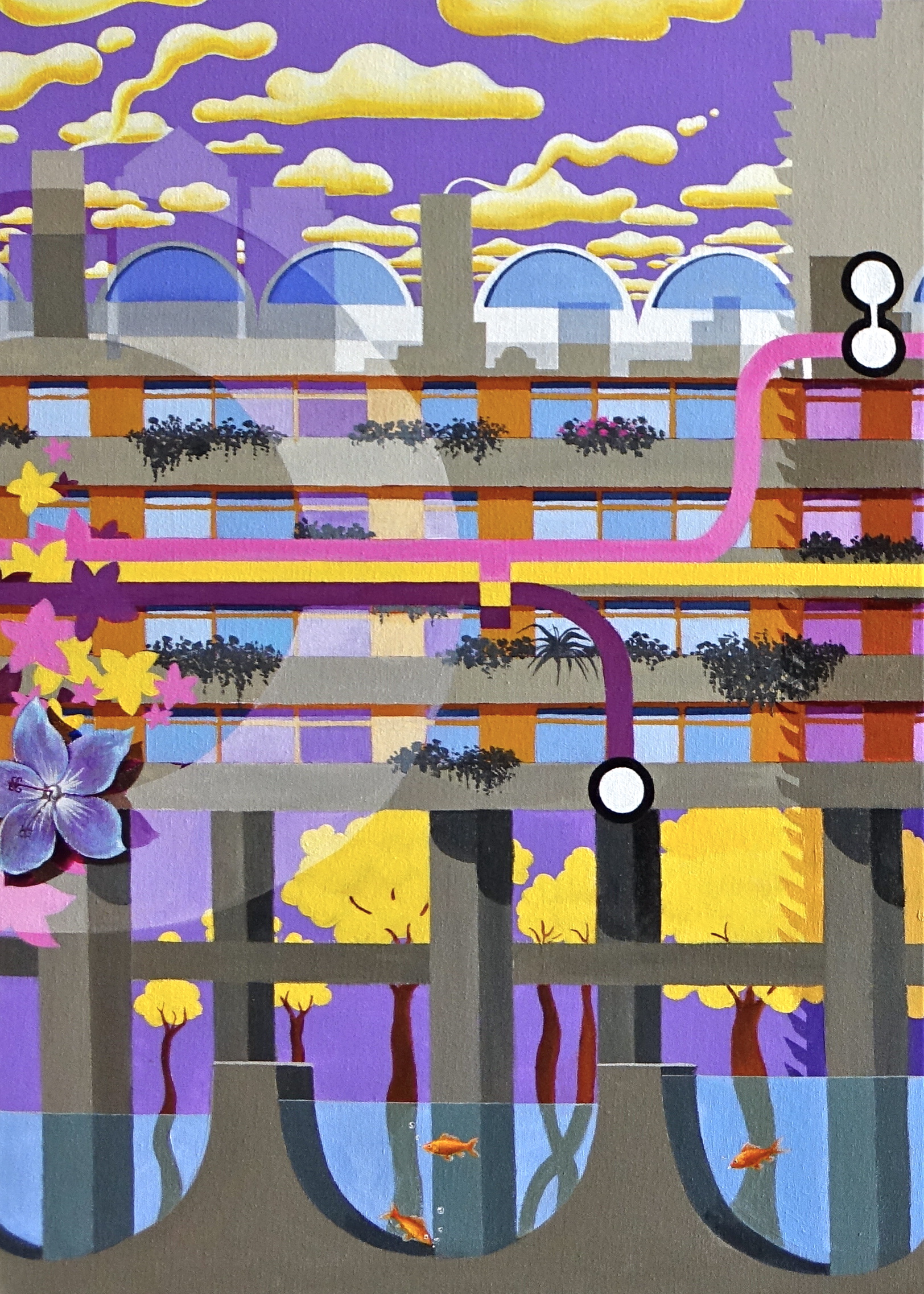
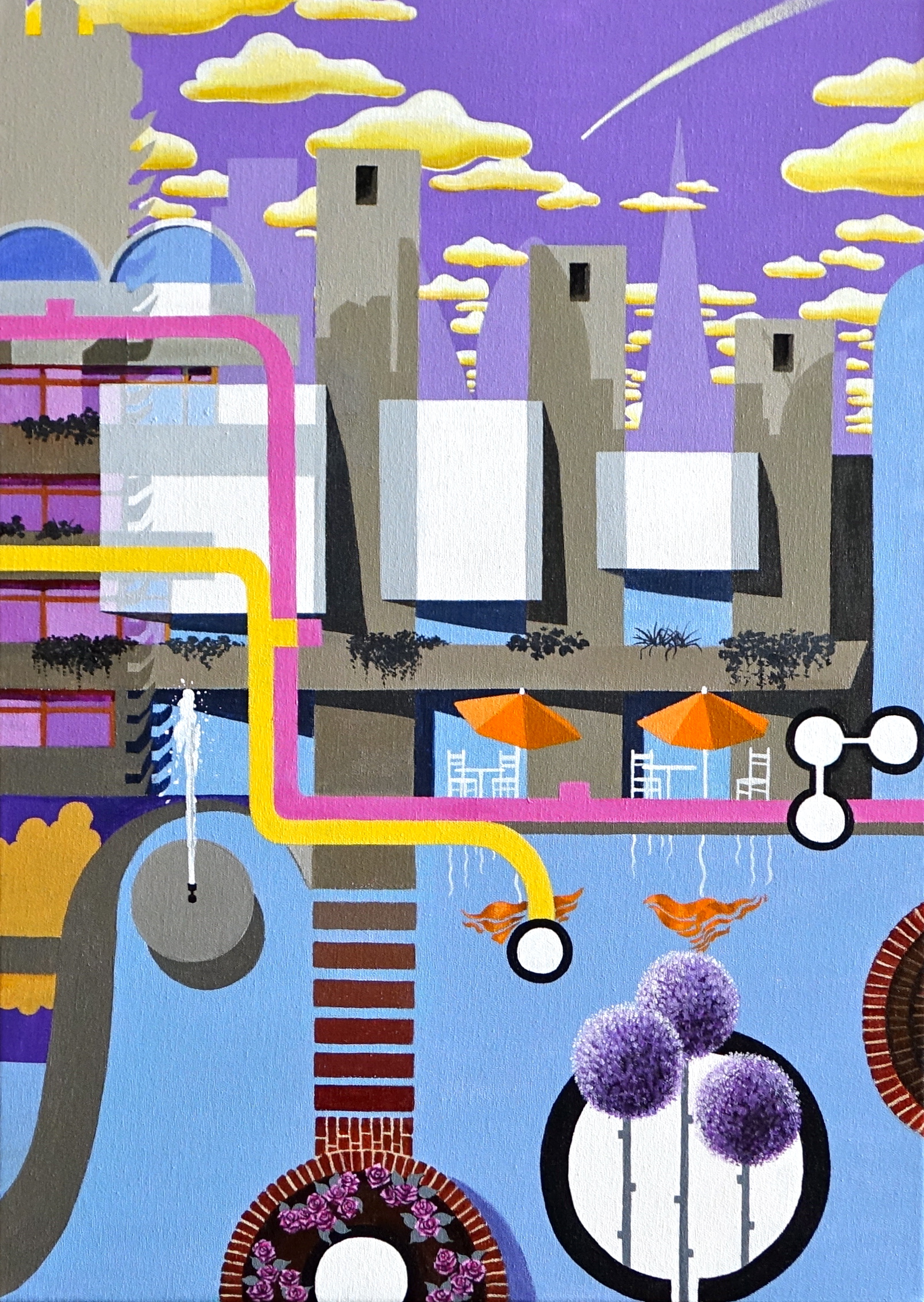
It was something of a challenge. Chief amongst the challenges was the scale of the piece – a hefty triptych to feature on a large blank wall – exciting in prospect, but less so when I was already working full time with only evenings and the occasional weekend free to paint. Second was the problem of inspiration. The Barbican does not fall under what one would ordinarily term “beautiful”. Built in the style typical of the 60s and now given the rather unflattering title “brutalist architecture”, the Barbican estate is all grey concrete, sharp jagged edges and high rise. However, the site, built to fill in one of many huge expanses of the City devastated by the Blitz in WW2, is undoubtedly iconic, and as I started to muse upon a possible approach to capturing the architecture on canvas, I noticed how the architecture formed a harmony of shapes, from a variety of circles and semi circles, as well as straight horizontals and the teeth like edges of its famous three towers. And then it came upon me – what other London icon is comprised of simplistic lines and circles? Why the Underground. An idea was born. 

The Barbican Triptych (2013-14 © Nicholas de Lacy-Brown, acrylic on canvas)

The Barbican Triptych (2013-14 © Nicholas de Lacy-Brown, acrylic on canvas)

My Barbican Triptych is both a homage to the architectural shapes of the Barbican and the city in which it is located. Along the horizon of all three canvases, the famous skyline of the City can be seen, while across the piece, another London icon dominates: the famous map of the Underground. Taking the idea further, I chose to paint the work in predominant shades of purple, pink and yellow, these being the likes (Metropolitan, Hammersmith & City and Circle) that pass through the tube station at the Barbican, while occasionally where round sunken flower beds would ordinarily be found in the Barbican’s waterways, these have been replaced with the famous black ringed circle stops of the tube map. 

The painting not only reflects the architecture of the Barbican but channels the plentiful water which can be found at the Estate, starting from the waterfall on the right and flowing up through fountains and past the main cultural centre of the Estate to the fish ponds on the far right. It also includes the plentiful flowers which today make the architecture less brutal, and the plants which flow from the various residential balconies there. 

The Barbican Triptych = Canvas 1 (2013-14 © Nicholas de Lacy-Brown, acrylic on canvas)

The Barbican Triptych – Canvas 1 (2013-14 © Nicholas de Lacy-Brown, acrylic on canvas)

The Barbican Triptych - Canvas 2 (2013-14 © Nicholas de Lacy-Brown, acrylic on canvas)

The Barbican Triptych – Canvas 2 (2013-14 © Nicholas de Lacy-Brown, acrylic on canvas)

The Barbican Triptych - Canvas 3 (2013-14 © Nicholas de Lacy-Brown, acrylic on canvas)

The Barbican Triptych – Canvas 3 (2013-14 © Nicholas de Lacy-Brown, acrylic on canvas)

It may have taken well over a year to complete but I am so proud of the final result. And somewhat appropriately, this painting was the last of many I have completed while living in London. How apt then that rather than the Mediterranean setting which tends to be the staple of my work, this painting should be made in homage to the city which, up until last weekend, was my home of 12 years. My final swan song to London. 

© Nicholas de Lacy-Brown and The Daily Norm, 2001-2014. Unauthorized use and/or duplication of the material, whether written work, photography or artwork, included within The Daily Norm without express and written permission from The Daily Norm’s author and/or owner is strictly prohibited. Excerpts and links may be used, provided that full and clear credit is given to Nicholas de Lacy-Brown and The Daily Norm with appropriate and specific direction to the original content. For more information on the work of Nicholas de Lacy-Brown, head to his art website at www.delacy-brown.com


Leaving London: Bidding Farewell to my home of 8 years

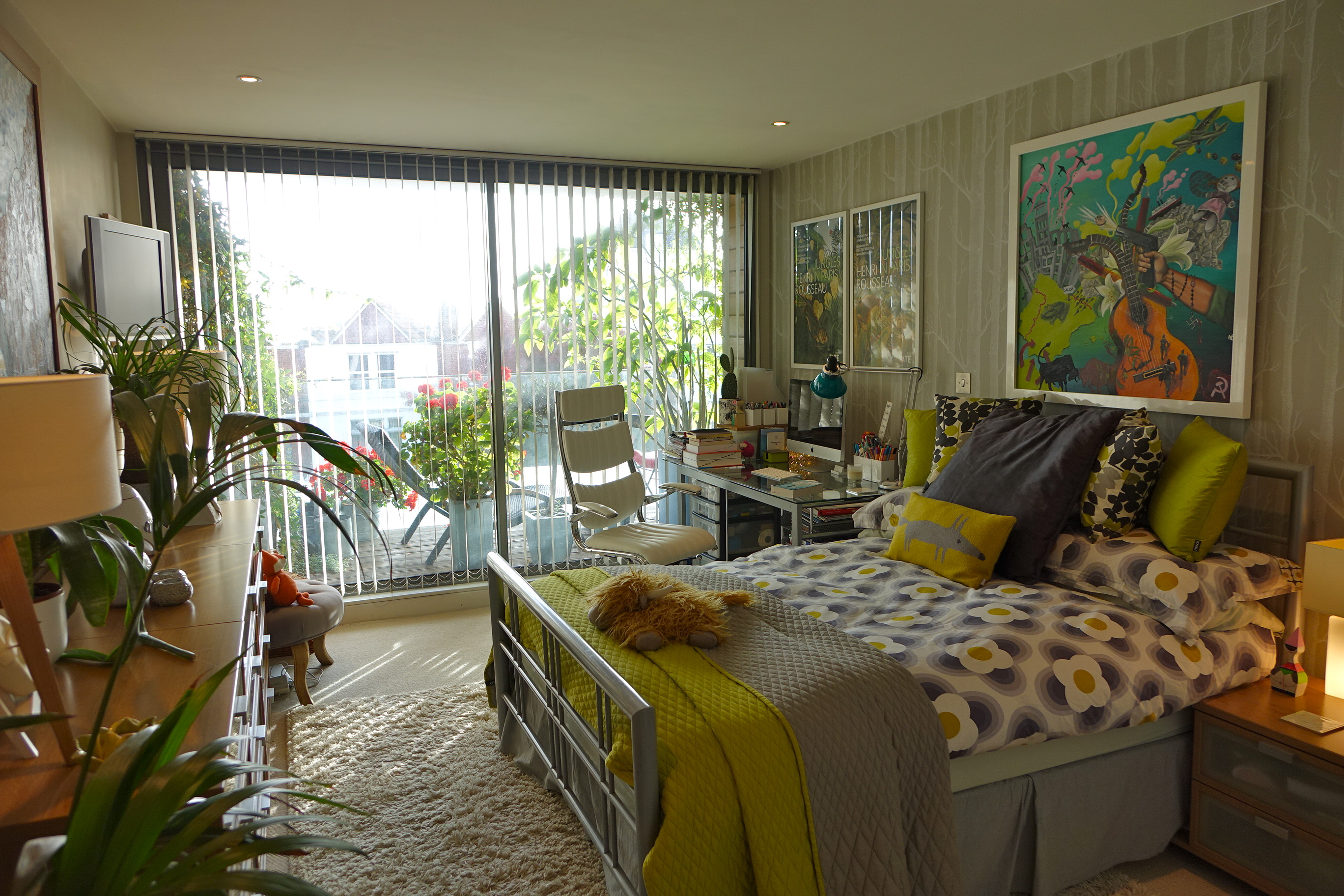
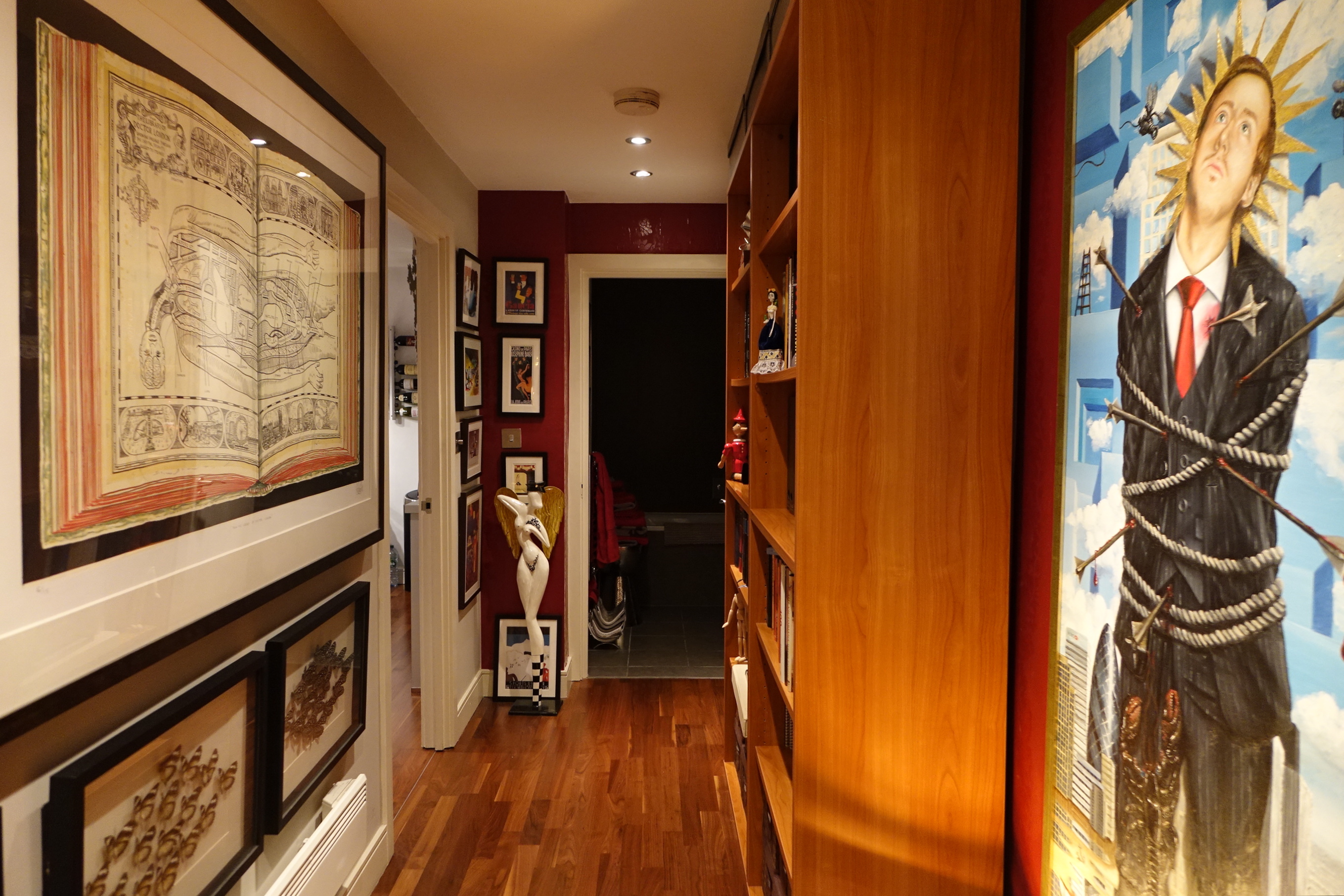
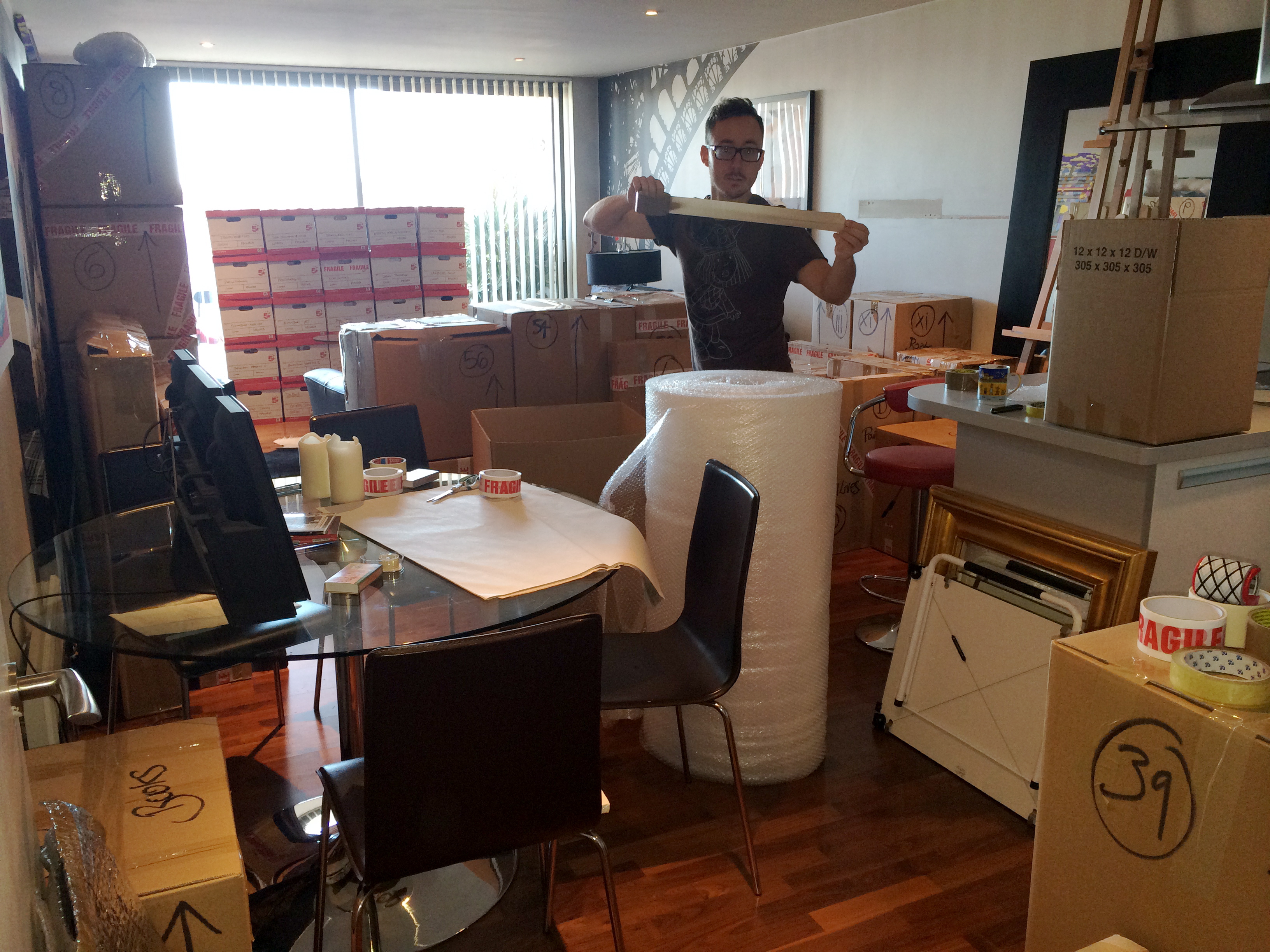
Seeing my London home of 8 years empty reminds me of the first few days when I first purchased it. Brand new, with building works only just complete, the flat was a wonderfully polished open plan space. I couldn’t believe my luck when I first moved in, moving from an old cramped Victorian terrace in Camberwell to this über chic space fit for a bachelor. At first of course there was no furniture, and it is of those times that I am now reminded – sitting on the floor with only a television for company; watching the Eurovision Song Contest with my bottom shifting uncomfortably on the new wooden floors. 

The years in between have been perhaps the most formative of my life. It was in that flat that I graduated from my Masters and qualified as a barrister; when I was put through the hell of pupillage and ditched so unjustifiably at the end of it; when I experienced the elation of a new job in government and where I came home two years later knowing that I needed a new challenge; when I met the love of my life, experienced the birth of two nephews and the death of their father; it was where I had the accident that changed me forever, and where I used the compensation monies to forge a future for the better. 

My flat at its best

DSC09846 DSC09891 DSC09930 DSC09920 DSC09897 DSC09937 DSC09882 DSC09916 DSC09902 DSC09878 DSC09856 DSC09955 DSC09951 DSC09876 DSC09942
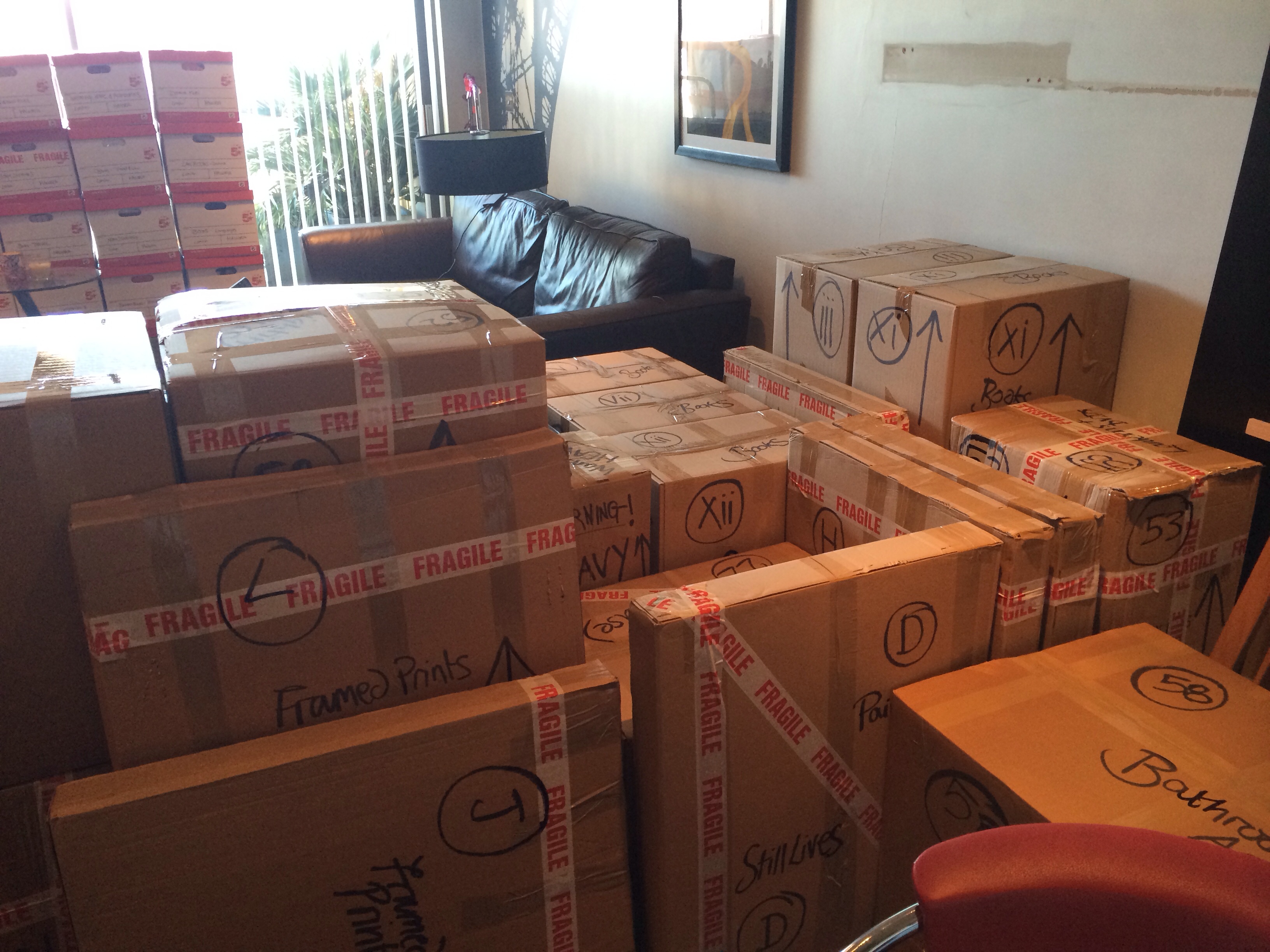
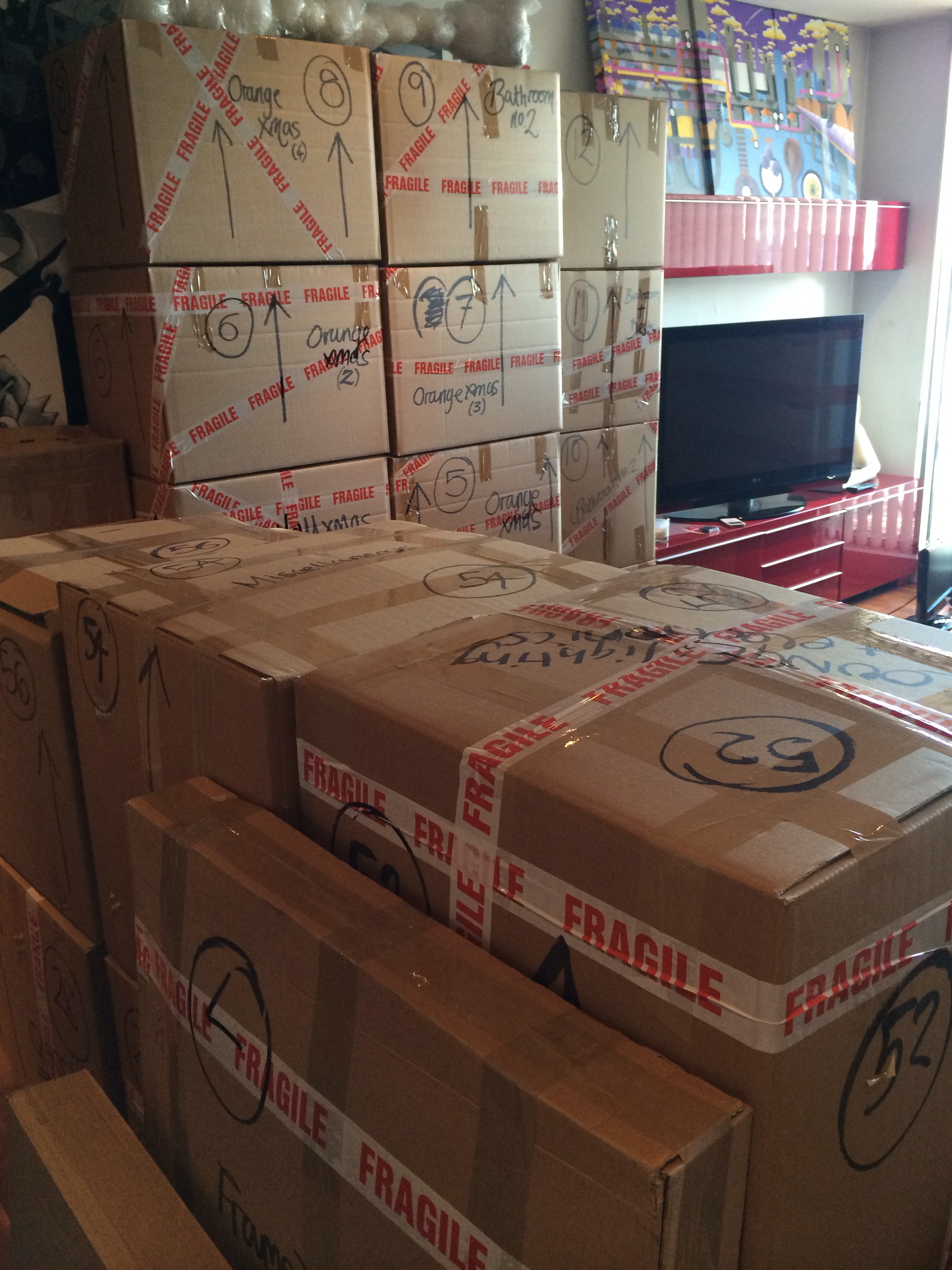
It is on that future that I now embark, although sadly that future must be without my beloved home. Packing up this place, the guardian of so many happy experiences, has undoubtedly been the hardest part about this move, but as each box was packed, a little bit of home disappeared. Now standing empty, it’s just a flat again – no longer my home. That home is currently making its way to Palma de Mallorca in cardboard boxes, and I cannot wait to get there now and unpack it. 

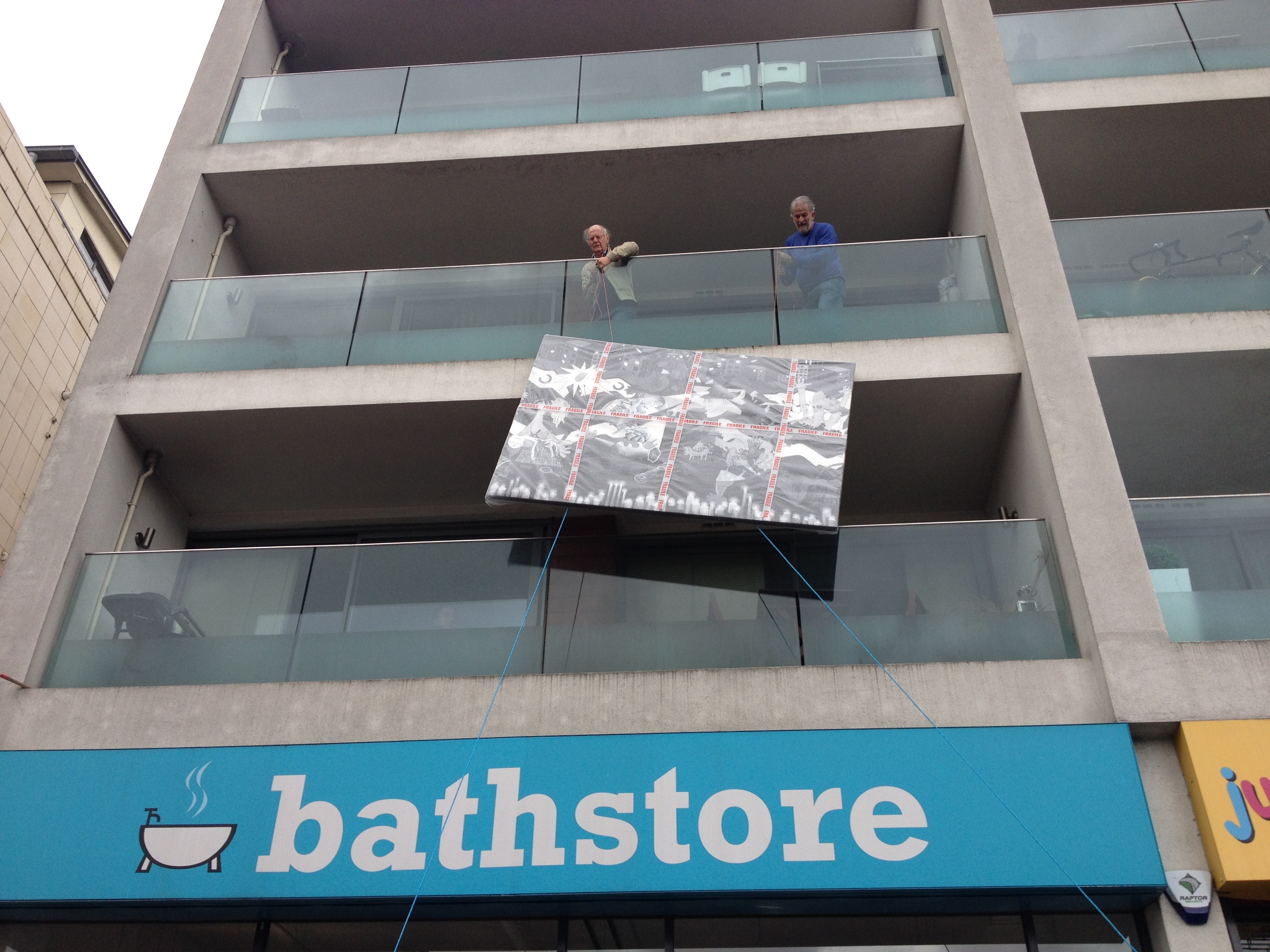
Packing up and getting Segunda Guernica out of the building!
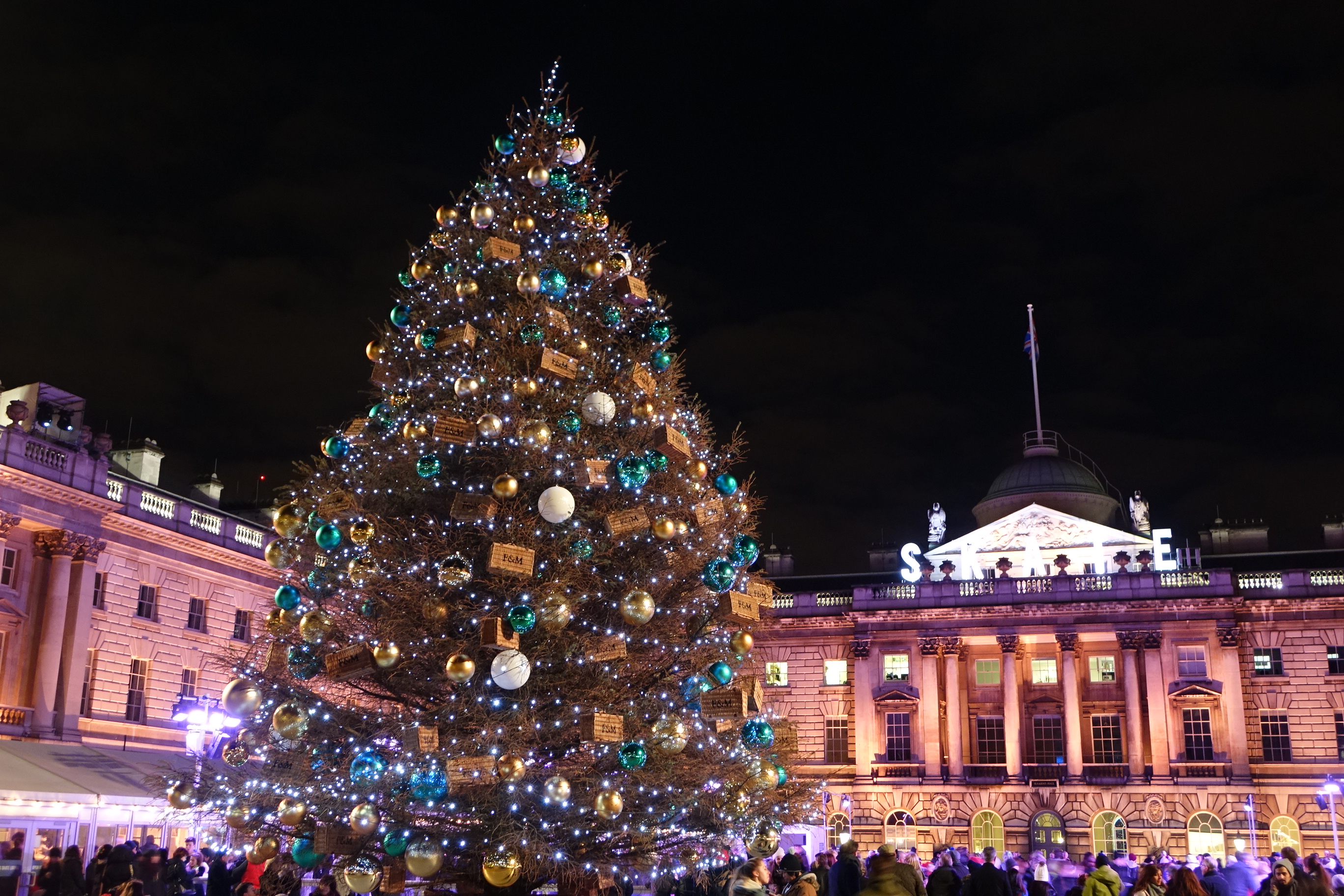
image-2 image image-1 IMG_1441
But for now, I thought I would mark this passing with a few photos of my flat at its best, together with some views of the move. For this is truly the end of the era, but only the next phase of my life. And The Daily Norm is coming with me for the ride – so see you in Mallorca! 

All photos and written content are strictly the copyright of Nicholas de Lacy-Brown © 2014 and The Daily Norm. All rights are reserved. Unauthorized use and/or duplication of the material, whether written work, photography or artwork, included within The Daily Norm without express and written permission from The Daily Norm’s author and/or owner is strictly prohibited.

Intelligent Insight: Grayson Perry – Who Are You?

Following on from his superb show, Tomb of the Unknown Craftsmen at the British Museum in 2010 is the latest collection of brilliantly insightful works by artist and craftsman Grayson Perry. This time fitting seamlessly into the collection of the National Portrait gallery, peppered throughout the museum therefore encouraging visitors on a kind of magical mystery your through the space, Perry’s new exhibition, Who are You? once again shows that Grayson Perry is one of the most intelligent artists of our times. Made in conjunction with a series of channel 4 documentaries reflecting on a series of individuals each struggling with some particular facet of their individuality, these “portraits” are very appropriately located within the hallowed halls of the London’s temple of portraiture. Ranging from etching to tapestry, enamel portrait to glazed pottery, they show Perry at his adroit best. But beyond the skilled execution of these works is the messages they so sensitively and intelligently portray. 

Line of Departure (2014 © Grayson Perry)

Line of Departure (2014 © Grayson Perry)

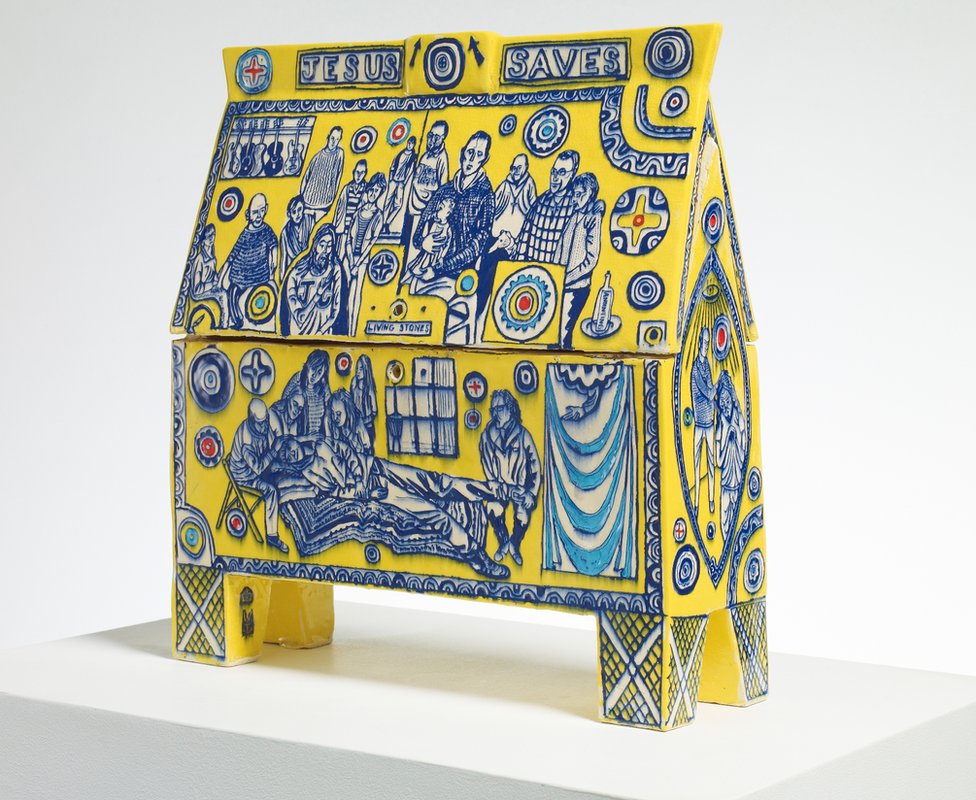
Jesus Army Money Box (2014 © Grayson Perry)

Jesus Army Money Box (2014 © Grayson Perry)

The Earl of Essex (2014 © Grayson Perry)

The Earl of Essex (2014 © Grayson Perry)

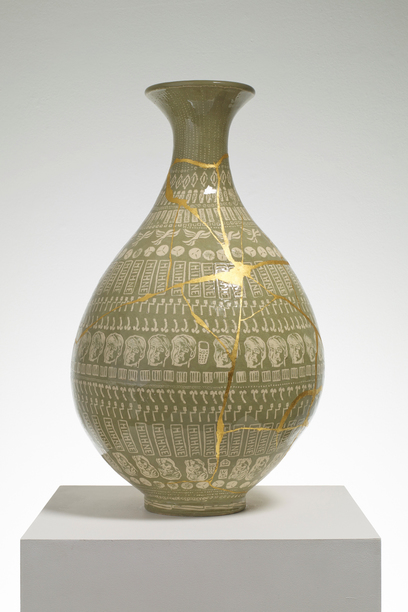
The Huhne Vase (2014 © Grayson Perry)

The Huhne Vase (2014 © Grayson Perry)

In mounting the show, Perry tells how he chose sitters who were each on some kind of identity journey. People who had changed religion or gender, physical or mental facilities, lost status or belonging to a group who are actively trying to change the way others see them. Thus Perry presents a vase representing the fall from grace of politician Chris Huhne, who was imprisoned for perjury after asking his wife to take the blame for a speeding offence he had committed. The vase shows his image and that of his car registration plate repeated over and over like the tire tracks of his car. It was smashed and pieced back together again in gold demonstrating Huhne’s downfall but also the fact that his new fragility in a world dominated by generic status figures will make him a richer more complex individual. There too Perry gives us a miniature enamel portrait hidden away in glass cases with others far older. It portrays XFactor star Rylan Clark as the Earl of Essex because, as Perry says, celebrity is the aristocracy of the day. 

But amongst my favourites was the Ashford Hijab, a brilliantly drafted black, white and red design on a silk scarf (appropriately) illustrating the draw of Islam for young white middle aged women who are sick of consumer culture and sexualised scrutiny of women and seek instead the comparative calm and integral values of Islam. So it shows one woman leading her family towards Mecca, her hijab being the metamorphosis of a road which in turn transforms from the outlet shopping centre of consumer culture from which she flees. Brilliant. 

The Ashford Hijab (2014 © Grayson Perry)

The Ashford Hijab (2014 © Grayson Perry)

Memory Jar (2014 © Grayson Perry)

Memory Jar (2014 © Grayson Perry)

I also loved Memory Jar, the vase sensitively portraying the effects of Alzheimer’s on a couple, as the disease ravages the mind of one man leaving his wife deprived not only of his personality and mental functions, but also destroying their shared memories. As Perry says, two people are the guardians of their shared memories. Once one person goes, so does the poignancy of the memories, and in depicting this he shows a kind of demon cutting up the family photos of the couple also reflected on the vase. It’s a stunning piece. 

And of course mention has to go to Comfort Blanket, a huge banknote tapestry representing everything that is so intrinsic to British culture and which makes the country such a stable, lawful, integral place, drawing people from all over the world. Of course fish and chips looms large, as well as words like “fair play” and “Posh and Becks”. Everything on it was so English I stood in awe at how masterfully Perry had managed to capture the essence of an entire nation in one tapestry. It also felt particularly poignant for me, an Englishman, as I prepare to leave England to move overseas in only a few days time. 

Comfort Blanket (2014 © Grayson Perry)

Comfort Blanket (2014 © Grayson Perry)

Grayson Perry: Who are You? is showing at The National Portrait Gallery until 15 March 2015. Entrance is free.

Late Turner at Tate: Repetitious repertoire with moments of genius

I think I may be almost alone amongst my British compatriots when I declare that I am not a huge fan of J M W Turner. In fact I’m fully expecting to receive a raft of hate mail when this review goes live on my blog and I conclude that Tate Britian’s latest exploit of this undoubtedly revolutionary British Artist is all a bit insipidly, uninterestingly “pastel”. Now don’t get me wrong, I am well aware that Turner was a master of his times, and likewise that he was crucial in the development of the impressionist, and then expressionist art movements that changed the world of art history. I do not doubt that without him, the whole revolution of modern art may never have seeded in quite the way it did, if at all. And I recognise that in so far as great British artists go (of which there are few), he is almost certainly one of the best. Yet when I am faced with a painting by Turner, I cannot help but feel depressed, and a little uninterested, my attention somewhat wondering away from the smudged colour palette, the greys and the pastels.

Tate Britain’s new Turner exhibition has opened with considerable fanfare. This is insuperably the case when any Turner show is opened in the UK, but the problem is, we’ve seen so much of the work before. Such is the result of an exhibition of Turner being shown at Tate, the very same museum which was bequeathed hundreds of Turner works a short time after his death. Since the exhibition focuses on “Late Turner” (works produced between 1835 and his death in 1851), it almost certainly features the lion’s share of the Turner Bequest, meaning that there is very little new to be seen by we London regulars. Still, one cannot doubt the scale and ambition of the show, which ably demonstrates that Turner was perhaps at his innovative best in this final period of his life. While the artwork is still trenched in the rigid tradition of the prescribed artistic and aesthetic tastes of the time (antiquity, pastoral landscape, naval scenes and the like), Turner was presenting canvases which aimed to capture more of an effect than a historical narrative. Even his history and antiquity paintings (of which there are many) focus more on the breathtaking light of a sunrise or sun set, or the moody effect resulting from a foggy encounter, than the story itself.

Regulus (1828)

Regulus (1828)

Peace - Burial at Sea (1842)

Peace – Burial at Sea (1842)

Ancient Rome; Agrippina Landing with the Ashes of Germanicus (1839)

Ancient Rome; Agrippina Landing with the Ashes of Germanicus (1839)

So to give the show its dues and focus in on the “good”, one cannot help but be stirred at times by some of Turner’s more atmospheric works, such as his paintings of stormy seas in Snowstorm (1842), so cyclical like a washing machine drum that you feel as though you are swept out at sea yourself – an effect which just can’t be captured from a postcard reproduction of the work. Mention also has to go to the stunning effects of light achieved by Turner – for example the burning glow of the Fire at the Houses of Parliament, and the incredible blinding light captured in his painting Regulus (1828) – an effect so well captured that I felt compelled to look away from the painting, as though I was staring into the sun itself.

Snowstorm (1842)

Snowstorm (1842)

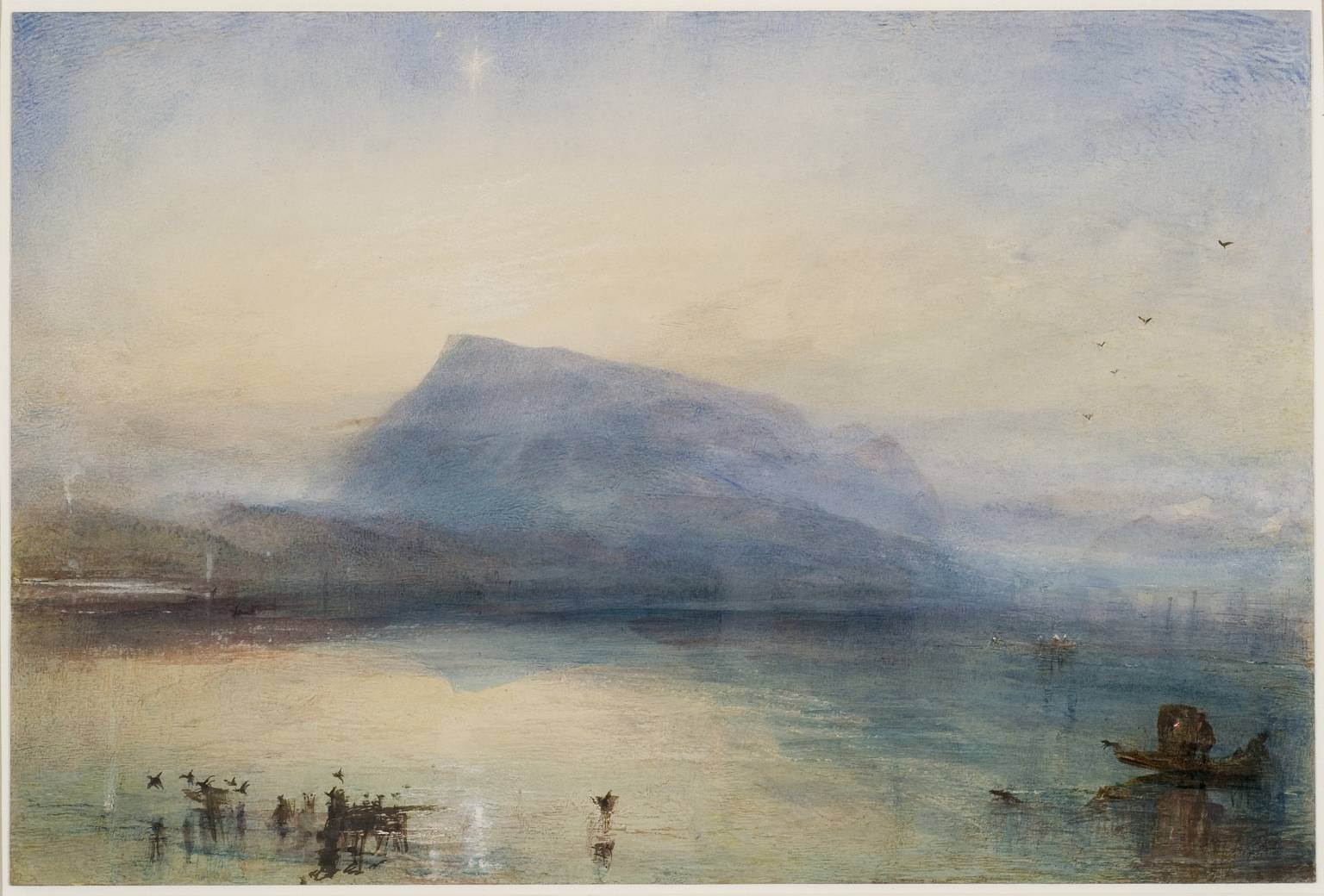
The Blue Rigi Sunrise (1842)

The Blue Rigi Sunrise (1842)

Burning of the Houses of Lords and Commons (1834)

Burning of the Houses of Lords and Commons (1834)

For me though, the success of the show – its scale – was also its downfall, as with so many Turners from the same period exhibited all together, one couldn’t help conclude that it was all a bit samey, and repetitive – a feeling also engendered by the RA’s Monet show a few years back, when one water lily after another began to look like a single mesh of watery wobbly lines so that you could no longer distinguish between them. This feeling is proliferated at Tate’s show by the unfortunate decision to paint the walls in the same predominant colour as the paintings, so that in one room, a gallery full of dull yellow paintings feels even duller and more dated thanks to the same colour having been painted on the wall. If only the whole show had been curated like the middle room, where Turner’s square and round paintings were hung on dark walls and spot-lit to magnificent effect. Under those conditions, the works really came alive.

So coming out of this exhibition, my conclusions were as follows: Turner left me flat, not so much because of his work, but because of the way the show had been put together. Too much, too samey, and horrible decisions regarding wall colours. What Turner was brilliant at was capturing light, and it is this, set against dark backgrounds, that Tate should have concentrated on, to give Turner’s final years the kind of exhibition they perhaps deserve.

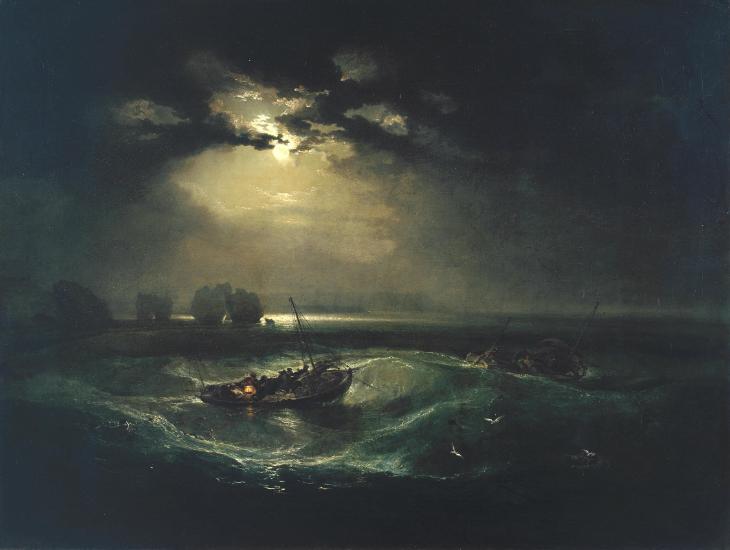
Fishermen at Sea (1796)

Fishermen at Sea (1796)

Late Turner: Painting Set Free is showing at Tate Britian until 25 January 2015

The East London Printmakers Annual Show: You’re Invited

My summer has been so incredibly hectic, full of travels, work and multiple new artistic creations that I have barely had time to promote the fact that several of my print works are about to feature in the East London Printmakers (ELP) Annual group Exhibition at the Embassy Tea Gallery in London Bridge over the next two weeks! And in fact it’s very much a case of better late than never, because the show will open this very night, with an exclusive guest appearance and official opening by none other than British abstract expressionist, Albert Irvin RA.

Amongst 70 artists exhibiting works created over the last year and aptly showcasing the versatility of printmaking as a medium will be none other than yours truly – me! Yes, this show will represent my first significant outing into the exhibiting circuit since my near sell-out show at the Strand Gallery in May, and I am particularly excited to be showing two brand new prints. The works, both of which were inspired by summer travels in Spain and Croatia respectively, mark something of an innovative departure for me. Having learned both the techniques of etching and woodcut, with these prints, I decided to combine the two things, thus taking the mediums in new directions, and printing on a totally different scale.

10644904_753873787981410_8613060105862232654_n

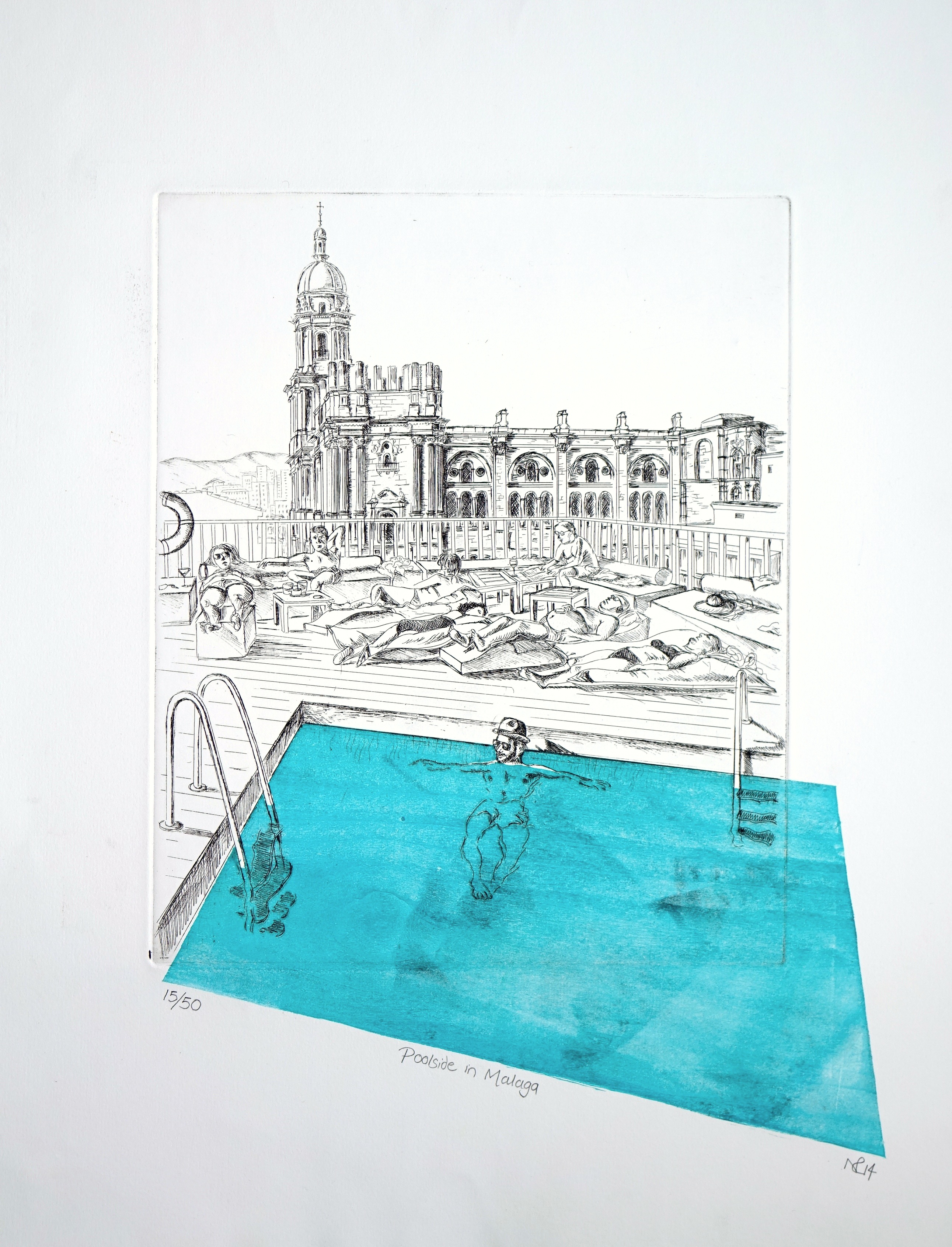
The first of the two prints, Malaga Poolside, shows a heady day when my partner and I sunbathed and swam on the incredible rooftop of the Molina Lario Hotel in Malaga. We couldn’t quite believe that up on that hotel terrace, we were able to swim with the stunning surroudings of Malaga’s one-armed cathedral just besides us, and this print attempts to capture that incredible view in a simple black and white etched line drawing, contrasting with the vivacity of the turquoise swimming pool which is almost Hockneyian in nature.

Malaga Poolside (2014 © Nicholas de Lacy-Brown, etching and woodblock on paper)

Malaga Poolside (2014 © Nicholas de Lacy-Brown, etching and woodblock on paper)

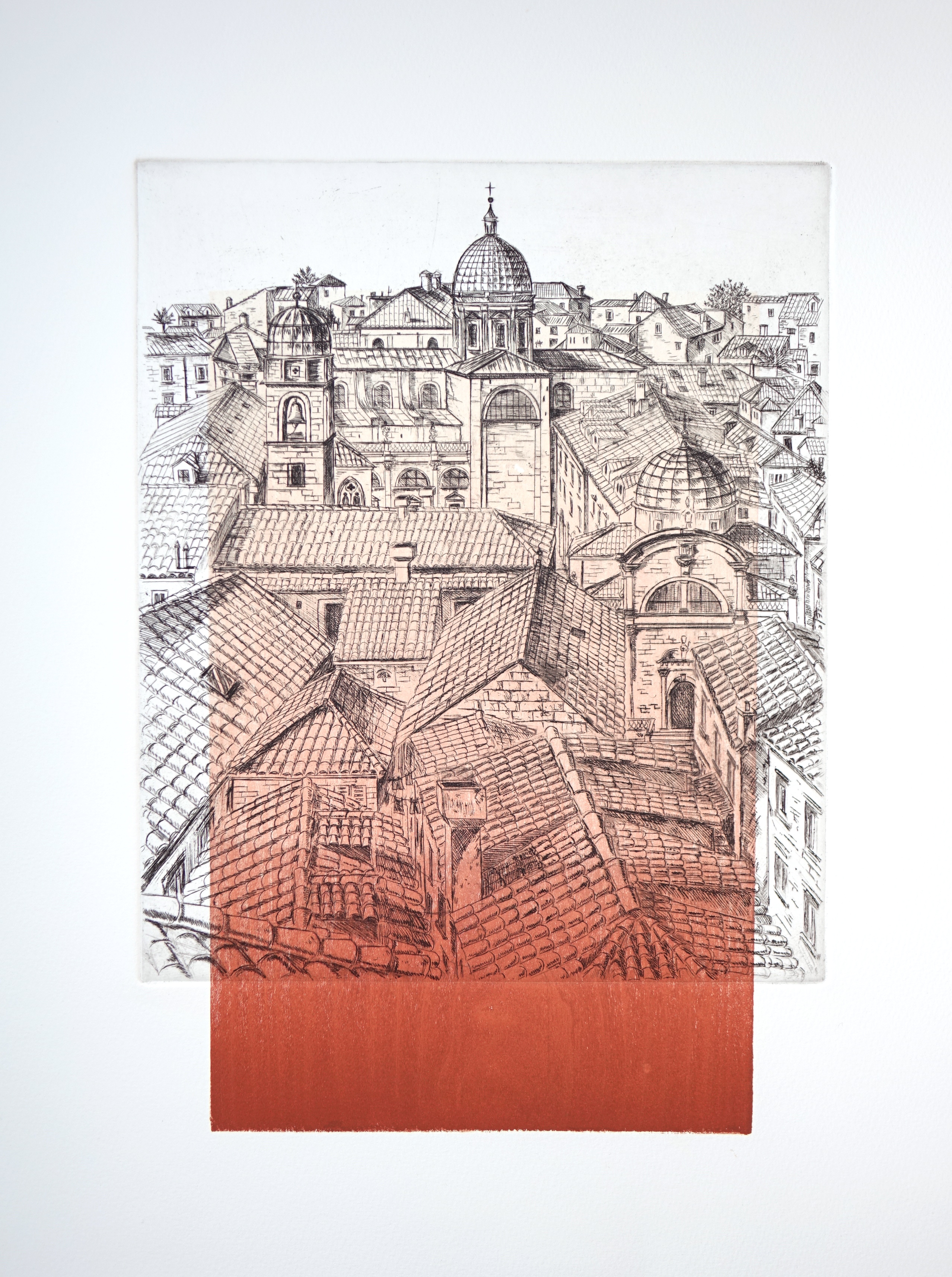
The second of my prints is entitled Terracotta Sunrise, and illustrates the swathe of terracotta rooftops which so captivated me when I visited Dubrovnik earlier this year. While I opted again for a simple line to illustrate the details of the compact houses and streets of this beautiful Croatian city, I wanted to use a graduating block of terracotta to subtly represent the overarching colour of the city when seen from afar, doing so with a graduating roll of colour which fades off almost like a sunrise.

Terracotta Sunrise (2014 © Nicholas de Lacy-Brown, etching and woodblock on paper)

Terracotta Sunrise (2014 © Nicholas de Lacy-Brown, etching and woodblock on paper)

But of course these are only photos (and not very good ones at that) and there is no substitute for seeing the real thing. So if you are able to get down to the Southawk/ London Bridge area of London tonight (for the opening) or any time over the next two weeks, do please come along – the gallery will be open until 6pm daily until 28th September. All the details can be found here. See you there.

10678733_753879087980880_4077473047340161283_n

London’s homage to print: Part 3 – Bruegel to Freud

Earlier this year I reviewed two London exhibitions which played homage to the brilliance and versatility of the printmaking medium, both through the chiaroscuro effects achieved in early renaissance woodcuts, or through the work of a Titan of contemporary British printmaking – David Hockney. Well no sooner had those shows shut up shop than another showcase to print has opened up, this time at my favourite gallery in London, the Courtauld. 

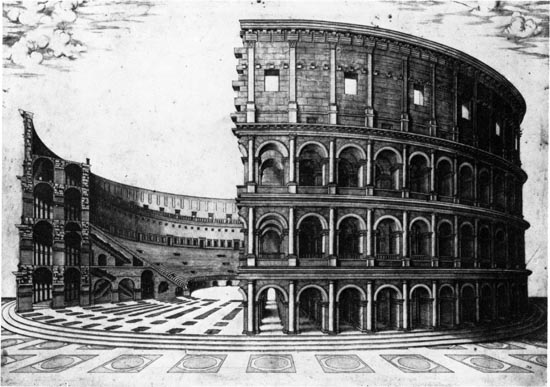
This new exhibition, From Bruegel to Freud is characteristic of the shows that the Courtauld does best: small yet focused, and although it displays only some 30 or so prints from a total collection of 24,000, the chosen prints perfectly illustrate the startling breadth and variety of the Courtauld’s impressive print holdings. And in giving itself over to a range of prints rather than honing in on one type or period, the exhibition ably demonstrates the potential of print both as an educator and communicator (for example Nicolas Beatrizet’s vast engraved copy of the Last Judgment wall of the Sistine Chapel, or the historical engravings of various architectural buildings such as the wonderfully detailed engraving of Rome’s Colosseum exhibited), as well as a wonderfully diverse medium for artistic expression in its own right. 

Engraving of the Colosseum

Engraving of the Colosseum

Nicolas Béatrizet, The Last Judgment

Nicolas Béatrizet, The Last Judgment

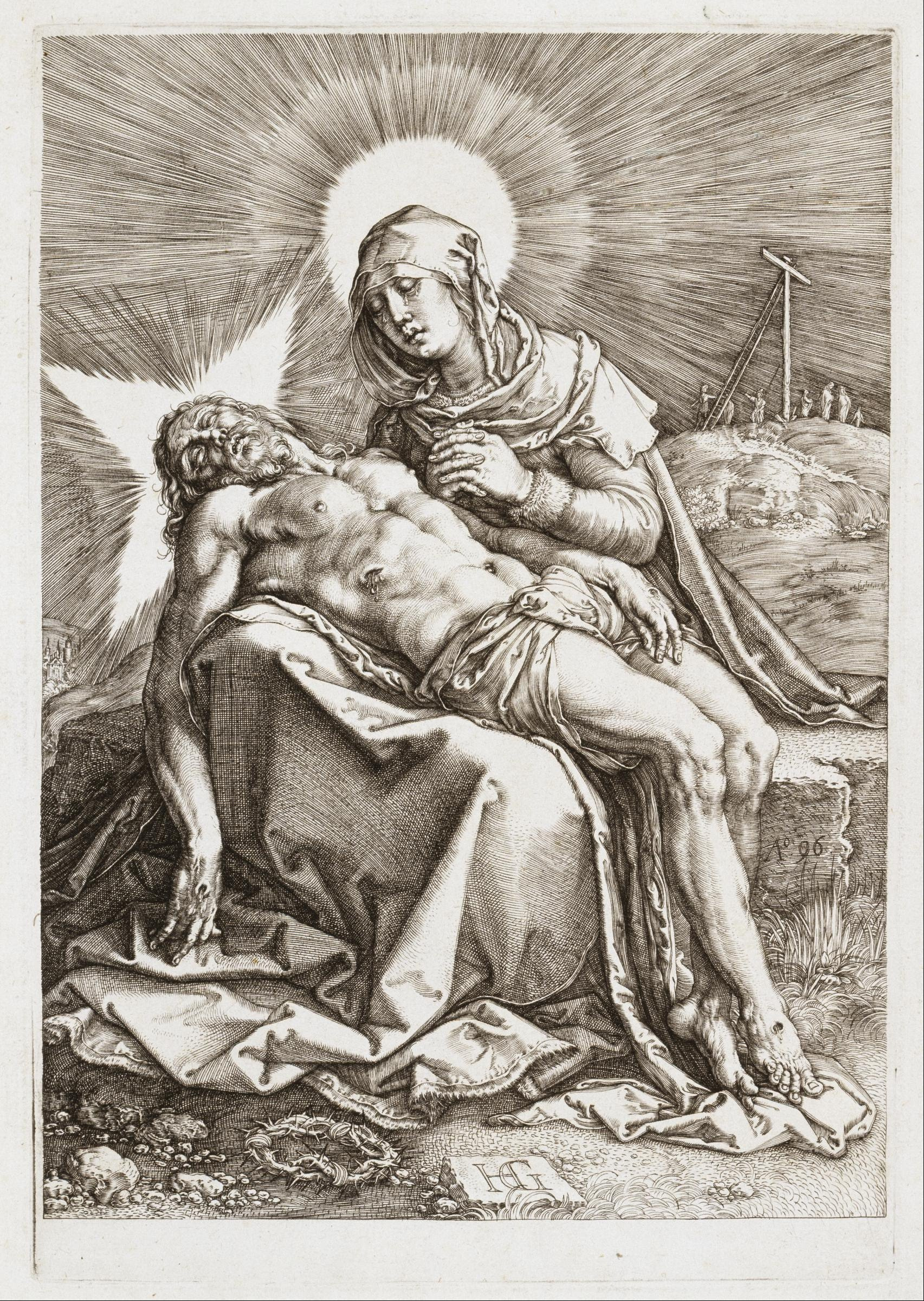
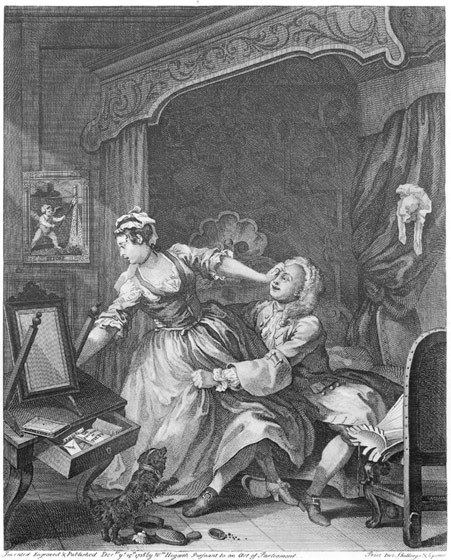
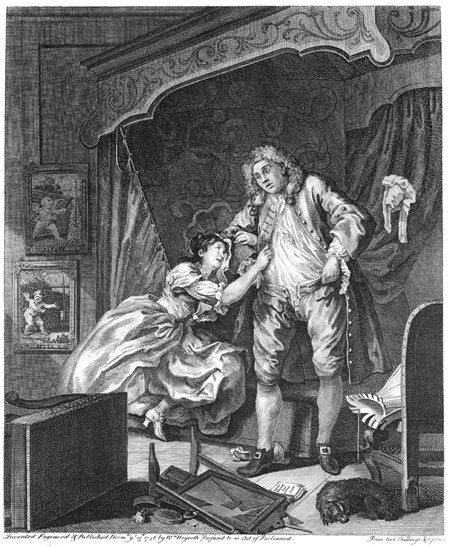
Starting with prints from the likes of Andrea Mantegna from the mid 1400s and ending with recent offerings from Chris Ofili, the show is chronologically broad. The early works are full of exquisite detail. I loved Agostino Veneziano’s The Academy of Baccio Bandinelli which, through engraving not only captures the brilliant detail of artists at work in a studio but also the drama of low candlelight with incredible shadows dancing and flickering on the wall behind. I also adored Hendrik Goltzius’s The Pieta, another engraving utilised to maximum effect – the lines and contours of Christ’s muscular body are stunning here. There was also great humour in Hogarth’s Before and After engravings, showing a man ravaged with passionate desires for a woman in one print, and the same man much dismissive once he has had his saucy way with her. 

Agostino Veneziano, The Academy of Baccio Bandinelli

Agostino Veneziano, The Academy of Baccio Bandinelli

Hendrick Goltzius, The Pieta

Hendrick Goltzius, The Pieta

William Hogarth, Before

William Hogarth, Before

William Hogarth, After

William Hogarth, After

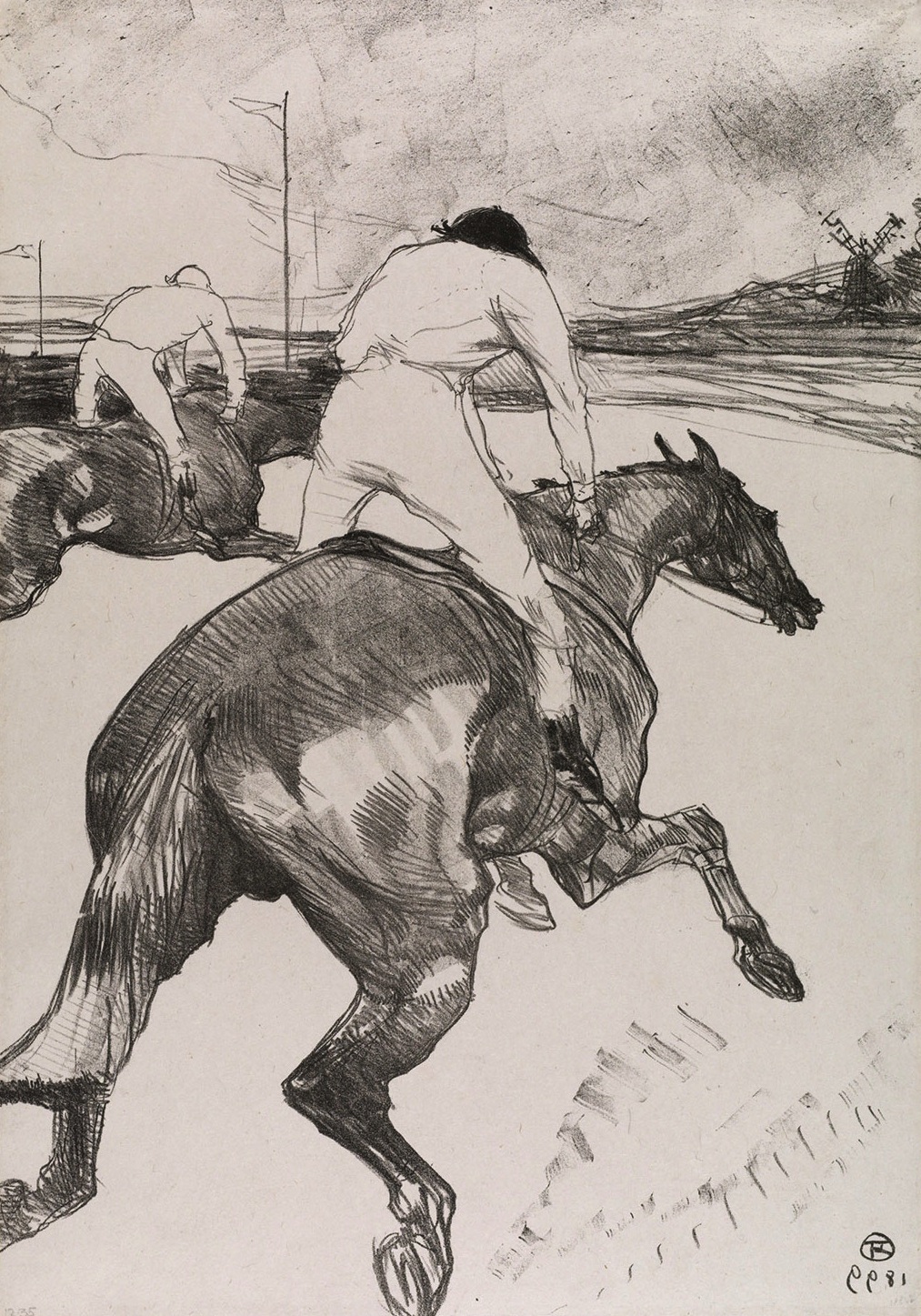
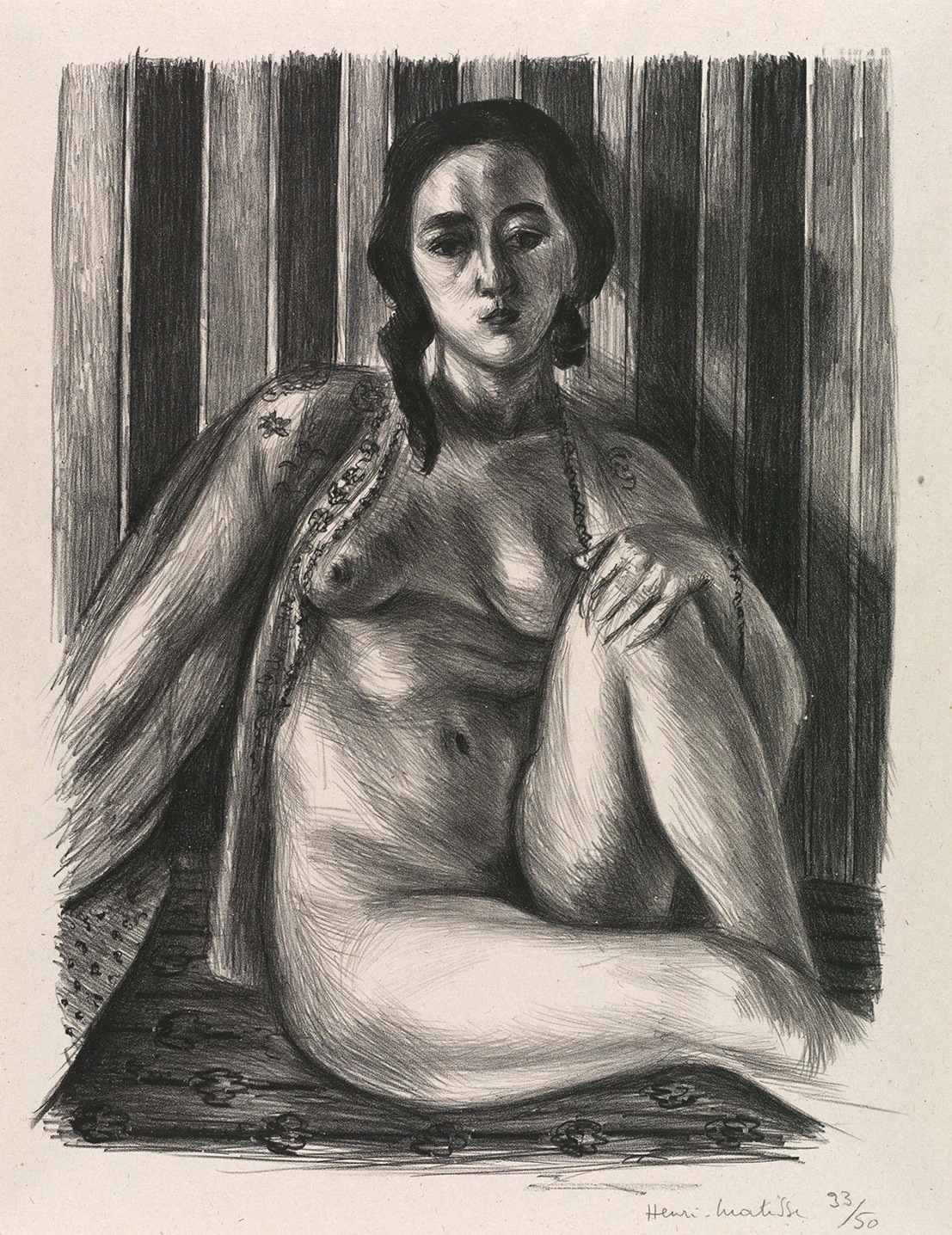
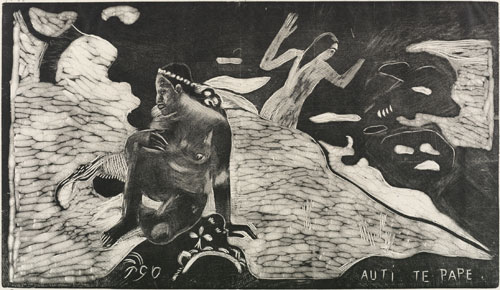
But perhaps unsurprisingly for a museum whose finest collection is its impressionist and post impressionist works, my favourites were those emanating from the late 1800s when printmaking as a medium was having a new hayday, and innovations such as lithography were opening up printmaking to more artists. Amongst them was Toulouse-Lautrec whose lithograph of a jokey straddling a fast moving galloping horse was rightly displayed at the centre of the show, and Bonnard, whose whimsical and somewhat mysterious Woman with a Child and dog from the Nannies’ Promenade series was my favourite in show. 

Toulouse Lautrec, The Jockey (1899)

Toulouse Lautrec, The Jockey (1899)

Matisse, Seated Nude Woman with a tulle blouse

Matisse, Seated Nude Woman with a tulle blouse

Pierre Bonnard - The Nannies' Promenade (1897)

Pierre Bonnard – The Nannies’ Promenade (1897)

Gauguin, Auti te Pape

Gauguin, Auti te Pape

But of course I cannot end this brief canter through the Courtauld’s show without mentioning one of the last prints being exhibited – Blond Girl by Lucian Freud. For it was this very etching, and those others held in the Courtauld’s collection, that inspired me to start printing a little over a year ago. And for all of the etchings and woodcuts I have done since, I have Freud and the Courtauld to thank.

Lucian Freud - Blond Gird (detail)

Lucian Freud – Blond Girl (detail)

This brilliant homage to print is on at the Courtauld until 21 September 2014.