Skip to content

Posts tagged ‘Painting’

Inspired by my surroundings: Paseo Mallorca 4

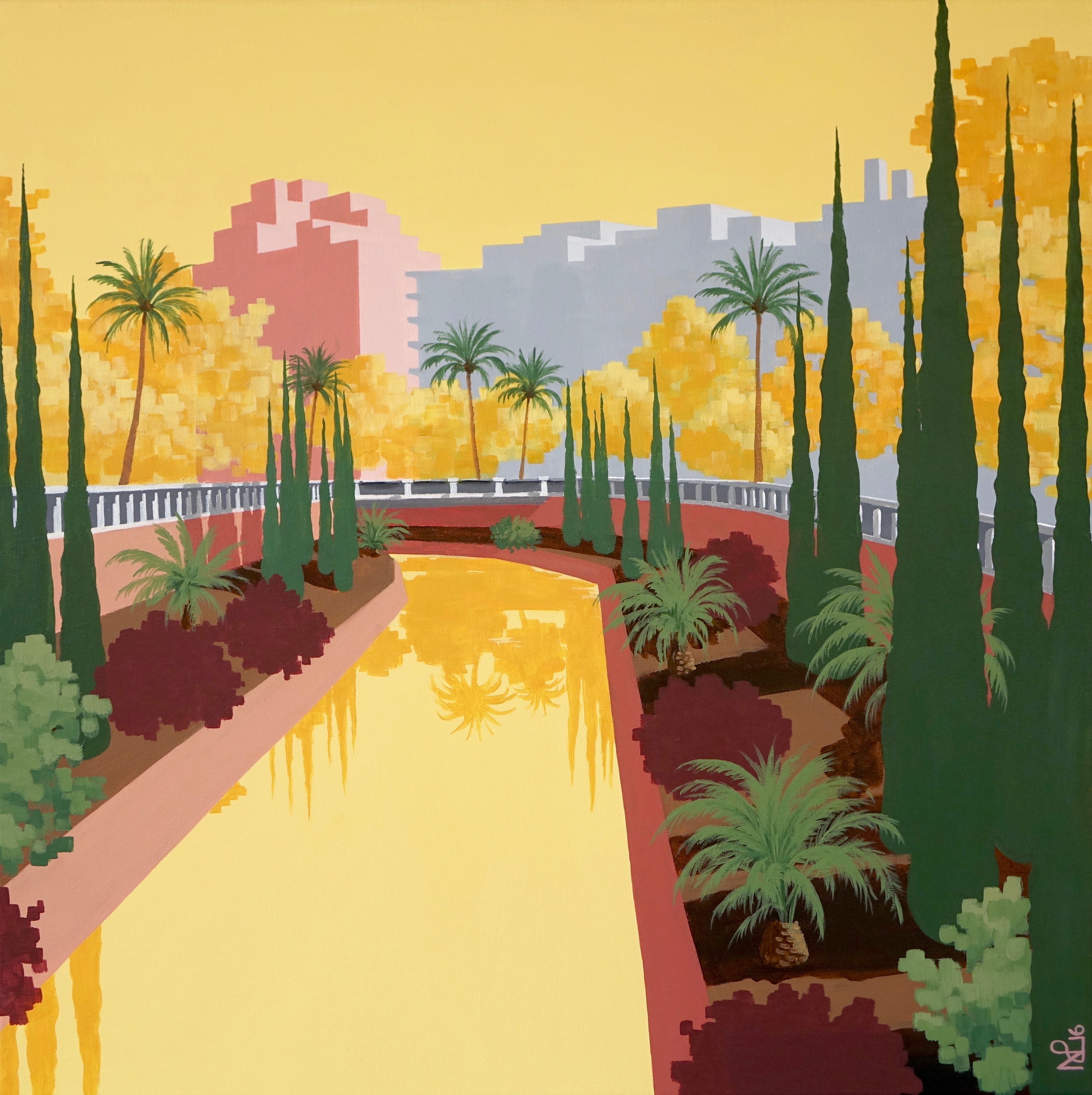
Those who live on the Mediterranean island of Mallorca count themselves lucky. Winter temperatures rarely drop below 10 degrees, and on days of winter sunshine, when its rays are trapped in a corner away from occasional breezes, you might think that you are living a continuous summer. And in the Paseo Mallorca, the treelined waterway which I currently call my home, the graceful beauty of cypress trees, palms and ancient Arabic city walls continues to inspire, no matter the season. This is never more so than at the close of day, when the drama of winter sunsets add a new element of grace to this verdant avenue.

Having now painted the Paseo Mallorca three times, including views of the bridge of Jaume III and up river towards my apartment I was recently struck with renewed enthusiasm by the angle I originally painted, looking southwards towards the sea and past the Es Baluard museum of art, but this time with the changes brought about by the atmospheric light of dusk. So having previously considered my Paseo Mallorca collection to be complete, I set about embellishing it with this further, darker enhancement, whose sky and light effects add something of a more realistic feel to a collection characterised by flattened colour panes.

paseo-mallorca-4

Paseo Mallorca 4 (2017 ©Nicholas de Lacy-Brown, acrylic on canvas)

It feels appropriate that I should be presenting this painting now, at the time of dusk, as the sun sets over my time in Mallorca. For all around me, my life in Mallorca is being packed away in boxes as I prepare to leave this paradise, and my beloved Paseo Mallorca, behind. This adventure is now at an end, and London is calling me back into its fold. But long shall the memories of Mallorca prevail in my heart, especially my time spent living on this most inspirational of streets.

© Nicholas de Lacy-Brown and The Daily Norm, 2001-2016. Unauthorized use and/or duplication of the material, whether written work, photography or artwork, included within The Daily Norm without express and written permission from The Daily Norm’s author and/or owner is strictly prohibited. For more information on the work of Nicholas de Lacy-Brown, head to his art website at www.delacybrown.com

Remembrance of things current (No.2): À la table de Mme Verdurin

Marcel Proust continues to ensnare me with the mellifluous poetry of his prose. Having struggled through the first 50 pages of his epic first novel, Swann’s Way, I found that what had at first been like an exercise in chipping away at solid ice had become the easier removal of slushy semi-melted layers, before the watery manifestation of his literary masterpiece washed over me without any effort on my part. I am now what could be termed Prousted, so easily accustomed to bathing languidly in my daily dose of Proust’s world that it has become less an escape from reality as a natural reacquaintance with a perfected present, from whose elegant embrace I depart unwittingly whenever I happen to put down the book.

Happily, when the time comes to place to one side the irresistible pages of In Search of Lost Time, my departure from Proust’s reality is rarely complete, for now the work is inspiring my artwork too. Just before Christmas, I introduced La Madeleine de Proust, the first instalment of my Remembrance of things current series of paintings. I have now completed the second: À la table de Madame Verdurin.

mme-verdurin-final

Remembrance of times current (No.2): À la table de Madame Verdurin (2017 ©Nicholas de Lacy-Brown, acrylic on canvas)

Anyone who has read Proust will know Madame Verdurin as the monarchical matriarch of her own exclusive, carefully selected carve out of Parisian society. Gathering together those people who she considered to be sufficiently witty to contribute to what she termed her collection of The Faithful, this little congregation importantly included Odette de Crécy who was later to become the infamous Mme Swann, wife of one of the book’s major protagonists, Charles Swann. The gatherings which Proust describes, ruled over by Mme Verdurin and her obedient husband, and playing host to the witticisms of guests, musical recitals, and even its own in-house artist, make for some of the most enjoyable passages of Swann’s Way. Providing an enthralling insight into the self-imposed societal norms practised by those who are not quite high society but form their own exclusive club in lieu of the better connections to which they secretly aspire, the Verdurin salon says so much of the social climbing and inter-class backbiting which was rife in Paris in the belle epoch.

Importantly for the novel, the house of Mme Verdurin provids the backdrop for Swann’s first encounters with Odette, and the frictions which thereafter developed when the couple dared to live a life beyond the congregation of The Faithful. In my painting, I have tried to capture the friction between Swann and Mme Verdurin in the two figures which dominate the bottom half of the piece. There, Mme Verdurin’s hairstyle is almost halo-like in her self-imposed status as a kind of deity in her home, while the red bar above her head is like the sentencing hat worn by a judge who makes severe judgement on the society around her. Above and below, the chandelier and the black and white floor represent the decorative embellishments which ensured that visitors to the Verdurin household were fully aware of their burgeoning social status, but the black and white also represents the keys of the piano which played out Vinteuil’s musical refrain which was to underpin the force of Swann’s passion for Odette. Yet for all this pomp and ostentation, the table of Madame Verdurin, around which the diners sit, is notably empty. Vacuous and without depth, like the true nature of the party’s rather frivolous conversation.

Now I am on the third novel of Proust, and with 4 still to go, I know that my collection of paintings will grow accordingly.

© Nicholas de Lacy-Brown and The Daily Norm, 2001-2017. Unauthorized use and/or duplication of the material, whether written work, photography or artwork, included within The Daily Norm without express and written permission from The Daily Norm’s author and/or owner is strictly prohibited. For more information on the work of Nicholas de Lacy-Brown, head to his art website at www.delacybrown.com

Artist in Focus: Grant Wood

Two weeks over the Christmas period in London and Paris provided the perfect opportunity to play catch-up on some of the incredible exhibitions which have been popping up in both cities, and for which I have been pining from afar. Whether it be Picasso Portraits at the National Portrait Gallery in London or Bazille at the d’Orsay in Paris, I have been literally itching to get inside the galleries to discover artists both familiar and new, set within the context of a new curatorial manifestation. Out of these exhibitions, I walked away struck by certain paintings and by certain artists whose work I am keen to share on The Daily Norm. For life is a continuing learning curb, and even behind the most famous work lies an entire portfolio of unknown paintings coming from a relatively un-talked of artist.

grant_wood_-_american_gothic_-_google_art_project

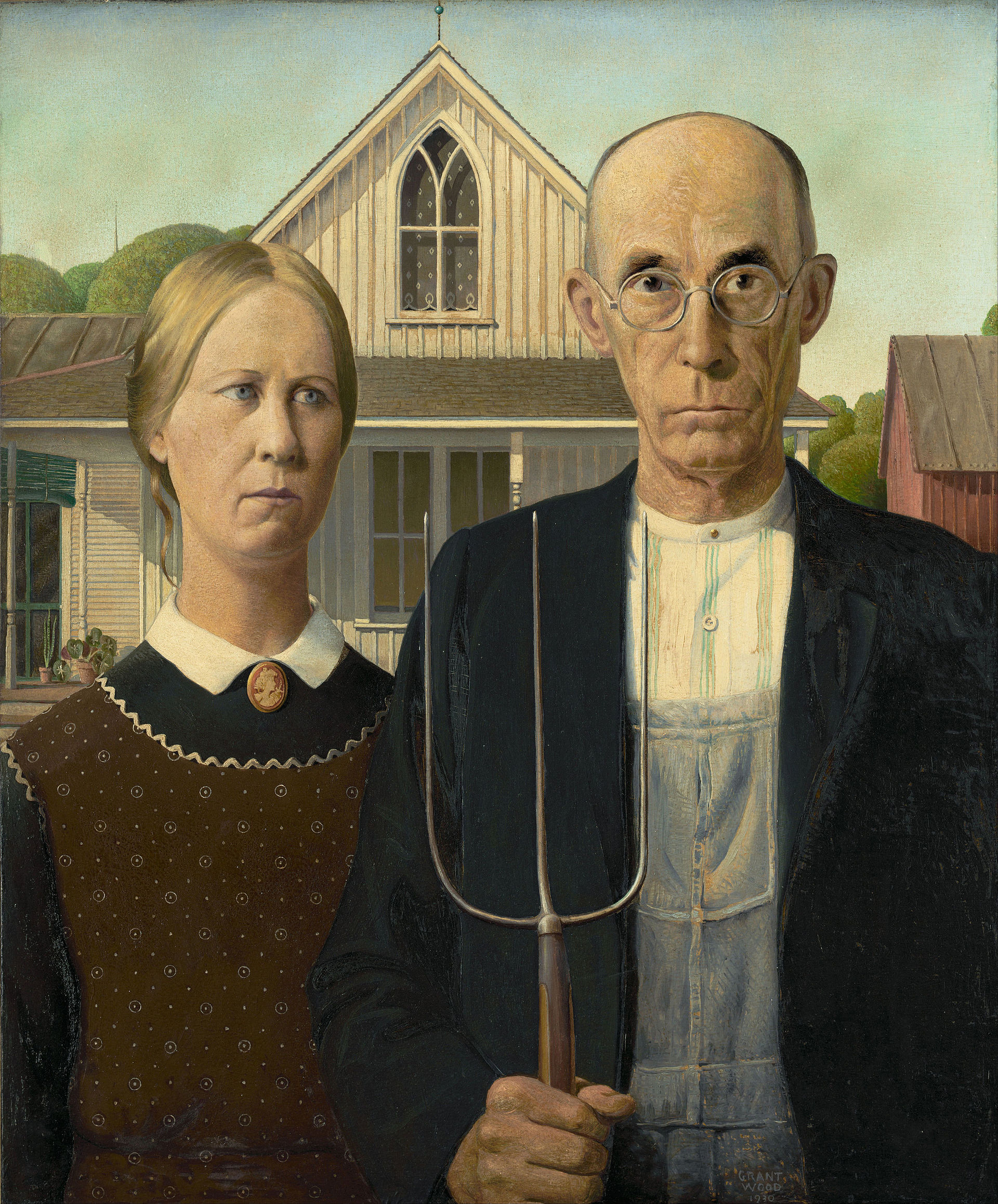
American Gothic, Grant Wood (1930)

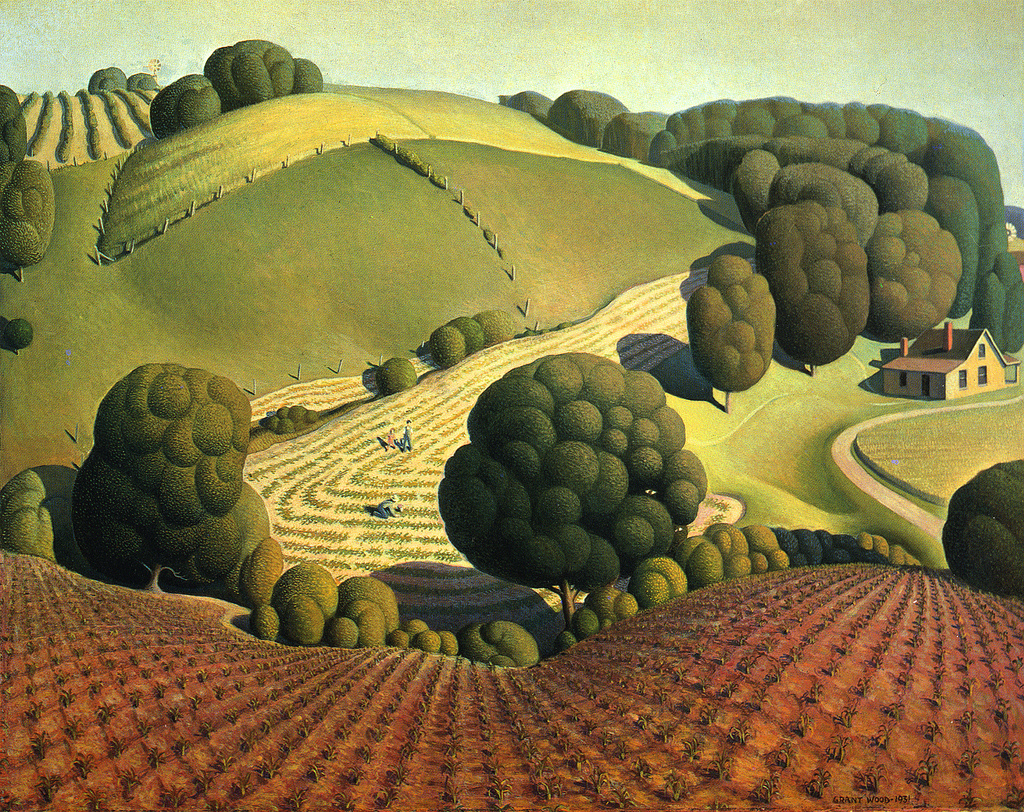
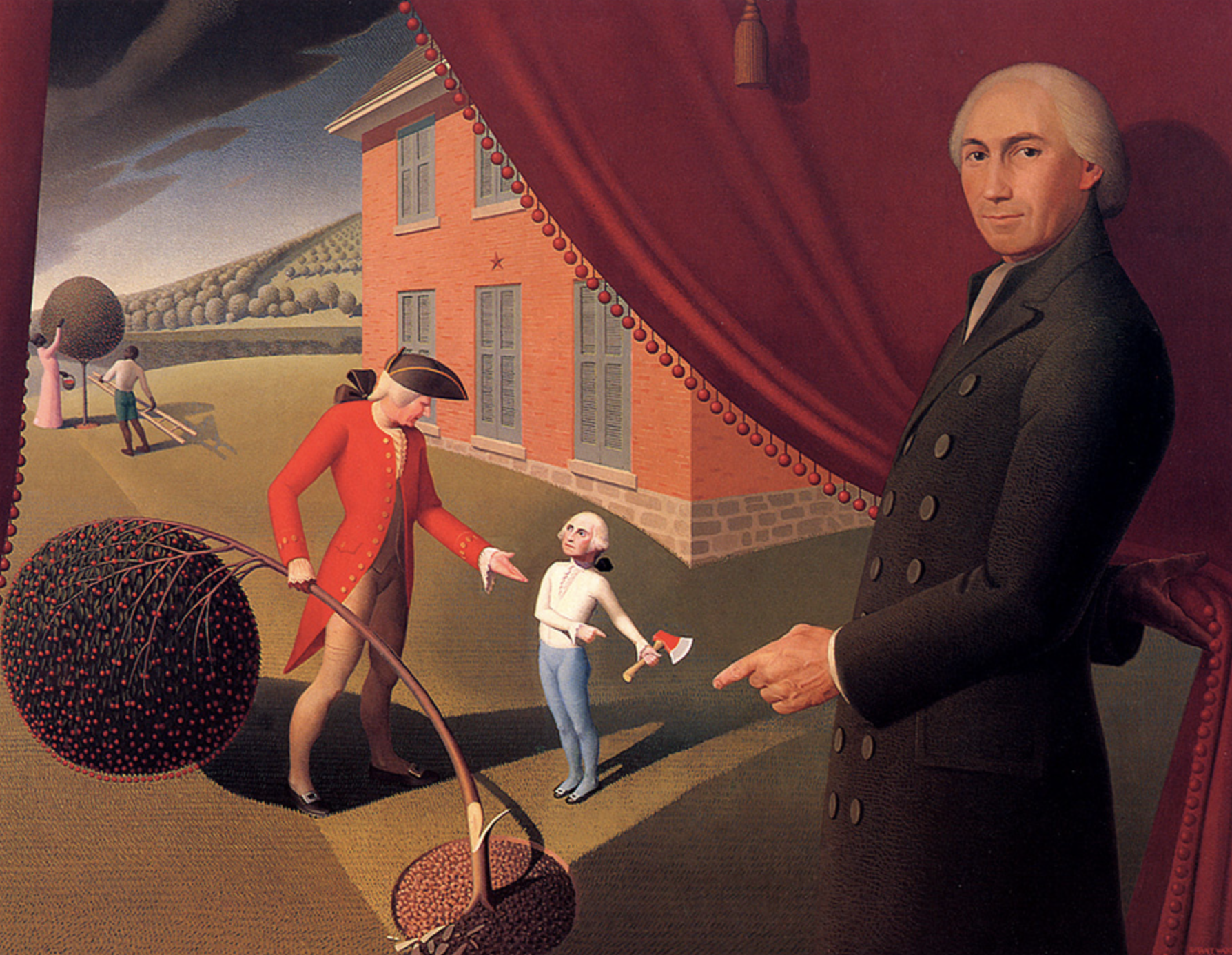
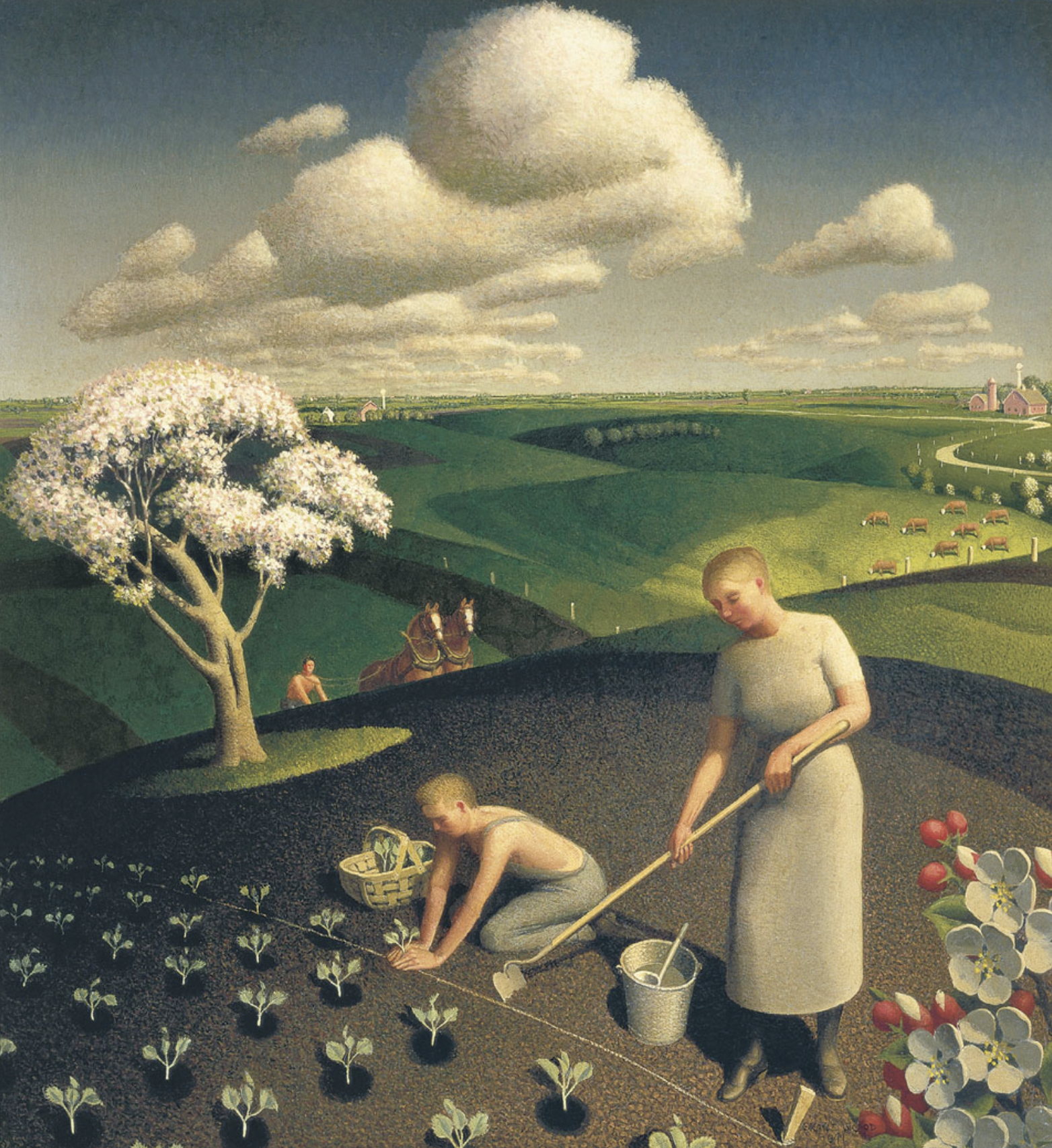
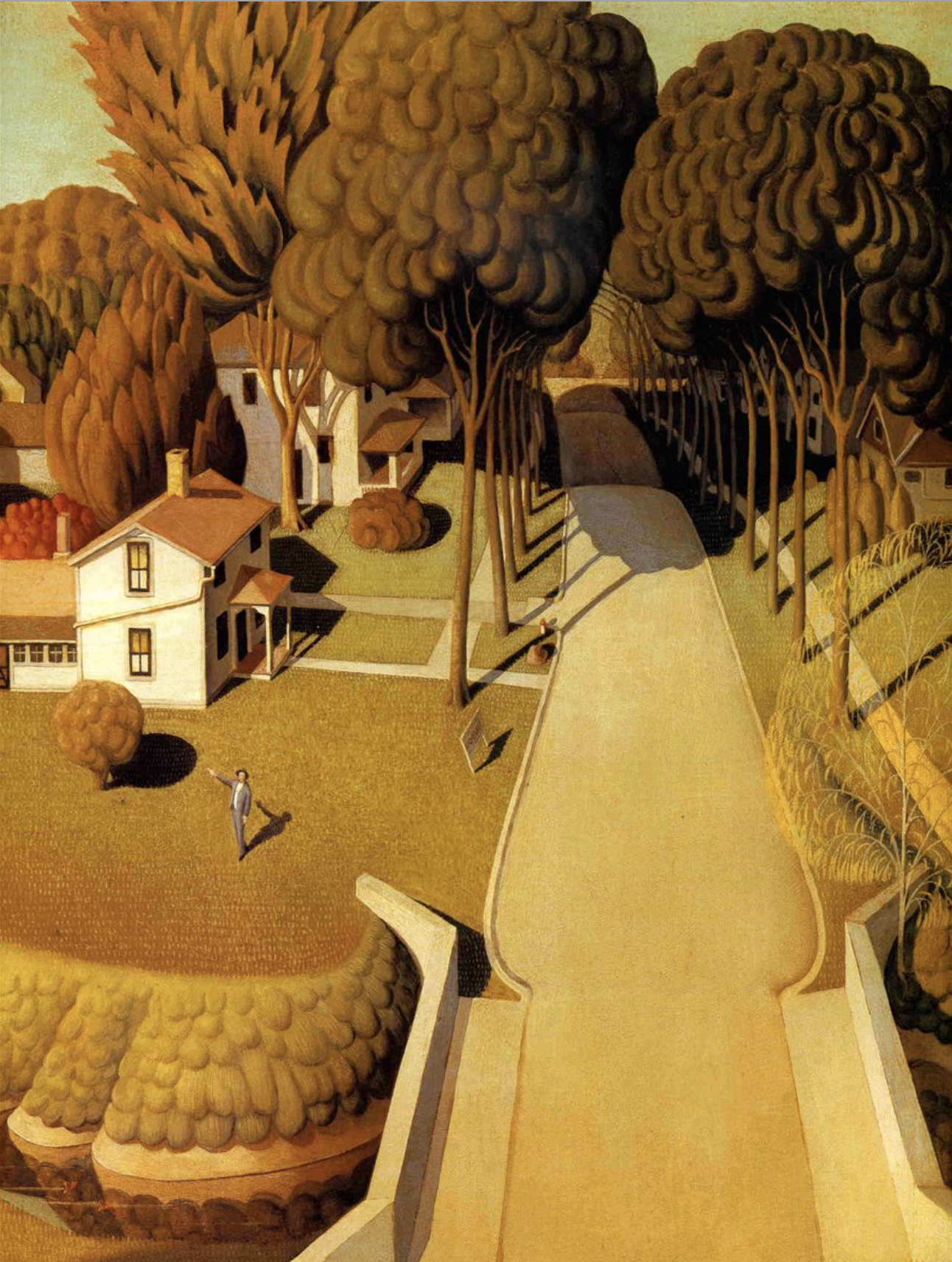
This is the case with Grant Wood, who is far more famous for his emblematic 1930 painting, American Gothic, than he is for fame in his own name. Usually housed in the Art Institute of Chicago, which recognised the piece for its iconic depiction of life in the rural American midwest in the pre-Depression age and bought the work, American Gothic is one of the most iconic paintings of the 20th Century, and is currently making its first European visit. For me, it was clearly the highlight of the exhibition currently running at the Musée de l’Orangerie in Paris, American Painting in the 1930s (although I gather that the work, and the show built around it, will soon make its way to London’s Royal Academy too).

Highlights of Grant Wood’s oeuvre

grant-wood-9

Young Corn (1931)

grant-wood-7

Parson Weem’s Fable (1939)

grant-wood-6

Spring in the Country (1941)

grant-wood-8

The Birthplace of Herbert Hoover (1931)

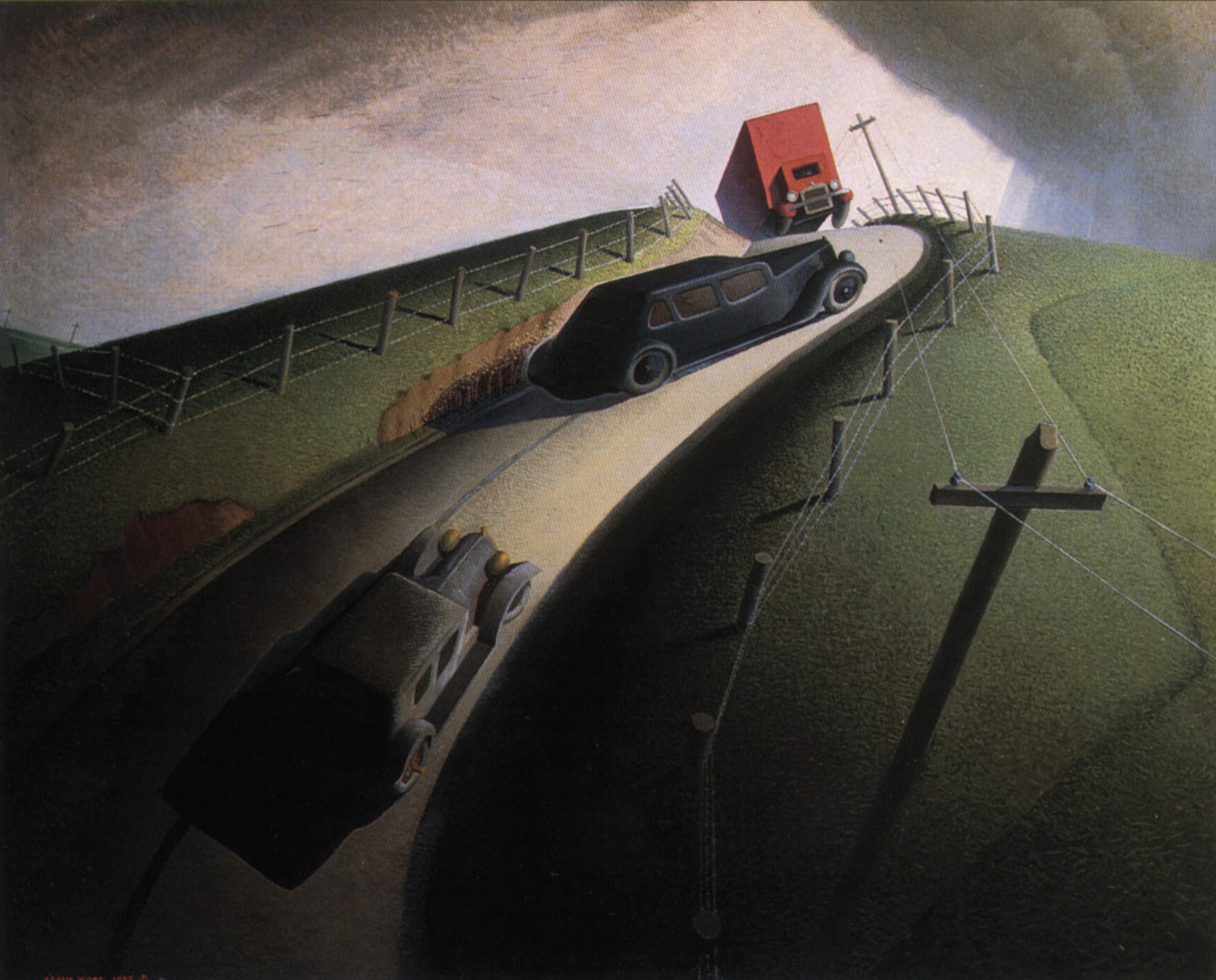
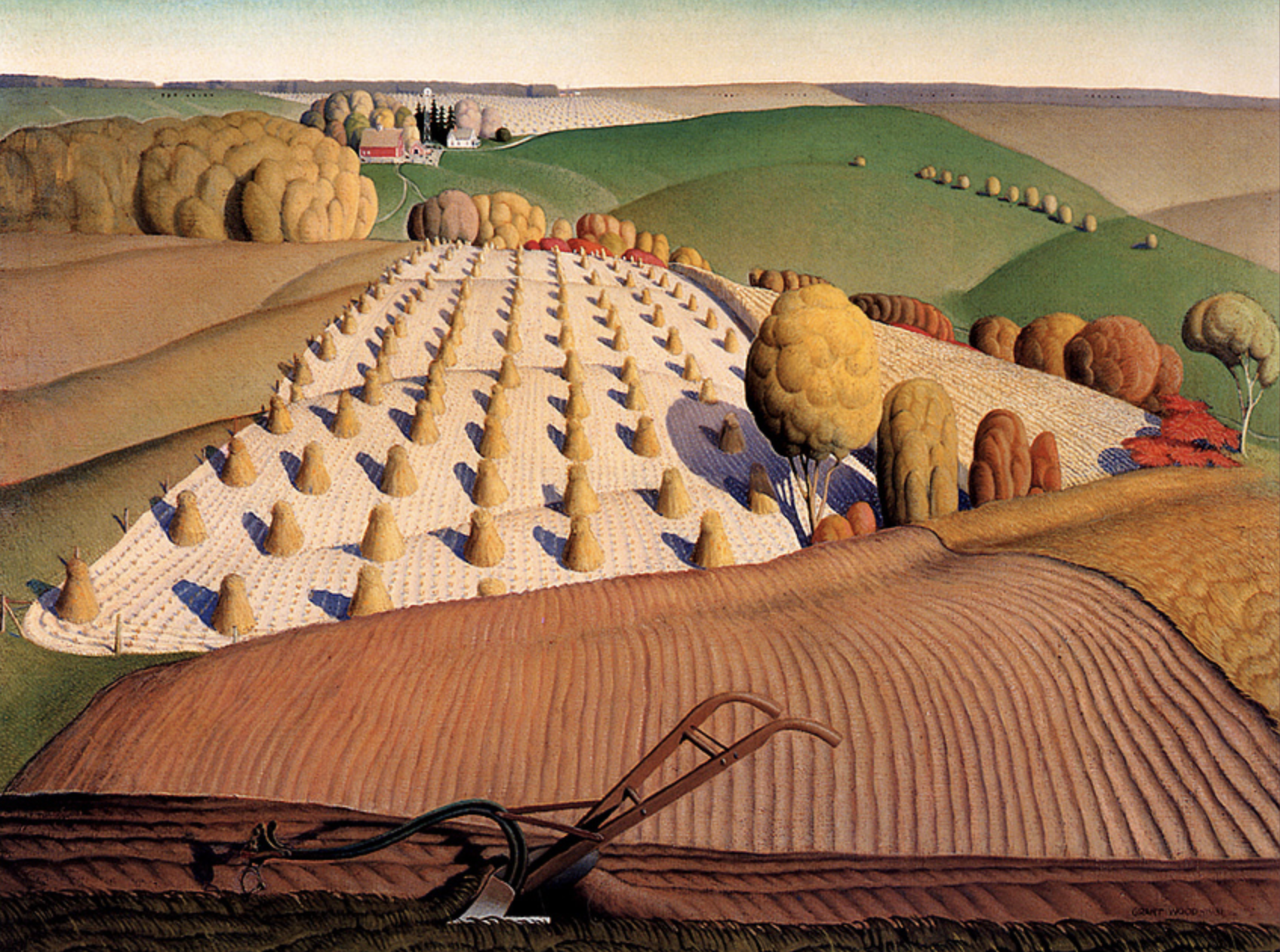
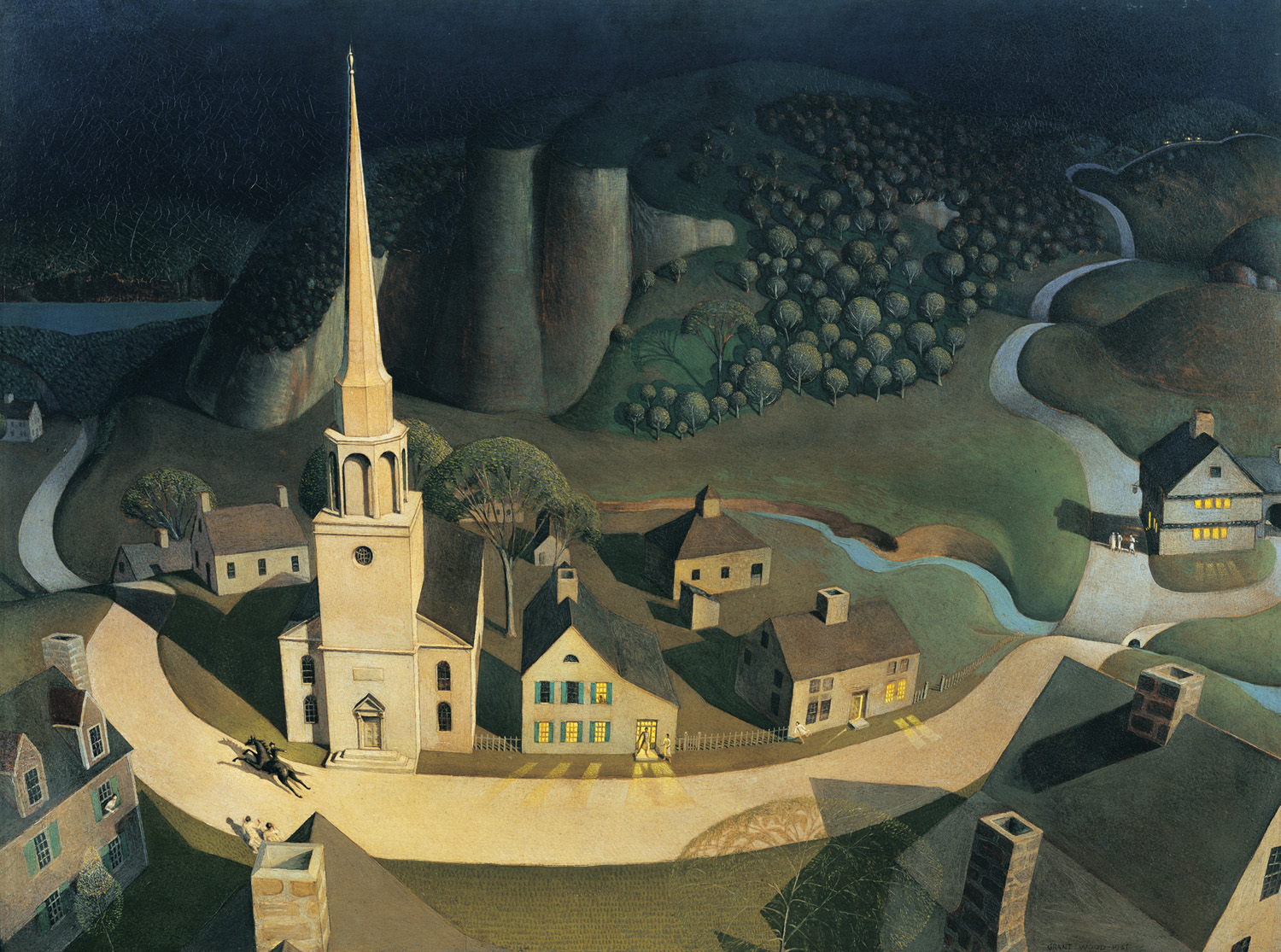
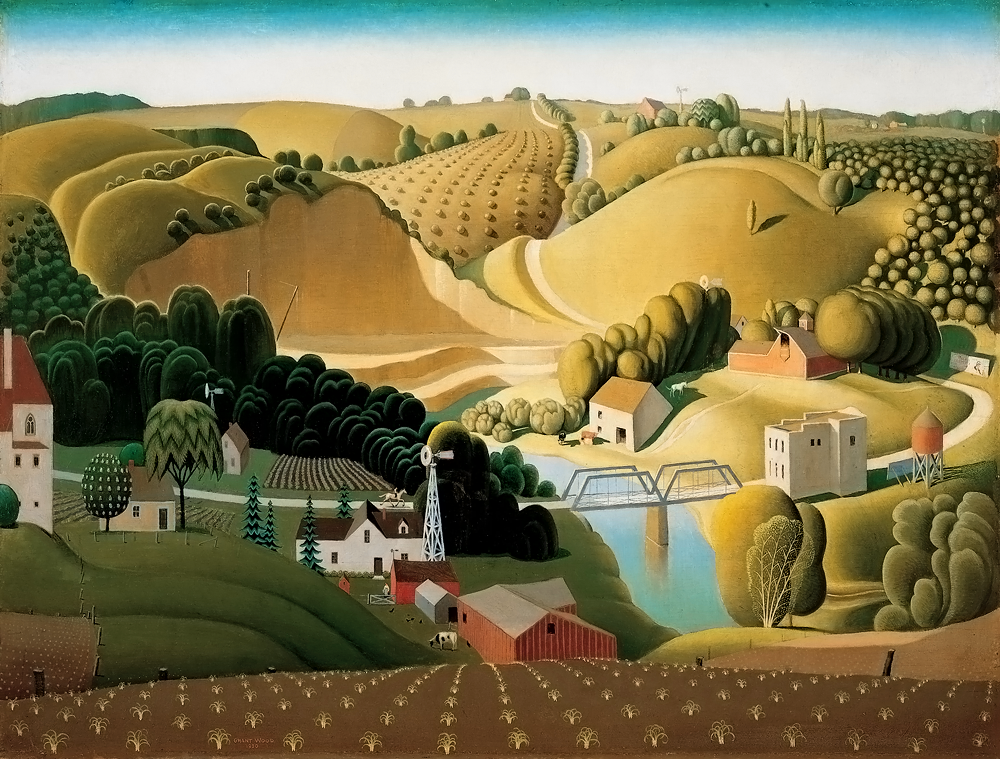
However, having swooned over my first face-to-face encounter with this iconic work and taken note of the name of its artist, what I wasn’t expecting was to find how prolific an artist lay behind the painting. For as we made our way around the exhibition, exploring its historically captivating theme of art before, during and immediately after the great American Depression, the name Grant Wood kept on popping up under all of the paintings to which I was instantaneously attracted upon entering each exhibition space.

Born in 1891 and painting until his death in the 40s, Wood’s early work shows the clear influence of impressionism and post-impressionism with more hesitant lines and a play on depicting realistic light. However, by the time he reached the 1930s, the artist had fallen upon a truly unique form of naive reality, depicting in beautifully bold colours and sharp, well rounded lines and figurative forms, the rolling rural landscape around his Cedar Rapids home.

grant-wood-5

Death on the Ridge Road (1935)

grant-wood-fall

Fall Plowing (1931)

POSTER_3A

The Midnight Ride of Paul Revere (1931)

stone-city-inbluesky

Stone City Iowa (1930)

Without a doubt, my favourites of his works are his exquisite landscapes, painted so idyllically as to be charged with a kind of fantasy-land quality, albeit recognising in their carefully executed details the depiction of agriculture and industry. Reducing trees into rounded, wooly forms, and using idealised shadow to round-off the land like the  voluptuous flesh of a Rubens nude, these landscapes are pure works of genius, and why the artist Grant Wood will now remain lodged in my artist consciousness for all time.

Remembrance of things current (No.1): La Madeleine de Proust

Memory is a powerful thing and there are times in life when it is triggered quite involuntarily. Such moments occur frequently during this season of Christmas for example, when the smell of tinsel upon opening a box of decorations may transport you directly back to a moment of your childhood, or when the sound of a carol may take you back to a chilly but magical evening in a carol concert. Such moments of involuntary remembrance were a principal preoccupation for the extraordinary French novelist, Marcel Proust, and the so called “Madeleine moment”, when the narrator is reminded of a whole raft of his childhood by the innocuous flavour of a madeleine dipped in tea, is one of the central most important moments of Proust’s seminal novel, In Search of Lost Time (À la recherche du temps perdu).

It has long been an ambition of mine to read Proust’s masterpiece of 7 volumes but I must admit that on previous attempts to start his epic, the scale, and the style of the work somewhat intimidated me. But I believe that there are good times and bad times to read such a substantial philosophical work, and from the moment I restarted the tome last month, I was hooked. As inevitably happens when I am engrossed in a book, Proust started to colour my present life and my imagination. The coincidence of reading his first volume with a visit to the Crystal Cubism exhibition in Barcelona made for a powerful motivation, and within days a painting, inspired by the very same Madeleine moment, was blossoming in my head.

proust-madeleine-final

Remembrance of things current: La Madeleine de Proust (2016 ©Nicholas de Lacy-Brown, acrylic on canvas)

And here is the result. A work which combines both the Madeleine, the musings which result, and a reflection upon my own current life while reading the novel. Thus you have the knitting with which I have been engaging myself of late, the armchair and lamp in which I have taken to reading the work, and the use of arabesque-like patterns taken from Pakistani fabric. For my current tea of choice is not the tila (lime blossom) featured in the novel, but Pakistani tea – a so called black tea with festive spiced hints. These reflections upon my current environment also inform the title of this new collection “Remembrance on things current” which is a play on the original title of the book, “remembrance of things past”  originally adopted for the seminal english translation before the more literal “In search of lost time” was universally accepted.

Now I am well into volume 2 of Proust’s work, and as his poetical reflections and magnificent belle epoch atmosphere continues to ensnare me, I have no doubt that a second painting like this one will not be long in coming.

© Nicholas de Lacy-Brown and The Daily Norm, 2001-2016. Unauthorized use and/or duplication of the material, whether written work, photography or artwork, included within The Daily Norm without express and written permission from The Daily Norm’s author and/or owner is strictly prohibited. For more information on the work of Nicholas de Lacy-Brown, head to his art website at www.delacybrown.com

Las Meninas: Fourth Interpretative Exercise

It’s been almost 10 months since I last created a work in my collection of painted interpretations of Velazquez´s famous masterpiece, Las Meninas, and in fact, after I had completed the third of the set, I thought that the group was pretty much complete. It was a collection which was significant not just in itself, but because it launched for me an entire new way of seeing both famous masterpieces and reinterpreting them (something which went on to inspire my new redevelopment of works by Rubens, Van Gogh and Courbet amongst others), but also instigated a new collection of more simplified quasi-cubist works developing flattened colour panes and using acrylic as a primary medium. However, at the time of painting the third Las Meninas, I also started a fourth, but as I remember it, a little while after starting, my interpretation of a Titian got me all carried away, and I left the canvas unfinished.

Thus it may have remained were it not for a spring (well autumn…) clean on which I embarked a couple of weeks ago. Discovering the canvas in its unfinished state I was 50:50 whether to bin it, or finish it. Opting to finish what I had started, I am now happy to present the final interpretation of Velazquez´s renowned masterpiece.

las-meninas-4-final

Las Meninas: Fourth Interpretative Exercise (©2016 Nicholas de Lacy-Brown, acrylic on canvas)

Taking the abstracted character shapes from both the second and third interpretations and reusing them in yet another composition, this work is more of a satyrical take on the modern day clinical art gallery in which works such as Velazquez’s can be seen today… seen but certainly not touched. With their security guards, their roped off works, their cameras and alarms and pristine white walls, galleries are not always the most welcome of places, especially when compared with the abundantly filled, cosy interiors depicted in the likes of the original Las Meninas. But at the same time, this vacuous white gallery setting has become the staple of art institutions the world over, a space which allows the masterpieces themselves to shine in relative safety, free to inspire future generations with their majesty, just as Las Meninas did me.

© Nicholas de Lacy-Brown and The Daily Norm, 2001-2016. Unauthorized use and/or duplication of the material, whether written work, photography or artwork, included within The Daily Norm without express and written permission from The Daily Norm’s author and/or owner is strictly prohibited. For more information on the work of Nicholas de Lacy-Brown, head to his art website at www.delacybrown.com
Palmanova: Colonial Age

It’s funny how coincidence so often dictates the trajectory of life. My weekend in Barcelona was booked on a whim, out of a desire to feel the stimulation of a big city. I had no idea when I organised the trip that the Picasso Museum was showing the most incredible exhibition of cubist art at the time I would be going. I likewise knew nothing of the show, nor the style of painting advanced by the Crystal Cubists when I started work on this painting, Palmanova: Colonial Age, which I am delighted to be sharing today. Yet somehow all of the elements of this period seem to have merged in one. The painting, and the trip, while advanced in separate moments, seem to sit perfectly alongside one another as a further phase in my development as an artist.

The project arose out of a restaurant decorating commission in the original Cappuccino Grand Café in Palmanova, Mallorca. A combination of the elegant tall palm trees swaying by the seaside outside, and the preexisting interiors of wood panelling which could not be changed, inspired an Indian colonial scheme, underpinned by rich greens and mustard yellows. This scheme was further advanced when coincidentally I found old artworks containing monkeys and palm trees which perfectly complemented the design, while the name of Farrow & Ball’s shade of yellow, Indian Yellow, likewise came as a signal for the design forming in my mind. But when we decided that the design required a painting for a finishing flourish, this image immediately jumped into my head.

palmanova

Palmanova: Colonial Age (©2016 Nicholas de Lacy-Brown, acrylic on canvas)


Palmanova: Colonial Age is a painting which is defined by the characteristics of crystal cubism which I admired so much in my last blog. Pictorially, it narrates both the surroundings of the restaurant where it now hangs – the sandy beach, the mountainous horizon, the sea and the palms – and likewise the Indian elements which underpin the interior design. But as I took the theme further, I realised that there were other similarities too between India and Palmanova. For while the “colonial” style of design stems largely from the time when the British Empire colonised and ruled India, Palmanova is an area of Mallorca likewise famous for its strong British population, and the local businesses, largely catering for Brit needs, are evidence of the success of this “colonisation”.

Somewhat tongue in cheek therefore I have applied the colonial theme to this sunny stretch of Spain when creating a cubist painting which for me perfectly complements the seaside location and the elegance of Britain’s great colonial age.

© Nicholas de Lacy-Brown and The Daily Norm, 2001-2016. Unauthorized use and/or duplication of the material, whether written work, photography or artwork, included within The Daily Norm without express and written permission from The Daily Norm’s author and/or owner is strictly prohibited. For more information on the work of Nicholas de Lacy-Brown, head to his art website at www.delacybrown.com
A Portrait of Mallorca

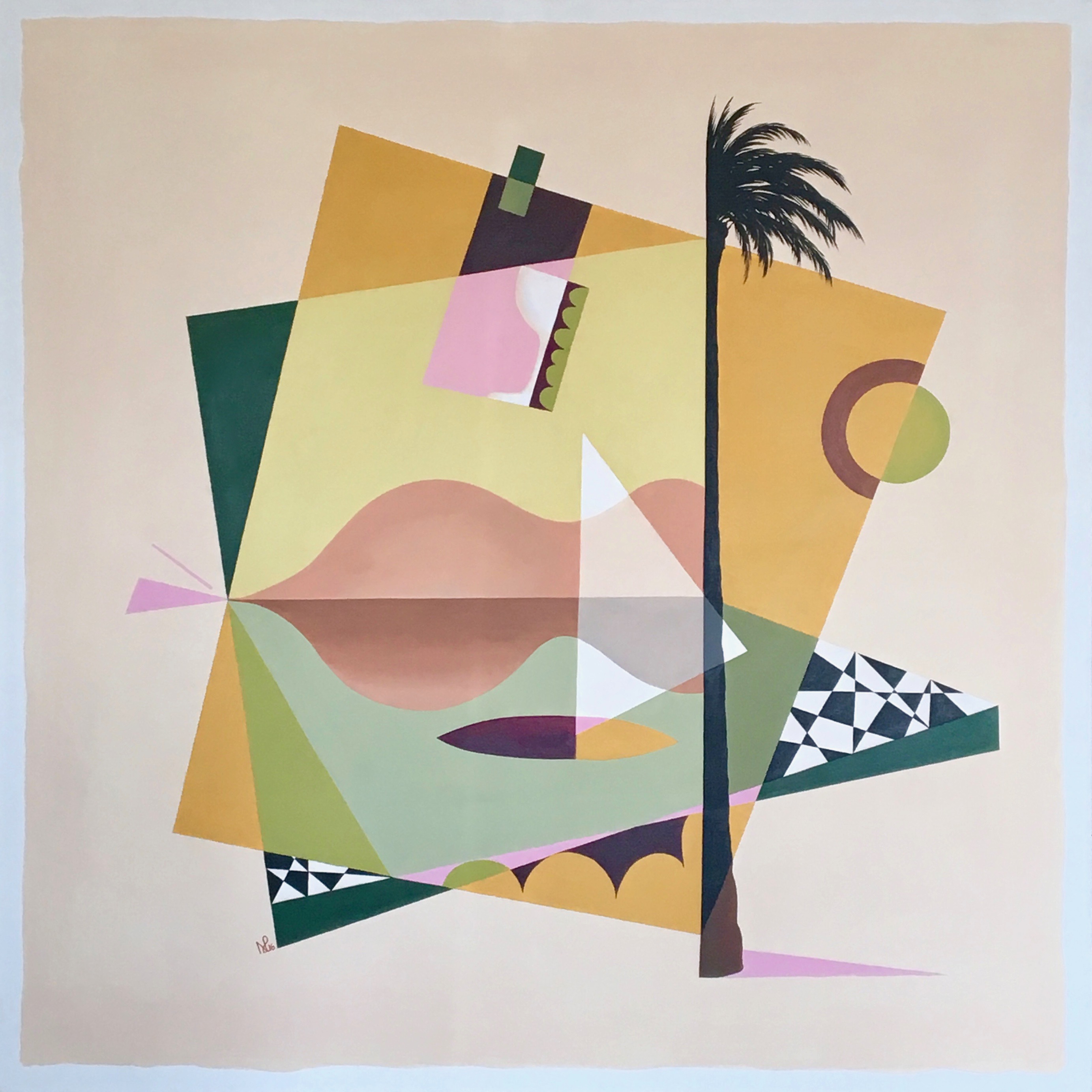
Sometimes I just want to paint what’s on my mind. The energetic fusion of ideas applied to canvas in a mixed and multifarious revolution of form and colour. But unlike the Expressionist movement, which tended to splash and splosh their emotion onto canvas in more of a literal application of paint, my variety of expressionism materialises in more of a controlled fashion. I suppose it says something about my rather controlling mind (a tendency for which my partner may testify). For my wildest form of expression is something more cubist in nature. I have always been enchanted by the age of the cubists. The ability to show an object or a subject on multidimensional planes has always filled me with an ultimate sense of pictorial satisfaction. And while my cubism is less a single subject and rather more a mixed bag of ideas, it definitely belongs to the genre.

retrato-mallorca-final

Portrait of Mallorca (2016 ©Nicholas de Lacy-Brown, acrylic on canvas)

This cubist work, which also belongs to my interpretative abstract way of thinking, is the latest canvas to hop off my easel and says everything and anything about the island on which I have spent the last two happy years of my life. It is for me a true portrait of Mallorca, because beyond the tacky tourism for which the island is so unfortunately infamous, the island is one of true bucolic peasant culture, with its own cuisine and characterised by a stunning mixed mountainous and coastal landscape. All this is represented in the imagery packed into this “portrait” which includes the spiralled ensaimada pastry for which the island is famous, the lacey headdress and straw hat worn by the traditional peasant women, as well as their flowing striped skirts flapping in the Mediterranean breeze. There too are the mountains and the beaches, the glittering coast and the yachts which encircle the island like moths around a light source. And of course the sails of the windmills, which likewise characterise the lower lying stretches of countryside.

It is a painting which fully encapsulates the multifaceted personality of an island which is much, much more than Magaluf.

© Nicholas de Lacy-Brown and The Daily Norm, 2001-2016. Unauthorized use and/or duplication of the material, whether written work, photography or artwork, included within The Daily Norm without express and written permission from The Daily Norm’s author and/or owner is strictly prohibited. For more information on the work of Nicholas de Lacy-Brown, head to his art website at www.delacybrown.com
Inspired by my surroundings: Paseo Mallorca 3

The Paseo Mallorca, a stretch of treelined river in Palma, continues to inspire. I am lucky enough to live on this panorama of green which acts like the lungs of a city already awash with the air of the Mediterranean. It is, if you like, the perfect gateway to the sea from the city sprawl built up alongside it, since a stroll along this tree-lined avenue will take you directly down to the city’s magnificent port.

I set about painting this stretch of urban utopia a few months ago, starting with the bridge closest to the Es Baluard museum of art, and moving onto the bridge of Jaume III and the magnificent post-modern stretch of residential buildings beyond. In this third addition to the collection, I move further up the river, to the area where I live. Here the bridges are simplified but the greenery is all the more stunning. The colour palette is carefully chosen to represent the humid warmth of the season (I started the work on the painting in July), and also to perfectly partner the first painting in this group. For me it captures the essence of this happy, leafy suburbia which I am lucky enough to call home.

paseo-mallorca-3-final

Paseo Mallorca 3 (2016 ©Nicholas de Lacy-Brown, acrylic on canvas)

© Nicholas de Lacy-Brown and The Daily Norm, 2001-2016. Unauthorized use and/or duplication of the material, whether written work, photography or artwork, included within The Daily Norm without express and written permission from The Daily Norm’s author and/or owner is strictly prohibited. For more information on the work of Nicholas de Lacy-Brown, head to his art website at www.delacybrown.com
Lady with a Yellow Sleeve (after Corot)

How things change. Having become so accustomed to walking the hallowed halls of London galleries for every changing exhibition, I now tread the sun dappled pavements of Palma de Mallorca and admire the beauty of nature rather than the beauty of paintings which capture it. However on occasion I get the opportunity to return to the London galleries I love, and the other weekend, I had the quick chance of dropping into the National Gallery where I was able to enjoy a temporary exhibition: Painters’ Paintings, which explored the impressive collections of art owned by some of the most renowned artists. Amongst an exhibition including a vast range of works from Titian to Picasso, the one painting which impressed me the most was formerly owned by Lucian Freud and painted in around 1870 by Jean-Baptiste Camille Corot, The Italian Woman or Woman with Yellow Sleeve.

corots-woman-final

Woman with a Yellow Sleeve (2016 © Nicholas de Lacy-Brown, acrylic on canvas)

corot-original

The original Corot masterpiece (© The National Gallery)

With its striking balance of colours, from the vivid red and blue of the lady’s dress to the yellow sleeve after which the painting is named, all set off against a morbidly dark background, you cannot help but be captivated by the work. No wonder the National Gallery chose to use the work as the poster-piece of their show. And as I approached the work, it was another one of those moments when a painting stirred me and I knew that an abstractive reinterpretation of the work was forming in my head. And here it is!

I would’t normally be overly attracted by a portrait of this kind, not least one where the sitter is gazing inwardly within her own world rather than outwards to the audience. But because of the colours Corot used, the painting moved me, and it is those colours which are allowed to shine in my simplified reinterpretation of the work. I hope you like it!

© Nicholas de Lacy-Brown and The Daily Norm, 2001-2016. Unauthorized use and/or duplication of the material, whether written work, photography or artwork, included within The Daily Norm without express and written permission from The Daily Norm’s author and/or owner is strictly prohibited. For more information on the work of Nicholas de Lacy-Brown, head to his art website at www.delacybrown.com
La Señora de Granada

Painting in Marbella is undoubtedly my greatest pleasure. Because there I can realise what must be the idyll of every artist – the ability to paint out in the open, but undisturbed by curious onlookers, in an utterly tranquil atmosphere with nothing to break the flow of the artist’s paintbrush or inspiration. And in my open-air studio in Marbella, I am able to enjoy the heady perfume of jasmine as I paint. What could provide better inspiration? It is perhaps no wonder that in that same garden space, I have painted some of my greatest, and most freely whimsical works over the years.

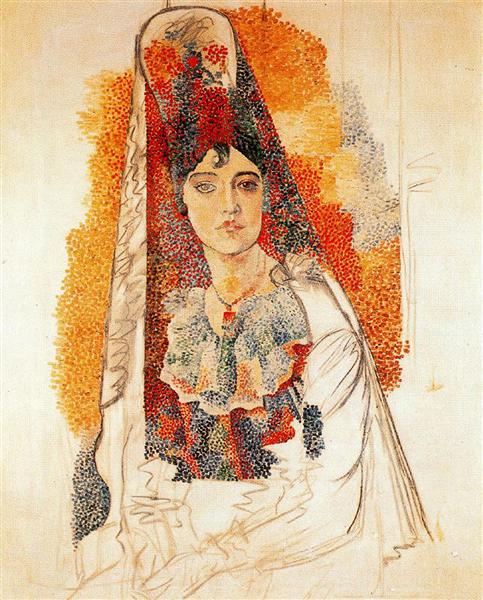
This year, I have had Granada on the mind. You may have noticed. And in my Andalucían garden, this manifested in the painting I am sharing today – an appropriate close to my Granada season, but a consistent continuation of the interpretative abstract style which has dominated my work this year. For this piece, I was not only inspired by Granada, but by another treasure of Andalucía – one Pablo Picasso – whose work has motivated me to paint many times before. My painting, named La Señora de Granada, was at least partially based on an interesting pointillist work by the great artist. Entitled Woman with Spanish Dress, this 1917 work is notable for its unfinished quality, and the resulting luminosity of whites and creams which dominate the work.

granada-lady-final

La Señora de Granada (after Picasso) (2016 ©Nicholas de Lacy-Brown, acrylic on canvas)

Whether or not Picasso intended his work to end up so white, I took this palette as inspiration for my own interpretation. Using his colours, and basic composition, my Spanish woman is at once enigmatic but full of personality. With her simplified coffee coloured lace, kinetic rose and flame like colours bursting as though from within her, she is the personification of Granada, the city that made my summer.

woman-with-spanish-dress-1917-jpglarge

Pablo Picasso, Lady with Spanish Dress (1917)

© Nicholas de Lacy-Brown and The Daily Norm, 2001-2016. Unauthorized use and/or duplication of the material, whether written work, photography or artwork, included within The Daily Norm without express and written permission from The Daily Norm’s author and/or owner is strictly prohibited. For more information on the work of Nicholas de Lacy-Brown, head to his art website at www.delacybrown.com