Skip to content

Posts from the ‘Travel’ Category

Paris Part III: The Musée d’Orsay rehang and, finally, some macaroons

Our last day in Paris, our last breakfast in Le Pain Quotidien on the Rue des Archives, but not the end for our art tour of Paris. For today, we decided to try our luck on a week day where we had failed on Sunday… the Musée d’Orsay. So, like Sunday, there were queues to get tickets. You can buy tickets for the museum online, but they don’t give you the option of printing at home (like the Grand Palais tickets) and instead you have to go in search of a FNAC store to collect your pre-bought tickets, which in my opinion somewhat negates the queue jumping benefits of buying online. So in the event, we waited 40 minutes in a spiralling but steadily moving queue to get in, and those minutes went by fairly quickly, as the anticipation of getting inside and feasting on perhaps Paris’ greatest art collection grew closer. And once inside, we were not disappointed.

Read more

Paris Part II: The Stein Collection, Munch (and the Screaming Norm) and the unyielding stench of Camembert

My feet still cry out in protest at the mere recollection of how much we were on our feet yesterday. But what a cultural extravaganza our eyes were able to feast upon as we went from one blockbuster exhibition to another.

First stop was the Grand Palais, at which we arrived slightly giddy having indulged in a mid morning mulled wine from the festive christmas market along the Champs Élysées. The Grand Palais is always the host of superb temporary exhibitions, having held Courbet, Renoir and Monet spectaculars in the last few years. This year’s offering is Matisse, Cézanne, Picasso…The Stein Family’s Adventure in Art which explores the stalwart patronage of the well known Stein family of superstar early 20th century artists at the shaky commencement of their careers, and exhibits the vast collection of important works which they amassed as a result (see my gallery below for a preview of some of the works in the exhibition).

The exhibition was split roughly into three sections, each following the acquisitions of the three respective Stein siblings, Leo, Michael (and his wife Sarah) and Gertrude. Michael and Sarah’s almost exclusive obsession with Matisse makes for a very comprehensive show of the latter’s earlier work, when, as undisputed head of the Fauvists, his paintings command attention with their multiple bright colours and coarse brush work. Leo Stein, the more conservative collector, whose at first collected with sister Gertrude, took more to Picasso, but stopped collecting his work shortly after the blue period, finding Picasso’s progression into cubism all too much. It was Gertrude Stein who took the collection further, resolutely supporting Picasso at every twist and turn of his experimental career before his prices spiralled beyond her reach. Then her patronage embraced the likes of Juan Gris and Picaba, right up to artists working in abstract which she began to collect before her death in the 40s. Ever the pioneer, Gertrude’s collection is substantial and multifaceted and makes for a fascinating overview of the post-impressionist period when art was changing rapidly. However my favourite section was Leo Stein’s Picassos from the blue period (see the gallery below). The melancholy figures and muted colours on these canvases are loaded with a depth of emotion and sophistication of draftsmanship which is lacking in the more superficial and, dare I say it, commercial compositions in his later work. Although of Picasso’s adventures into cubism, there are some superb examples, particularly in the preparations he makes for Les Damoiselles d’Avignon. Also worth seeing are the works of Juan Gris who, taking the torch from Picasso, explores the cubism genre in his brilliantly composed geometric fragmentation of everyday life.

Read more

Paris Part I: Dali, Moreau and the problem of getting a good macaroon.

It’s Paris season at The Daily Norm, and here in the City of Lights, Paris pulsates with the buzz of pre-Christmas anticipation, millions packing the shops and the metro, the streets starting to sparkle with fairy lights, and a chill in the air coupled with the occasional waft of log fires from the Marais chimneys indicating that Christmas is close at hand.

But the city is not just readying itself for seasonal festivities. Tourists continue to pack and cram into every irresistible cultural corner, cameras flashing, and queues forming. Yes, those queues have been the bane of my Paris visit so far, curling tirelessly out of every museum, on the metro platforms, out of restaurants, and even to get into some shops! Our primary intention, as we set off yesterday morning, was to visit the Musée d’Orsay, my partner having never seen it before, and myself intrigued by the rehang on an allegedly revolutionary scheme of coloured walls which are meant to enable the impressionist paintings to glow more against their new backgrounds. However as we approached, it was possible to see, even from the Tulleries across the river, the masses queuing before the entrance, these queues snaking way beyond the old railway building and almost onto the nearby bridge.

Read more

Sunday Supplement: Le Paris Formidable

Ahhh as this blog goes to print, I am breathing the air of Paris, the most beautiful city in the world. Paris has no substitute for me. It is the ultimate jewel in the crown of global cultural offerings, every corner of the city exudes architectural magnificence, the Haussmann boulevards are so perfectly laid out that down each road your eyes feast upon one stunning postcard view after another, as the Tour Eiffel, the Arc de Triomphe, the river, the Opera Garnier all come into view. On the streets, the air is crisp and wintery but across the breeze the scent of a magnificent city in perpetual motion fills even the most unwitting visitor with a sense of anticipation. Even the antiquated metro has its own scent of the art nouveau. I adore Paris, from the inherently atmospheric tip of the Butte in Montmartre, to the boutique lined cobbled streets of the Marais. It is a constant inspiration, and I need to visit at least once a year to have my ultimate fill of this stunning city.

Le Paris Formidable (2000, acrylic on canvas) © Nicholas de Lacy-Brown

So it’s only suitable then that in this week’s Sunday Supplement, I focus upon the painting which started it all for me when I was 16 – Le Paris Formidable.

Read more

Norms do… Velázquez

For the final instalment of The Daily Norm’s Spanish Season, I present the second of my Norm paintings completed while in Spain… Infanta Norm! Infanta Norm is painted in the style of the Spanish Artist supremo, Diego Velázquez. Velázquez’s masterpiece, Las Meninas, is one of Spain’s most famous classical paintings, and is without a doubt the star of the show in Madrid’s Prado Gallery. The paintings is a scene depicting a day in the life of the court of King Felipe IV of Spain. As the Spanish Court’s principal artist, Velázquez painted a number of portraits of the royal family. Amongst them are various portraits of the King’s children or “Infantas”, the likes of which form the inspiration for my own “Infanta Norm”. These paintings, along with Las Meninas, have become iconic of Spain’s golden age, and the royal princesses, with their wide dresses and equally wide hair, all adorned with gleaming jewels and rich fabrics, have become staples of Spain’s tourist iconography. Hence every souvenir shop in Spain now sells reproductions of the familiar wide-dressed princesses. I in fact have a relatively less tacky red ceramic reproduction in my London lounge!

Infanta Norm (After Velázquez) (2011, acrylic on canvas) © Nicholas de Lacy-Brown

In the gallery below I enclose a few images of the collective paintings which inspired my Infanta Norm. The painting’s composition is almost entirely based upon Velázquez’s Infanta Don Margarita (1660) with its voluptuous silk curtain hangings framing the figure of the young princess. However, for her hair and some of the dress detailing, I have also taken details from two other Velázquez portraits of Princess Margarita and her sister, Maria Teresa.

Read more

New Norm Exclusive: Flamenco Norm

Sevilla2005Julio 025

Image via Wikipedia

From the first Norm I painted to the newest… during the last two days of the Daily Norm’s Spanish season, I will be presenting the two new Norm paintings which I have been working on while in Spain. This is something of an exclusive for the Daily Norm, and for me, as this is the first time I am presenting my “next generation Norms” to the public. Unlike the limited collection of original Norm canvases, the next generation Norms are slightly more sophisticated, benefitting no doubt from several years of interim painterly experience, although maintaining the same air of lighthearted joie de vivre as the original collection.

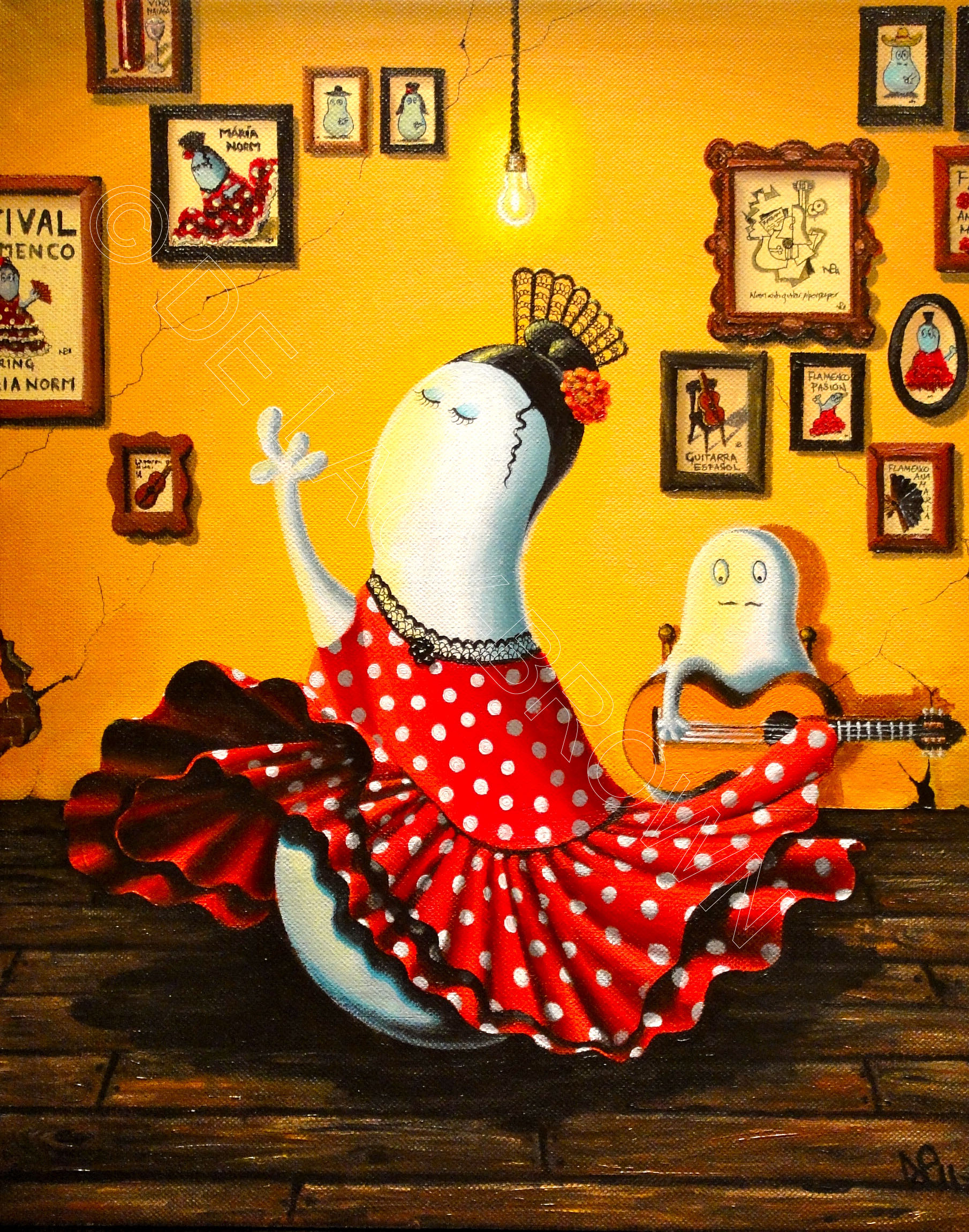
The first next generation Norm is Flamenco Norm. Flamenco Norm is something of a star. She exudes the energetic, impassioned movement of the flamenco, the multiple folds and frills of her polka-dot skirt swirling through the air as her body pulses with the intense and powerful rhythm provided by the guitar player behind her. Her arm is thrust upwards as the energy and spirit of the dance reaches the tips of her twisting fingers, while in her face, her eyes close in the intensity of the moment of duende, when all the raw, almost orgasmic emotions of the dance culminate in a moment of pure, uninhibited passion. Around her, the setting is an old flamenco club like those found in the smallest little villages of Andalucía, where the priority is not in the outmoded decor of the yesteryears, but in the moment of the dance. Hence the walls are starting to bulge and crack, the posters on the wall advertise past flamenco stars, alcoholic beverages and other flamenco paraphernalia, a single bulb hangs from the ceiling lighting only the star of the show, and the wooden floor is battered down by generations of dancing spectacles upon its resonant boards.

Flamenco Norm (2011, acrylic on canvas) © Nicholas de Lacy-Brown

This is not the first time I have been inspired to paint the flamenco. Below is my 2004 painting Duende, painted to a degree in the style of Picasso, the dancer’s face betraying dual emotions as she both fights and indulges in the intensity of emotion rupturing at the moment of duende.
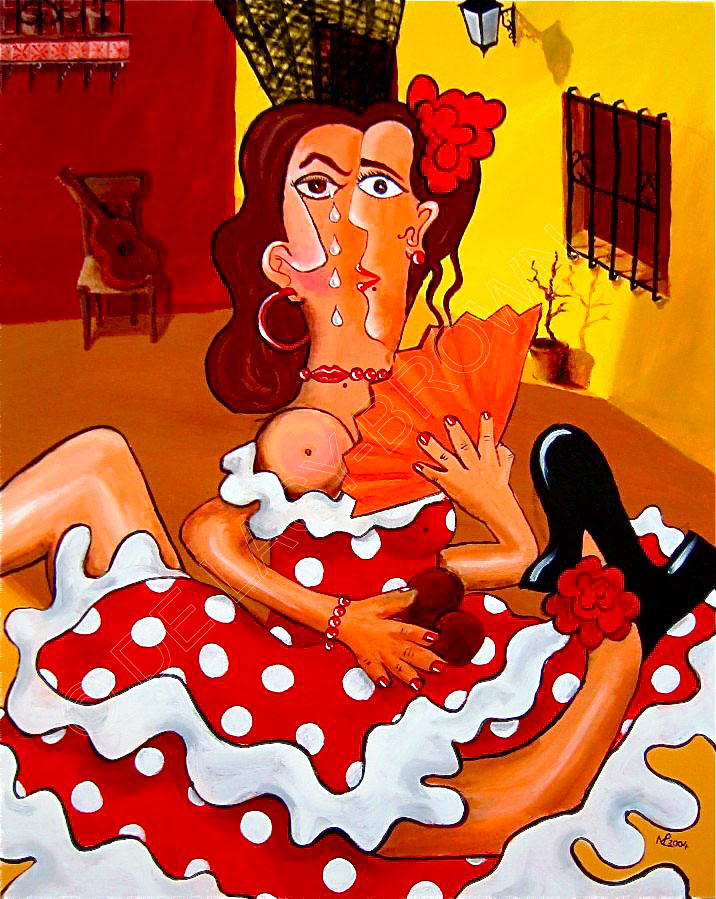
Duende (2004, acrylic on canvas) © Nicholas de Lacy-Brown

© Nicholas de Lacy-Brown and The Daily Norm, 2005-2011. Unauthorized use and/or duplication of the material, whether written work or artwork, included within The Daily Norm without express and written permission from the The Daily Norm’s author and/or owner is strictly prohibited. Excerpts and links may be used, provided that full and clear credit is given to Nicholas de Lacy-Brown and The Daily Norm with appropriate and specific direction to the original content.

The rain in Spain… and other Spanish truisms

There is a common vernacular, made famous no doubt by the mellifluous tones of Audrey Hepburn in My Fair Lady, that the rain in Spain falls mainly on the plain. I beg to disagree. The rain in Spain in fact falls on the coast, over the mountains, outside in the garden and sometimes (because the houses here really aren’t built for the rain), inside. This past weekend,

Rain flowing down the roads in Marbella yesterday

staying on the Costa del “Sol” has been like living under a power shower as the skies bucketed down in a continuous barrage of water. The Spanish tourism industry claim that the Costa del Sol enjoys an average of 300 days of sunshine per year but I doubt that average reflects current trends. Every time I come out to Spain other than in July or August, it rains, torrentially. The houses, with cool interiors and flat roofs are built for the sun, and feel damp and miserable when it’s wet outside. The road drainage is similarly built to cope with occasional showers. Yesterday my mother and I were stranded in a café as rivers of rainwater gushed down the streets, turning the roads into rivers, leaving all those who had not thought to bring wellington boots on holiday (?!) unable to cross. There is a similarly common vernacular in Spain, that all the English flood into Spain to escape “rainy” England. The tables are surely turning, no doubt as global warming takes hold, and in 20 years don’t be surprised to find a barrage of Spanish owned second homes on Britain’s south coast, as the Spanish flee the newly named “Costa del Lluvia” in search of sun! Read more

Norms do… Picasso

Norm with Guitar, Pipe and Newspaper (After Picasso) (2011)

Continuing with the Spanish theme of my current blogs written from the great European peninsula itself, I have decided to focus on one Spaniard who has frequently influenced my own work as an Artist, and countless artists over the last 100 years: Pablo Picasso. The great artist, whose works boast the first, second and third place in the world records for the most expensive art works ever sold, was born very close to where I am currently staying, in Malaga. His works are sometimes divisive, but most universally admired. A few critics bemoan the childlike expression of much of his latter work, but as I have often found, it is in fact much more difficult to paint naively when, like Picasso, it is a natural instinct to paint well. What appear to be haphazard brush strokes are probably the result of many hours or even days of contemplation. The underlying balance which enables us to view a Picasso painting as a satisfied viewer may well have taken an enormous amount of preparation to achieve. In any case, Picasso is not just about eyes found where ears should be, and ears painted somewhere around the sitter’s feet. He was in fact tremendously vital to art history. He took art to new boundaries. He was a key proponent in cubism, and in abstract. He brought us a new, emotionally raw way of portraying lovers, family and other people in his life, opening the doors to the likes of Francis Bacon and his infamously savage, blurred and disfiguring portraits . Moreover, the breadth and variety of Picasso’s career provides us with a significant account of twentieth century history, not least his stunning and deeply poignant portrayal of the Spanish Civil War in Guernica, which continues to stir emotions today as perhaps the boldest declaration against war ever painted.

Read more

Norm Profile: Matador Norm and the beauty of the Corrida

As part of my introduction to the Norms which I’ve painted so far, it is only appropriate, since I write this is sunny Spain, that the first Norm to take the stand is Matador Norm. He’s a popular chap: Used as the principle publicising image of my 2006 solo exhibition “Between Me and My Reflection”, he was one of the first paintings to be sold on the opening night. The buyer (who’s name, of course, I am not at liberty to publicise) is the owner of one of the UK’s most prominent men’s fashion and accessories brands and I was therefore delighted when the sale was made – the buyer obviously has excellent taste! While Norms have always been popular amongst my dedicated art-loving followers, it did not surprise me that Matador Norm had particular appeal. The image, with its warm golden colours, the sparkling costume of the Matador, and a slightly retarded looking bull, all flanked by a curious crowd of spectator norms, combines to illustrate the spectacle of the bullfight which is now synonymous with Spanish culture across the world. Read more

In honour of Hockney: the DigiNorm

So three days into the blog and already I’m jetting off and finding the editorship of a Daily difficult to achieve away from the wireless comforts of the Daily Norm head office. So as I was sat on a flight to Spain today (a few norms in tow, playing dominoes together in my bag) playing with my iPad and finding it ever so slightly limited in airplane mode, I decided to go all Hockney and play with the application ‘Brushes’. Hockney swears by it. He creates (or can one say ‘paints’?) a new iPad painting/picture on a daily basis, sending them round to the lucky few recipients who no doubt pass them on to countless friends who can then boast of having an original Hockney in their inbox. While this poses a justifiable question mark over the value of a digital image which can be mass produced an infinite number of times, it is easy to understand why Hockney loves this new medium – the luminescence of the backlit iPad screen is something which no conventional canvas can boast, no matter how well lit from in front. Hockney recently had an exhibition of his iPad works in Paris, and more will be on show, I gather, in his blockbuster expo at the Royal Academy in the new year. Any how, it was with this in mind that I doodled myself today and have to admit, with a bit of patience, it’s a pretty cool medium, especially in this new digital age. So in advancing the spirit of the Norms’ regeneration in the digital age, I present to you my first iPad painting… The DigiNorm!