Skip to content

Mallorca Map Commission Part 1 – Mallorca and Ibiza

I never made a secret of the fact that I love Cappuccino Grand Cafe, the expanding café restaurant business which has taken the island of Mallorca by storm and is now gradually expanding across the sea to Ibiza, mainland Spain and the Middle East. In fact my love affair with the cafe, which begun in their sumptuous beachside Marbella branch, first manifested itself in my painting of Norms dining at Cappuccino Marbella, a painting which was later featured in their first issue of the Cappuccino Grand Papier, the suitably glossy homegrown publication which was published in May.

Imagine my excitement then when Cappuccino then commissioned me to hone both my artistic skills and my love for the café by illustrating a series of maps of the cafés across Mallorca and its elegant capital, Palma, to be featured in Cappuccino’s second magazine this summer.

Excited, I boarded a plane from rainy England to the sun drenched Balearics at the end of last May so that I could properly research each and every detail of the many Cappuccinos the island has to offer. I’d be lying if I said it was an arduous task, exploring as I was not only the many stunning and unbeatable sites the cafe inhabits across the island, but also sampling their rich and varied continental menu in each location. Full of ideas, I returned home to the UK in earnest, opened up my large drawing board, and got to work.

The finished Mallorca Map (2013 © Nicholas de Lacy-Brown)

The finished Mallorca Map (2013 © Nicholas de Lacy-Brown)

The maps were not easy. The level of detail required to properly represent the various cafe locations as well as the Cappuccino brand and all its food took many painstaking hours of work over a series of several weeks. But I was delighted with the results. Yet despite finishing my maps back in June (and July for Palma – check that one out tomorrow), they’ve been the art world’s biggest unveiled secret until their publication in the Second Edition of Cappuccino Grand Papier this August. And now, finally, I can unveil the maps to you in all their many details.

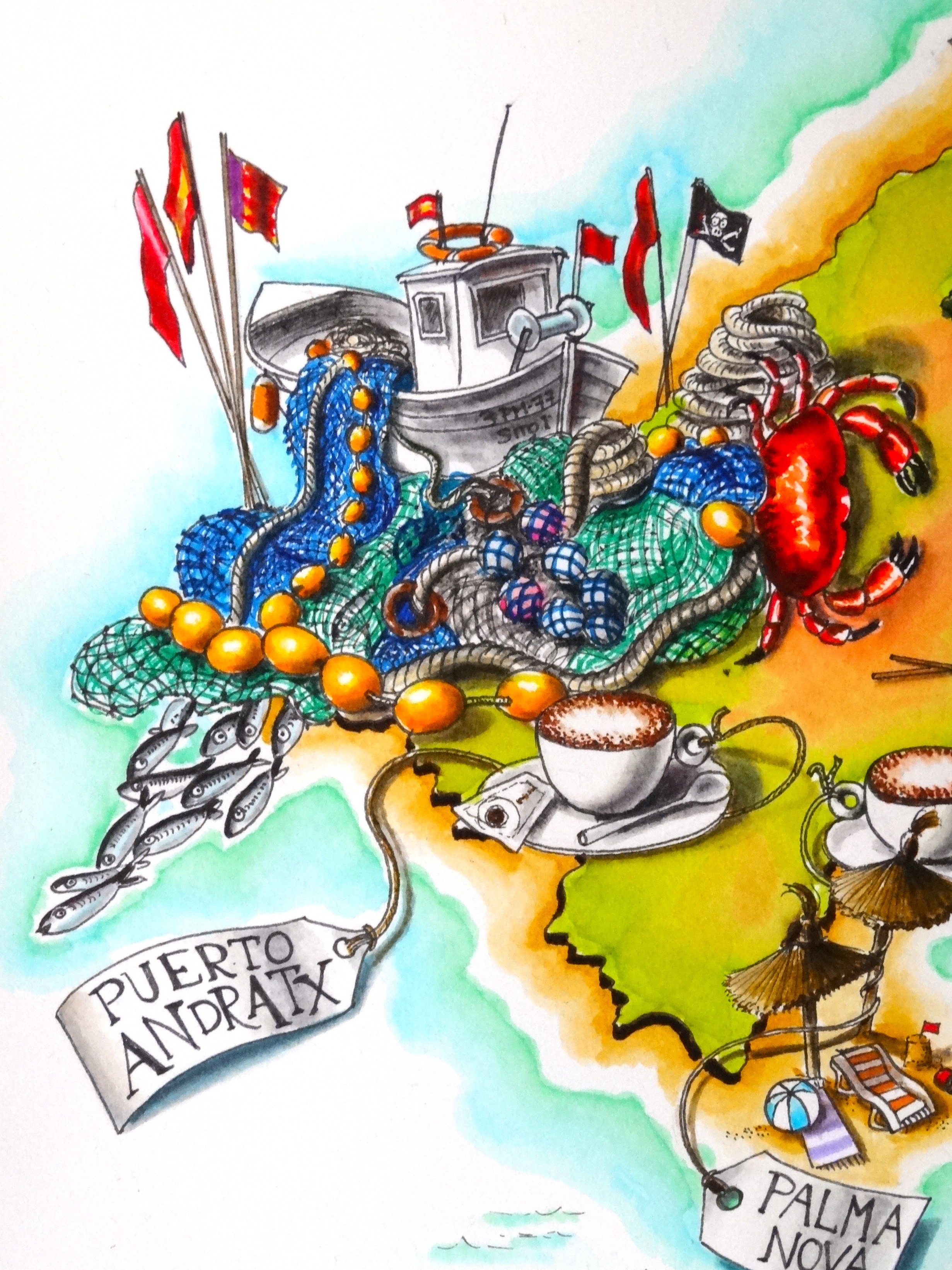
On today’s post I present my map of Mallorca, the idyllic Spanish island from where Cappuccino Grand Cafe was born, and with whom the Cappuccino brand is now synonymous. With branches in the Port of Pollensa, the Port of Andratx, Puerto Portals, Palma Nova, Valldemossa and a great many more in Palma itself, there was plenty of detail to capture on my map. Using icons which characterise the various locations across the island, such as the famous Real Cartuja monastery in Valldemossa (where Chopin and George Sand famously spent a miserable winter), the sumptuous pine trees of Pollensa, and the fishing nets of Andratx’s fishermen’s port, I packed my illustration with both geographical indicators, and of course that all important coffee cup symbolising the location of the cafés.
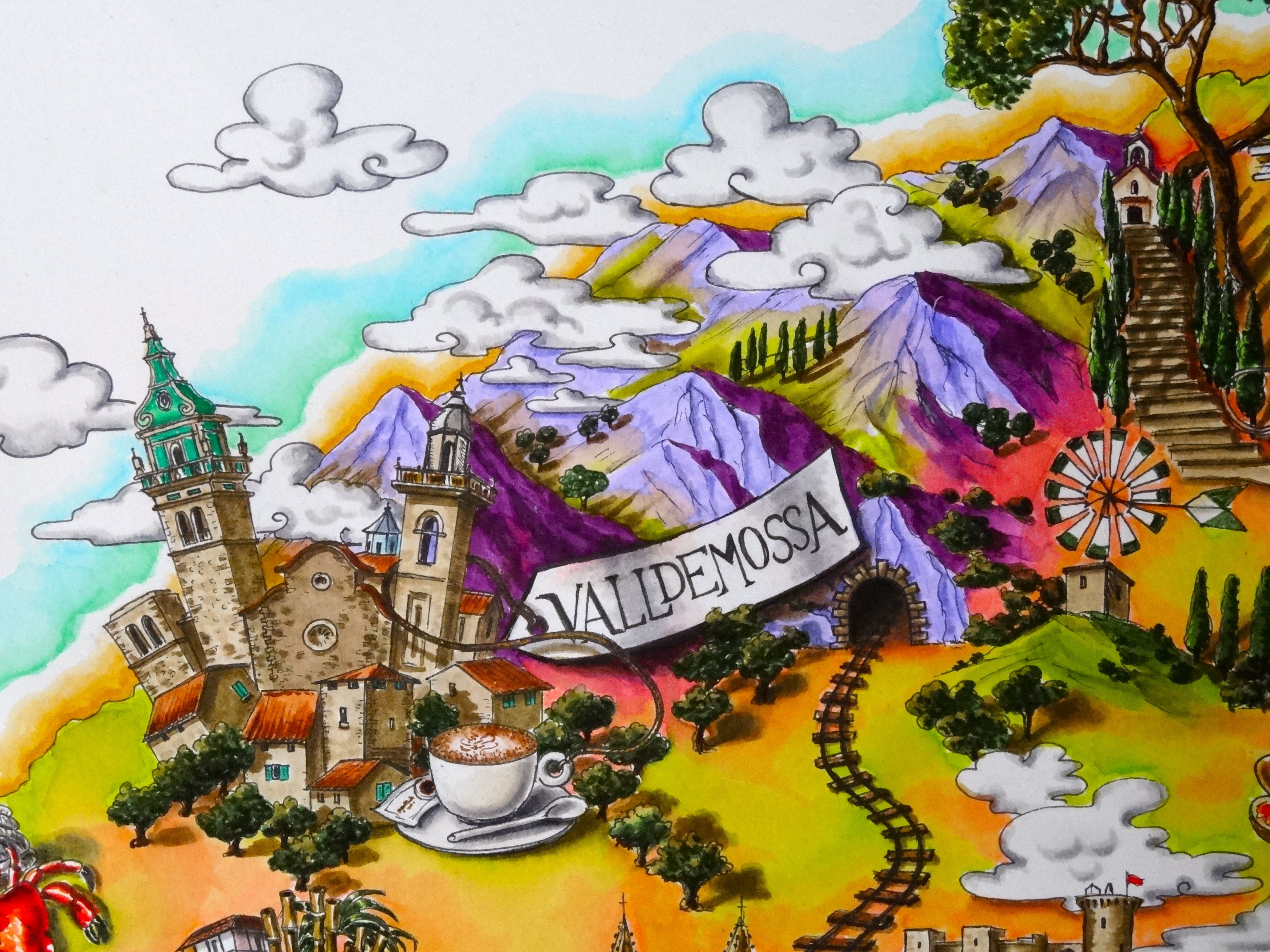
Valldemossa detail
Valldemossa detail

Puerto Andratx detail

Puerto Andratx detail

Puerto Pollensa detail

Puerto Pollensa detail

Palma detail

Palma detail

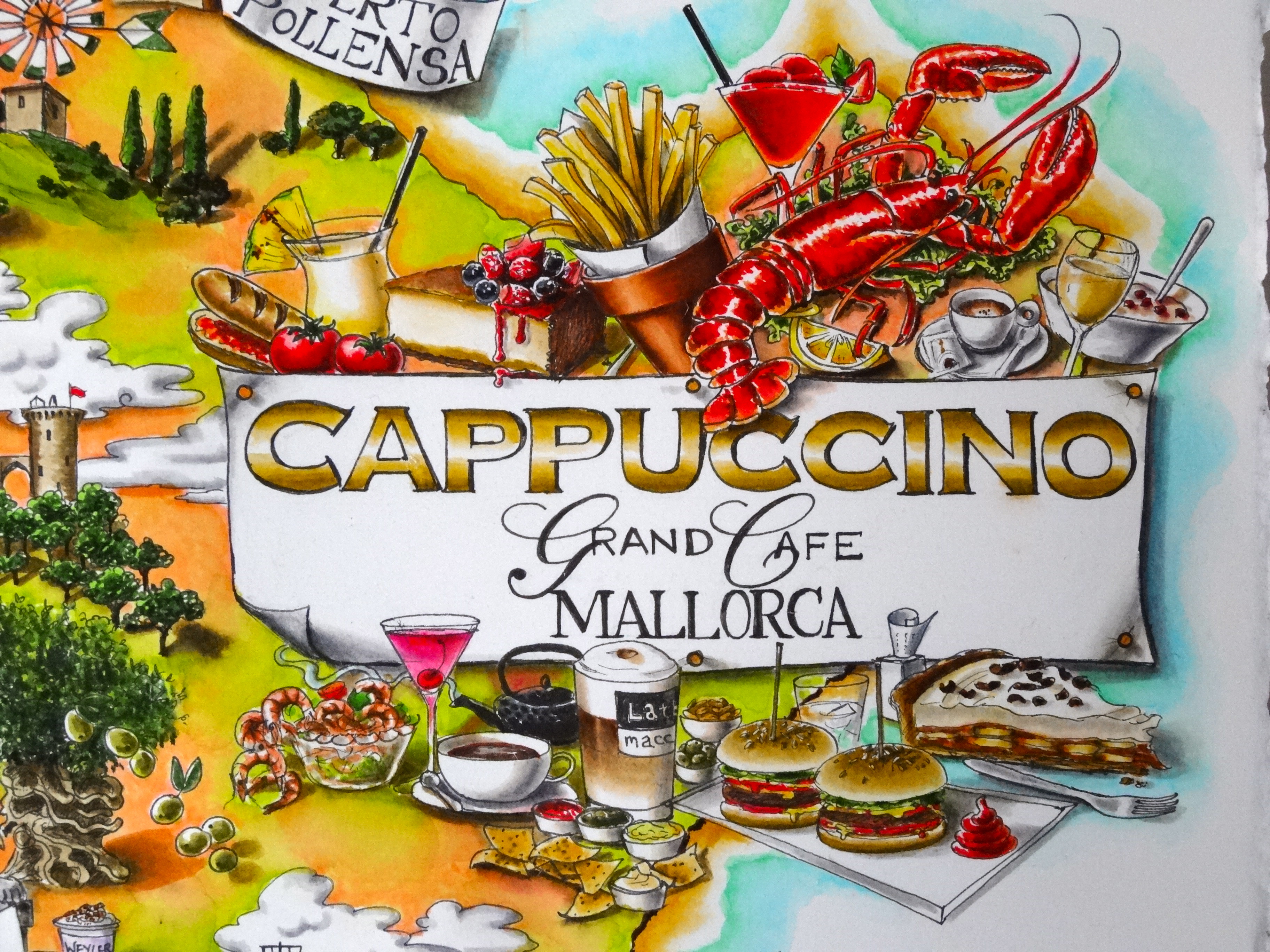
Meanwhile for the map’s title, the brand of Cappuccino is surrounded by a glorious cornucopia of some of the chain’s most iconic offerings, from classic cocktails to its irresistible creamy banoffee pie.
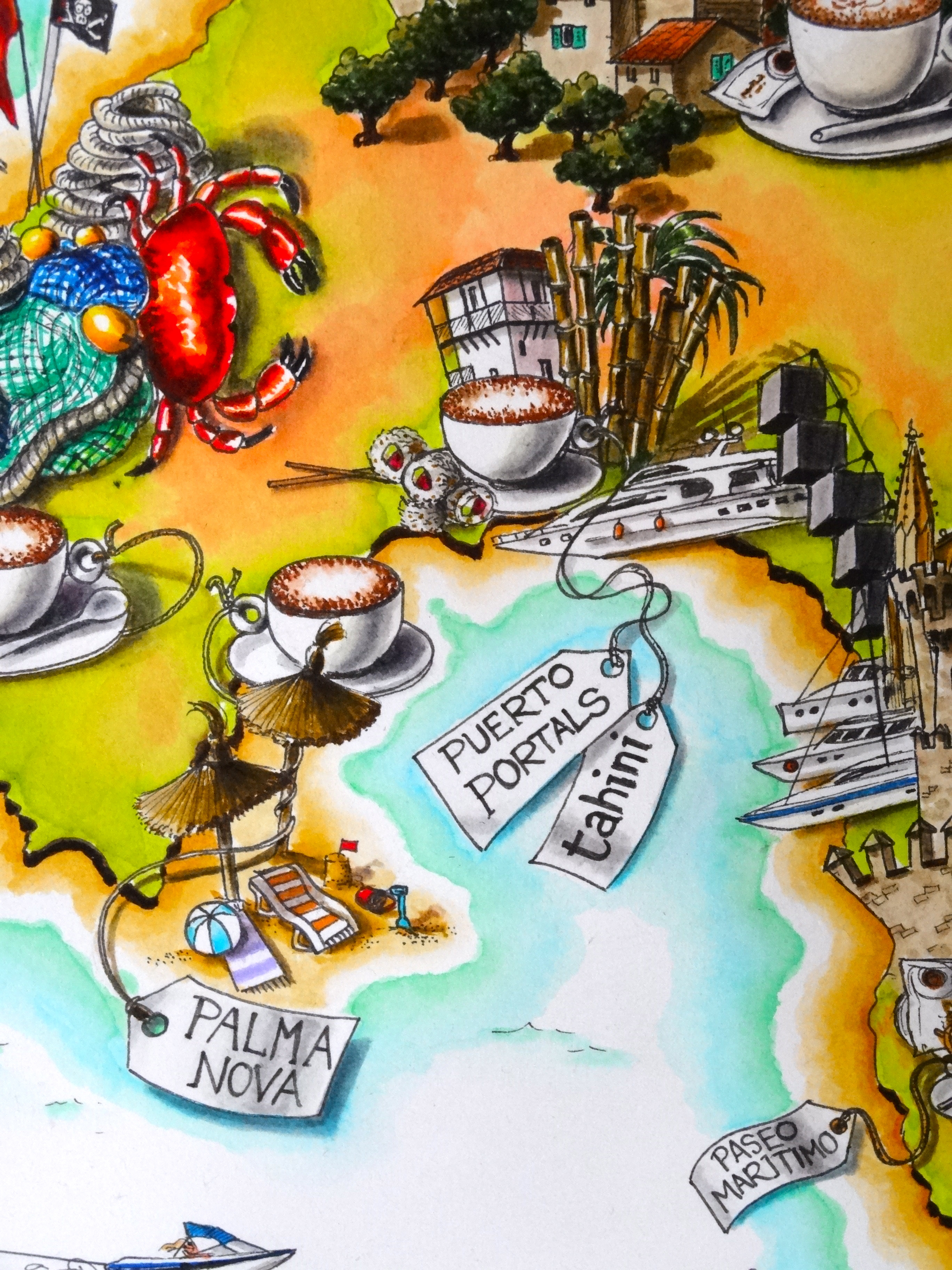
Puerto Portals, Tahini and Palma Nova detail
Puerto Portals, Tahini and Palma Nova detail

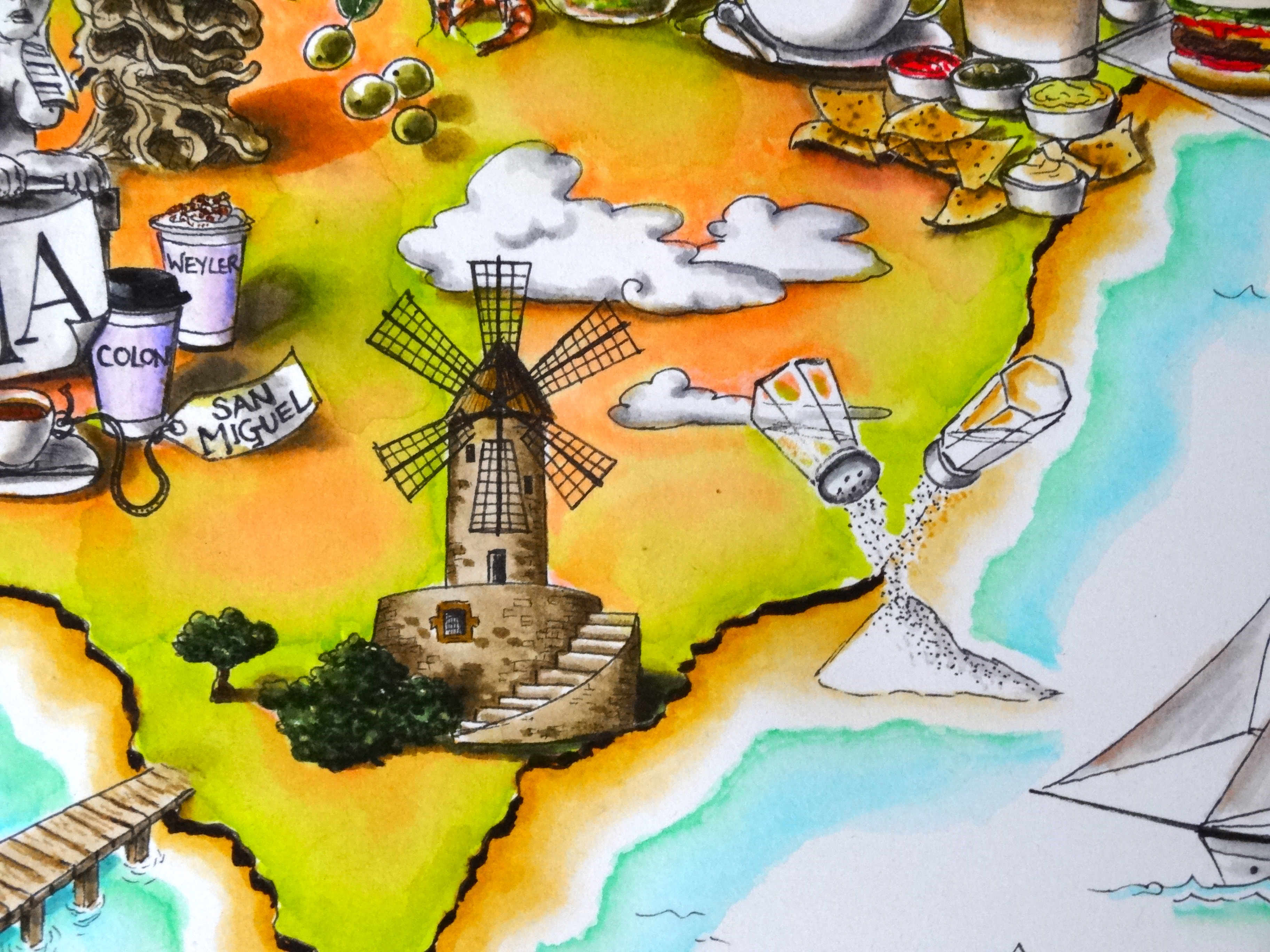
Windmills and sea salt detail
Windmills and sea salt detail

Cappuccino Fusion detail

Cappuccino Fusion detail

And such is the pace of Cappuccino’s current expansion that even while I was designing my map, two new cafes were opened on the nearby island of Ibiza. So a small bolt on map of Ibiza was to follow, including the two new cafes which are perfectly located on the waterside of the island’s stunning Marina Ibiza.

Ibiza (2013 © Nicholas de Lacy-Brown)

Ibiza (2013 © Nicholas de Lacy-Brown)

So without further ado, I leave you to check out the maps. Return to The Daily Norm tomorrow, when I’ll be profiling the second of my Mallorca maps – a focus on the beautiful capital city of Palma. In the meantime, you can see the maps in all their magazine glory in a digital version of Cappuccino Grand Papier. Take some time to flick through – it’s a great magazine!

© Nicholas de Lacy-Brown and The Daily Norm, 2001-2013. Unauthorized use and/or duplication of the material, whether written work, photography or artwork, included within The Daily Norm without express and written permission from The Daily Norm’s author and/or owner is strictly prohibited. Excerpts and links may be used, provided that full and clear credit is given to Nicholas de Lacy-Brown and The Daily Norm with appropriate and specific direction to the original content.

Genius of Geometry: Patrick Caulfield

When I attended the Royal Academy’s Summer Exhibition in 2006, I was completely stunned by an artist to whom the Academy had dedicated a room of its annual summer show: Patrick Caulfield. Born in London in 1936, and died in 2005 (hence the tribute paid to him at the following Summer Exhibition), Patrick Caulfield’s flattened geometric black-lined block coloured works have now become synonymous with the age of British pop-art, although it was a title which Caulfield actually rejected. And he was probably right to. While his works, largely acrylic on canvas, share many of the characteristics of the pop art age (bold colouration, simplified forms, black outlines), pop art promoted and impersonated the commercial world, while Caulfield’s works actually reference art historical notions of representation; from still life to pictorial depth, albeit represented in his characteristic paired down flat colours and simple linear expression.

Early output

Pottery (1969) © The estate of Patrick Caulfield

Pottery (1969) © The estate of Patrick Caulfield

Foyer (1973) © The estate of Patrick Caulfield

Foyer (1973) © The estate of Patrick Caulfield

Café Interior: Afternoon (1973) © The estate of Patrick Caulfield

Café Interior: Afternoon (1973) © The estate of Patrick Caulfield

Wine Glasses (1969) © The estate of Patrick Caulfield

Wine Glasses (1969) © The estate of Patrick Caulfield

Battlements (1967) © The estate of Patrick Caulfield

Battlements (1967) © The estate of Patrick Caulfield

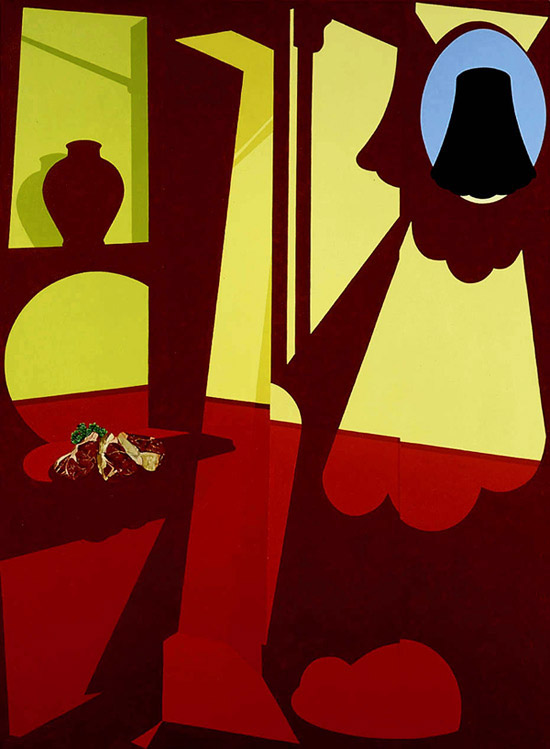
Dining/ Kitchen/ LIving (1980) © The estate of Patrick Caulfield

Dining/ Kitchen/ LIving (1980) © The estate of Patrick Caulfield

It only took one glance that summer of 2006 at the perfectly painted lines and faultless application of block colours used artfully to depict rooms and places, café scenes and still lifes to know that I was completely in love with Caulfield’s works. While I adored the sparse simple images of his 1960s work, my real admiration was reserved for the knockout creations of the mid 70s, when Caulfield started to play with styles, integrating into his then renowned geometric works hints of trompe l’oeil photorealism. So in works such as Dining/Living/Kitchen for example, Caulfield paints a scene characterised by black outlines, block shadows, dispensed brushwork and anonymous handiwork and inserts into it a casserole dish so perfectly represented that you would swear a photo had been collaged onto the background. This technique is used with spectacular success in After Lunch, where the window (or is it a picture hanging on the wall?) looking onto an Austrian landscape is photorealistic to an awe-inspiring standard, while in Happy Hour, the wine glass at the painting’s centre actually reflects in its sheen a realistic depiction of the bar which, elsewhere in the painting is only represented with paired down flattened forms. Absolutely brilliant.

Tromp L’oeil brilliance

Happy Hour (1986) © The estate of Patrick Caulfield

Happy Hour (1986) © The estate of Patrick Caulfield

After Lunch (1975) © The estate of Patrick Caulfield

After Lunch (1975) © The estate of Patrick Caulfield

Still Life Autumn Fashion (1978) © The estate of Patrick Caulfield

Still Life Autumn Fashion (1978) © The estate of Patrick Caulfield

Interior with a Picture (1985) © The estate of Patrick Caulfield

Interior with a Picture (1985) © The estate of Patrick Caulfield

Second Glass of Whisky (1992) © The estate of Patrick Caulfield

Second Glass of Whisky (1992) © The estate of Patrick Caulfield

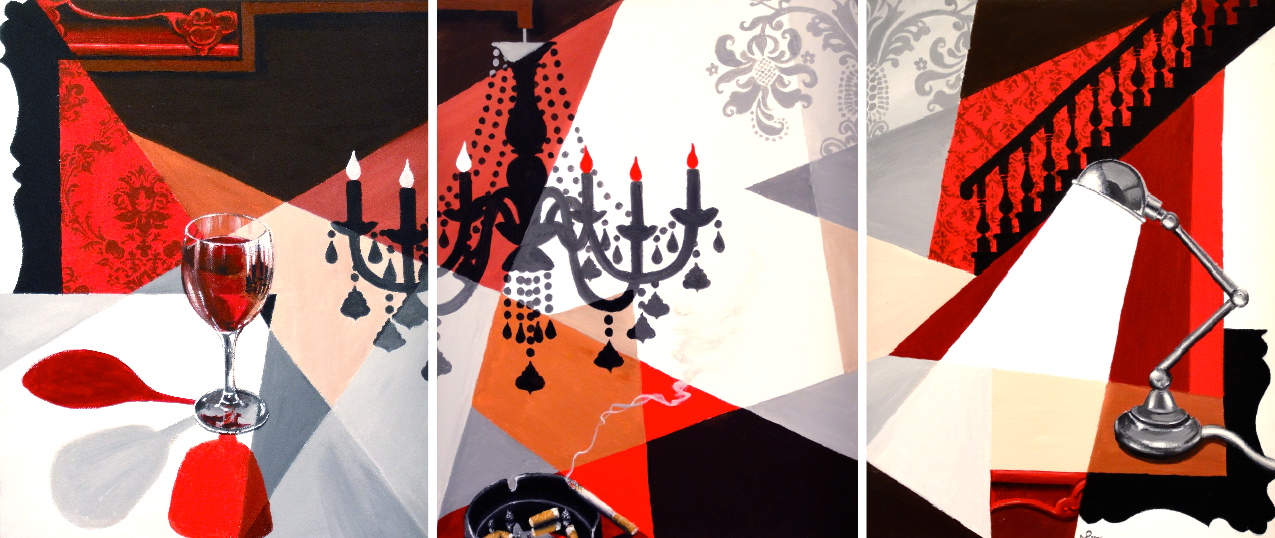
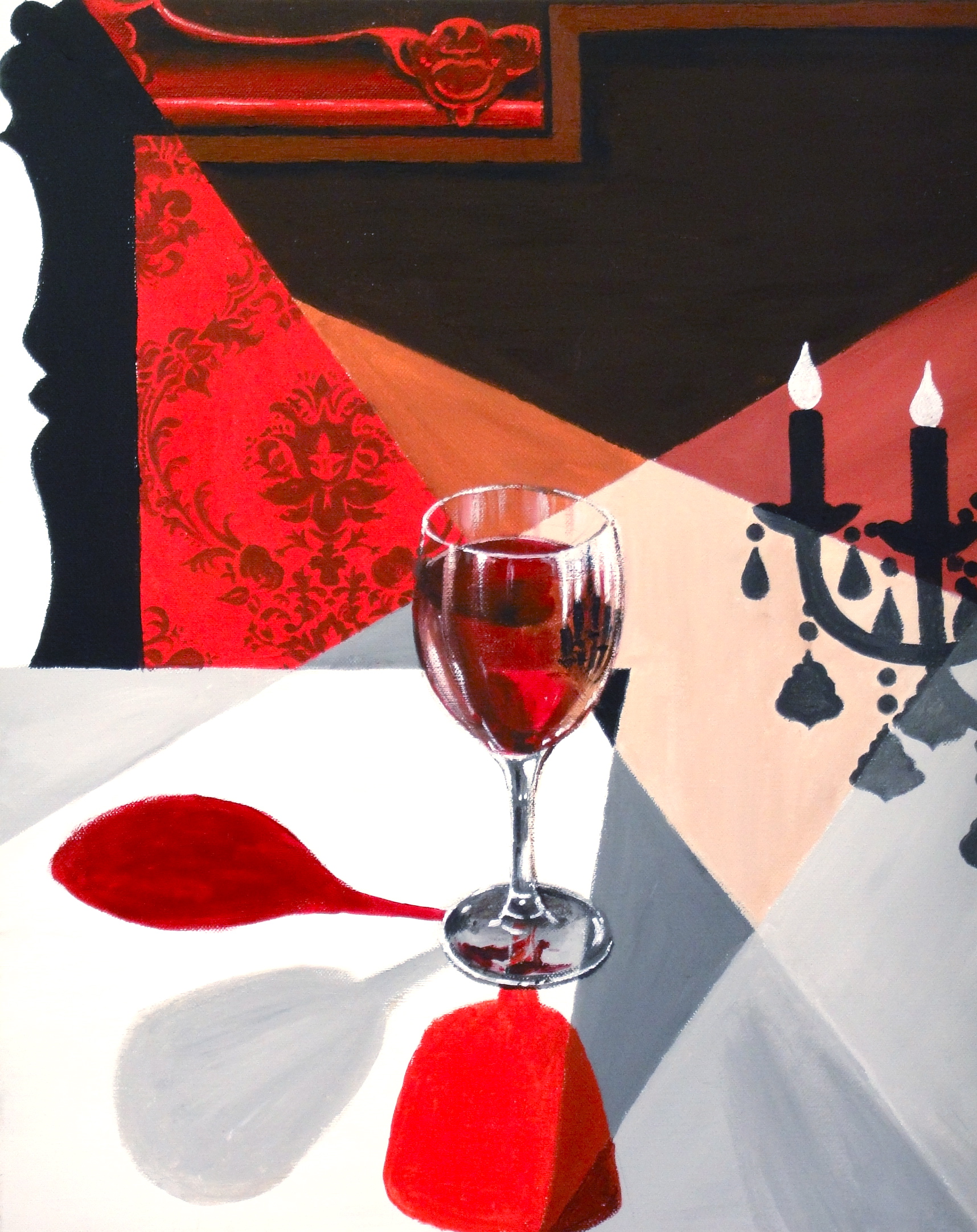
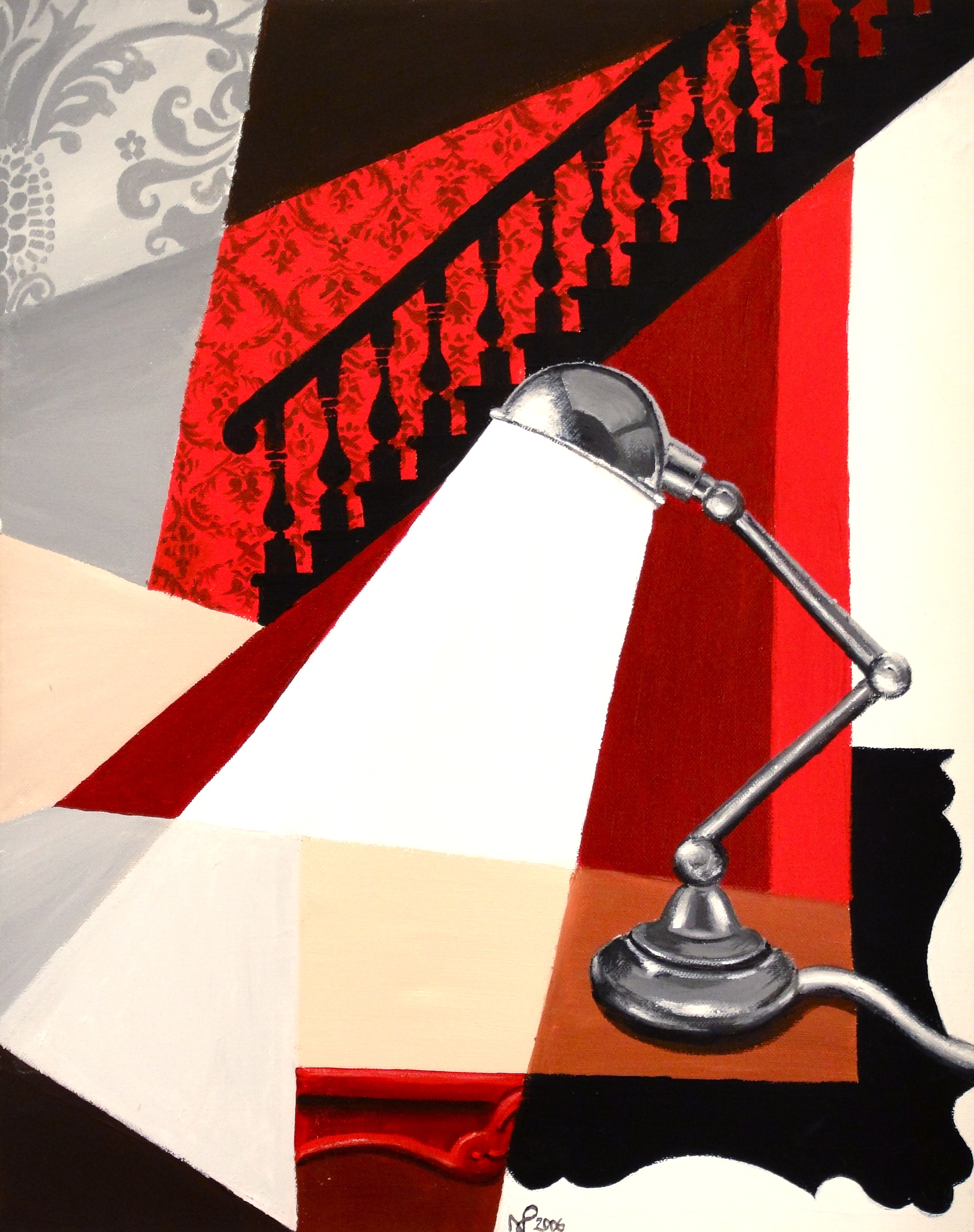
Caulfield’s work not only thrilled me; it also inspired me. I am much indebted to the influence Caulfield had upon my own work – my painting Vintage Q, painted that summer immediately after seeing the RA show, is directly inspired by Caulfield’s technique, while Q4 and Q5, which followed suit, are likewise. Meanwhile, I think much of the interior design I put into place around my apartment flows directly from his mix of contemporary block colours, and interlaced with hints of rich, detailed damask patterns.

Later works: light and shadow

Room 3-95 (1995) © The estate of Patrick Caulfield

Room 3-95 (1995) © The estate of Patrick Caulfield

Trou Normand (1997) © The estate of Patrick Caulfield

Trou Normand (1997) © The estate of Patrick Caulfield

Bishops (2004) © The estate of Patrick Caulfield

Bishops (2004) © The estate of Patrick Caulfield

Hedone's (1996) © The estate of Patrick Caulfield

Hedone’s (1996) © The estate of Patrick Caulfield

Rust never sleeps (1996) © The estate of Patrick Caulfield

Rust never sleeps (1996) © The estate of Patrick Caulfield

Fruit display (1996) © The estate of Patrick Caulfield

Fruit display (1996) © The estate of Patrick Caulfield

So for that reason alone, Caulfield has always stuck in my mind, but imagine my delight when this summer, a solo show held at Tate Britain afforded me the opportunity to see Caulfield’s works all over again. In 5 exquisite galleries, a comprehensive selection of Caulfield’s works took us from his most simplistic 60s creations (a simple grey well reduced to flattened, even more simplified forms; a bend in the road, some castle battlements (above) and so on), to his brilliantly innovative 70s works, where trompe l’oeil dazzles the senses and shines amongst the flatter planes of the large-scale block colour canvases, and then onto the 80s and beyond, when Caulfield began to experiment more with light and shadow, not focusing so much on the thick outlines of black, but expressing an object with shadows and throwing light, albeit in block-colour form.

My works: inspired by Caulfield

Vintage Q (2006 © Nicholas de Lacy-Brown)

Vintage Q (2006 © Nicholas de Lacy-Brown)

Vintage 1 NEW 2011 Vintage 2 NEW 2011 Vintage 3 NEW 2011

Q4 (2007 © Nicholas de Lacy-Brown)

Q4 (2007 © Nicholas de Lacy-Brown)

Q5: Chez Helen (2008 © Nicholas de Lacy-Brown)

Q5: Chez Helen (2008 © Nicholas de Lacy-Brown)

I realise that in writing this review, I am somewhat missing the boat, seeing as the Caulfield show at Tate ended last weekend. But that is no reason why the genius of this brilliant artist should not be applauded to the full – an artist who took 60s simplification in an altogether more mentally complex direction; whose works have become iconic in the chic interiors of London’s cool hotels and boutiques; and whose images have been fundamental in shaping my own creative output as an artist.

Marbella Twenty-Thirteen | Favourite Photos

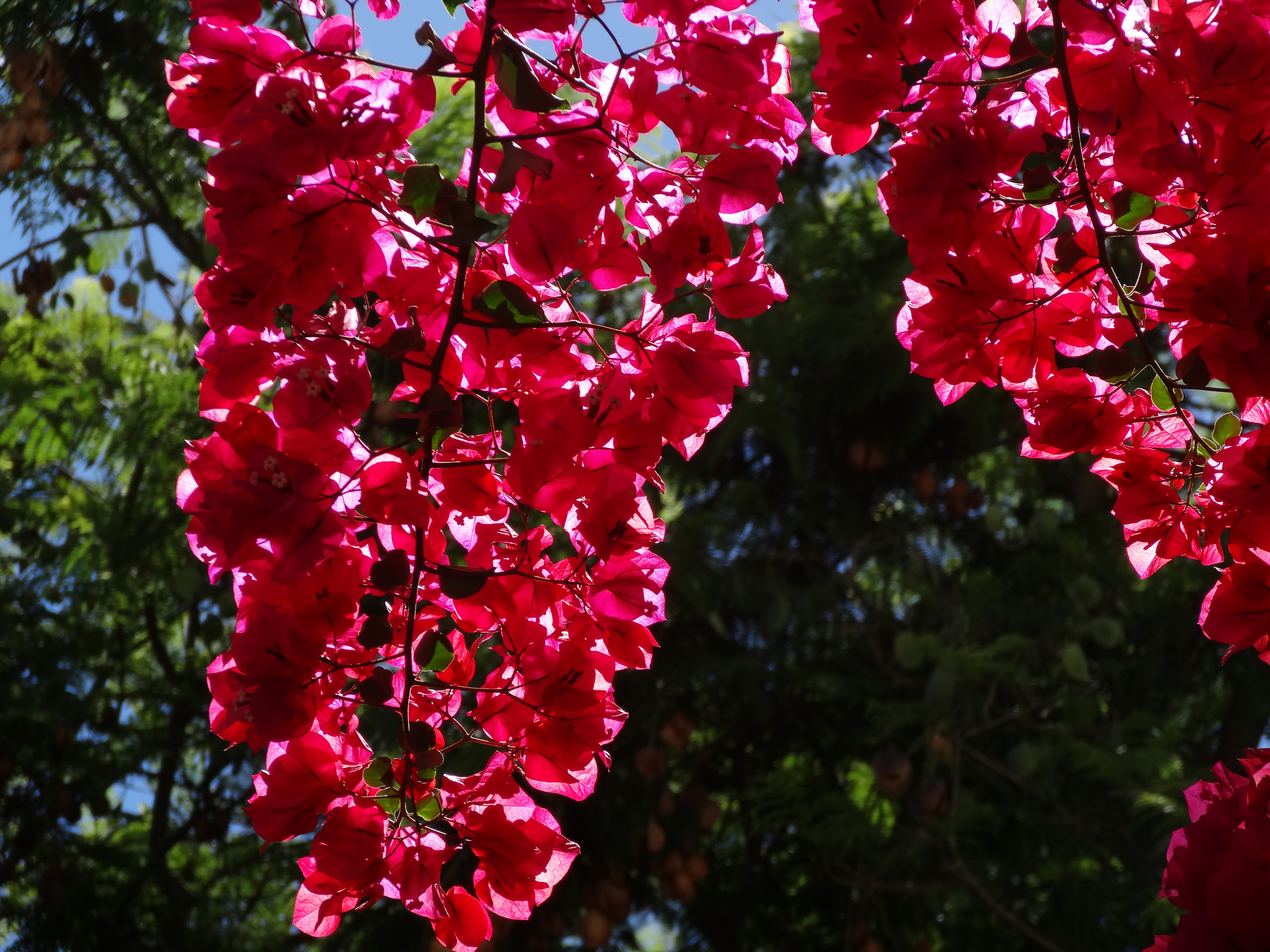
As my Marbella season comes to an end, and the third of my summer-time travel tripartite waits eagerly in the wings for Daily Norm exploration  (yes, Poland is on its way…!) I wanted to end this series of Summer Spain posts, as I so often do, with a series of some of my favourite miscellaneous photos. Like always, these photos really are a hodgepodge selection, from beautiful stained-glass butterflies and fuchsia pink bourganvilla, to crazy curly street lamps and olive oil bottles glinting in the sun. I love the smaller details which have been captured in this set, such as the tiny little yellow ladybird who appeared like a birthday good luck charm on my 30th when I sat sipping champagne by the sea; and the amazing black and white polka dot body of that incredible butterfly whose startling orange wings glowed like a light suspended in midair when caught by the rays of the sun. But some of these photos also capture wider planes and more general atmospheres, such as the cafe scene in orange square and that fatty delicious churros I ate on my birthday.

DSC05481 DSC06467 DSC05557 DSC05619DSC06560

As ever these are a set of photographic memories which I will always cherish as something to look back on in the privacy of my own home, but which are somehow all the richer, for my being able now to share them with you. Enjoy.

All photos and written content are strictly the copyright of Nicholas de Lacy-Brown © 2013 and The Daily Norm. All rights are reserved. Unauthorized use and/or duplication of the material, whether written work, photography or artwork, included within The Daily Norm without express and written permission from The Daily Norm’s author and/or owner is strictly prohibited. 

Composition No. 9: Ojén Rooftops

I’ve always loved terracotta tiled roofs, for the same reason I suppose that I love palm trees and the chirping sound of cicadas in the heat – because they remind me of the Mediterranean, of the sunshine, of the summer. And is there a sight more conceivably Mediterranean than a little hill top village, a cluster of white washed walls when seen from the side, and a angular hodgepodge of terracotta roofs when viewed from above?

It was exactly this kind of collective village feel that I tried to emulate when I moved onto my 9th gouache composition in the dying days of my Spanish holiday, and having visited the hilltop village of Ojén up in the mountains behind Marbella. The lower section of the village, when seen from the upper road which cuts through its centre makes for a rather breathtaking spectacle; its terracotta roofs uniform apart from the odd turquoise ceramic exception; this consistent sea of peachy-red marking a wonderful contrast against the undulating hillsides which form a backdrop against the village, rolling steadily down the mountain as they fade outwards towards the sea. I was particularly enamoured by the hills around Ojén, not least because, whether it be by reason of agriculture or just because of the natural lie of the land, the hillsides appeared to be almost spotty on the one hand with olive trees, like the polka dot traje de flamencas of the flamenco dancers, and crossed with horizontal stripes on the other.

Composition No. 9: Ojén Rooftops (2013 © Nicholas de Lacy-Brown, gouache on paper)

Composition No. 9: Ojén Rooftops (2013 © Nicholas de Lacy-Brown, gouache on paper)

Naturally I couldn’t resist but reflect these patternings in my latest gouache composition, the likes of which I present, fresh from my artist’s sketchbook, terracotta roofs (and those odd turquoise exceptions) included. I hope you like it.

© Nicholas de Lacy-Brown and The Daily Norm, 2001-2013. Unauthorized use and/or duplication of the material, whether written work, photography or artwork, included within The Daily Norm without express and written permission from The Daily Norm’s author and/or owner is strictly prohibited. Excerpts and links may be used, provided that full and clear credit is given to Nicholas de Lacy-Brown and The Daily Norm with appropriate and specific direction to the original content.

Marbella Twenty-Thirteen | Ojén

When I think Andalucía, I think narrow white washed streets clinging to steep mountain sides; seas of terracotta tiled roofs jostling for space in a crowded maze of twisting ancient streets; houses almost spilling from inside out, as residents take to sitting outside in the cooler evening air; and those white washed walls being intermittently punctuated by rich floral sprays such as the vivid pinks of brugmansia and the fragrant perfume of jasmine. And while Marbella, the location of my ultimate of August holidays, has its fair share of white washed wonders collected together in the winding cobbled streets of its stunning old town, it’s the little hilltop Andalus villages which for me characterise the very epitome of Southern Spanish charm.

So to discover these little hilltop gems one has to leave Marbella, and the sprawling Costa del Sol behind, but this isn’t exactly easy to do for the likes of me who has no car – the Costa, unbelievably is not on the Spanish train network, and the destinations served by the local bus service are limited. Happily however, there is one exception to this sorry state of transportation – every few hours, a bus leaves from Marbella centre and makes the 30 minute journey, up into the mountains, to the nearby hilltop village of Ojén, home to none other than Julio Iglesias himself.

Scenery from Marbella to Ojén

DSC06308 DSC06316 DSC06330

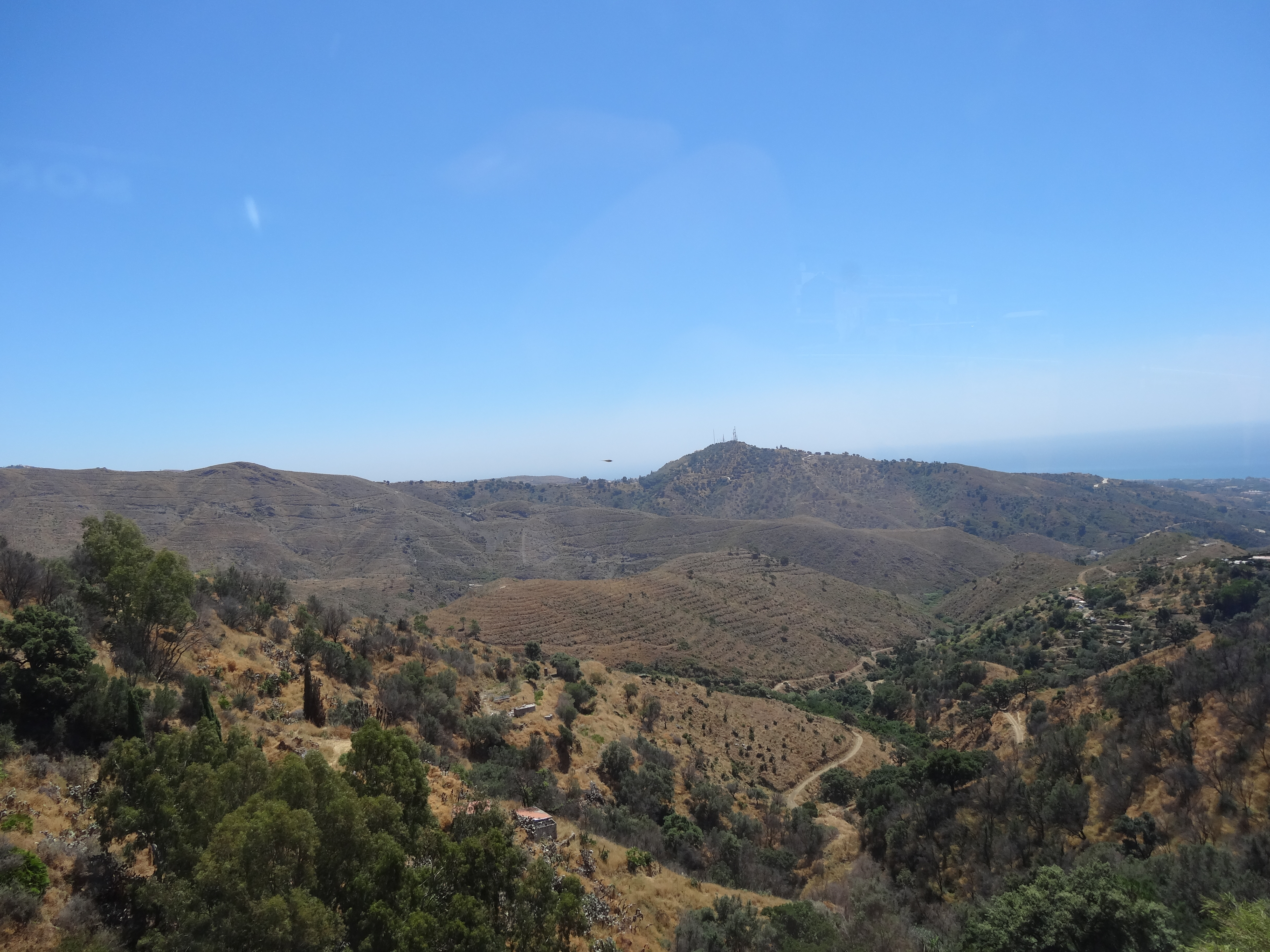
As soon as you leave Marbella’s centre and begin to ascend the main road into the Sierra Blanca mountain range which rises so prominently behind the town, you notice the scenery begin to change. As the bus descends and the road skirts the steepening mountain sides, the landscape opens up before you so that urban dwellings are replaced by vast ochre planes, their rocky arid topography punctuated by olive trees and the odd cypress. At this time of year the landscapes are particularly dry, but this year they retain the black charred scarring which a devastating forest fire caused last year when it spread across the planes of Andalucía. This does nothing to distract from the beauty of the landscape however, whose slopes and pastures meander and undulate downwards towards a stunning view of the Mediterranean sea and Marbella some 1000 metres below.

A few minutes of winding roads later, and the little village of Ojén appears. Home to around 1000 people, it is a cluster of dazzling white set against the ochres and browns of the surrounding hillsides. Those hillsides are reflected in the streets and homes of the village which, in places, appear to be almost precariously clinging to the hillsides and near vertical angles, the stone sloping streets following suit and making a climb upwards under the midday sun a challenging prospect. But my goodness me, what a gem of a town this is – a magical collection of Andalucía’s best – those white washed houses and little tiled roofs, old woven chairs left outside tiny town houses, windows open in a vain attempt to catch a little breeze.

Perhaps the highlight of this town is the central square, surrounded by little bars and a tiny church at its centre, the baking marble pavements cooled slightly by the sound and spray of trickling water from a large fountain which remains remarkably cold even in the average 40 degrees of a typical summer’s day. It was there that my partner and I headed one lunchtime, braving the heat in order to recapture a moment we had enjoyed in the village a few years before, when we ate a plate of Spanish ham in the cheapest of cafes, but whose flavour was so intensely salty and rich that no tapas has lived up to it since. This time round, the ham did not disappoint, and basking in the almost oven-like heat of the square, we revelled in the soft melting fat and unctuous meaty texture of that ham, washed down with a small cerveza, some bread and olives. Surely as typically, simply delicious as Andalucía gets.

DSC06343 DSC06345

I leave these reflections with some photos from the day; a collection of images straight from the heart of Andalucía.

All photos and written content are strictly the copyright of Nicholas de Lacy-Brown © 2013 and The Daily Norm. 

Marbella Twenty-Thirteen | Puerto Banús

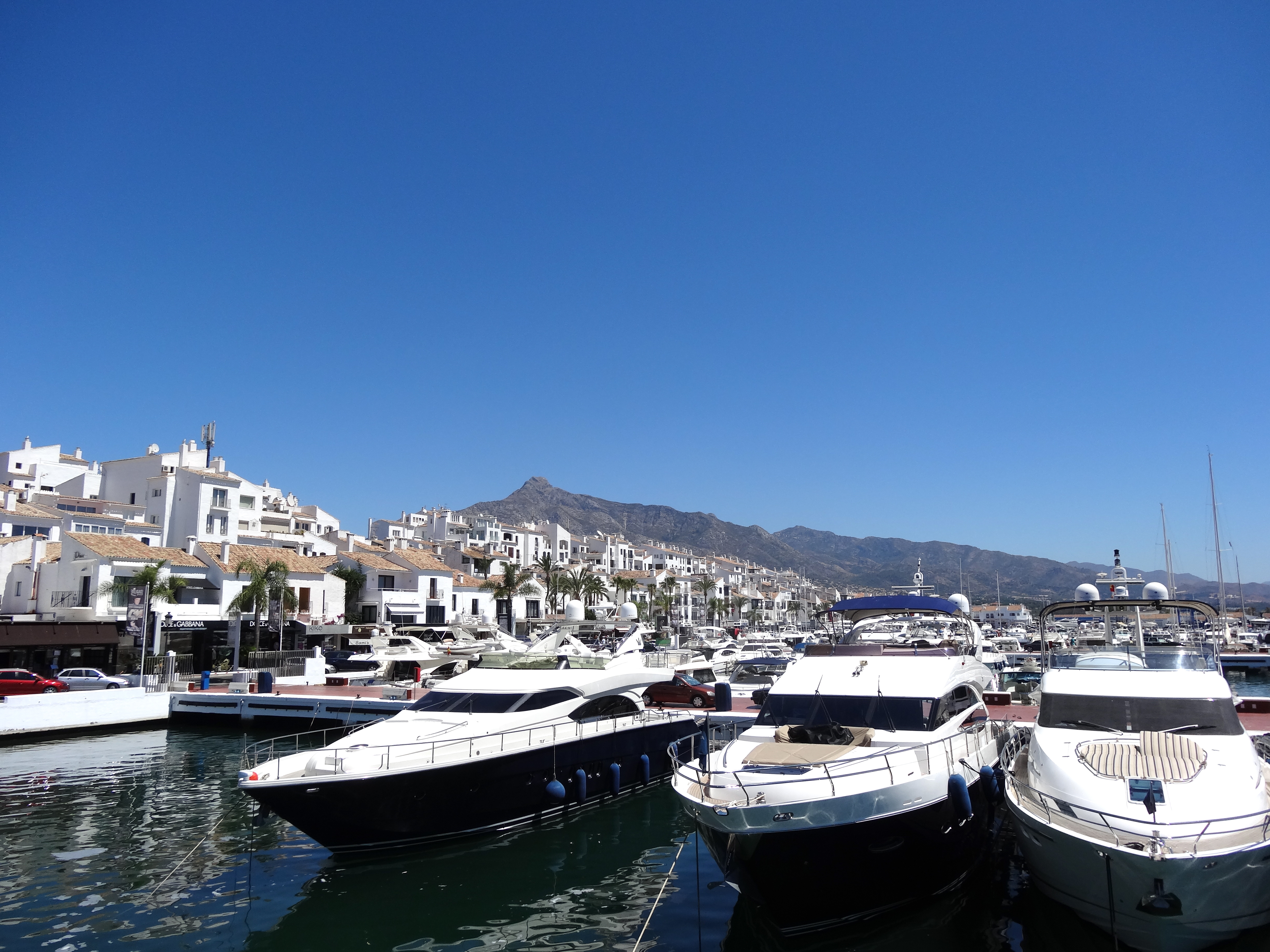
While Marbella is pretty much famous throughout the world for its richer, glitzier suburb marina of Puerto Banus, about 10km along the coast from the centre, the port, which houses the big gaudy yachts, the high end fashion boutiques and the boy-toy roof-off sports cars is far removed from the true Marbella, which at its heart has a gem of an old town, and in the streets around it extends a charm of a bustling Spanish town, but one which has authenticity and a feel of Spanish community running through its every vein. Puerto Banus is a different kettle of fish altogether. If superficial needed a dictionary definition, Puerto Banus would be it. Constructed from scratch in the late 1960s by Jose Banus, and opened at a lavish 1970 gala with attendees such as Grace Kelly, then Princess of Monaco present, the port very quickly became the favourite destination of the jet set and those with plenty of cash to splash. Today, the port retains its self-indulgent character, albeit that the occupants have probably become richer, and almost certainly tackier, with their fake bodily parts, hideously botoxed blown-up lips, overly worked tans and hair extensions. The lack of taste in the place really does grate, and after an hour or so amongst the nouveau riche, I am rarely happier to get back to the Andalus authenticity and charm of Marbella’s old town.

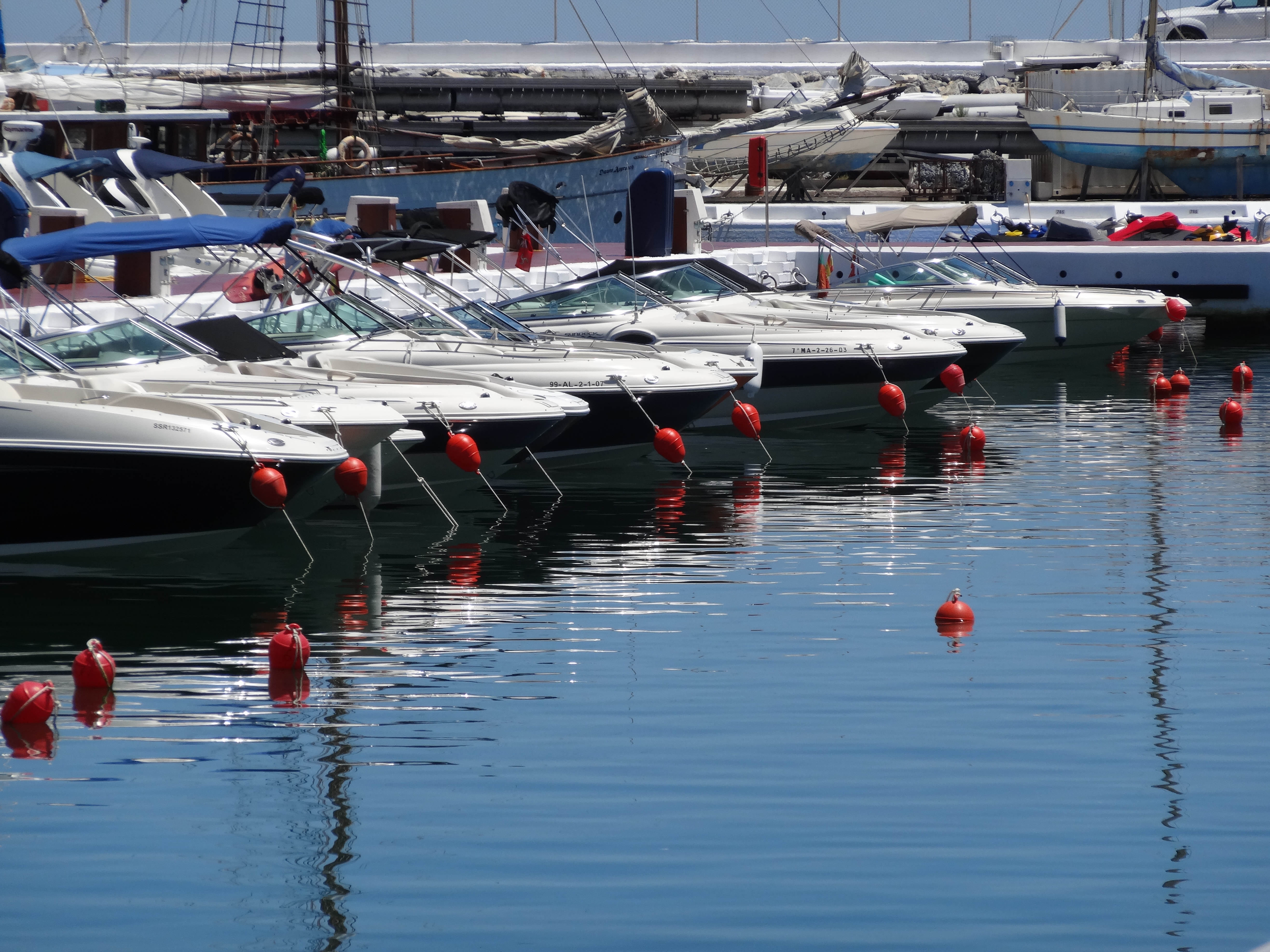
Taking the boat from Marbella to Banus…

Marbella's port

Marbella’s port

DSC05632

The catamaran taking us to Banus

The catamaran taking us to Banus

IMG_4075

But get away from the tacky masses, and block out the drones of Essex accents and other unsavoury lingos, and the fact remains that Puerto Banus, built in a uniform dazzling low-rise white, with similarly sparkling white yachts before it and the stupendously beautiful Marbella mountain rising up behind it, is really very beautiful. And there is no better way to approach the port and therefore regard it from a safe distance in all its peopleless beauty than to take a boat from Marbella’s slightly less salubrious marina, to Banus. At the cost of only 8 euros one way, it’s almost the same price as a taxi, but the trip affords stunning views of the Marbellan coastline, reminding passengers of just why the town was named “Sea Beautiful”.

Puerto Banus in all its glory

DSC05679 DSC05685 DSC05674 DSC05663 DSC05672

Once in Puerto Banus, a few restaurants round the corner from the main boutique-filled thoroughfare enable quiet al fresco dining with a stunning port-side location, while just outside of Puerto Banus, in the stretch between Banus and Marbella are situated some of the most stunning, tranquil and quiet beaches in all of Marbella. So when my partner and I headed to Banus by boat this summer, we were surprised how much of an enjoyable experience we could extract from a Port which we have formerly declared a no-go zone. Not only did the lunch trip and the boat over afford us stunning views of the marina and the coast, but our return journey provided us with the most beautiful vistas of them all. Because for those with the energy and the appetite for a long walk, the walk on foot, along Marbella’s amble seaside-promenades from Banus back to the centre of Marbella, is undoubtedly the most stunning walk to be had on all of the Costa del Sol. While it takes a good 90 minutes without stopping, and longer when you stop to take advantage of the tranquil beaches and the well-situated seaside cafes, the path takes you past bounteous plump cacti, extravagant private villas, luxury hotels and quiet beaches which resemble something out of paradise. The walk is in fact so close to my heart that a couple of years back it inspired me to paint “Paseo Banus” (see below).

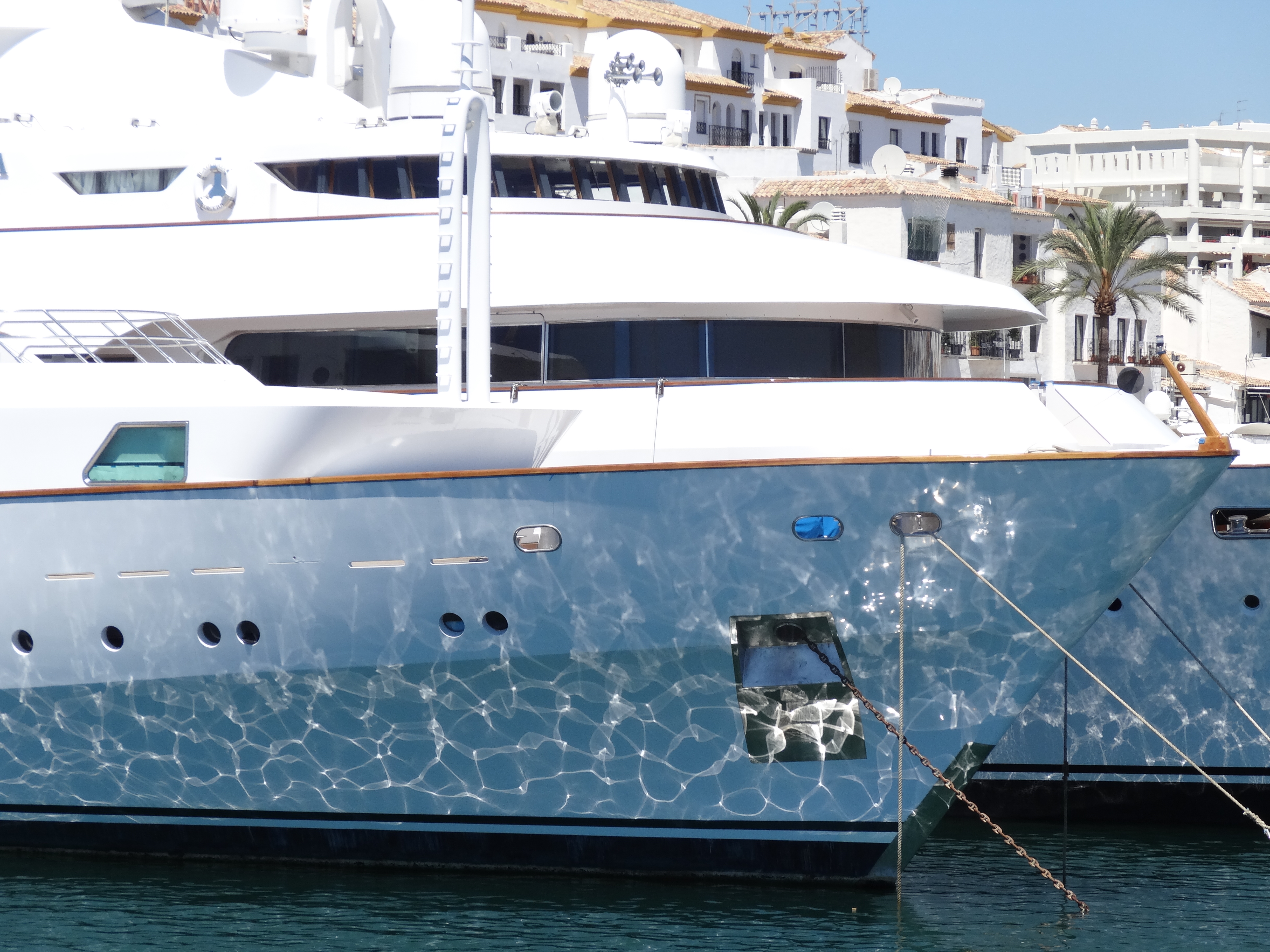
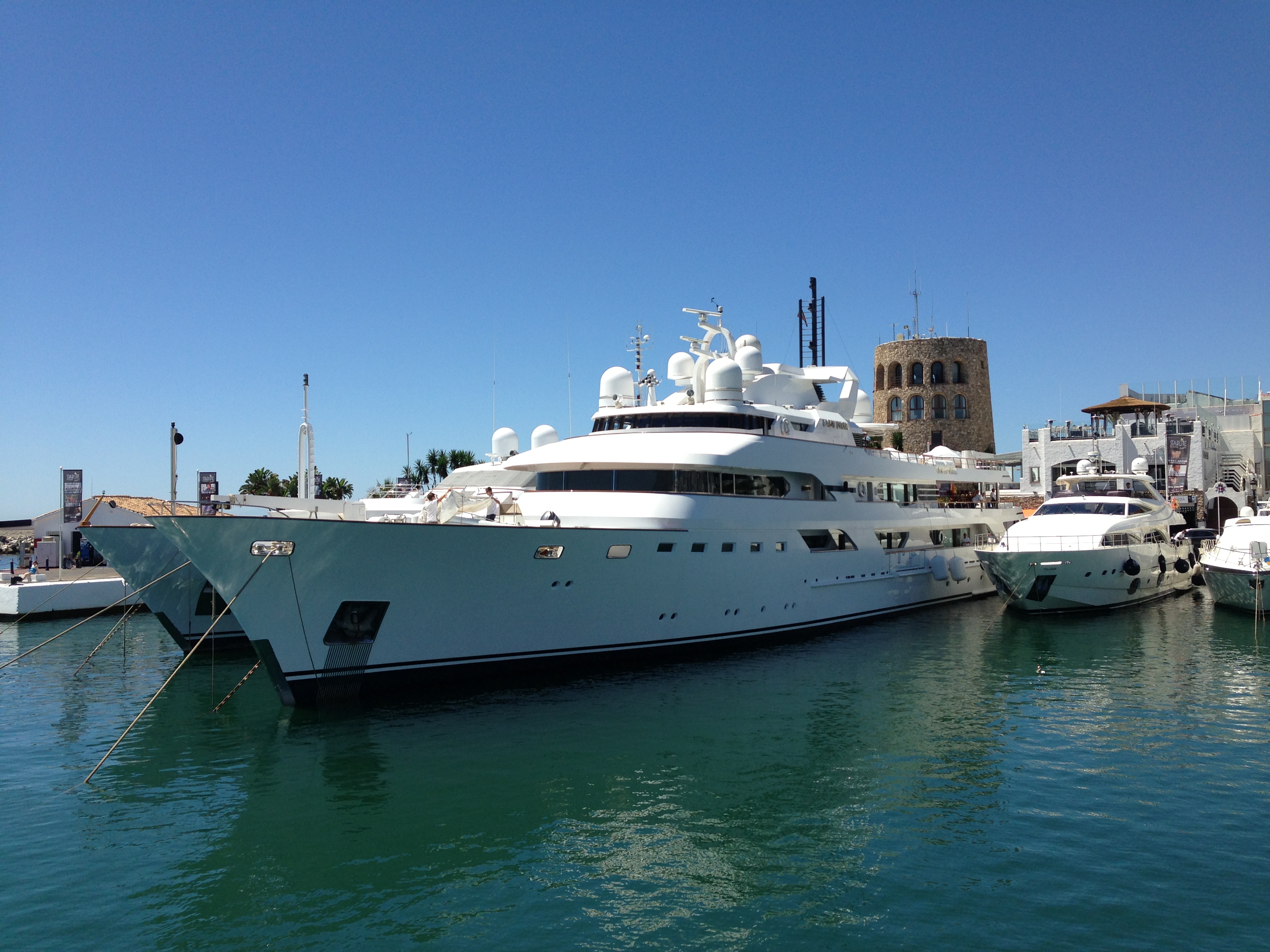
The famous Banus yachts

DSC05657 IMG_3586 DSC05662 DSC05687 DSC05669

The photos which you now see are from our trip to Banus, and the stunning walk home to Marbella’s centre which followed. Our walk probably took around 3 hours by the time we had stopped off at our favourite café Cappuccino Grand Café (and on another occasion Ibiza’s favourite – Café del Mar) and also spent a good hour dipping in and out of the super-calm sea, revelling in being the only people on a very quiet beach. But what an afternoon it was – sunny, hot, tranquil, beautiful – the riches of Marbella reserved for those who make the effort to walk out to them.

Walking from Banus back to Marbella

DSC05689 DSC05698 DSC05693 DSC05706 DSC05692 DSC05703 DSC05718 DSC05713 DSC05705

…and the painting it inspired

Paseo Banus (2011 © Nicholas de Lacy-Brown, Acrylic on canvas)

Paseo Banus (2011 © Nicholas de Lacy-Brown, Acrylic on canvas)

All photos and written content are strictly the copyright of Nicholas de Lacy-Brown © 2013 and The Daily Norm. All rights are reserved. Unauthorized use and/or duplication of the material, whether written work, photography or artwork, included within The Daily Norm without express and written permission from The Daily Norm’s author and/or owner is strictly prohibited. 

Composition No. 8: La Flamenca

Enrapturing, passionate, chromatic; clapping hands, a deep pulsating rhythm manifested in stamping feet, forceful bursts at the hip, all the way up to the twisting, extending, angular movements in the fingers; her face revels in an outward disclosure of passion felt deep within; her wailing, harsh swansong sings of deep sorrow; of inherent, historical pain; her dress, an abundant effluvia cascade of polka dots and frills moves to the same captivating rhythm as the dancer, its multiple layers swaying and bouncing, augmenting the dazzling mirage of a tangible passion climaxing towards its duende.

The dance of flamenco has long fascinated me, captivated my very heart and soul as it leaves me spell bound, pinned to the spot, enraptured by the raw materialisation of an emotional depth and cultural heritage which is so different from any dance ever made in the polite ballrooms of the west. When I went to see a concert of Estrella Morenete this Spring in London, I sat throughout much of the performance in tears. There is something about flamenco – its melodies and rhythms just as much as its dance which has the power to transport directly into the heart of Spain, and I think for this reason alone, I am in love with it.

Composition No. 8 - La Flamenca (2013 © Nicholas de Lacy-Brown, gouache on paper)

Composition No. 8 (La Flamenca) (2013 © Nicholas de Lacy-Brown, gouache on paper)

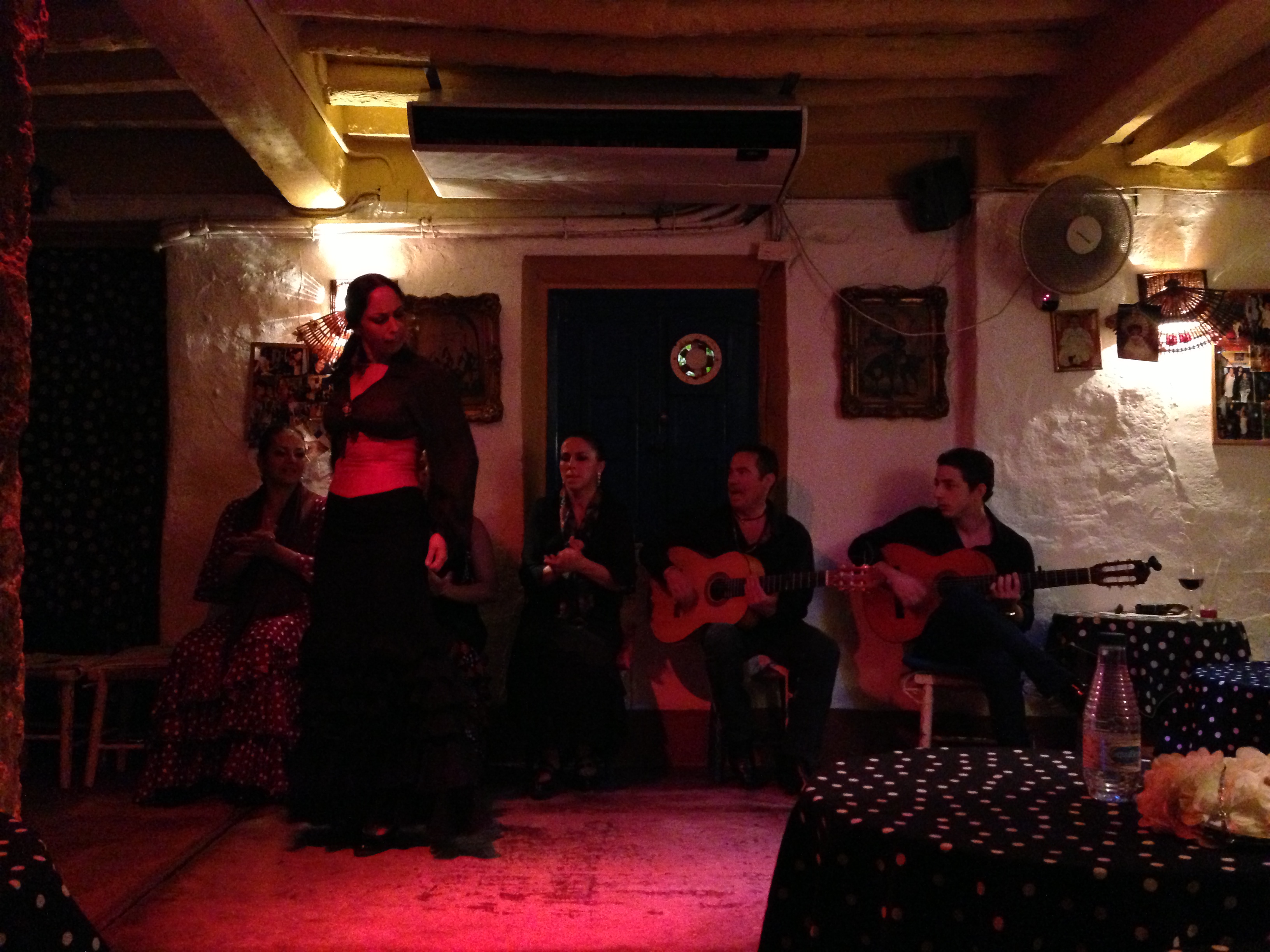
This summer’s return to Spain of course never failed to inspire me artistically as the last few posts on The Daily Norm will demonstrate – and where that inspiration led to paintings, I continued to explore the medium of gouache which I first started using a few months back. When I headed along to the Flamenco Ana Maria in Marbella’s old town on the night before my birthday, and was again entranced by the exquisitely spontaneous emotional outpouring of the music and the dance, I knew that Flamenco would inspire my next gouache. So following on from my series of “compositions” in which I take more of an abstract attitude to otherwise figurative works, I constructed my dancer (on a page twice the size of my other compositions numbers 3-7) utilising the idea of an overlapping construct which I have been exploring in my other works, something which worked well when I was unable to settle on one pose, and so instead depicted several poses, all overlapping into a collective exploration of the electric impassioned movements of a flamenco dancer.

Her dress, my favourite feature, is a cornucopia of different reds, polka dots and of course those lacey frills, while the background attempts to reflect not only the angular, chromatic, discordant sounds of the flamenco rhythms and moves of the dance, but also echoes the kind of rich elaborate Moorish wooden ceilings which were introduced in Spain during the Islamic occupation of Al Andalus, and are now an iconic feature of the Islamic architecture which has helped to shape the cultural character of the South, and is indeed accredited to having given birth to the songs and movements of the Flamenco we know and love.

So without further ado, I leave you to look at my new composition, and also, below, a series of photographs from our recent visit to the Flamenco in Marbella. Hasta luego.

IMG_3861 IMG_3859 IMG_3852 IMG_3864 IMG_3849

© Nicholas de Lacy-Brown and The Daily Norm, 2001-2013. Unauthorized use and/or duplication of the material, whether written work, photography or artwork, included within The Daily Norm without express and written permission from The Daily Norm’s author and/or owner is strictly prohibited. Excerpts and links may be used, provided that full and clear credit is given to Nicholas de Lacy-Brown and The Daily Norm with appropriate and specific direction to the original content.

Málaga | Part 3 – Photographic Miscellany

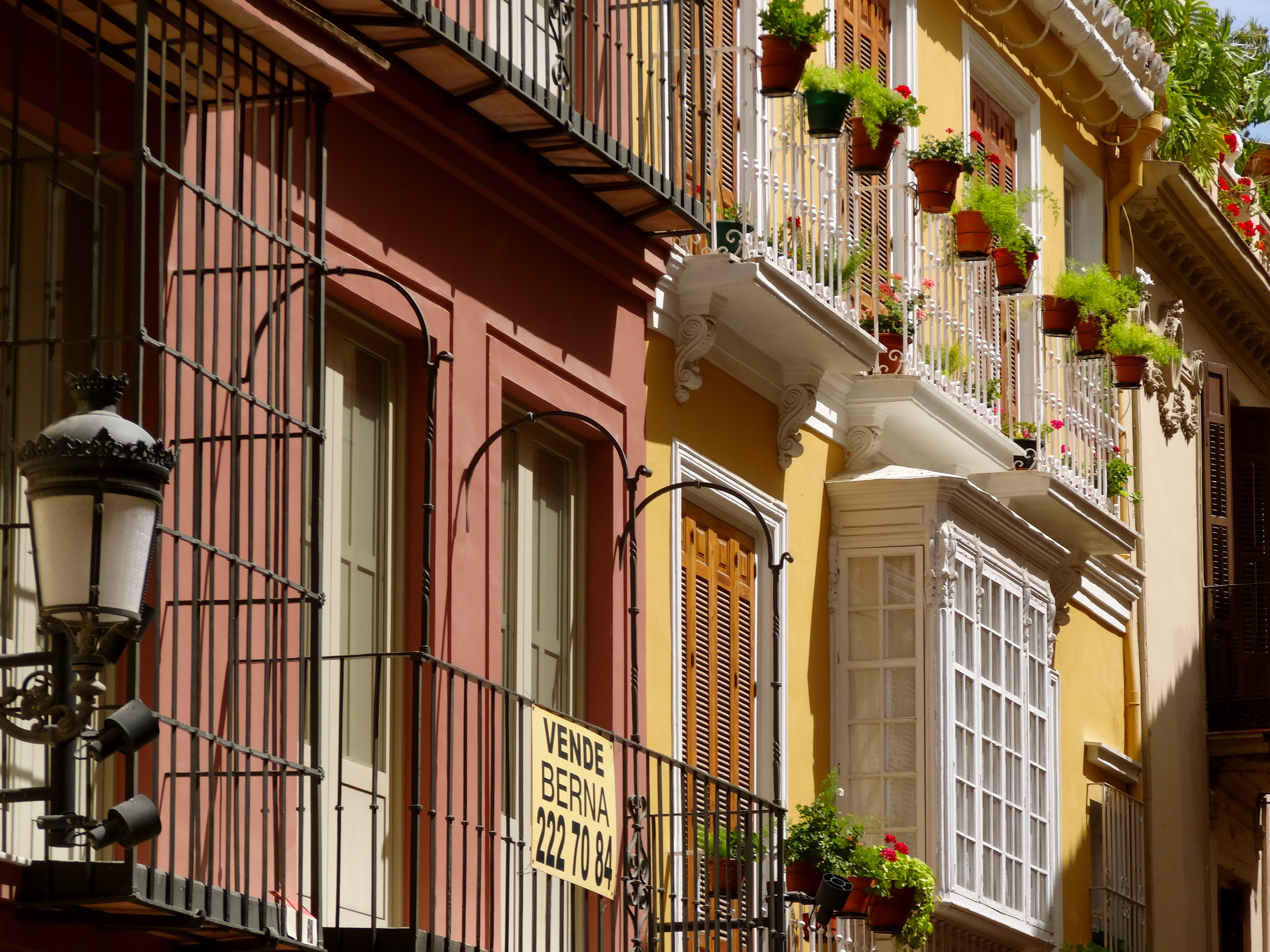
Oh vivid Málaga, city of Mediterranean light, upon whose sandy shores the sun shines bright, casting its yellow glow across fading evening skies, and in paint on the facades of its insuperably elegant streets. Málaga is a city upon which the embrace of nature has not been scared off by the growth of civilisation; as abundant botanic gardens overhang paths perfect for strolling, and the sea air wafts into the hot shopping streets. It is a city where both big and small co-exist in perfect harmony: the vast one-armed cathedral and the tiny new pink growths of a tropical baby plant; the large public plazas and the tiny winding streets of the city’s oldest district. And like so many of Spain’s great cities, Málaga is another whose buildings have been sprinkled with the wand of architectural elegance, as the glass plated balconies and curled wrought iron details of the Modernista era have found their place so comfortably in this most Southern of cities, offsetting 1920s western refinement against the robust remains of the Moorish East.

DSC06005 DSC06207 DSC05961 DSC05783 DSC06023_2

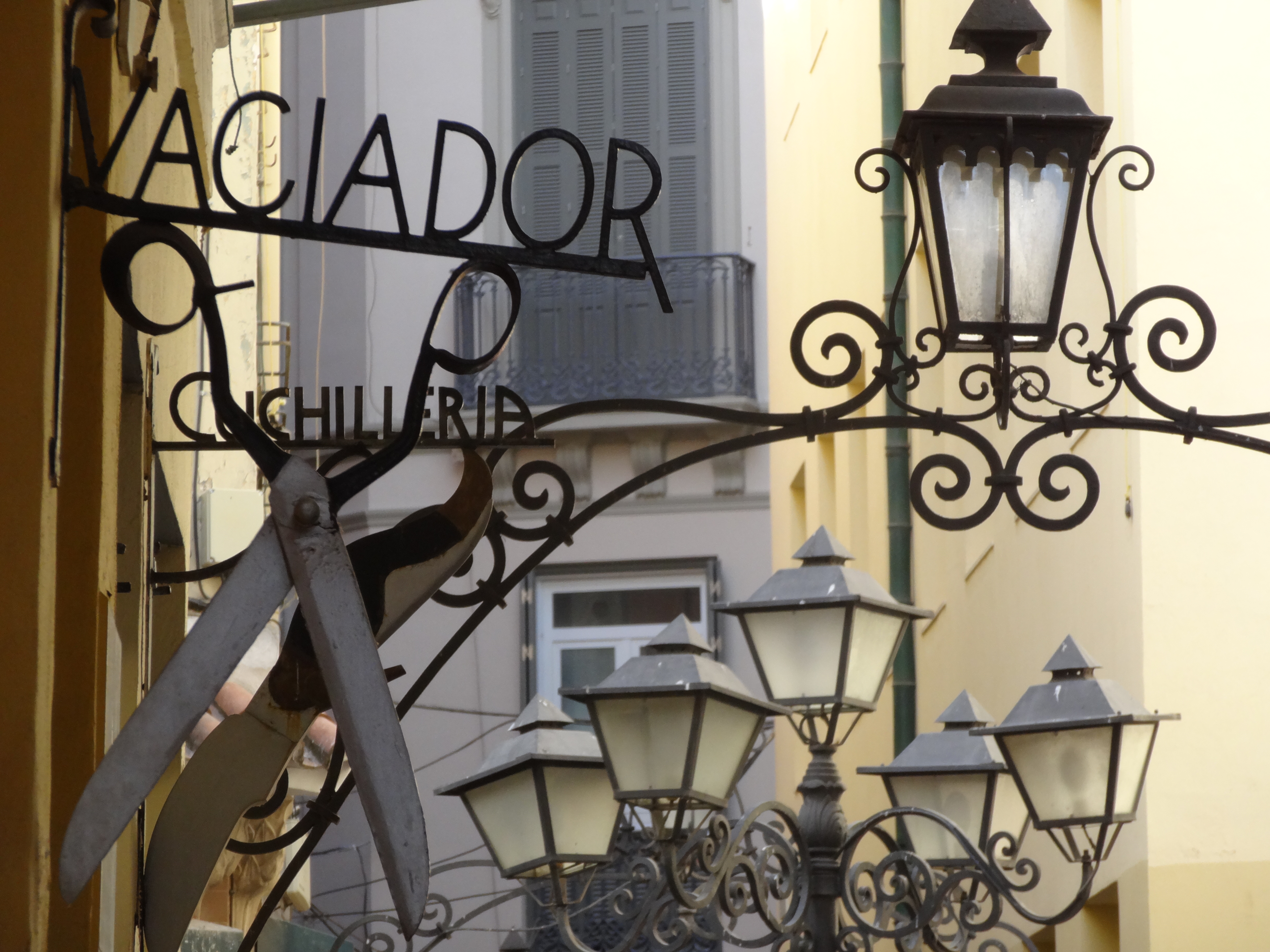
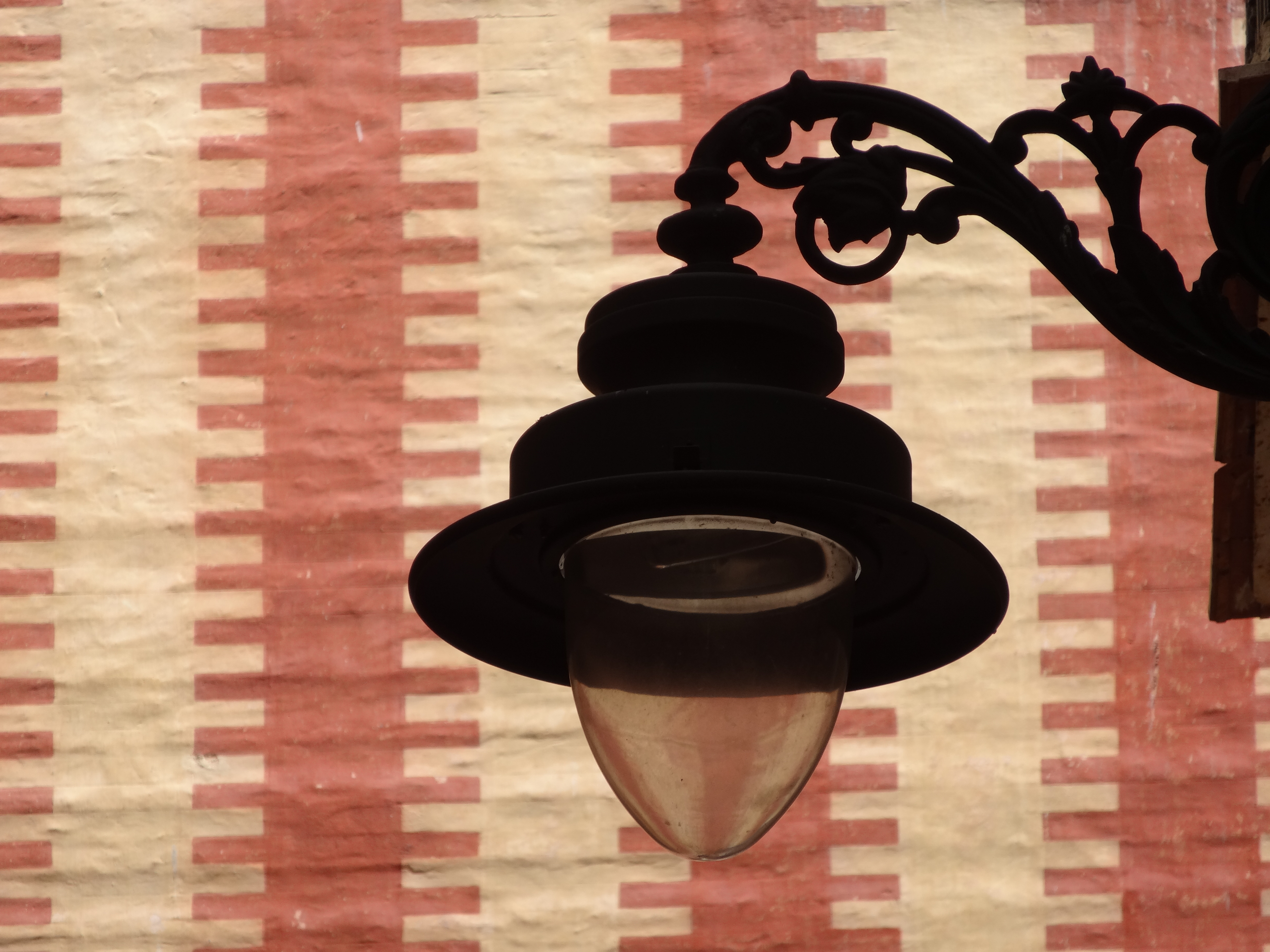
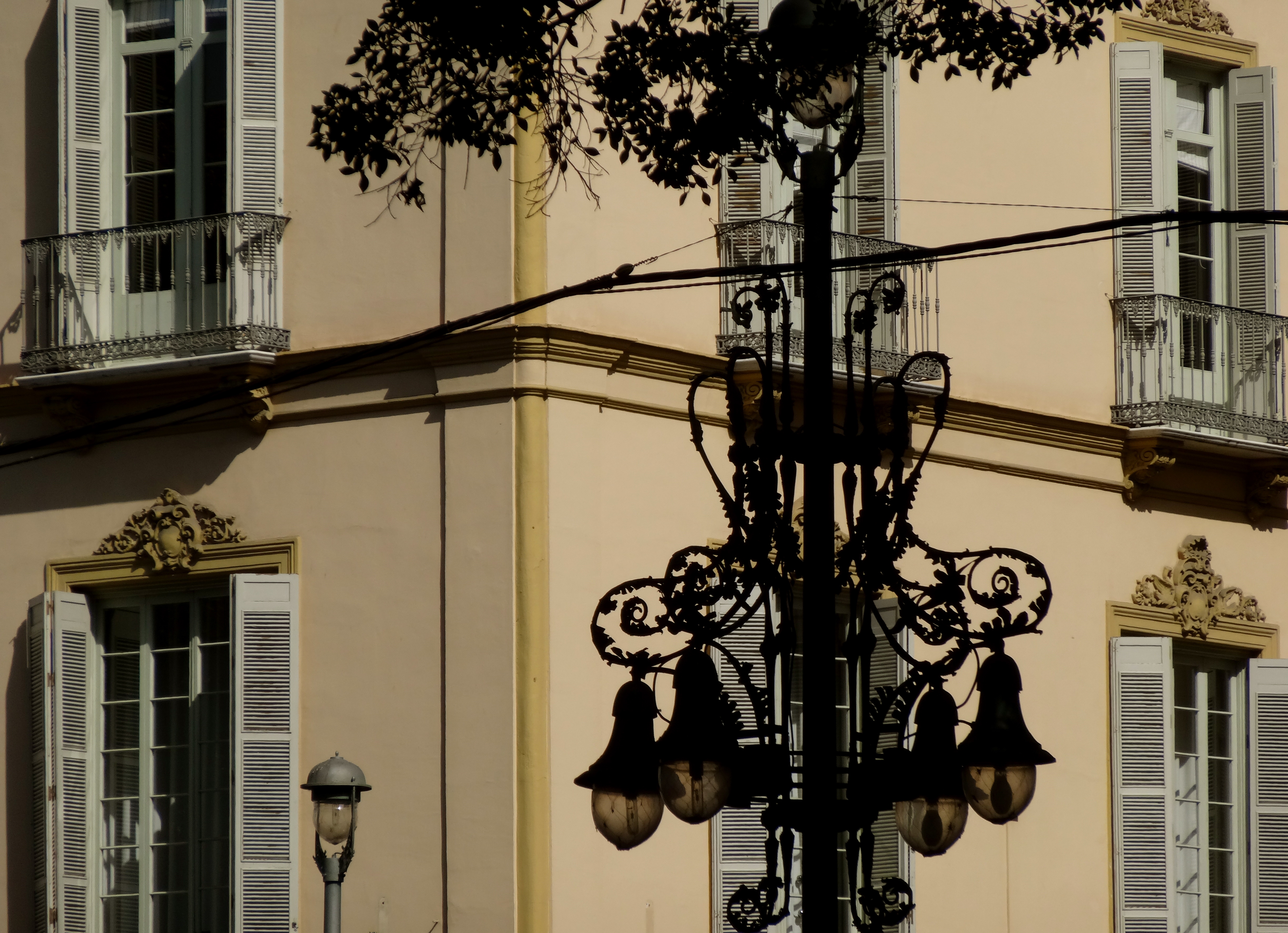
Málaga is a city so rich in photographic inspiration that in a mere 24 hours in the city, I managed to capture some 500 shots on my camera. Don’t worry – I’m not planning to bore you with them all here, but below are 33 of my favourites: From graceful street lamps and multi-coloured facades, to tranquil moorish gardens and the paper lanterns of a small street fiesta – here are my memories of Málaga on camera.

All photos and written content are strictly the copyright of Nicholas de Lacy-Brown © 2013 and The Daily Norm. All rights are reserved. Unauthorized use and/or duplication of the material, whether written work, photography or artwork, included within The Daily Norm without express and written permission from The Daily Norm’s author and/or owner is strictly prohibited.  

Málaga | Part 2 – The Jungle and the Genius

It is said that Henri Rousseau, the post-impressionist famous for painting lush jungle scenes complete with hunting lions, terrified tigers and monkeys feasting off tropical fruits, never actually went to the jungle. Rather he took his inspiration from the plentiful species of tropical plants kept in greenhouses at the Jardins des Plantes in Paris. Yet had Rousseau travelled a little further south, to his neighbouring Spain and down to the Mediterranean city of Málaga, he might have stumbled there upon a jungle paradise so profuse in its verdant abundance despite being located right at the heart of the urban city, that he might truly have considered himself to have entered Amazonia.

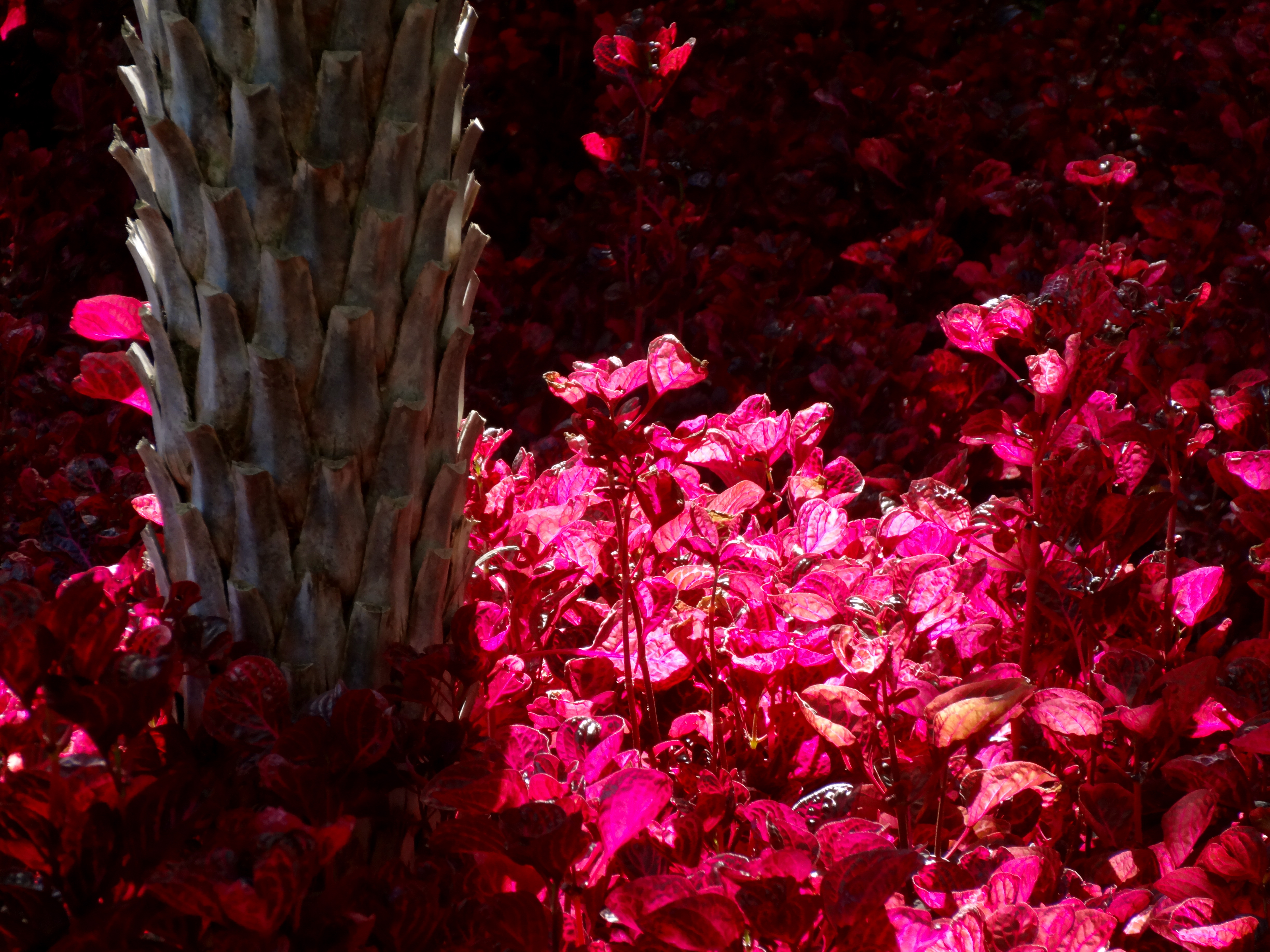
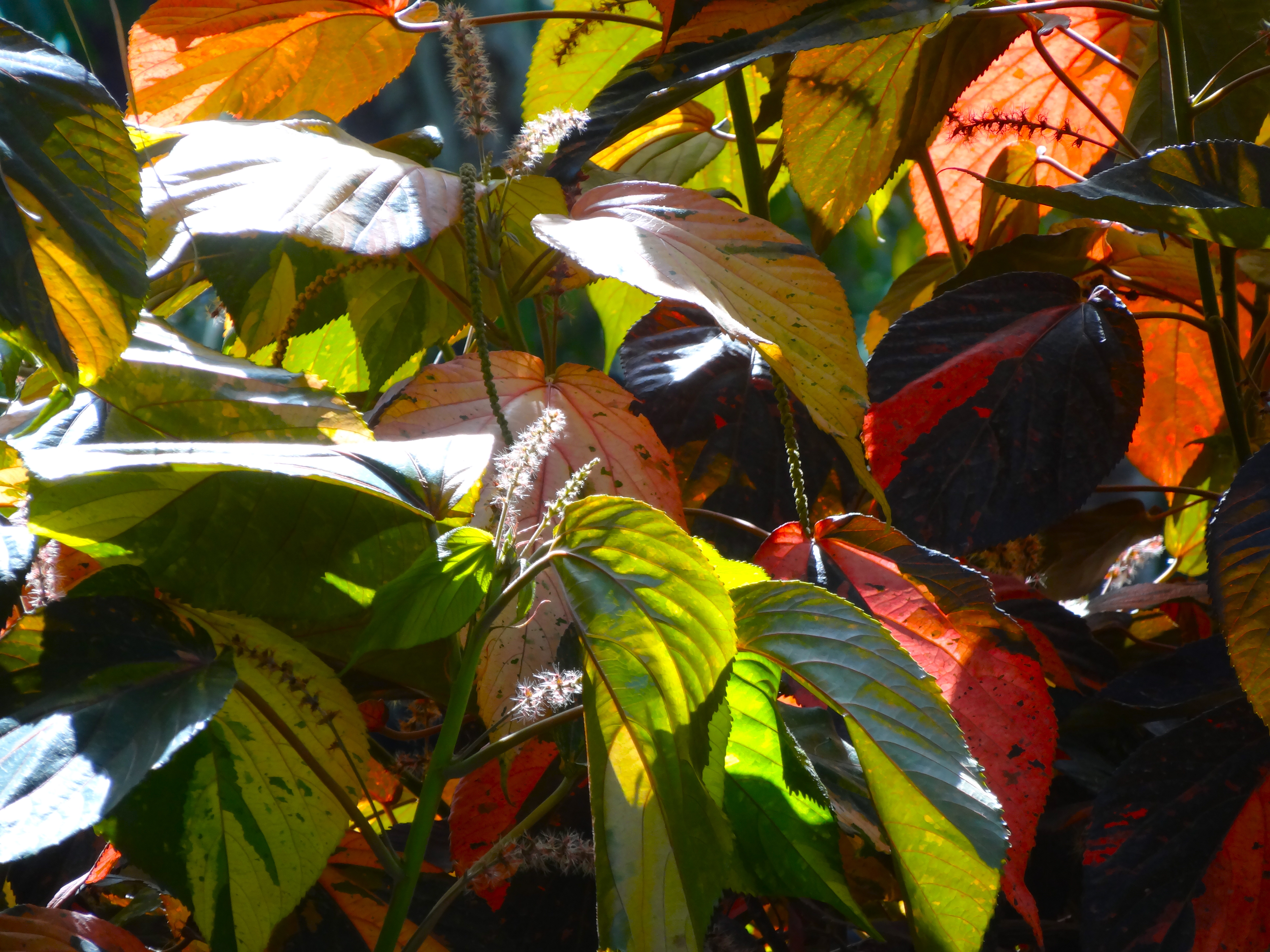
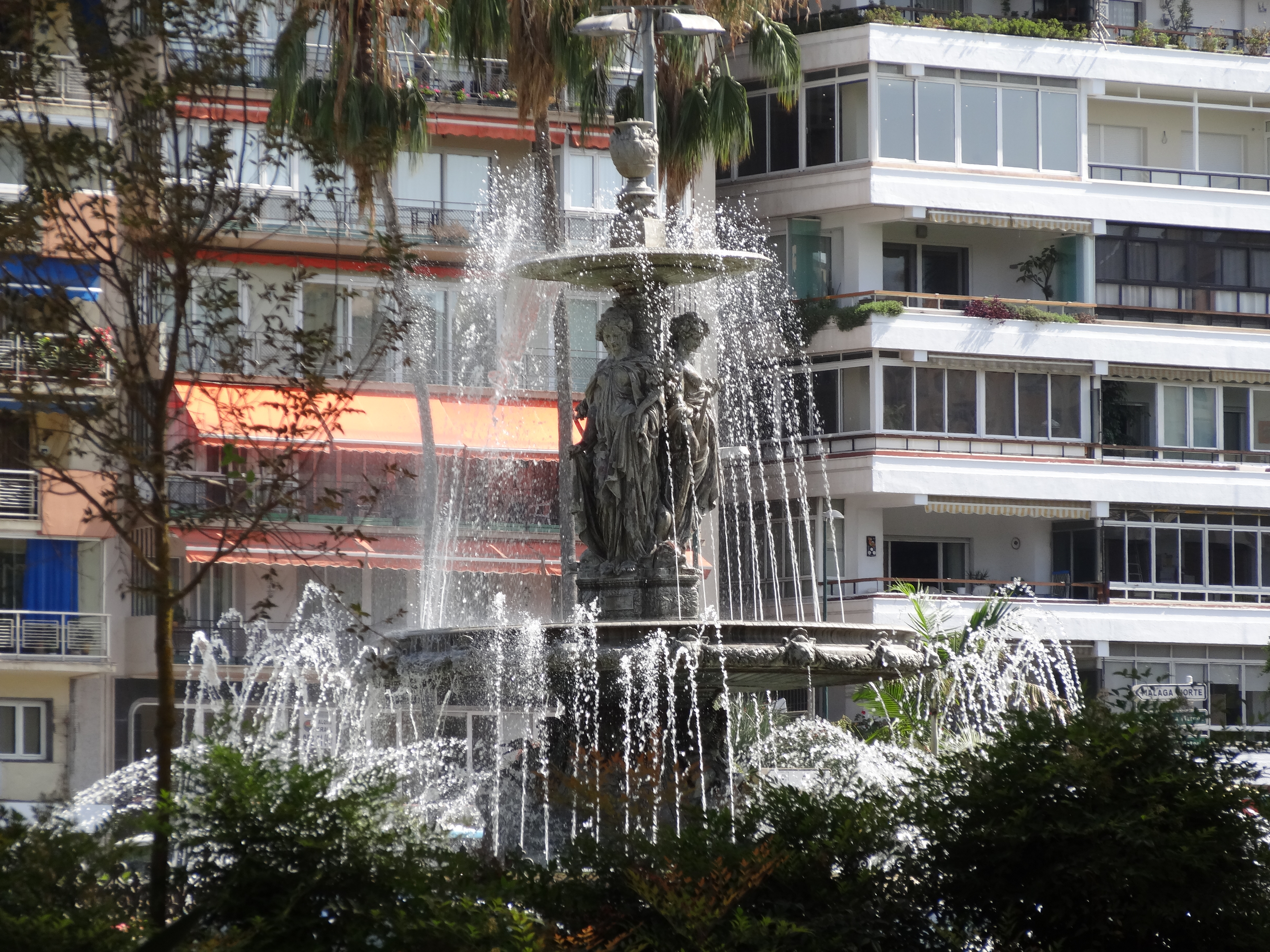
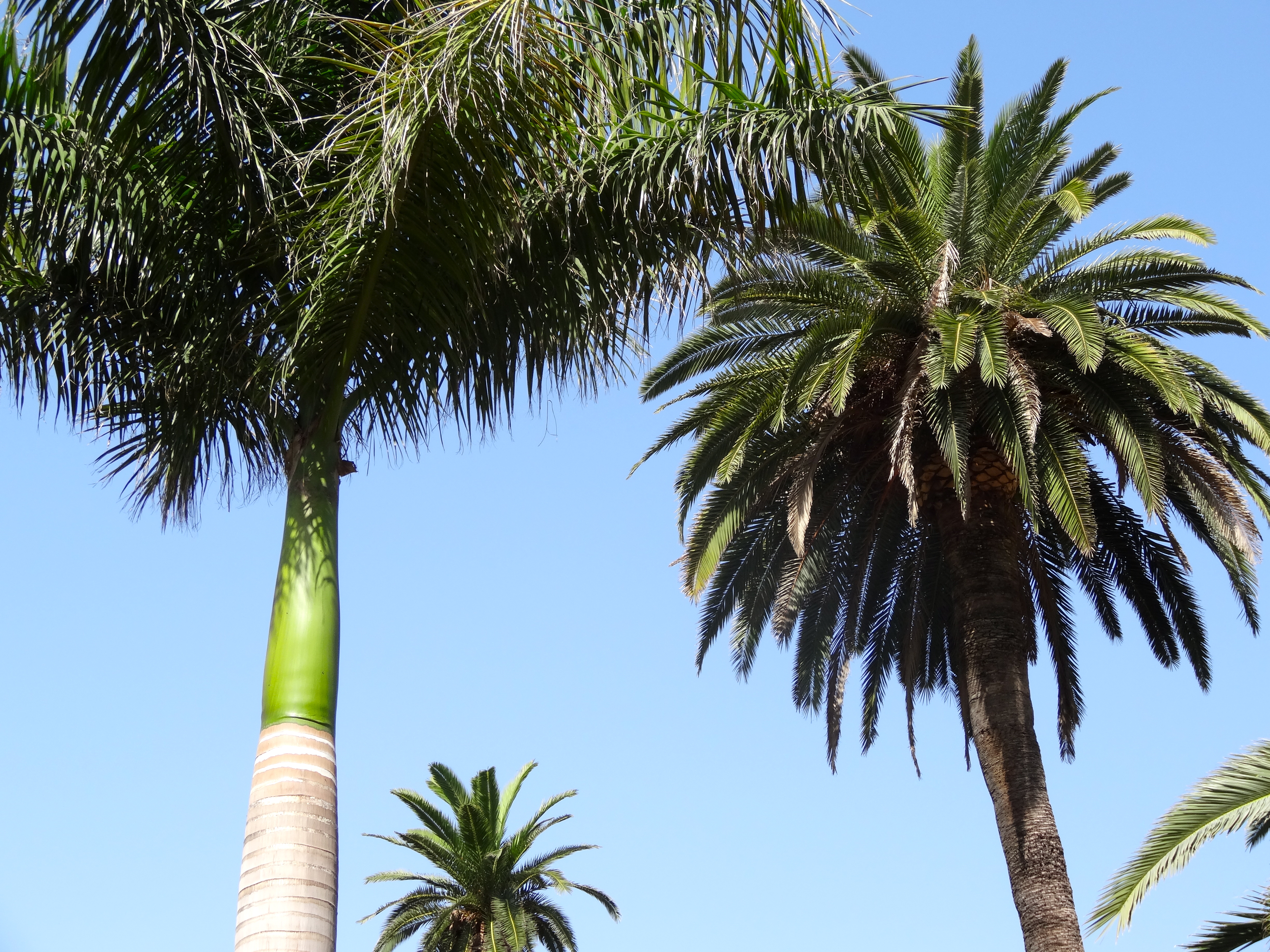
Yes, my thoughts could not help but stray to Rousseau, one of my favourite of all artists, as we strolled – my partner and I – through Málaga’s impressive centre at the start of our second day in the city, discovering there this inexhaustible cornucopia of botanical ravishment running alongside the port on one side, and the city’s main artery – the aptly named Paseo del Parque – on the other. So profuse in their scale and variety, palms and flowers, ferns and fronts burst from flower beds like an unplanned jungle paradise, with rich coloured leaves glowing red and pink and a vibrant lime green against the morning sunshine, while winding paths cutting through overhanging boughs and under a shelter of richly layered leafy canopy made for a walk which was both tranquil and invigorating.

DSC06047 DSC06063 DSC06036 DSC06053 DSC06107 DSC06073 DSC06044 DSC06033 DSC06057 DSC06046 DSC06049

I could go on about that park all day, and I could show you so many more photos of the rich variety of plant life than I have featured on this page. Needless to say, the park – a free-to-access world of botanical discovery – is but one further feature which makes a visit to Málaga such a satisfying experience. For beyond the impressive galleries, the museums and the imposing cathedral lies a city whose natural landscape benefits from a glittering coastline, a wide sandy beach and a flashy new marina, as well as a backdrop of undulating mountains and a city centre bursting with plant life. And beyond the greenery, a city of elegant narrow winding streets and broad boulevards lined with shiny marble pavements has developed, with large squares and shops, cafes and restaurants to rival any of Spain’s more prominent cities.

DSC06100 DSC06088 DSC06110 DSC06077 DSC06104 DSC06076DSC06097

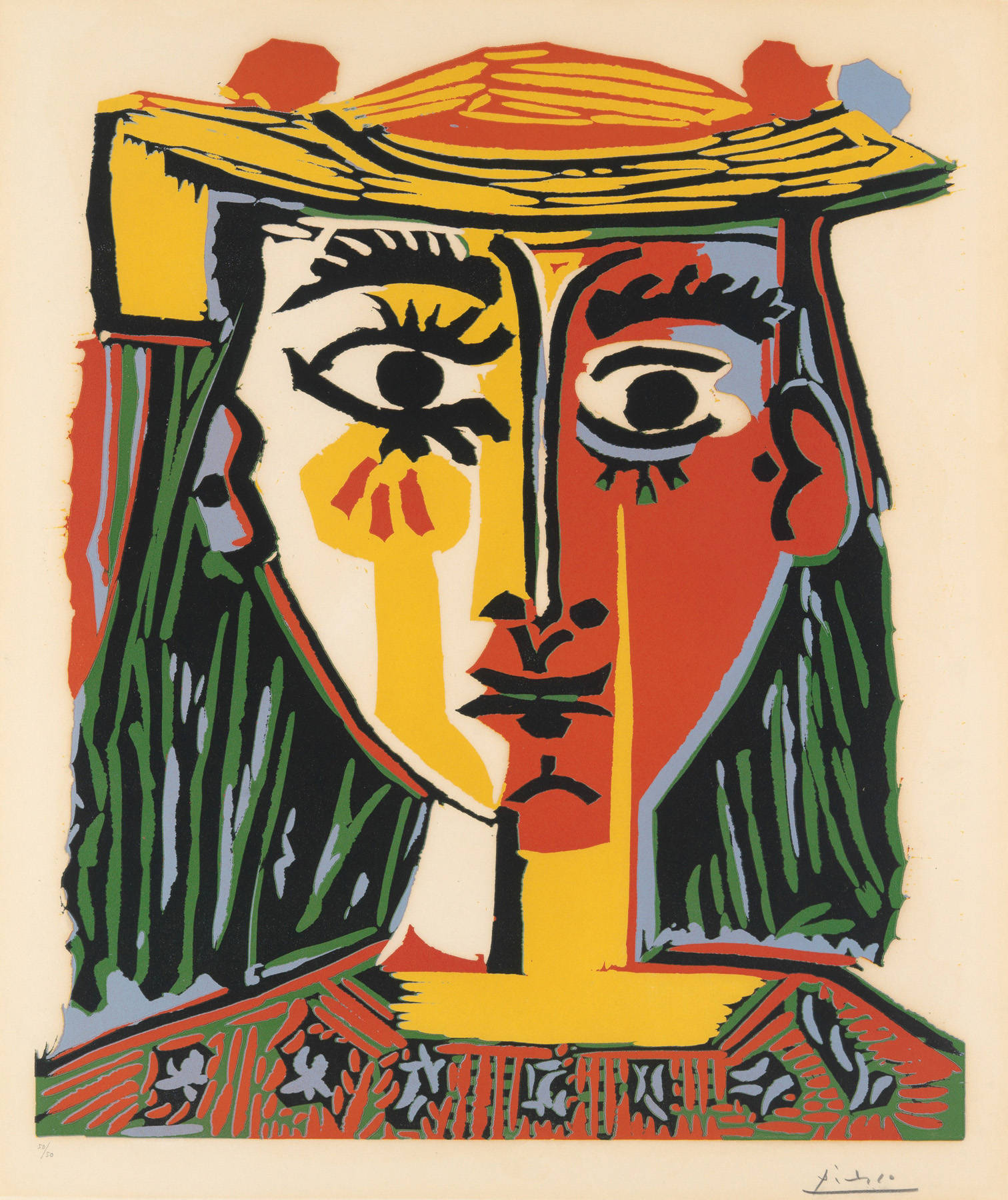
But there’s no denying that for all the history, the seaside location and the jungle which so entranced me, Málaga is perhaps best known for being the birthplace of perhaps the most famous artist of all times – the breaker of faces, father of cubism and all round genius Pablo Picasso. And unsurprisingly, the city’s superb Museo Picasso Málaga remains the number one attraction of the city. Located a mere block away from the cathedral, the museum is located in a former palace which has been so sympathetically but innovatively modernised to house the museum that I love visiting just to see the building alone. With its all white walls, preserved moorish ceilings, and groups of precisely aligned red geraniums all housed in black ceramic pots, it is the height of architectural chic, and the perfect backdrop to Picasso’s multi-coloured works.

The chic gardens of the Museo Picasso Málaga

DSC06149 DSC06142 DSC06158 DSC06143

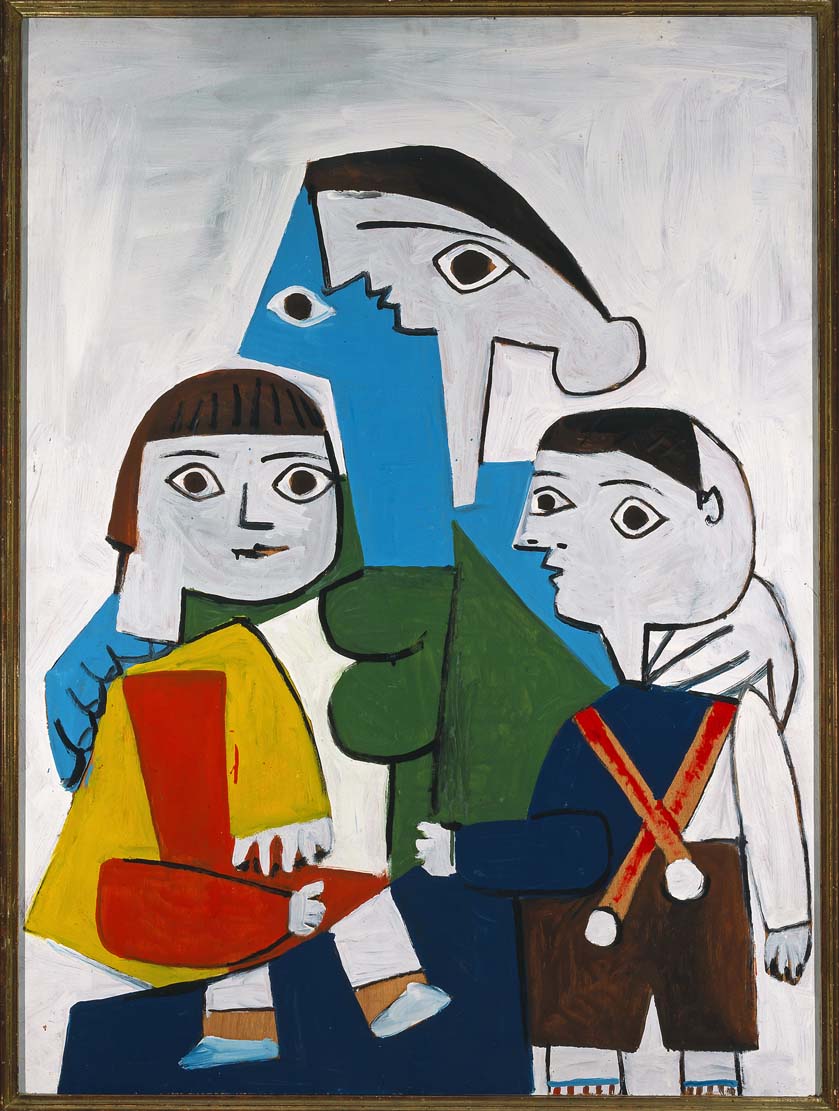
Although I must have been to the museum at least 3 times before, I could not resist returning on this trip to Málaga, not only to indulge in the beauty of the museum’s surrounds, but also to enjoy the temporary shows which have been organised in celebration of the museum’s 10th anniversary. The first was an exhibition dedicated to Picasso’s depiction of family – a show which proved to be comprehensive in scale and offered an expansive view across the whole of Picasso’s career, as his depictions of family and friends remained a consistently prominent theme running throughout his art, but one which became subjected to his ever changing styles, from fine art figuration, to cubism, from blue period to pink, and finally to the fragmented faces and naive representation for which Picasso is now most famous.

media-fotos-Maternidad sobre fondo blanco ampliada 20120819picasso-60 picasso-met-2010-32

The second temporary exhibition had very little to do with Picasso at all – rather concentrating on the actor come photographer come artist come director Dennis Hopper, who made for a superbly curated, dynamic show which explored not just the persona of Hopper but also the time in which he lived through photographs of 60s America, through his association with revolutionary artists such as Andy Warhol and David Hockney, and through his collection and contribution to the pop art movement. A brilliant show and demonstration that the Picasso museum is not just a one-trick pony, but an important contributor to Málaga’s dynamic cultural landscape.
Dennis Hopper by Andy Warhol

Dennis Hopper by Andy Warhol

But what with the culture, the ever beckoning elegant streets, the vast parks and the long seaside paseos, the Picasso Museum pretty much marked the end of the road for us, as our feet throbbed and our energies became exhausted in the hot August heat. For only 40 minutes away by bus, Marbella again awaited, amid promises of lazy beach days, of mint tea in the garden under the perfumed jasmine tree, of painting in the afternoons and long seaside coffees in the morning, and of a little old town house which, for its proximity to the stunning city of Málaga alone, I feel very lucky to call home.

Málaga | Part 1 – Capital of Culture

Whether it’s because the city was recently working towards a bid for European Capital of Culture (which disappointingly, was won instead by San Sebastian in Spain’s North – not entirely sure why), or just because it was sick of being forever overshadowed by the glitz and glamour of Marbella to the West, and the popularity of tourist spots such as Nerja and Granada to the East, Málaga – the 6th biggest city in Spain and the most southern large city in Europe – has certainly upped its game of late. Following on from the introduction of the phenomenal Picasso museum a decade ago (Málaga is the artist’s birth-town), the city has gone on leaps and bounds to develop its cultural and leisure landscape, making it easily one of the most enriching and enjoyable places to visit in Southern Spain.

Asides from the Picasso Museum and a host of other novel museums dedicated to the likes of Flamenco, bull fighting and Semana Santa, Málaga also boasts two major archaeological treasures – the Moorish Alcazaba, whose walls crown one of the prominent hills encircling the city, and an excavated Roman Theatre. Its wide sandy beach is now accompanied by a brand new leisure port, following a huge reconstruction of the area in which an industrial marina has been transformed into a glitzy promenade boasting glass fronted boutiques and restaurants and a palm-lined avenue. And as for its art scene – well it’s alive and kicking, with the CAC Contemporary Art Museum showing some of the most prominent artists of the contemporary art world, and the latest and most exciting addition of all: the new Carmen Thyssen museum, an outpost of the world-famous Thyssen-Bornemisza Museum which is one of the “big three” art galleries (together with the Prado and the Reina Sofia) drawing art lovers in their millions to Madrid.

The elegant streets of Málaga

DSC06190 DSC05825 DSC05832 DSC06137 DSC06130

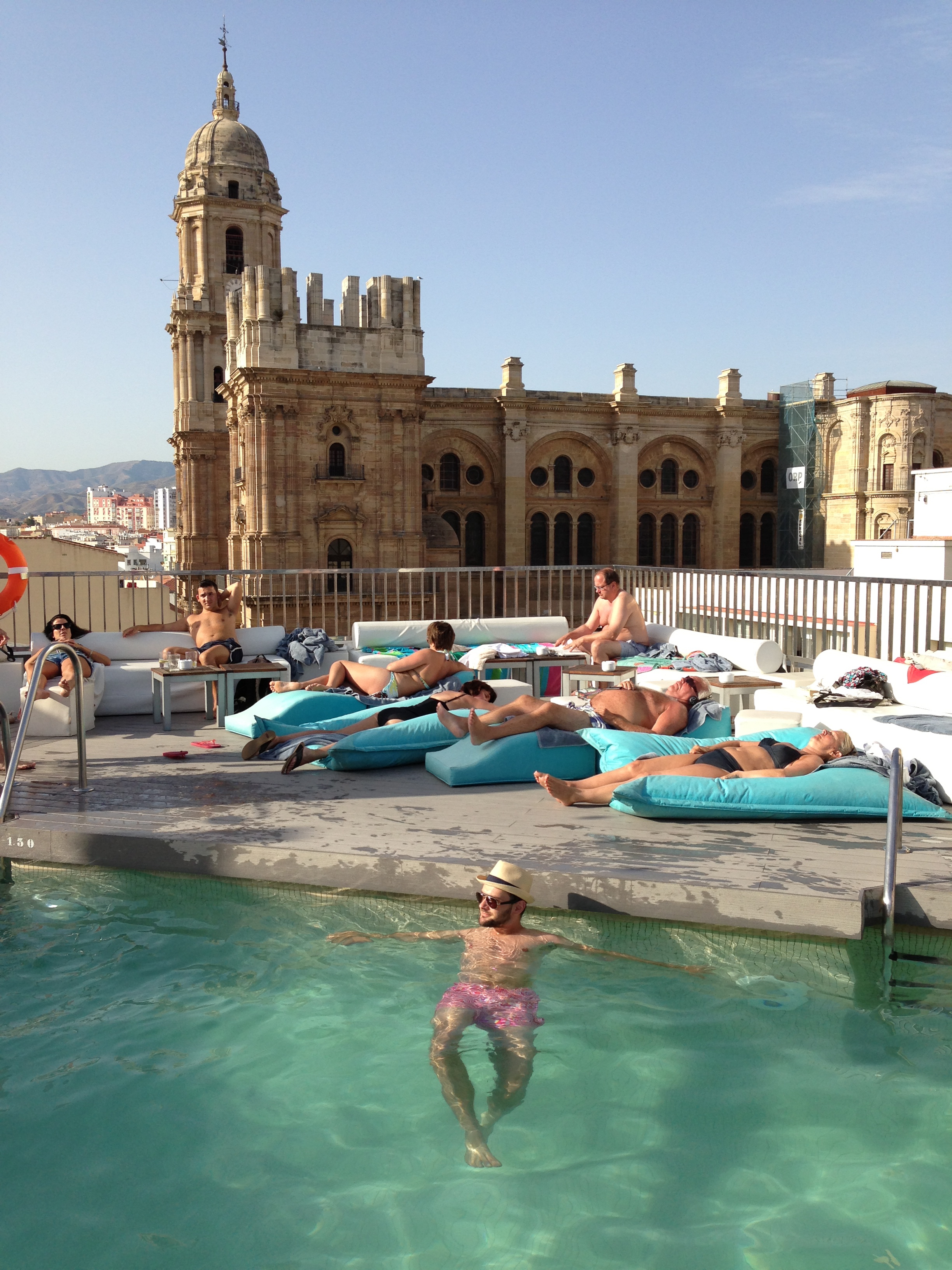
Having learnt that the Carmen Thyssen museum had now opened (it actually opened in 2011, but I was a bit slow in picking up on this), my partner and I were quick to arrange ourselves a little trip from Marbella to Málaga, leaving behind the beaches for a short immersion within Málaga’s cultural offerings. But what with the opening of the new port, and the attraction of Málaga’s elegant Modernista streets beckoning, we felt it only reasonable to turn our initial plans of a day trip into a one-night stay. And so it was that our trip to the city was enriched by the silky lining that only the comfort of a night in a splendid hotel can offer, comfort which comes no more so that at the hands of the Molina Lario Hotel which we made our home for the night, a newish hotel based in a hybrid renovation of modernist palace and brand new building, and which boasts a stunning rooftop pool with unbeatable views over Málaga’s “one-armed lady”: the Cathedral whose second bell tower was never finished owing to a lack of funds, and which today is the most famous icon of the city.

Now how about this for a pool with a view…

IMG_3705 DSC05953 DSC05890 DSC05956

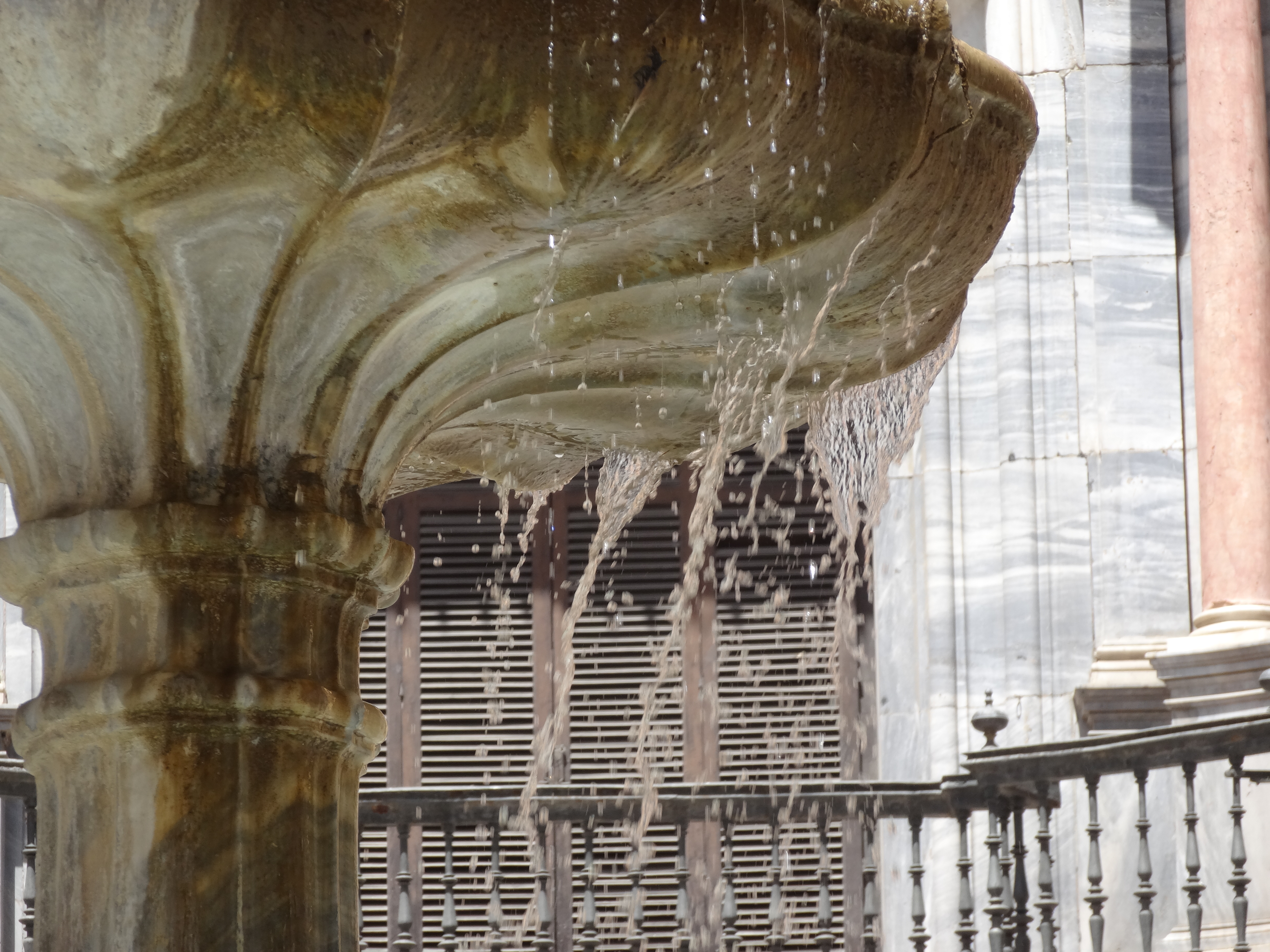
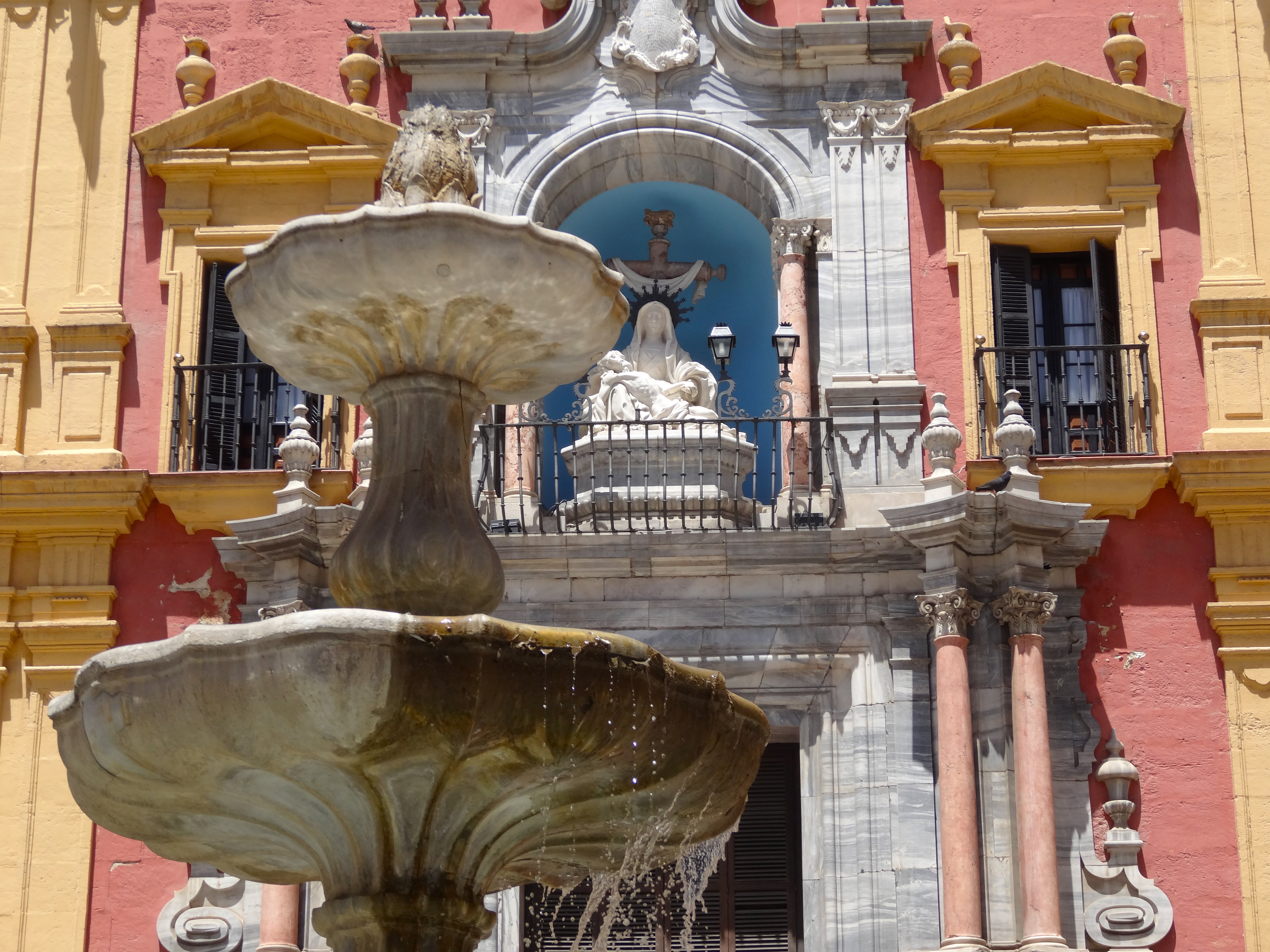
As the photos above will more than demonstrate, we certainly made the most of all that the hotel had to offer, and sipping wine on the pool side terrace overlooking a vast panorama of the city in the dying light of the day has to have been one of my highlights of the whole Spanish holiday. But what about that museum? Well once we had managed to pull ourselves away from the plentiful distractions which our hotel provided, we headed straight for the Thyssen, our passage being interrupted only once or twice by the pull of the beautiful Plaza del Obispo, whose iconic red and yellow Episcopal Palace and its viewpoint straight onto the façade of Málaga’s imposing Cathedral made a stop in the idyllic square for a glass of something ice cold and thirst quenching a practical prerequisite. But thanks to the Thyssen’s superb location, just west of the main Plaza de la Constitucion, we soon made it to this impressive new museum, whose architecture, based around the old Palacio de Vaillalon but benefiting from innovative new extensions is, in itself something to be admired before the collection is even surveyed.

The Plaza del Obispo

IMG_3653 DSC05758 DSC05757 DSC05766 DSC05853 DSC05762 IMG_3840

…and the Carmen Thyssen Museum

DSC05788 DSC05793 DSC05803 DSC05805

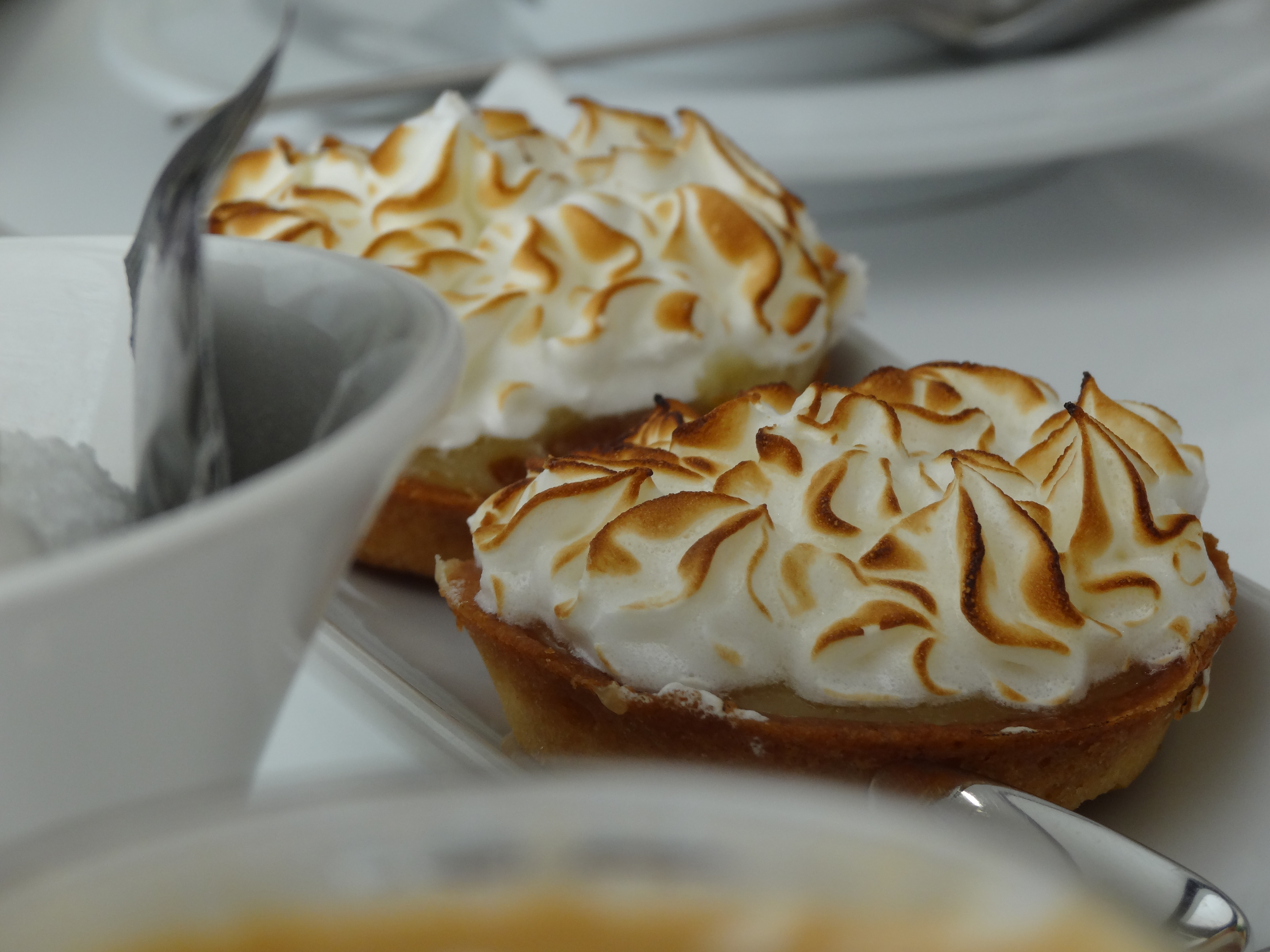
Having entered through the museum’s sun drenched traditional courtyard, and helped ourselves to a small cortado coffee and a miniature lemon meringue pie in the café, we slowly made our way around the museum’s four floors of Andalucía-based art, largely emanating from the 19th century. I have often heard this period of Spanish art, between the golden age greats of Velazquez and El Greco, the traumatic masterpieces of Goya, and the 20th century brilliance of Picasso and Dali, to be dismissed as insipid; even boring. But for those who love the rich history-rich culture of Southern Spain, this collection is a treat. From street scenes showing the Easter Semana Santa parades in all their lavish details, and almost impressionistic depictions of the Spanish coast, to stunningly detailed paintings of traditional Andaluz patios, and crowds bursting into local bull rings, there really is something for everyone in this perfectly located collection which really does beat to the rhythm of Andalucía’s heart.

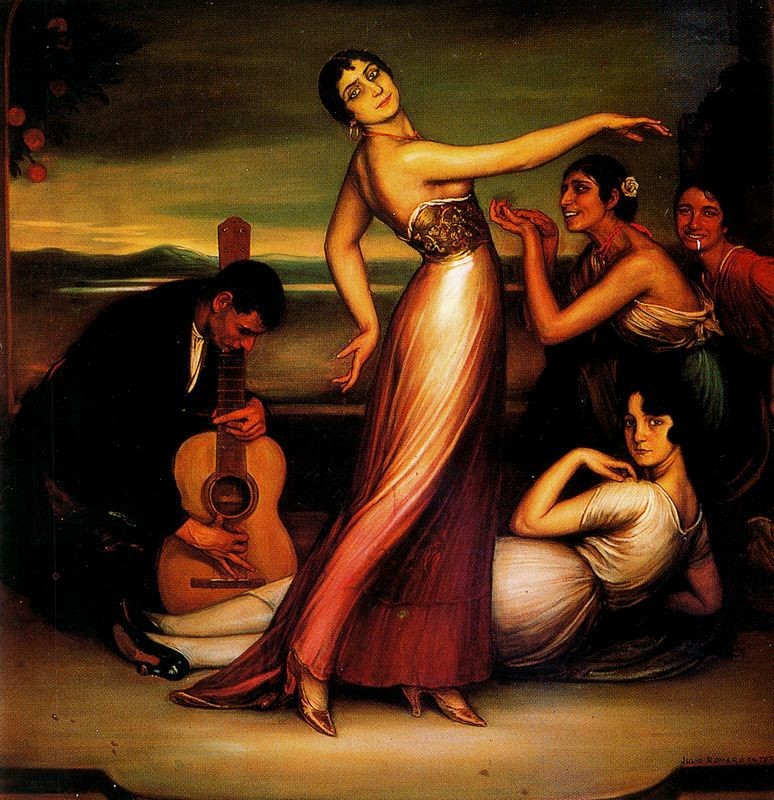
Our visit also coincided with a temporary exhibition of Cordoba based Julio Romero de Torres (1874-1930), a master of  Andalucían symbolism, with an oeuvre associated with popular and folk trends, interspersed with the wide-eyed females who languish so prominently and poetically across his canvases against strangely surreal, often looming skies.

A selection of Romero de Torres’ work

La_Buenaventura_by_Julio_Romero_de_Torres Julio_Romero_de_Torres_-_Venus_of_Poetry_-_Google_Art_Project Alegrías_by_Julio_Romero_de_Torres

Back at the hotel, our feet pulsating after an afternoon exploring both the Thyssen and the elegant streets and Plazas surrounding it, all that remained was to enjoy that incredible view from the comfort of our hotel’s rooftop swimming pool, and later to dine in the city’s bustling tapas-bar lined streets, with a stroll along the glittering new port before bed. The perfect end to a day as rich as Málaga is abundant – in culture, in architecture, in beauty, and in progress: No longer just the gateway to the Costa del Sol, Málaga has surely earned its place as one of Spain’s must-visit cultural centres.

Málaga’s glittering new port

IMG_3746IMG_3740 IMG_3764 IMG_3760

Details of the Carmen Thyssen Museum, including temporary exhibitions and future shows can be found here.