Skip to content

Posts tagged ‘Art’

Sunday Supplement – The Joie de Vivre Triptych

The sun is shining in London, the olympic torch is gradually winding its way around the country to rapturous applause, and the nation is decking its streets in union jacks in anticipation of the Diamond Jubilee celebrations next weekend (you notice I’ve ignore the slight blip that was eurovision last night, when the UK came second from bottom in the results table – but no surprises there, it only goes to emphasise our disconnection from continental europe). So with spirits high, and with what looks like the arrival of summer (finally!) I have decided to showcase a triptych of paintings which I completed when the times were good, the sun was shining, and I was enjoying uninhibited zest for life. I was holidaying in Marbella, Spain at the time. I had just finished my law degree, and was spending almost a month in Spain. By day I would enjoy the freshness of the mediterranean sea, the heat of the beach, and the pleasure of seafood and of wine. In the balmy afternoons, I would retreat to our sun-dappled garden, under the shade of our fragrant jasmine tree, and rest, contemplate, and (being english, even when in Spain) drink tea.
It was in these times of ultimate afternoon delight that the Joie de Vivre triptych was born, three paintings which were unplanned, but which burst freely out of my paintbrush and straight onto canvas, an apt demonstration of my uninhibited happiness when life was good, the drinks flowed, the sea lapped upon the shore and my imagination came to life.

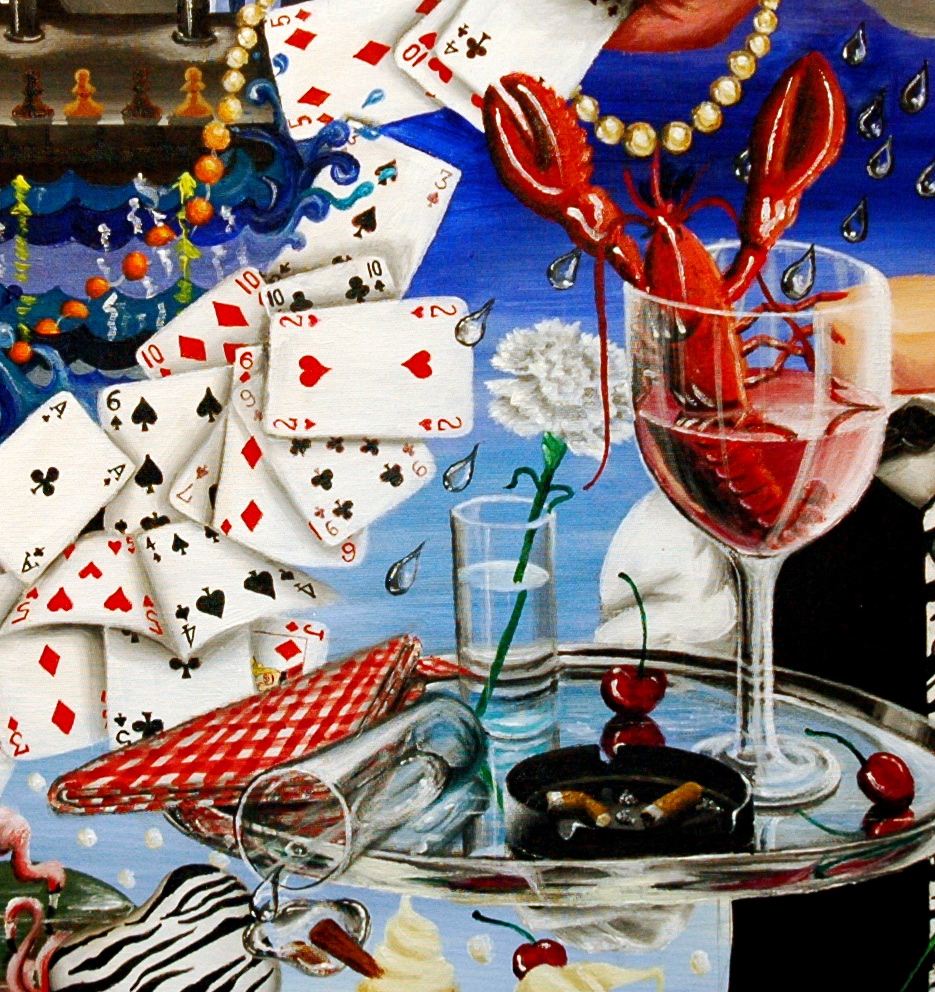
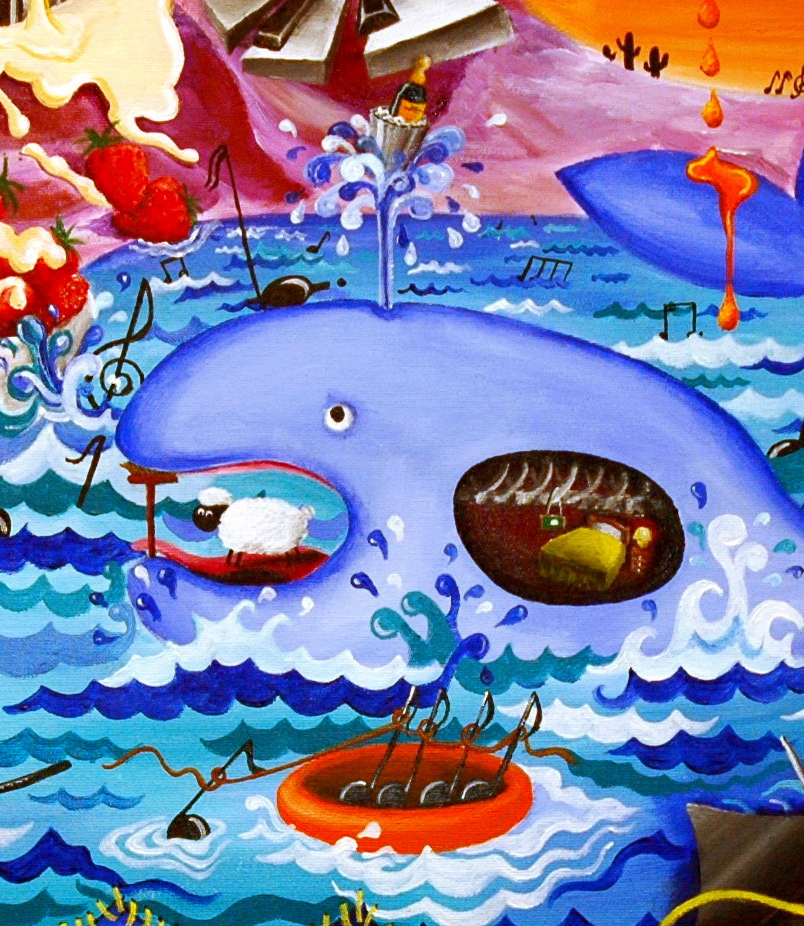
The resulting triptych sold at my 2006 exhibition, Between me and my Reflection and is now one of my best selling limited edition prints (with some still for sale on my Etsy store). It celebrates the ‘zest’ or joys of life through an illustration of the three stages of culinary and alcoholic indulgence during the day; lunchtime, afternoon tea and evening. Recreation and hedonism are central to the juxtaposed images with a further emphasis on home entertainment, namely piano/music, cards/gambling and chess. Opulence is illustrated by symbols of extravagance contained within all three images, as well as buried treasure and jewellery. Sea food is the culinary indulgence on the menu: many other life-forms or objects are anthropomorphised, for example, the sheep seen in the domestic setting of its whale-house, the musical notes struggling to save each other from the perils of a rough sea, and a snail which digs underground to retrieve the buried treasure. The ‘zest of life’ which these images embody is also specifically reflected by the citrus slices which radiate perfect weather conditions in each scene, while a human hand is always “on hand” to assist in the activities being illustrated, whether it be pouring the cream for the afternoon’s strawberries and the marie-rose sauce for the crab, or dealing out the cards for an evening of casino entertainment. The painted images flow and metamorphose from one object to another, as a string harbour-side lights becomes a string of pearls which in turn  becomes of floating buoys or a sudden rain shower becomes ice cream, piled on a cone to be enjoyed with a glass of rosé.
There’s a lot to explore in these paintings, which are typical of what happens when I set my mind loose, so without further ado I will let you enjoy the paintings in full, hoping that you take from them the optimism for life which they engender as you go about enjoying your sunny sunday and forthcoming summer.
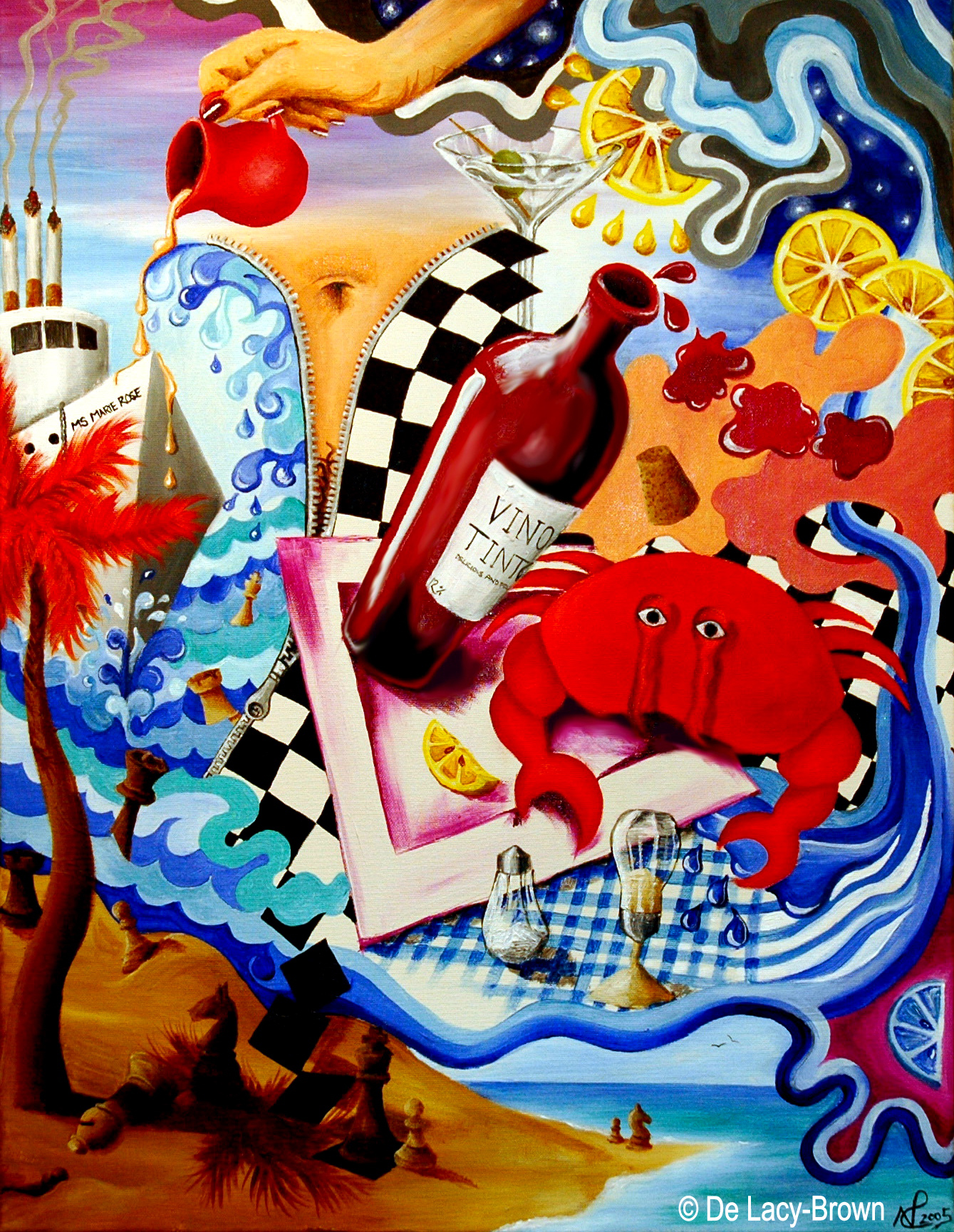
Joie de Vivre/ Zest of Life 1: Crab Cocktail (2005 © Nicholas de Lacy-Brown, acrylic on canvas)

This print is available to purchase as a limited edition print at my Etsy store 

Joie de Vivre/ Zest of Life 2: Afternoon Sea (2005 © Nicholas de Lacy-Brown, acrylic on canvas)

This print is also available to purchase as a limited edition print at my Etsy store

Joie de Vivre/ Zest of Life 3: Casino Nights (2005 © Nicholas de Lacy-Brown, acrylic on canvas)
This print is also available to purchase as a limited edition print at my Etsy store

© Nicholas de Lacy-Brown and The Daily Norm, 2001-2012. Unauthorized use and/or duplication of the material, whether written work or artwork, included within The Daily Norm without express and written permission from The Daily Norm’s author and/or owner is strictly prohibited. Excerpts and links may be used, provided that full and clear credit is given to Nicholas de Lacy-Brown and The Daily Norm with appropriate and specific direction to the original content.

The Daily Sketch: Norms at the Damien Hirst Exhibition

It’s all very well a gallery playing host to these rotting cow heads and life cycles of flies with their maggots and detritus and moving little black bodies, but what if the little scientific show-in-action managed to escape from the careful confines of its Damien Hirst supervised glass tank? Even when we visited Hirst’s room full of butterflies at Tate Modern last weekend, we managed to walk out of the room with part of the exhibit attached to our backs (a butterfly landed on my partner… and was swiftly rescued by a Tate attendant before we walked off with potentially one of the most valuable butterflies in the word unknowingly upon our person). So what if those pesky flies managed to escape too? Sadly in Norm world, this question was not just posed in theory alone. All that rotting caused a flap of the tank to come open (or perhaps it was sabotage?!) and for one poor Norm who took the insects’ peculiar fancy, he found himself the number one lunch attraction for a very hungry group of flies.

Norms at Tate Modern (2012 © Nicholas de Lacy-Brown, pen on paper)

And just in case you don’t know which Damien Hirst “artwork” I am talking about, herewith, the offending article… I swear that blood must cause havoc for a gallery’s wooden floors…

Damien Hirst, A Thousand Years (1990)

So let this be a lesson to you all ye who dare to enter Tate Modern’s latest Damien Hirst retrospective. It’s all well enough to stop and stare, but those ghastly flies are but a pane of glass away from a role reversal whereby you become the attraction! Of course while you’re there, be sure to look out for  the Norm in Formaldehyde, which will surely be the highlight of your experience. Here’s a picture of it (one I made earlier).

The Physical Possibility of a Norm in Formaldehyde (after Damien Hirst) (2011 © Nicholas de Lacy-Brown, pen on paper)

© Nicholas de Lacy-Brown and The Daily Norm, 2001-2012. Unauthorized use and/or duplication of the material, whether written work or artwork, included within The Daily Norm without express and written permission from The Daily Norm’s author and/or owner is strictly prohibited. Excerpts and links may be used, provided that full and clear credit is given to Nicholas de Lacy-Brown and The Daily Norm with appropriate and specific direction to the original content.

Damien Hirst at Tate: Repetitive, super-sensationalised science-show which is strangely enjoyable

The blockbuster show of Tate’s annual exhibition calendar, a retrospective to YBA supremo Damien Hirst, has been long anticipated by London’s art scene as well as the purveyors of trashy gossip magazines and followers of The Only Way is Essex alike. And such is the pull of Damien Hirst – this isn’t highbrow fine art, it’s not oil paintings fastidiously executed or sculptures miraculously carved from marble. This is a highly-commercialised , over-exposed fair ground of cut up creatures and stomach-churning curiosities, highly laminated multi-coloured, multi-formed collected lacquered lustre and sparkling, extravagant and utterly pointless bling. And where there is bling, that twinkle to attract the masses, you don’t need to be erudite and sophisticated to pull in the crowds. This is Tate doing household gloss paint, not oil paint.

Damien Hirst, Lullaby, the Seasons (2002) (detail)

Damien Hirst, Arg-Glu (1994)

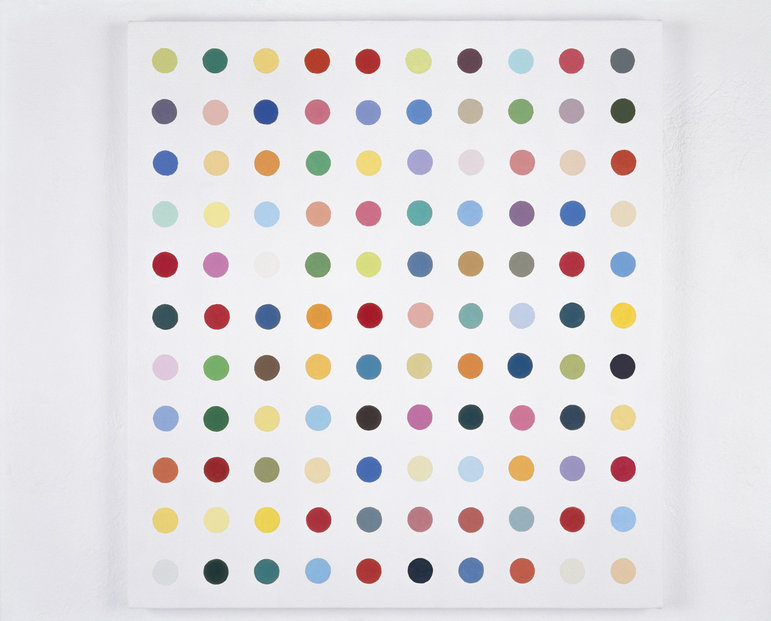
To give him is due, Mr Hirst is unapologetically tawdry . He doesn’t at least pretend to be the next Caravaggio. He makes art for a modern generation, a generation which consumes weekly updates on Katie Price’s deflating boobs rather than a good Jane Austen, who are only too aware of drug culture, who over use and abuse pharmacies in their hypochondriacal self-obsession, and are ultimately attracted by the latest trend, sensation or sparkle. No wonder Damien Hirst has been successful. He only had to stick diamonds to the fatalistically familiar skull and reproductions started springing up in homewear stores up and down the country. He took polka dots and made them uber-cool. Yet the Spanish have been celebrating the steadfast spot in their flamenco garb for centuries. Commercially clever Damien Hirst surely is. Super-skilled artist? I have my doubts. Yet without the guise and mystique of art to promote him, wouldn’t all of Damien Hirst’s oeuvre fall into a science museum/ interior design shop/ chemist/ butchers/ fishmongers where it belongs?

Damien Hirst, In and Out of Love (White Paintings and Live Butterflies) (1991) (detail)

There weren’t many surprises in the show. Such has been the success of Hirst’s publicity machine that almost every work is almost instantly recognisable.The dot paintings were predictable, and there were an AWFUL lot of them.  The great shark looms menacingly at the centre of the show. Either side of the shark, the sliced-in-half cow and calf, a few other fluffy sheep and birds (all in formaldehyde) are flanked by those repugnant rotting flies. All around the animal detritus, the repetitive spot motif translates into the pharmacy cabinets with row upon row of pill bottles, and then to the pills themselves, painstakingly laid out on shelf upon shelf, while next door you have fish, all laid out in the same direction, apparently “for the purpose of understanding”. Then you move on to the butterflies – the simpler butterfly pictures were a disappointment – the beautiful creatures had been clumsily placed onto thick gloss paint which messily spilled onto their delicate features.

Damien Hirst, Doorways to the Kingdom of Heaven (2007)

Much more impressive were the complex butterfly collages which were symmetrically placed to form incredible stained-glass window formations, not to mention the room which was full of live butterflies, their chrysalises forming their own kind of natural art as they attached themselves onto the blank canvases hung on the walls. There too were the “spin paintings” (basically paint chucked onto a fast moving canvas) and then, as though to emphasise the repetitive nature of Hirst’s work, a “bling” version of everything – the pill cabinet replaced with crystals, the coloured spots painted on a gold background, a smaller shark floating in a black tank rather than white, and butterflies stuck onto a gold canvas. There was also a superfluous obsession with cigarettes and ashtrays, used in Hirst’s art to make the oh-so novel point that one day we might die. Clever.

Damien Hirst, Judgement Day (2009)

Damien Hirst, The Physical Impossibility of Death in the Mind of Someone Living (1991)

So it was all rather predictable, and very repetitive, but strangely, and I hate to admit this, enjoyable. The insides of a cow are fascinating, not least when you get to walk in between the two halves of a once unified body. Looking down the huge throat of a shark at close quarters, shivering with horror when faced with its ghastly serrated teeth and menacing empty eyes is a unique experience, and the opportunity to appreciate the startling natural beauty of a multi-coloured catalogue of butterflies was a wonder. So too is it fun to look upon row upon row of multi-coloured pills and reflect on how many beautiful colours exists amongst a group of medicines which appear so mundane when viewed in isolation, or to appreciate the great skill of gravity in making such vivid and striking splashes when paint is spun around a canvas.

One of the spin paintings

However one can’t help but conclude, upon later analysis, that all the things you enjoyed at the exhibition were just   examples of the splendour of nature itself – the beauty of butterflies, the complexity of animal organs, the results of a spinning mechanism whose beauty is owed simply to chance. And yet if we had seen these things in a science museum, would we have given them a second glance? The isolation of the mundane within an artistic context certainly gives the objects the mystique and glamour which makes them deserving of our attention. But it is ironic that so much of what is praised of Damien Hirst’s work is what has simply been left to nature, or to chance.

Damien Hirst, No Feelings (1989)

Damien Hirst, For the Love of God (2007)

I cannot overly bemoan Hirst for creating a show which offers the chance to interact with his work, to engage with nature, and to enjoy thinking about what is, and what is not, art. I was also pleased that Tate did not try to swamp the visitor with overtly complex and inevitably meaningless lectures on what the art is supposed to mean and how it should be interpreted. Rather, on the whole the visitor was left to enjoy the show relatively uninterrupted, although Hirst’s titles are quite often unnecessarily convoluted and embarrassingly pretentious, not to mention barely related to the work titled.  But what really does make me feel uneasy is the knowledge that hardly any of the work on show has been made or created by Hirst himself, that there is no indication of any artistic talent, only of clever ideas.

Damien Hirst, The Anatomy of an Angel, 2008 – but who sculpted it??

As an artist myself, the most enjoyable thing about an exhibition for me is the chance to interact with it, to look at the art works and learn from the techniques, to appreciate the variation in skill and representation. In this exhibition that opportunity to interact with the work was lost. There is only so far you can be captivated by a medicine cabinet or a canvas packed with dead flies. In the latter butterflies gallery for example, where butterflies were used like stained glass windows, there was a sculpture of an angel, partially cut open to reveal the anatomy underneath. The sculpture was at first captivating, but the fact that I did not know who sculpted it, and whose skill I was appreciating really left something missing for me. The fact that most of these works are made my some factory process leaves me dead inside, just as I would be if someone asked me to study supermarket shelves for an hour.

For me, much of what is produced under the “Damien Hirst” brand will never be true art. It may be design, it may be the work of some unknown worker in the Hirst factory, or it may just be well preserved science, but it so often lacks the prerequisite skill to be art. Others will fiercely oppose my view, but that’s the great thing about the creative world. It makes us think, and in that respect alone, Damien Hirst is undoubtedly successful.

Damien Hirst, Sympathy in White Major – Absolution II (2006)

Damien Hirst at Tate Modern, London, is on until 9 September 2012.

Sunday Supplement: Convalescence Behind Bars

Yesterday I braved the crowds (which weren’t actually all that bad) and strove boldly into an exhibition which I have been trying to put off for a while (purely because I feared how it would ignite the great contemporary art cynic inside me and make me thoroughly moody for the rest of the weekend): I went along to the Damien Hirst “retrospective” (he is still very much alive and kicking) at Tate Modern, London. The exhibition, which I shall review fully in The Daily Norm tomorrow, wasn’t actually all that bad. One of the works which really captivated, was his four cabinets, irrelevantly entitled Spring, Summer, Autumn and Winter respectively, full of pills. You wouldn’t normally notice the humble pill. In fact generally speaking, when you’re having to take a pill, it invariably holds some negative connotation, whether it’s an illness-defying super drug or a good old vitamin D supplement just because your work (or country, as is the case with the UK) precludes you from getting enough sun.

Damien Hirst, Lullaby, the Seasons (2002) (detail)

When Damien Hirst put a plethora of different coloured, different sized tablets together, each meticulously displayed in a huge mirrored and glass cabinet, he called attention to the strange and unique beauty of the humble pill. Who would have imagined there were so many shapes and colours in amongst our medicines. Even the powder inside the capsules looked like a floral pattern from a distance as different beads of colour intermingled delicately.

All of this brought to mind a time when I too had to take so many tablets and pills that I was able to admire them with an artist’s eye, when a collection of multi-coloured pills started to look like a rainbow in my hand, until reality set it and I realised with horror that having been taking such a cocktail of drugs for so long, my poor liver would surely be irreparably damaged and my natural bacterial system zapped dry of any life or goodness.

My leg in the weeks following the accident

The time was 2008 and the three years which followed. It was in the aftermath of a terrible accident which blighted my life. When a lorry crashed into a wall as I was passing by, the full 10 ft concrete mass fell on top of me, crushing my right leg to smithereens. Only the quick reaction and medical skill of the trauma unit at St George’s Hospital in south London managed to save my leg, but in order to piece the leg back together, I had an illizarov frame attached to my leg. For anyone who doesn’t know what one of these frames is (I’ve enclosed as ungruesome a photo as possible of the leg a few weeks after the accident) it’s a series of metal supports which “fix” the broken bones from the outside with pins which insert the leg directly. I had to wear this complex frame for 9 months. It was the most horrific, painful period of my life, and convalescing with one of these monsters attached was by far the most frustrating and horrendous process of my recovery. I felt like a prisoner in this frame which could never be removed, and which caused so much agony.

In order to get through the long aftermath of my accident, I painted. The ten paintings which I completed at this time are amongst the most important of my current oeuvre because without the ability to paint, I don’t know how I would have survived. The painting I am focusing on today, and the one which Damien Hirst brought to mind, is this one, Convalescence Behind Bars: The Banoffee Blood-Press (2008, © Nicholas de Lacy-Brown, oil on canvas).

Convalescence Behind Bars: The Banoffee Blood-Press (2008, © Nicholas de Lacy-Brown, oil on canvas)

I thought the frame looked a bit like a French press caffetiere, so I painted it as such. But in this painting the frame presses not coffee, but blood. Blood which, as it percolates through the press reveals it’s true components – pill upon pill of the drugs I had to take at that time: Tramadol, Amitriptyline, Flucloxacillin, Temazepam, Paracetamol, Co-codomol, Ibuprofen, you name it, I was taking it. Then to the left, the humble banana, a nourishing food at a time when I could barely eat, and the fear of slipping, which would have smashed my bones to smithereens all over again.

So pills are beautiful, but they also represent pain. For me, I have a love-hate relationship with these colourful capsules, reminding of a time when my world was rocked by trauma, and a future in which my leg will suffer interminably. It’s a bit like my relationship with Damien Hirst’s work itself. More on that, tomorrow.

© Nicholas de Lacy-Brown and The Daily Norm, 2001-2012. Unauthorized use and/or duplication of the material, whether written work or artwork, included within The Daily Norm without express and written permission from The Daily Norm’s author and/or owner is strictly prohibited. Excerpts and links may be used, provided that full and clear credit is given to Nicholas de Lacy-Brown and The Daily Norm with appropriate and specific direction to the original content.

The Daily Sketch: Norms on the Underground

We pay hundreds per month for the “convenience” of travelling by Tube into London. There are some of us who travel to the heart of the great city to speak lawyer talk about human rights. Yet surely the most fundamental of all human rights are in breach when, having paid your earnings away to Transport for London, you then find yourself packed so inexorably like a tin of 50% extra free sardines into the coffin-like surrounds of person squeezed upon person, that the right  to move, read, sit, stand untouched, even breathe is placed in serious jeopardy.

I’ve tried travelling on the tube at all different times, going in earlier, later and in the middle of the rush, just to avoid the humiliating cattle herding onto a train from which i emerge with fresh shirt crumpled, drenched in sweat (both mine and, undoubtedly that of the bloke squeezed in uncomfortably close next to me), gasping to take in air having tried, almost to the point of suffocation, to avoid breathing while enjoying a close encounter with the armpit of a freakishly tall passenger (which always appears to find itself cupping the space around my nose). I’ve even travelled backwards just to come forwards again. But no, it’s the same every day. We are crammed onto these compact capsules, within an inch of our life. Just when you think no one could possibly squeeze into the carriage, another ten push their way into the crowd, like crowd surfers, incongruous to the consequences for the people they slam their bodies into, so long as they get to work on time.

Tube Norms (2012, © Nicholas de Lacy-Brown, pen on paper)

It’s the same in Norm world of course. Except for them things get even worse. The more their round forms squish together, the more their bodies give way to yet more Norms entering the tube carriage until, unavoidably, the crowd of Norms merge into one, unmoving mass of gelatinous substance, so immovably merged together that when the train eventually reaches it’s destination, they can barely move themselves away from the interlocked mass in order to leave.

Hmm, now I come to think of it, not worse at all. Welcome to London 2012, home of the olympics. And oh, how I look forward to that.

L.S. Lowry is coming to Tate Britain

I was thrilled by the news last week that Tate Britain will be honouring the work of frequently overlooked British industrial landscape painter L.S. Lowry from 25 June to 20 October 2013. The only frustration is that I have a whole year to wait until the spectacle hits London!

Lowry has long been one of my favourite British artists, ever since my parents purchased a tiny cottage in rural Isle of Wight almost 20 years ago, and along with the various odds and ends left in the cottage by the previous owner, there was a strangely gloomy yet enticing industrial scene hanging on the wall together with a group of funny little people walking around in the foreground.

L S Lowry, Street Scene (Pendlebury)

I was strangely fascinated by the image, which bared very little resemblance to the fresh, green bucolic landscape surrounding the cottage. Rather this industrial scene was rather bleak, in monotone shades of browns and greys, with vast forests of chimneys puffing smoke into the air in a continuous, unyielding fashion, while the workers all dressed in the same earthy tones looked the same – small cogs in a spiritless industrial machine. Despite its apparent despondency, the painting fascinated me, for it showed a snap shot of the humdrum of modern life, but in a style which was both naive but accessible. I had been introduced to Lowry, and I have been hooked ever since.

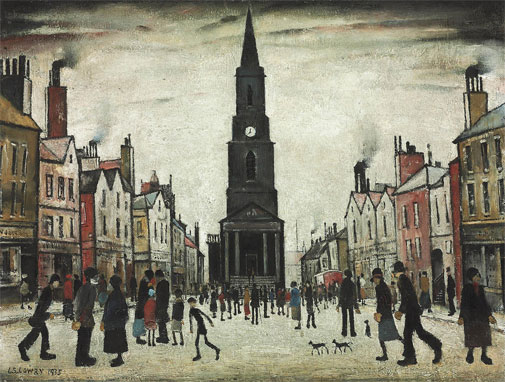
L S Lowry, A Market Place, Berwick upon Tweed (1935)

It is perhaps because of the naivety of Lowry’s draftsmanship, such as his figures, which are often referred to as “matchstick men” which has caused him to be relatively overlooked in the history of British art. I have often looked on amazon, for example, for a catalogue of Lowry’s oeuvre, but have found publications of his works to be woefully lacking. The only exhibitions I have attended of his works have been small scale sales of limited edition prints in private galleries, and I must have bemoaned the lack of a retrospective show of his work on at least a dozen occasions. It is therefore with great excitement that I await Tate’s show, and in the meantime fully intend to get everyone else excited by a small gallery below of some of Lowry’s works.

L S Lowry, Huddersfield (1965)

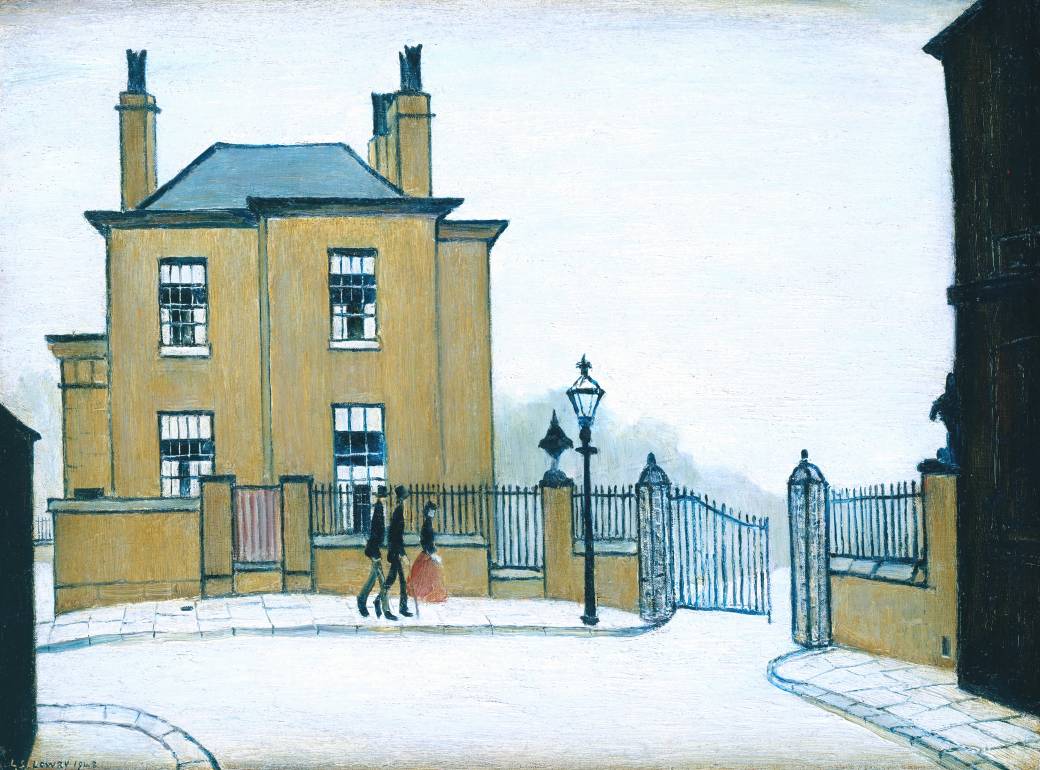
Bleak and grey as ever, the works rarely diversify from depicting scenes of industrialised Northern England where Lowry was born and worked and which, during the years of Queen Victoria’s reign had become a hub of industrialised growth leading to a population boom but a vast decrease in living conditions. Lowry demonstrates that England is not all lush green and pleasant lands as captured in works by Constable, or grand waterways and misty sea views as pronounced with such effect by Turner. Rather, these industrialised landscapes are typical of much of the country, even to this day, and Lowry’s paintings not only reflect upon the 20th century urban landscape, but also focus on the everyday lives of the ordinary masses. Yet in doing so, he rarely focuses on a single individual. Rather, through painting large groups, Lowry represents a typical city day for what it really is – large groups of people, all stripped of personality, as towns become influxed with workers, and the individual merges into one roving mass. Like the impressionists before him, Lowry is a proponent of the ordinary, but unlike the Manets and Degas of this world, Lowry depicts lives as most of us see them – crowds of faceless individuals, who represent statistics, but whose stories remain locked in the crowds.

L S Lowry, Industrial Landscape (1955)

L S Lowry, The Pond (1950)

L S Lowry, The Old House, Grove Street, Salford (1948)

L S Lowry, Coming out of School (1927)

Information of Tate’s forthcoming show can be found here.

Sunday Supplement: Tragic Conflict – Sophocles’ Antigone

Following on from last weekend’s greek inspired Sunday Supplement and food fest (still remaining to be shared – I’ll try to get it up this week!) I turn this Sunday to another of my paintings which looked to Greece for its inspiration. As a teenager I was an avid fan of Greek mythology and Greek tragedies from prolific ancient Grecian playwrights such as Aeschylus, Euripides and Sophocles, a passion which was founded in my A-Level classical civilisation studies and which continued when I travelled on my own “grand tour” around Europe, visiting the likes of Ithaca, supposed birthplace and kingdom of Odysseus, and Delos, the now deserted island of Apollo off the coast of Mykonos. All of this took something of a necessary backseat when I went on to study law at university, but resurfaced once again when I was studying a Masters in Medical Law and Ethics. As part of the ethics section of the course, we dealt with the question of tragic conflict – situations when, for example, a parent comes under a terrible dilemma when two co-joined twins require a separation: lose one twin to save the other or both will die – what do you do? As part of our ethical approach to the dilemma, we were directed to read Antigone, by Sophocles, a play in which a similar tragic conflict is played out. For King Creon, the tragic conflict was the choice between his role as King and protector of the State versus his role as family man. When one member of his family betrayed the State, what choice should he make? State, or family?

The play is a powerful one, and the moment I read it, the story began to play out as an illustration in my mind. I set to work on a new canvas, and this was the result.

Tragic Conflict: Sophocles’ Antigone (2006 © Nicholas de Lacy-Brown, Acrylic on canvas)

King Creon of Thebes saw people not in terms of love or blood, but through their role in the State over which he ruled. He threw out the body of his own great-nephew, Polyneices to the crows because of his treachery to the City, and sentenced to death his great-niece, Antigone, his moral antithesis, whose morality was based in blood and familial honour. In my painted interpretation, the play is illustrated on a never-ending chess board, and as such illustrates the regimental regime fronted by Creon. Every character in the play is represented as a chess piece, so that rather than as a human individual, they are illustrated only in relation to their role, as seen by Creon, in the State. But no game of chess can properly function without the moves of a human hand. In denying a place for humanity within his Kingdom and morality, Creon makes a tragic fault, and as perhaps the real tragic hero of the play, he sees his Kingdom destroyed, his family dead, and his loyal chorus (the pawns) desert him. Meanwhile, Antigone, the hand of human morality and protagonist of the play, marks the final blow to Creon’s tragedy as Polyneices’ honour is restored with the support of the gods, and Creon’s regimental world is blown apart. I should add that the can of “Dead Bull” (looking like “Red Bull”) represents the portents of death predicted by Creon’s priest.

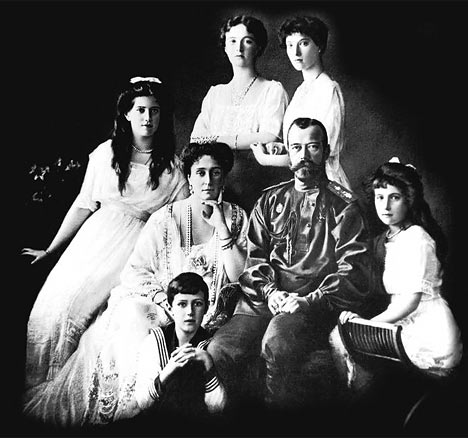
Tzar Nicholas II and his family

Creon’s dilemma is not unique to the times of ancient Greece. In 1917, King George V had a choice whether to save his cousin, Tzar Nicholas II and his family from the impending threat of the revolution in Russia, by allowing him asylum in the United Kingdom, or leaving the Tzar and his family to their peril in order to preserve the position of the Royal family in the UK amid fears that there would be a similar revolution in the UK, not to mention the fear that the Russian royals would become a focus for anti-reovolitionary focus in times of war. In the end, he chose his role as statesman and refused his cousin asylum. The decision must have been agonising, but like King Creon, he chose to protect the State over his family. The consequence for the Tzarian royal family was a tragedy indeed.

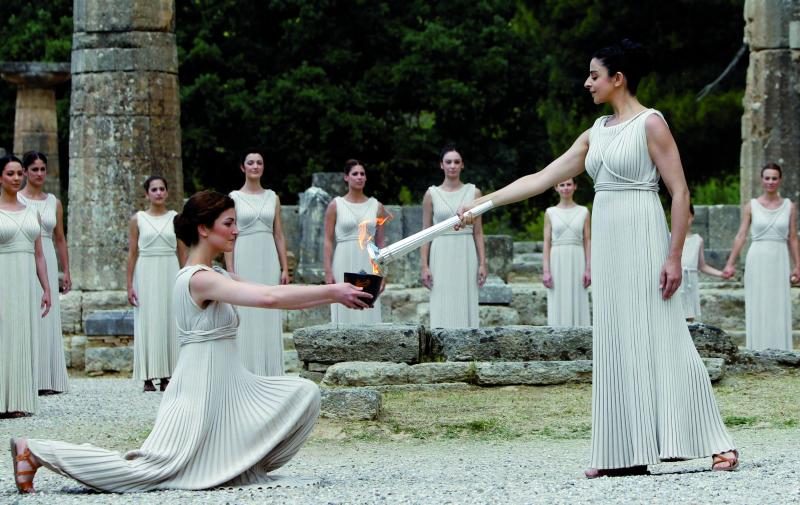
All this goes to show that Sophocles’ moral message is as relevant today as it was when he wrote it in or before 442 BC. This week saw the London 2012 olympic flame lit by the sun on Mount Olympus in a ceremony which reflected religious rituals from Ancient Greece. Press commentary on the ceremony made light of the “costumes” worn by the flame bearers and the frivolity of the dancing and the spectacle. I thought it was stunning, a moving demonstration that religions and traditions past, while mainly captured within the pages of mythology, still have the power to impact upon us and guide as all as we face both spectacles and moral dilemmas in our everyday lives.

Lighting of the Olympic flame

© Nicholas de Lacy-Brown and The Daily Norm, 2001-2012. Unauthorized use and/or duplication of the material, whether written work or artwork, included within The Daily Norm without express and written permission from The Daily Norm’s author and/or owner is strictly prohibited. Excerpts and links may be used, provided that full and clear credit is given to Nicholas de Lacy-Brown and The Daily Norm with appropriate and specific direction to the original content.

The madness continues: Rothko and Munch sales break new auction records (and steal yet more works from the public eye)

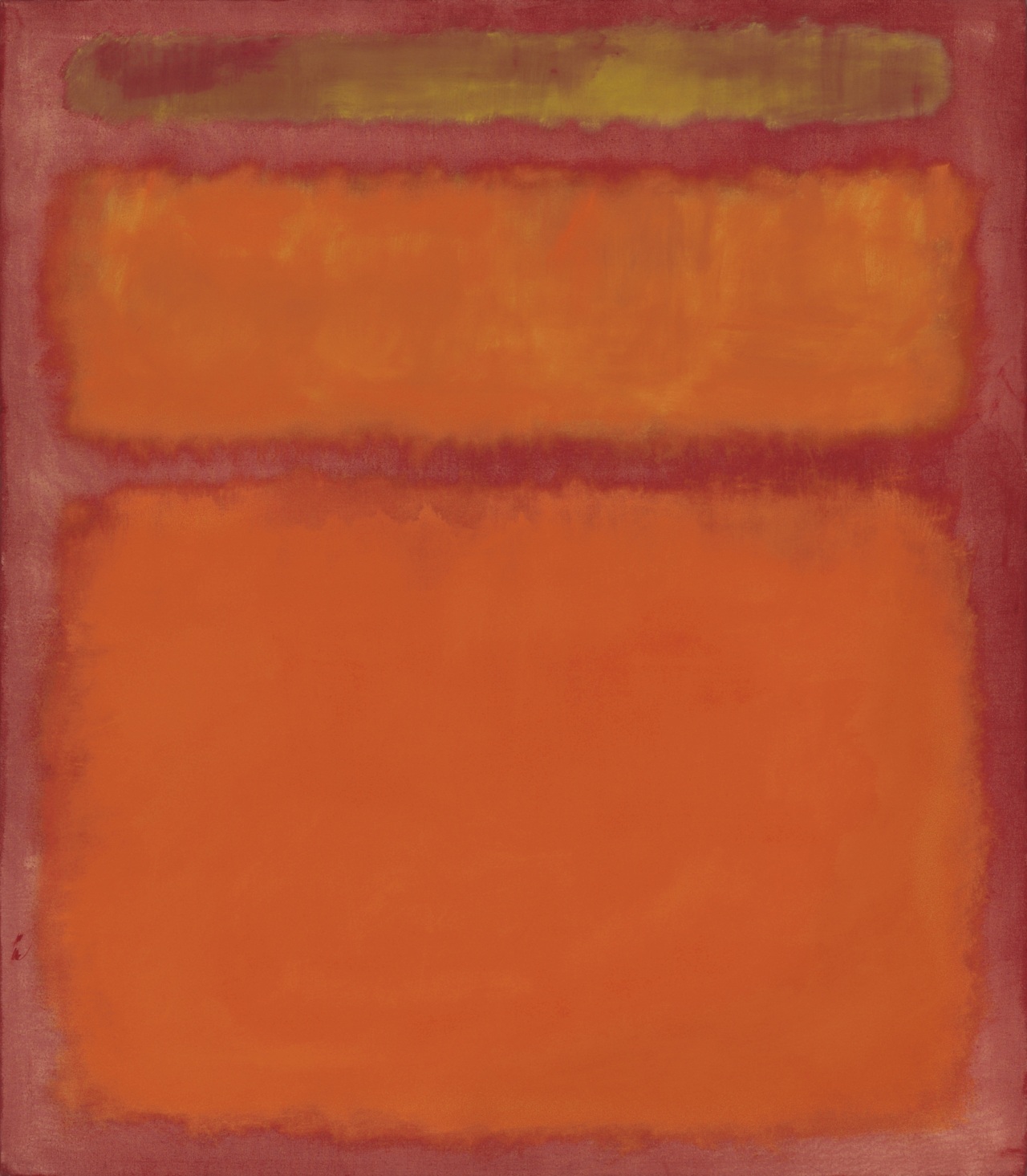
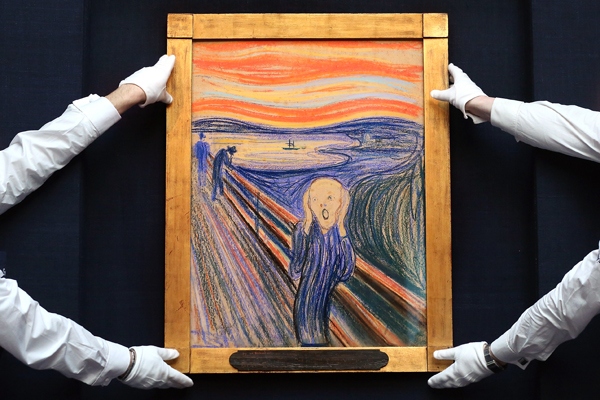
Your eyes do quite possibly deceive you. This is not a photo of haphazardly applied paint samples on my living room wall in the consideration of a new mediterranean-inspired coloured scheme. Oh no. It is a painting, originally entitled Orange, red, yellow by american artist Mark Rothko and not just any painting either. This striped bodge-job of a monotoned canvas has the honour of reaching the highest price ever fetched by a piece of contemporary art at auction when it sold at Christie’s auction house last night for $86.9million. And this sale comes only a week after a pastel version of Edvard Munch’s The Screan set a new world record for the highest price ever paid for an artwork (of its era) at auction at a price tag of some $119.9. Did I mention that half the world is in a recession?

Mark Rothko, Orange, Red and Yellow (1961)

That’s not where it ended either. With total takings of $388 million, last night’s Christie’s auction was the most lucrative in history. I’m sure I’m not the only person who feels slightly ill about this. This hideous commercialisation of art works is the same force which drives contemporary artists of our age to be amplified and promoted as serious artists purely because a rich man has backed them despite their decided lack of talent. It’s a world which most artists would gawp at, appalled at the rich men lavishing their coin over an art work, not because of its merit, but because its artificially escalated price tag defines them as wealthy men with apparent cultural appreciation despite their probable inability to tell you a single historical fact about the artist they have just lavished millions on. After all, wasn’t it Rothko himself who, upon being awarded a commission to paint two major mural commissions for the Seagram’s luxury Four Seasons restaurant commented that he wanted to paint “something that will ruin the appetite of every son-of-a-bitch who ever eats in that room. If the restaurant would refuse to put up my murals, that would be the ultimate compliment. But they won’t. People can stand anything these days.” What then would he have thought about one of his works selling for such an absurd sum, and entering the collections of one of the richest men on the earth? He’d say the same thing no doubt: people can stand anything these days, especially when it gives them a bit of status amongst all their equally rich friends.

Edvard Munch, The Scream (pastel)

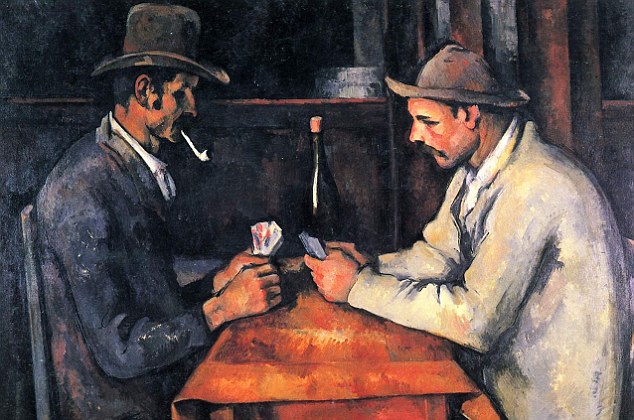
It’s not just about the price either. Munch’s Scream is thought to be making its way to the private collection of the Qatar royal family, and there it will join Cezanne’s Card Players sold to the Qatari royals for an equally absurd amount last year. What would Munch, whose painting represents a time of intense personal agony, or Cezanne, who spent his career agonising obsessively over finding a new way of representing the life of peasants and Provencial countryside, have thought about their works ending up in some dessert (and oil) surrounded palace in a part of the world where freedoms are suppressed, homosexuals are persecuted, and women are swathed in material, hidden from the view of men? Wasn’t the intention of the impressionists and post-impressionists and most artists for that matter to liberate through their art, to emphasise the lives of the ordinary people, be them whores or gays, women in the nude or men in emotional turmoil? I can almost hear Cezanne turning in his grave, no doubt somewhere near the Mont St Victoire, as I type.

Cezanne, The Card Players – bought by the Qatar Royal Family

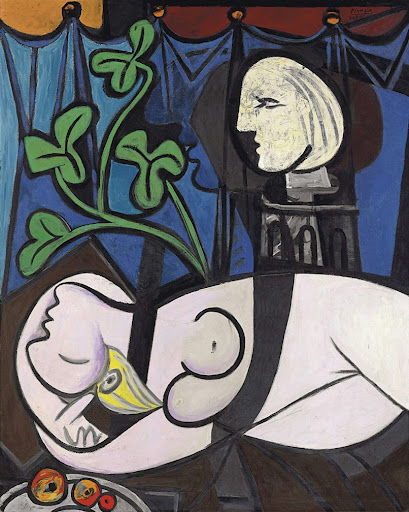
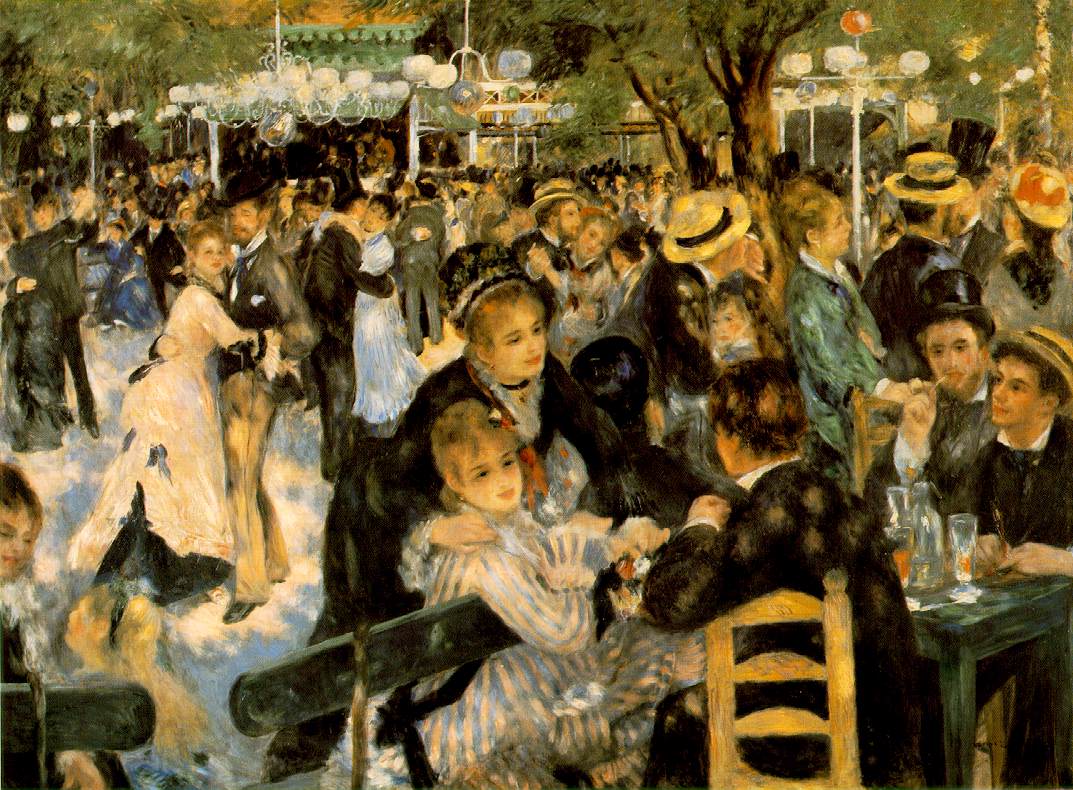
Worst of all is that the destiny of the majority of these privately bought paintings is to be hidden away in vast private collections, locked away from public view, as the increased secularisation and privatisation of the world’s masterpieces continues. And as the prices are pushed up, so too is the opportunity for a public gallery, most of them cash strapped, to ever acquire one of these great art works again. While the occasional private purchaser is good enough to loan their acquisition to a public gallery for public view, such as Picasso’s Nude, Green Leaves and Bust sold to a private bidder (thought to be a Russian oligarch) but currently on show at Tate Britain as part of its Picasso and Modern British Artists exhibition, most will never see the light of day again. Much like Renoir’s Bal du moulin de la Galette, purchased by Ryoei Saito in 1990 and supposedly never heard of from that day onwards.

Picasso, Nude, Green Leaves and Bust (1932)

It’s not like these paintings are stunning. Munch’s recently sold Scream was only a pastel study and not nearly as intense as the oil-painted original which thankfully remains on public view in Oslo. Rothko’s work on the other hand (for I hate to call it a “painting”) is a matter of personal taste, although I am sick of constantly being told that Rothko’s works are moving, incredibly important masterpieces worthy of my attention. Because they’re certainly no worthier of my attention than the blank canvases sat in my cupboard, and the only thing that moves me about them is why they are taking up valuable space in some of the most important contemporary art museums in the world. Anyway, I digress. No matter what my personal opinion is of Rothko, I recognise his place in art history, and once again I would prefer to see his works on public display for the contemplation of countless generations, than for the sole entertainment of a few Qatar Royals and a herd of camels.

Renoir, Bal du Moulin de la Galette

In an ideal world, legislation would be passed forcing public galleries to have first dibs when an important work comes up for sale, at a heavily reduced price of course. But sadly this is not how the world works. Everyone wants to make a profit, and no more so than the auction houses of London and New York who revel in their press-grabbing broken records in the same way that White Star Line encouraged a speedier Titanic voyage in order to make headlines with the ship’s early arrival in New York. And we all know how that story ended, don’t we.

Johan Zoffany: Society Observed

If you’ve read my last few posts, you’ll probably  know that the weather in London is bleak, persistently grey, and wintery cold. Sorry to go on, but to be fair, it has been like this since the beginning of April. So while we all gasped a sign of understandable relief to have a bank holiday weekend with one extra day off work, I for one did not relish the enhanced days of freedom alongside what looked to be a weather forecast stuck somewhere in December. So what to do with a wintery weekend in May save for staying in bed? Why, a good old exhibition of course.

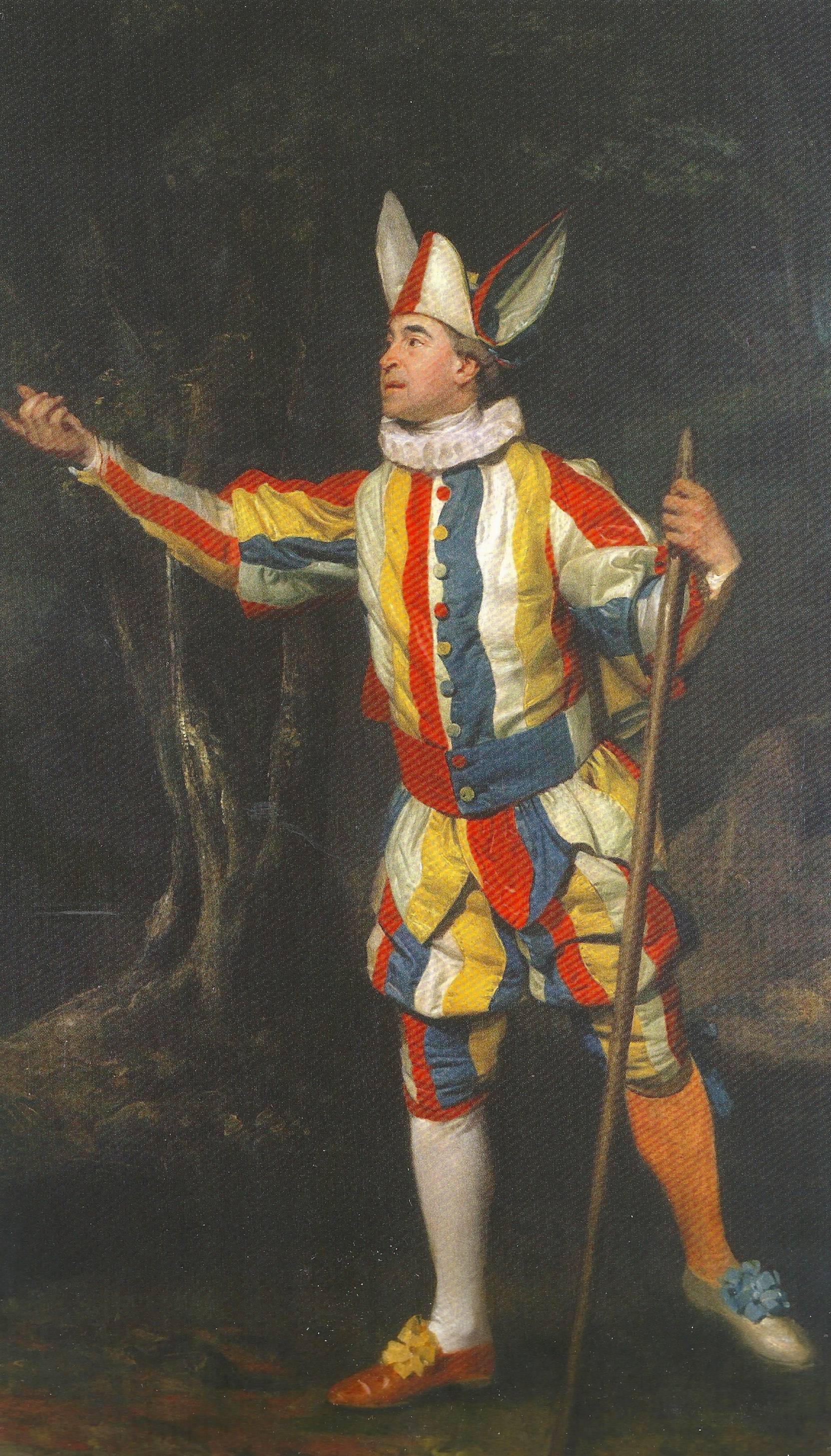
Thomas King as Touchstone in ‘As You Like It’ (1780)

London has been the European capital of exhibitions this year, from David Hockney for which queues formed an hour before opening and extended long past the Royal Academy courtyard until closing, to that Da Vinci spectacular at the National Gallery, for which queues not only spiraled around the whole of the West End, but tickets started reaching astronomical figures in the dark and dangerous world of the black market. We’ve had a bit of Picasso, and a whole show devoted to Lucien Freud, and now we have the master of marketing manipulation himself, Damien Hirst, installed at Tate Modern. But otherwise things are drying up a bit on the exhibition front, with some new shows promised towards the end of the year, but nothing compared to the blockbuster paroxysm which we had at the start (I’m not too sure why they decided to show the best stuff at the beginning of the year before the Olympics start… but owing to the ridiculous crowds experienced when it was just us Brits in tow, it’s probably a good thing that we didn’t have to compete with the rest of the world in the galleries as well).

Henry Knight of Tythegston with his Three Children (1770)

So this weekend I had a choice of Hirst, which I’m trying to put off for as along as possible because he makes me angry, Nicholson/ Mondrian which looks a bit geometric, Turner, which is all very well but a bit samey, and this Zoffany chap at the Royal Academy. I’ve never heard of Zoffany before, but seeing as the Royal Academy is currently in a visitor loll, after the close of Hockney and before the opening of their annual car crash – The Summer Exhibition – I decided to give him a go.

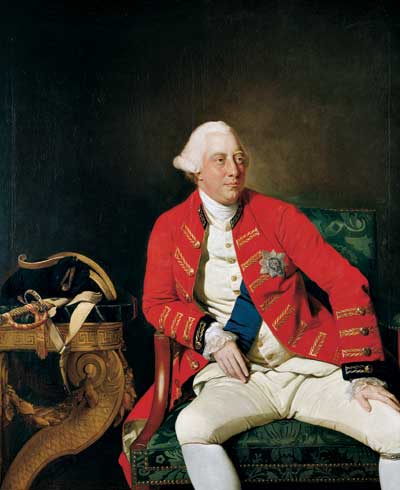
Johan Zoffany (1733-1810) was born in Frankfurt, Germany, but moved to England at the age of 27. A keen socialite and excellent networker, he soon found himself the darling of the rich, influential aristocrats and profligate patrons of the age. Within four years he was enjoying the patronage of King George III and his wife Queen Charlotte, and was also the beloved of the Austrian Royals, being created a Baron by the Archduchess Maria Theresa at the age of 33.

Zoffany was a keen social observer. Through his connections in high society, and through his friendship of leading actor of the  time David Garrick, Zoffany was afforded countless opportunities to paint scenes enriched by the lively portrayals of contemporary society, from lavish theatrical productions of Shakespeare’s As You Like It and Macbeth, to complex portrayals of musician troupes, families in conversation and at play, large social gatherings watching cock fights in India and attending the Uffizi in Florence, and the Royal Family in both formal attire, and playing dress up.

George III (1771)

The distinctive thing about Zoffany’s works is this element of social interaction which he portrays. Unlike many portrait painters of his day, he did not paint head to toe, stiffly posed portraits. Rather he painted his sitters, both singularly, as couples or as large groups, interacting and in the course of “doing”. For this reason, his paintings are both wonderfully natural, and appear to represent a highly realistic snapshot on society of that day. This realism is of course vastly augmented by his meticulous attention to detail and his impeccably intricate fashioning of fabrics, furniture, interiors and objects.

The show starts with a number of mythological and allegorical pieces. One of my favourites was this, David with the Head of Goliath (1756). Some have asserted that the piece is a self-portrait, others disagree, but all comment upon what appears to be the purposeful homoerotic and phallic nature of the piece, as David’s sling hangs close to Goliath’s open mouth, while David stares out provocatively, holding what appears to be the glans of a marble phallus from an antique sculpture in his hand.

David with the Head of Goliath (1756) National Gallery of Victoria, Melbourne.

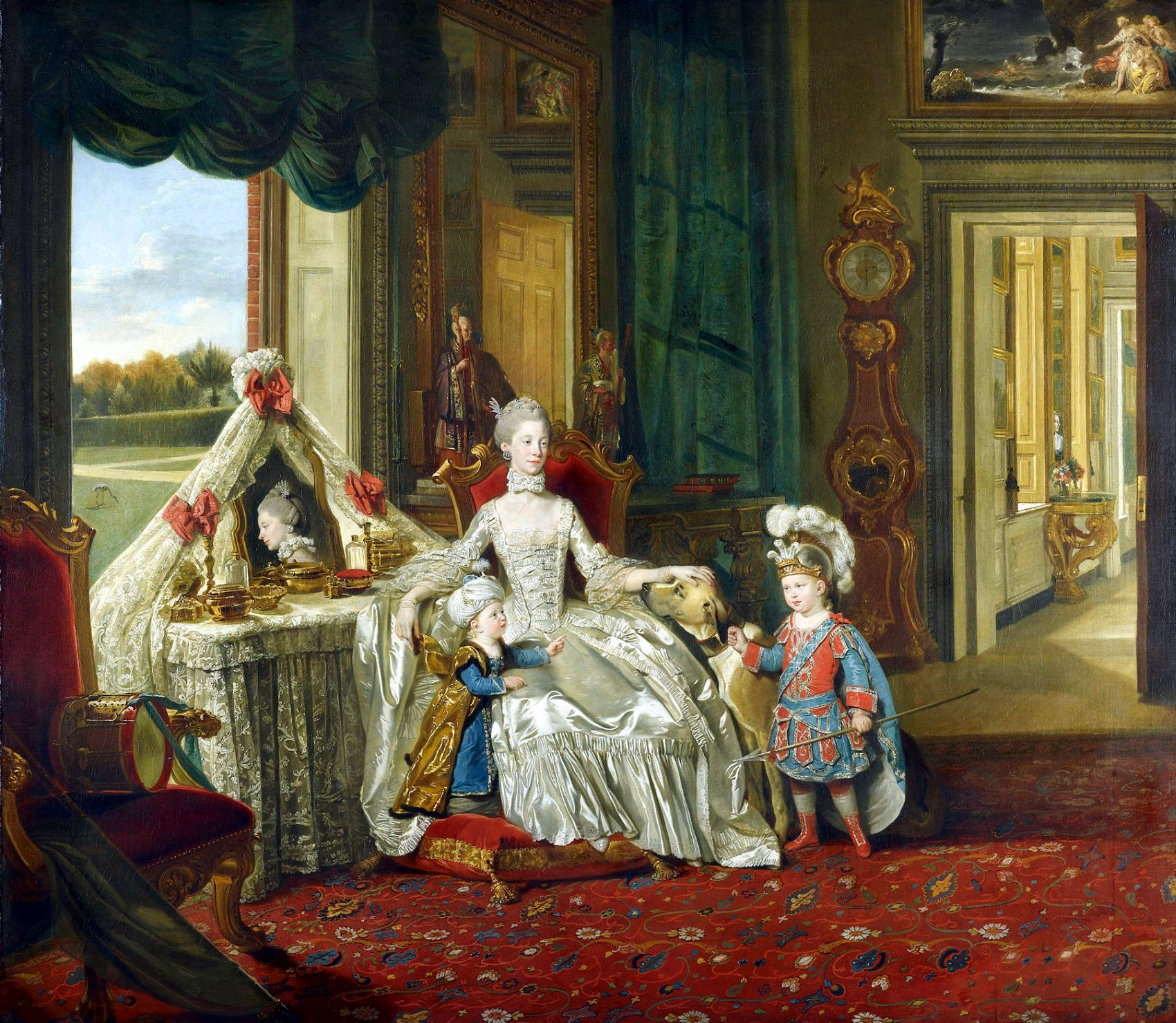
Of Zoffany’s various Court paintings, my favourite was this one, showing Queen Charlotte with her sons George, Prince of Wales, and Frederick, Duke of York. Asides from the cuteness of the young prices dressing up, one as Telemachus, son of Odysseus from Homer’s Odyssey, and the other in a Turkish costume, the thing that struck me most about this painting was the stunningly executed drapery of Queen Charlotte’s dress, painted with exquisite skill and attention to detail.

Queen Charlotte with her Two Eldest Sons (1764-5), The Royal Collection of HM Queen Elizabeth II

It wasn’t all high society that Zoffany observed. This painting, of an optician with his attendant, exhibits with great sensitivity two ageing craftsmen in a cluttered workshop filled with a plethora of materials each painted with intricacy and realism. For me, it is reminiscent of a an old Dutch interior scene by the likes of Vermeer, but with the added intensity and captivating quality held in the direct gaze of Mr Cuff the optician.

John Cuff and his Assistant (1772), The Royal Collection of HM Queen Elizabeth II

Zoffany’s real skill lay not only in social observation, but in his attention to detail. One of my stand out favourites of the exhibition was this painting, showing the library of Charles Townley complete with a large variety of sculptures from antiquity echoing the grand tour travels which were so fashionable in those days across continental Europe, and in which Zoffany too indulged when he went to Italy for a number of years at the behest of his patron, Queen Charlotte.

Charles Townley’s Library No. 7 Park Street, Westminster (1781-3, 1792, 1798)

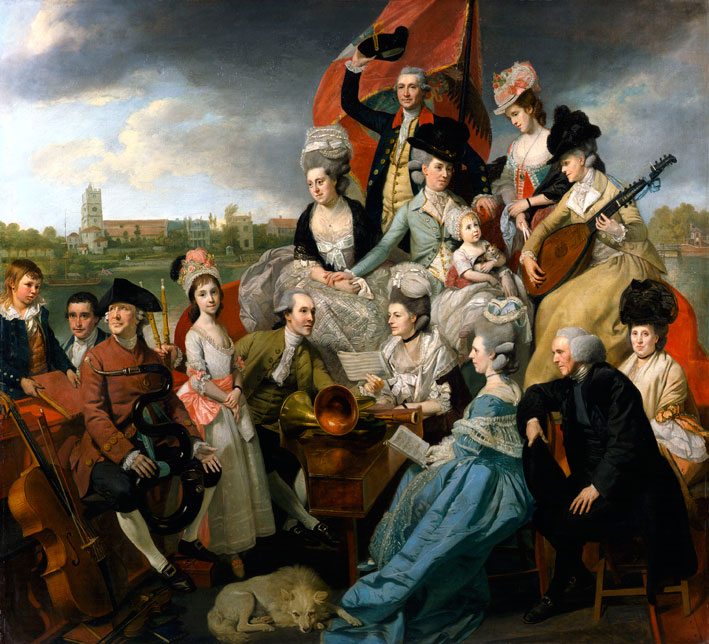
Finally I loved this group portrait of the Sharp family, a family of musicians who used to gather together once a fortnight to give performances. In the summer these performances were given by the Sharps on yachts, shallops and barges in what they termed “Water Scheems”, becoming so well known in doing so that they captured the attention of George III himself. This painting shows one such gathering on a barge on the River Thames – you can see Fulham Church in the background.

The Sharp Family (1779-81), National Portrait Gallery

This exhibition just goes to show that sometimes it’s the old masters and past artists, although perhaps lesser known, but whose skill is nonetheless indubitable, that really shine. The Hockneys and the Hirsts of this world may pull the crowds, seduced and manipulated as they are by the media sway, but the real treasures are to be found in the oeuvres of the past masters, painters who worked at a time when skill was King, and an unmade bed was swiftly remade and freshened, not displayed in a gallery or proclaimed a masterpiece of art. We can always live in hope that such days of aesthetic appreciation and just reward will return. In the meantime head along to the Royal Academy. The show is on until 10 June 2012.

Sunday Supplement: Achean adventure and Cruise thru Cubes

I’m in Greece mode. It all started the other night when I was channel flicking in a desperate attempt not to go to bed which means the inevitable rise the following morning for work. In the process, I staggered upon the film version of Captain Corelli’s Mandolin starring Nicholas Cage and Penelope Cruz and I was entranced. Despite having the film on DVD in my cabinet and having seen it at the cinema when it first came out, I’ve always dismissed the film to some extent because, like many other fans of the sensational Louis De Bernieres original novel, I was pretty upset about how much the film changed the charm, and crucially the ending of the book. I wasn’t best pleased about the casting of Cage as Captain Corelli either, who I had always imagined to be a short, rotund charismatic fellow.

Nevertheless, when I caught a glimpse of the film, it entered my flat, descended with the rest of the UK into a renewed wintery gloom, with a much needed breath of fresh summery air. Who cannot be seduced by the stunning cinematography of the film which was set exclusively on the island of Cephalonia, as De Bernieres had intended.

So all of this has sparked off a Greek revival in my flat. Greece has been getting a lot of bad press recently, what with financial disaster threatening to instigate a total collapse of the single European currency, and countless violent strikes and protests reacting against the suffocating austerity budgets imposed across the county. But while its coffers may be found wanting, what Greece does have is a wealth of cultural and historical richness which is almost unrivalled, not to mention a cluster of beautiful island destinations, each with their own individuality and incredibly picture-postcard views.

The beaches of stunning Cephalonia

I was lucky enough to  visit the Greek islands twice during my gap year back in 2001/2, first piggybacking with my sister upon my parents’ wedding anniversary celebratory cruise around the Aegean Sea, and later in the year, joining two very good friends for a little island hopping around the Ionian Islands of which Cephalonia is one. While I would love to return to these gorgeous lands, where empty beaches and crystal clear waters can be found in their plenty, along side charming crumbling houses, and dry arid landscapes and mountain passes, I have in the meantime satisfied myself by grabbing the Captain Corelli DVD and watching the film through not once, but twice. I have also been cooking dish after dish of Greek treats (hopefully to be featured on my blog sometime this week) and now, for your viewing pleasure, I’m featuring two of the paintings I completed back in my gap year, at the ripe age of 18, when I first visited Greece on my parents’ anniversary cruise.

Shot from the film of Captain Corelli’s Mandolin

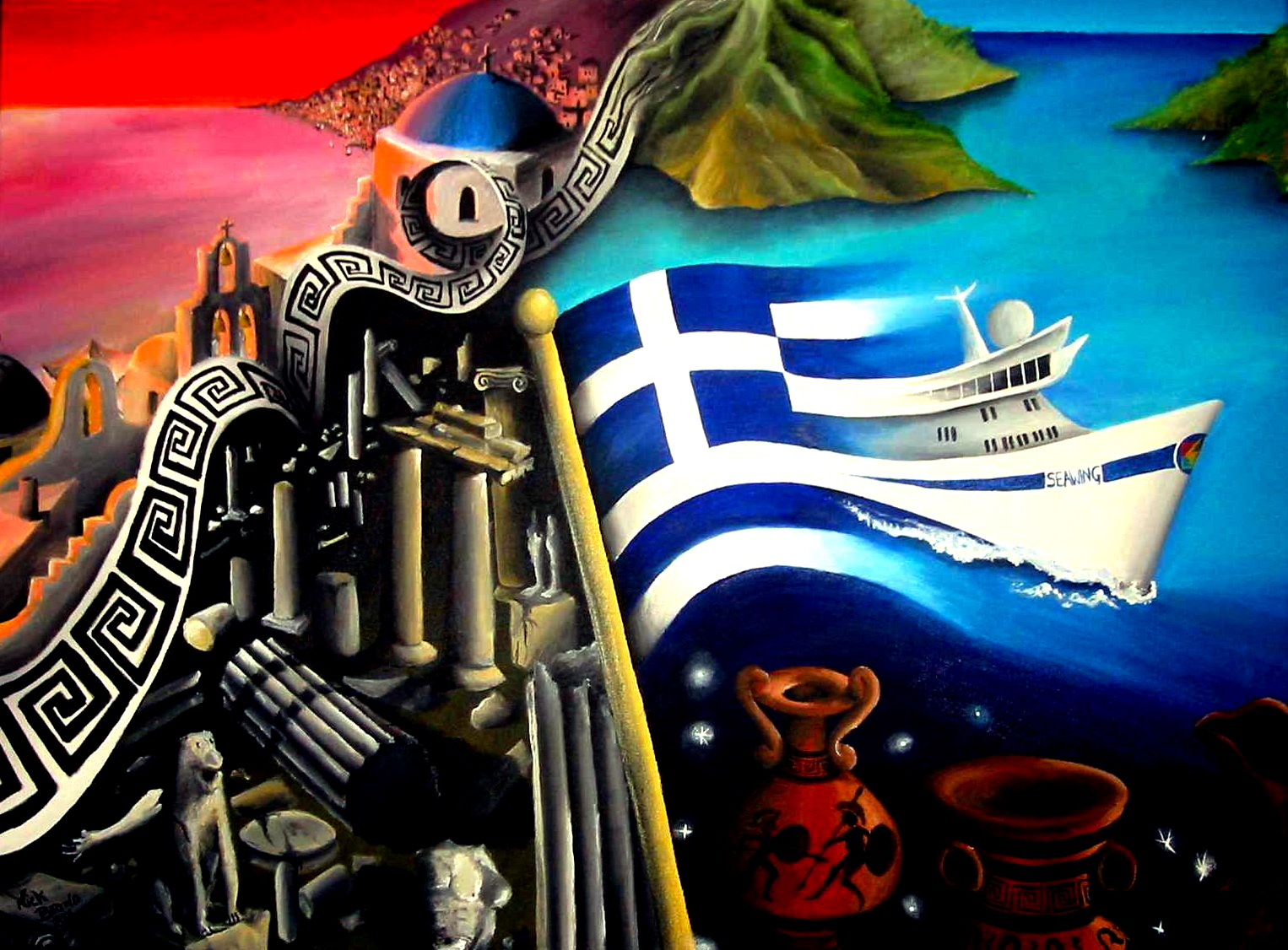
The first painting, Achean Adventure (2001), reflects not only upon the cruise liner, which can be seen emerging from the Greek flag, but also the antiquity which features predominantly across Greece (and which had a particular fascination for me having just completed my A-Level classics studies at the time) and the beautiful Grecian landscapes such as this one, of the island of Santorini.

Achean Adventure (2001 © Nicholas de Lacy-Brown, acrylic on canvas)

The second painting, Cruise Thru Cubes (2001) works like a multilayered exploration of our cruise around the Aegean Sea. Uncover various layers of the painting, and you see the cruise liner having docked and sailed in a variety of different destinations across the cruise, amongst them Mykonos (on the right) and Santorini (on the left).

Cruise thru Cubes (2001 © Nicholas de Lacy-Brown, acrylic on canvas)

It’s good to give these paintings a good airing. Completed over ten years ago, they were some of my earliest painting attempts, and Achean Adventure was sold shortly after I painted it when it was first exhibited in Sussex.

Hopefully this post will bring a little mediterranean sunshine into your Sunday especially if, like mine, it’s gloomy like hell. I’d better sign off now… I feel the need to shop around for a cheap trip to Cephalonia…

© Nicholas de Lacy-Brown and The Daily Norm, 2001-2012. Unauthorized use and/or duplication of the material, whether written work or artwork, included within The Daily Norm without express and written permission from The Daily Norm’s author and/or owner is strictly prohibited. Excerpts and links may be used, provided that full and clear credit is given to Nicholas de Lacy-Brown and The Daily Norm with appropriate and specific direction to the original content.