Skip to content

Posts tagged ‘Review’

London’s homage to print: Part 2 – David Hockney Printmaker

Last week I told you all about the first of two high profile celebrations to printmaking currently being held in London. The first, Renaissance Impressions at the Royal Academy charts the development of woodcut to create all of the depth and powerful contrast of chiaroscuro in the 1500s. The second unveils a whole new side to celebrated contemporary artist, David Hockney, best known for his colourful Los Angeles Swimming Pools and large scale multi-piece canvases of the Yorkshire countryside, but here shown to be as skillful a printmaker as he is a painter, or, in my opinion, more so.

In presenting this brilliant little exhibition, Dulwich Picture Gallery shows Hockney as a subtler artist; without the distractions of his trademark bold colours, this is Hockney the skilled draftsman; without the almost theatre-scenery sized canvases, here we see Hockney as a man of detail, capturing intimate scenes with a personal aspect, and delivering sometimes simple still lives but with all of the energy of those familiar swimming pool scenes.

David Hockney, Lithographic Water Made Of Lines And Crayon (Pool II-B) 1978-80 © David Hockney / Tyler Graphics Ltd

David Hockney, Lithographic Water Made Of Lines And Crayon (Pool II-B) 1978-80
© David Hockney / Tyler Graphics Ltd

David Hockney, Self Portrait, 1954 © David Hockney
David Hockney, Self Portrait, 1954
© David Hockney

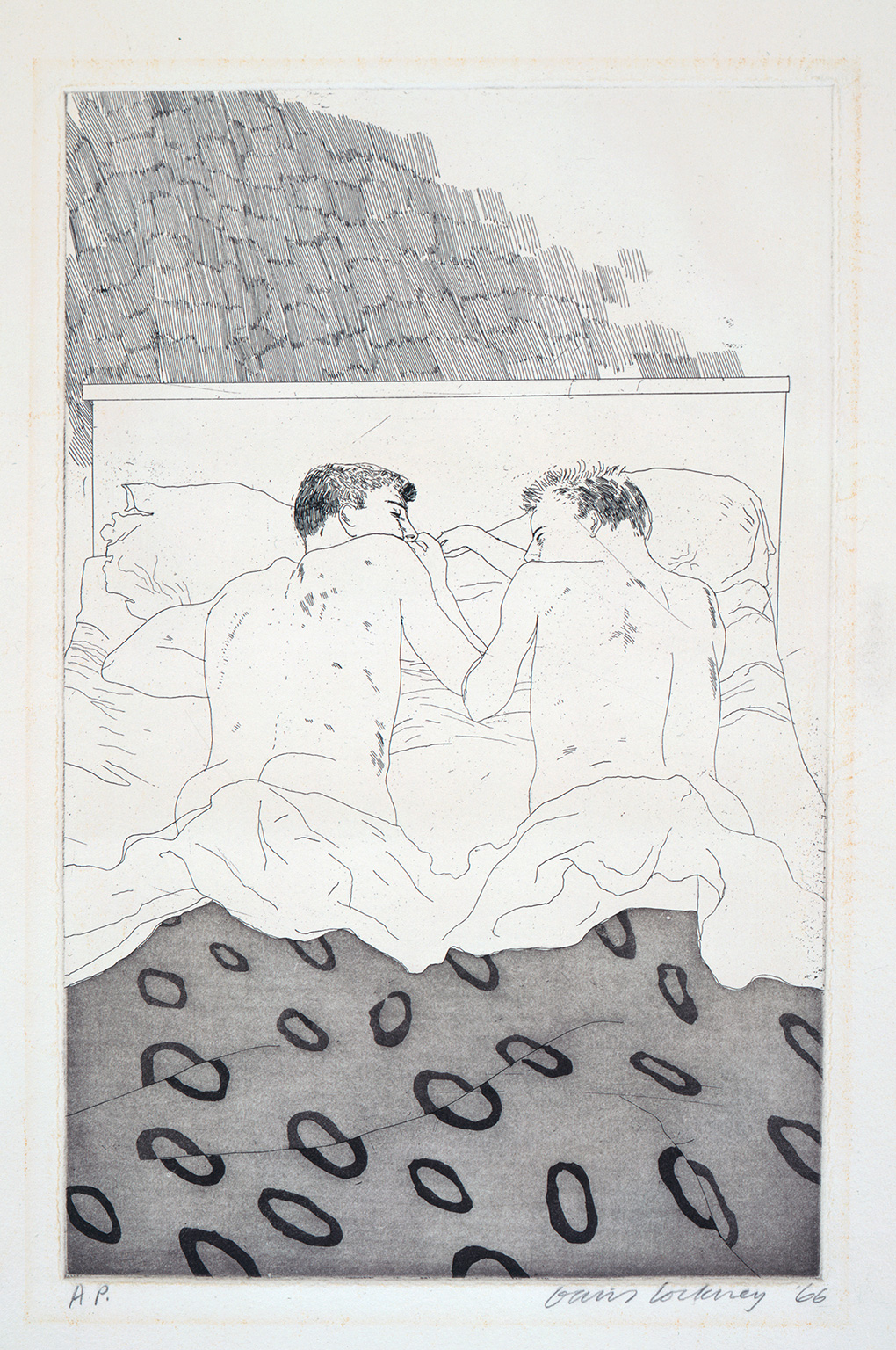
David Hockney, Two Boys Aged 23 or 24 from Illustrations For Fourteen Poems from C.P. Cavafy, 1966-67

David Hockney, Two Boys Aged 23 or 24 from Illustrations For Fourteen Poems from C.P. Cavafy, 1966-67

It is abundantly clear, from the first room of the chronologically hung exhibition, right through to the last, that printmaking has been an important and consistent accompaniment to Hockney’s creative process throughout his career. From his first etchings, amusingly poking fun at his fine art degree (I like the etching which was created using his actual fine art diploma, The Diploma (1962)) and taking a new spin on Hogarth’s The Rake’s Progress, pictorially describing Hockney’s own move to, and development in the US, right through to his recent and renowned use of the iPad as a new digital tool for creating print works, Hockney embraced print and all of the possibilities it provided for artistic expression. His main printmaking stints appear to have been in etching (which lends beautifully to the simple linear illustrations for Cavafy’s Fourteen Poems) and lithography (his print version of his famous swimming pool series being a particularly good example), although Hockney also extended into less traditional print methods – his use of a coloured photocopier to gradually build up a complex image was, for example, particularly effective.

But asides from Hockney’s excellent handling of the medium of print, the images themselves make this show a clear sell-out success. In his Cavafy series, Hockney’s prints exude a wonderful, but always polite intimacy which seems to be characteristic of his somewhat reserved but slightly cheeky persona. With their common place objects and models staring straight out from the print, these images appear to welcome the audience into the works. As viewers, we don’t feel like voyeurs, but more like welcome participants; friends joining in on the happy-go-lucky lifestyle Hockney portrays. In his later Mexico works; Hockney gives us a vivid, energetic lithography whose varying angles and stilted perspective appear to pulsate and dance to the rhythm of that hot Latin country, and remind me a little of the stunningly colourful Grand Canyon works he painted in the late 90s.

David Hockney, Views of Hotel Well III, 1984-85 © David Hockney / Tyler Graphics Ltd., Photo Credit: Richard Schmidt

David Hockney, Views of Hotel Well III, 1984-85
© David Hockney / Tyler Graphics Ltd., Photo Credit: Richard Schmidt
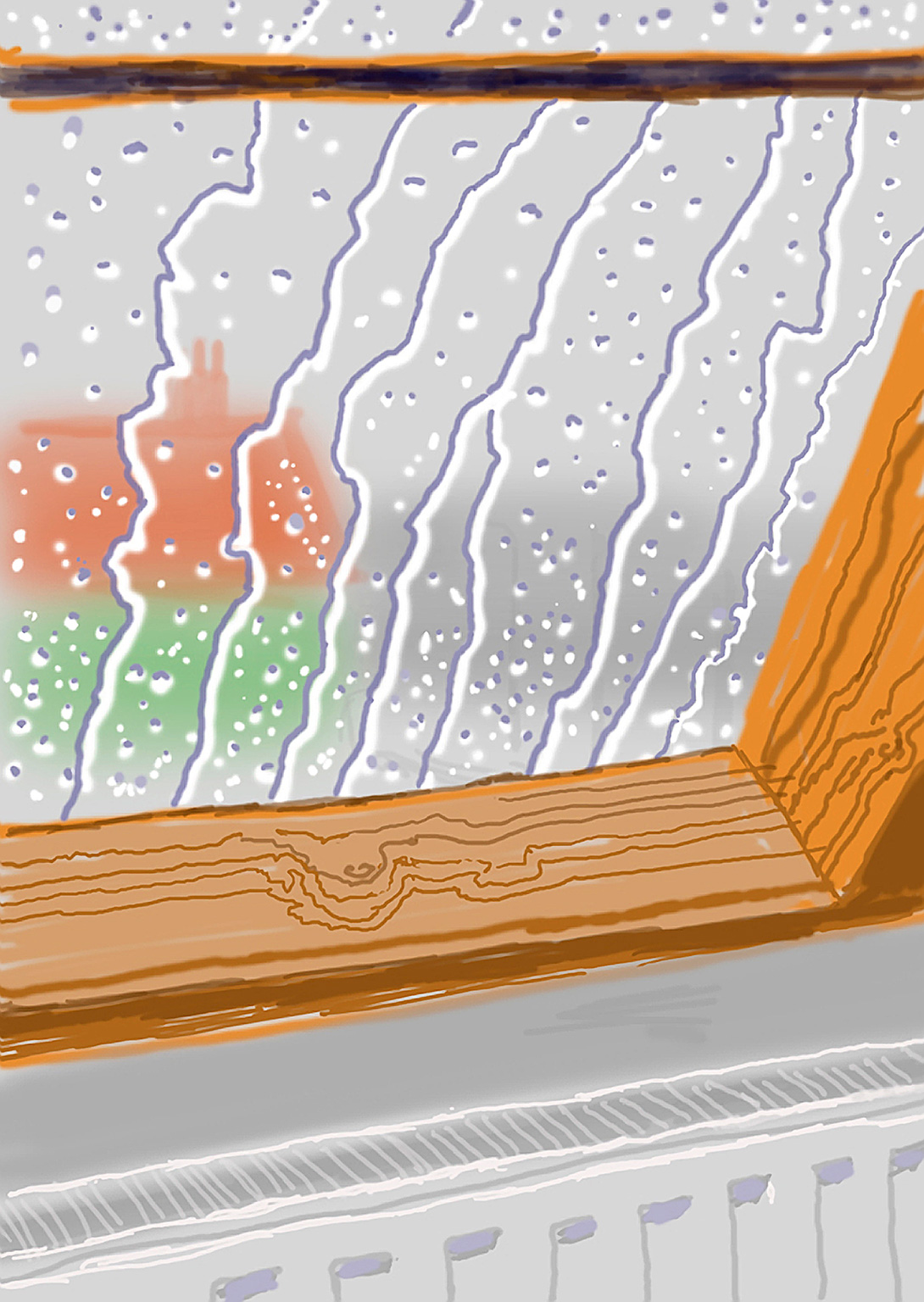
David Hockney, Rain on the Studio Window, From My Yorkshire Deluxe Edition, 2009

David Hockney, Rain on the Studio Window, From My Yorkshire Deluxe Edition, 2009

David Hockney, Artist and Model, 1973-74 © David Hockney

David Hockney, Artist and Model, 1973-74
© David Hockney

David Hockney, Lillies, 1971 © David Hockney

David Hockney, Lillies, 1971
© David Hockney

I also found that some of the best works were the simple ones – a vase of cala lilies, with an accurate and precise cross-hatched background contrasting with the purity of the white flower; a superb iPad image of raindrops running down a window which exudes the cosiness of looking out at rainfall while benefitting from the dryness and comfort of home; and portraits of friends, simply posed, looking straight out at the viewer, prompting interaction, welcoming us in.

It is, therefore, a show with something for everyone, but with an overriding central devotion to the versatile, unique art of printmaking.

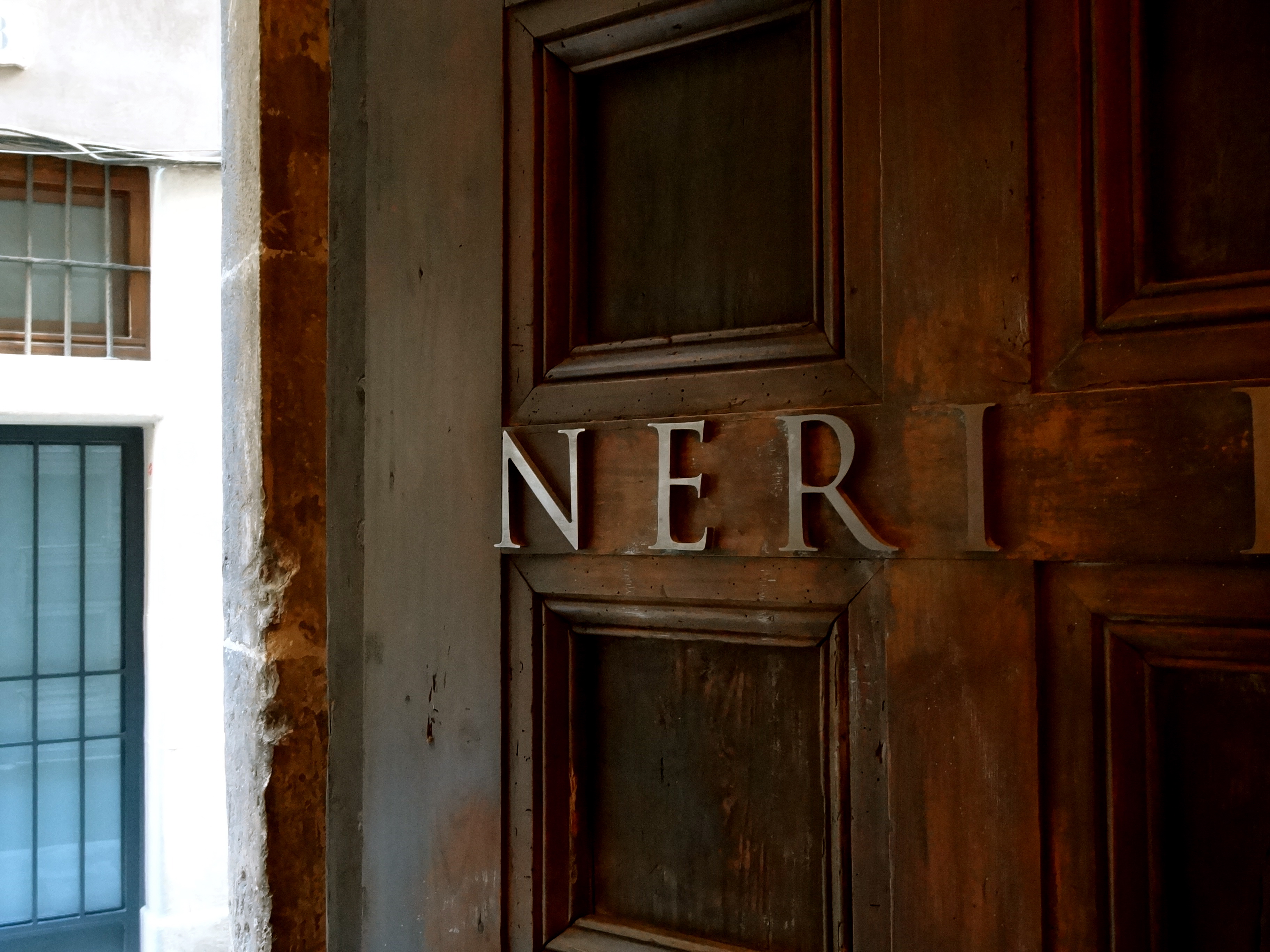
Barcelona | The Hotel Neri

For years I have walked past the Hotel Neri on C/ Sant Sever, nestled as it is in the atmospheric narrow streets of Barcelona’s gothic quarter, and swooned in admiration: Admiration for a hotel so perfectly situated in between the old gothic Cathedral and the church of Santa Maria del Pi; for the sophistication of its low lit interiors, its large plate glass doors and its stylised furnishings, all of which I had peeked when I passed by its windows; and for the preeminent offerings of its esteemed restaurant, which I first sampled back in 2010. But come 2014,  the opportunity finally arose to upgrade from diner to full-time guest, as I took my place in this wonderful hotel – albeit, sadly, for a mere 3 days and nights.

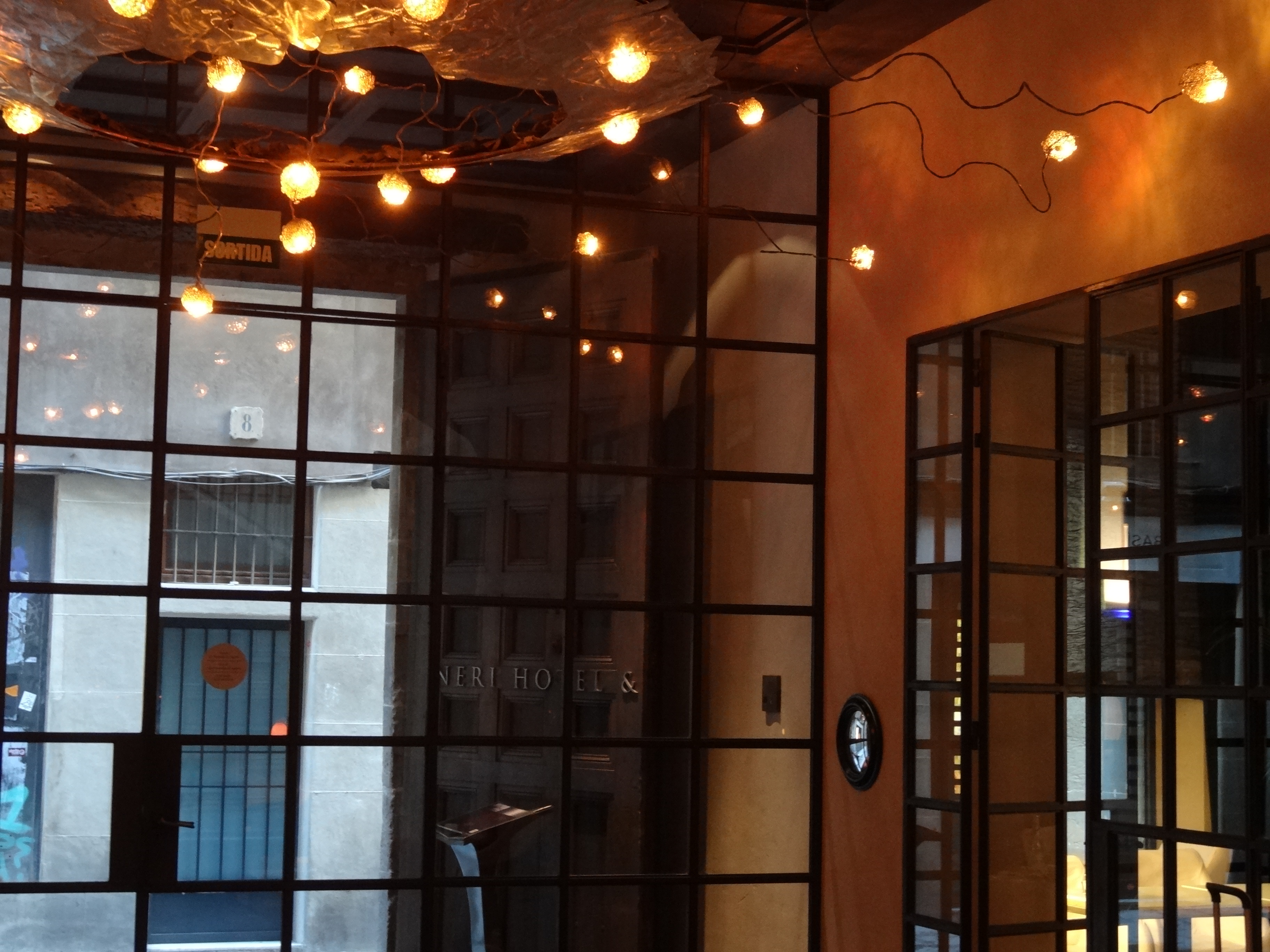
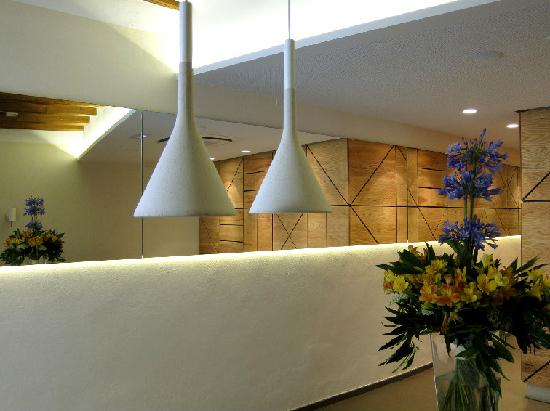
The striking design of the Hotel Neri, which is a member of Relais and Chateau, and part of the Anima Hotels group, is obvious from the moment you first walk into the ambient reception via the beautifully renovated Sant Sever entrance. The interior designer, Cristina Gabás, has combined the historical aspects of this building, some of which dates back to the 12th century, with the sleek modernity which goes hand in hand with the boutique quality which characterises this hotel. With low hanging lights and heavy dark green velvet curtains; large areas of glass set within rough stone and alongside elegant crystal chandeliers, the reception is the ultimate showcase to the high standard of design chic which is consistent throughout the hotel.

Reception chic

DSC02918 DSC02493 IMG_3893 DSC02452 DSC02917 IMG_3897 IMG_3876

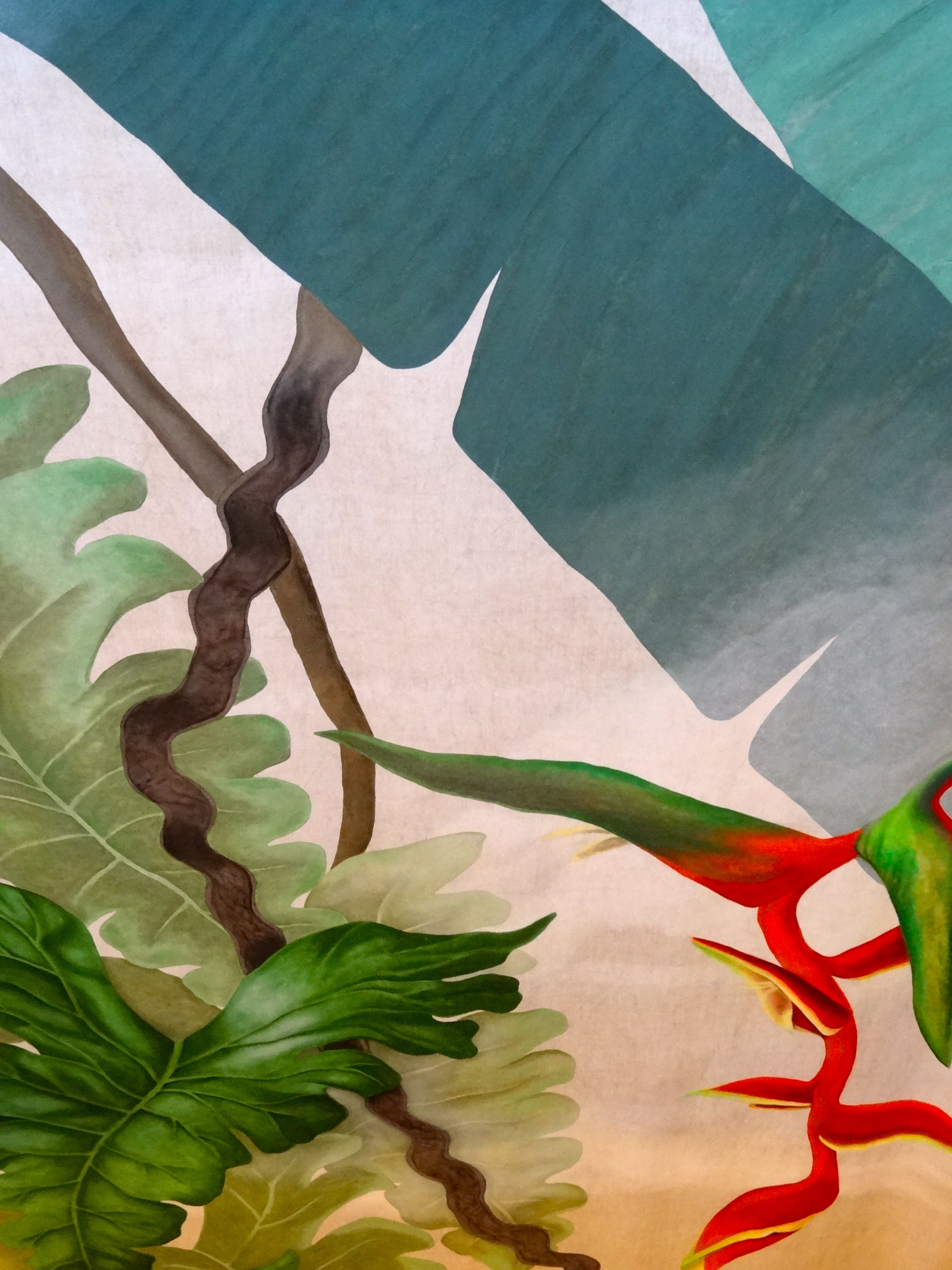
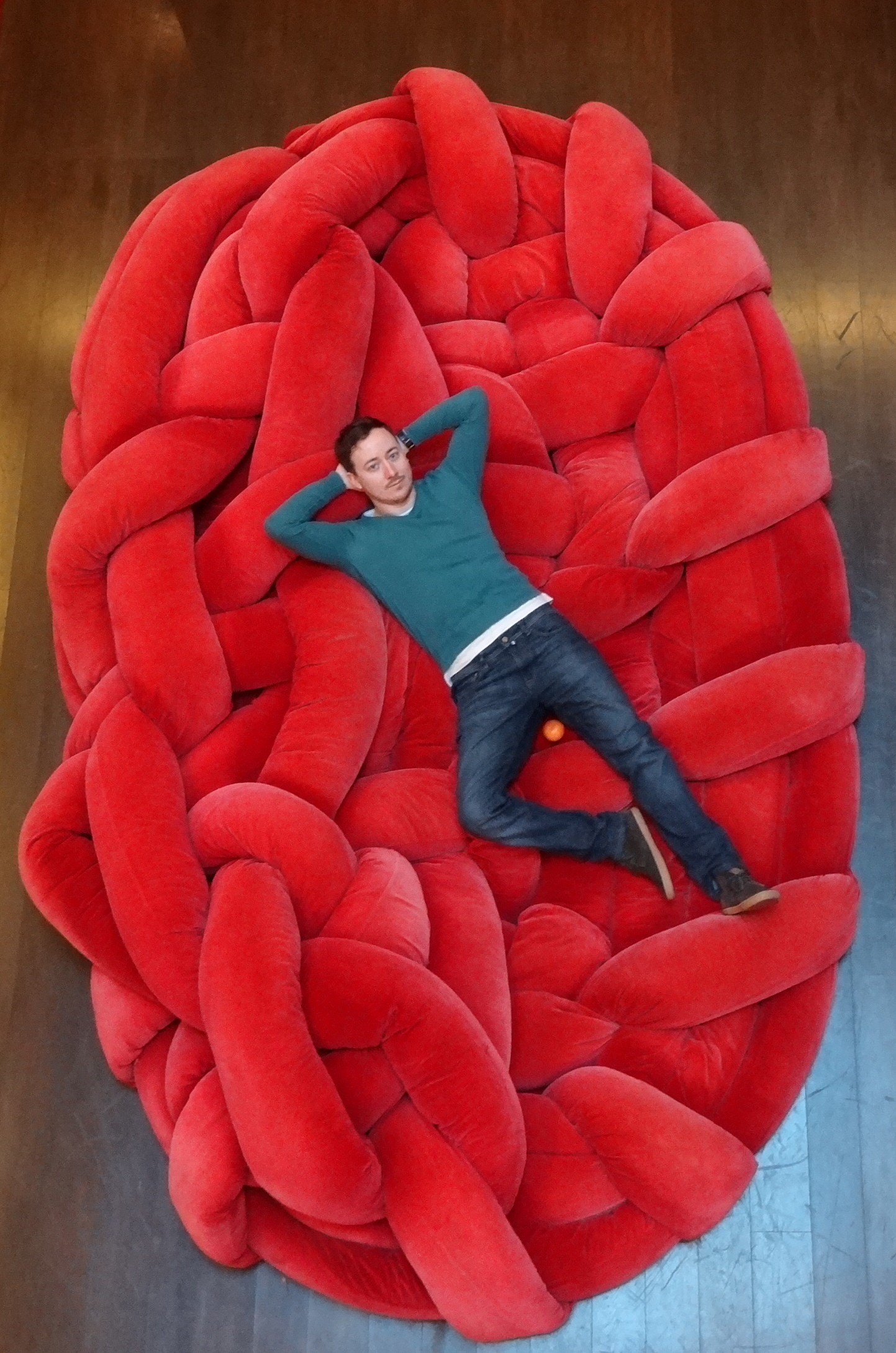
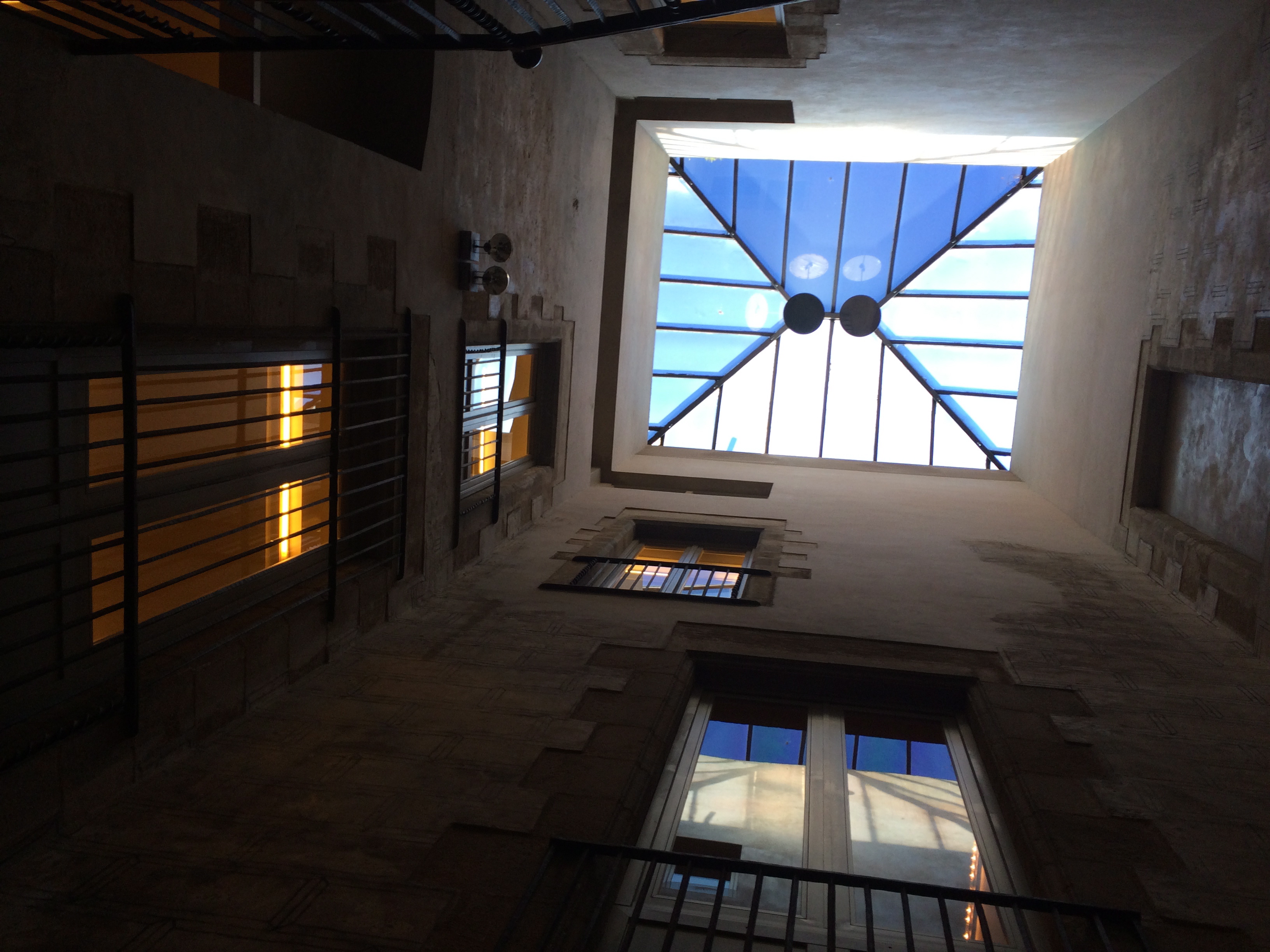
One of our favourite areas was an inner courtyard towards the back of the hotel. Glassed over at the top and plunging through the entire height of the hotel, this open courtyard area lent light and airyness to the hotel, while a large botanical design tapestry hanging down the entire height gave further freshness and dynamism to the design. And if that image represented the jungle, the huge vivid red cushion-come-sculture at the foot of the tapestry must have been the exotic fruit. It was surely comfortable to lie out on!

DSC02433 DSC02467 IMG_4019 DSC02435 IMG_3901

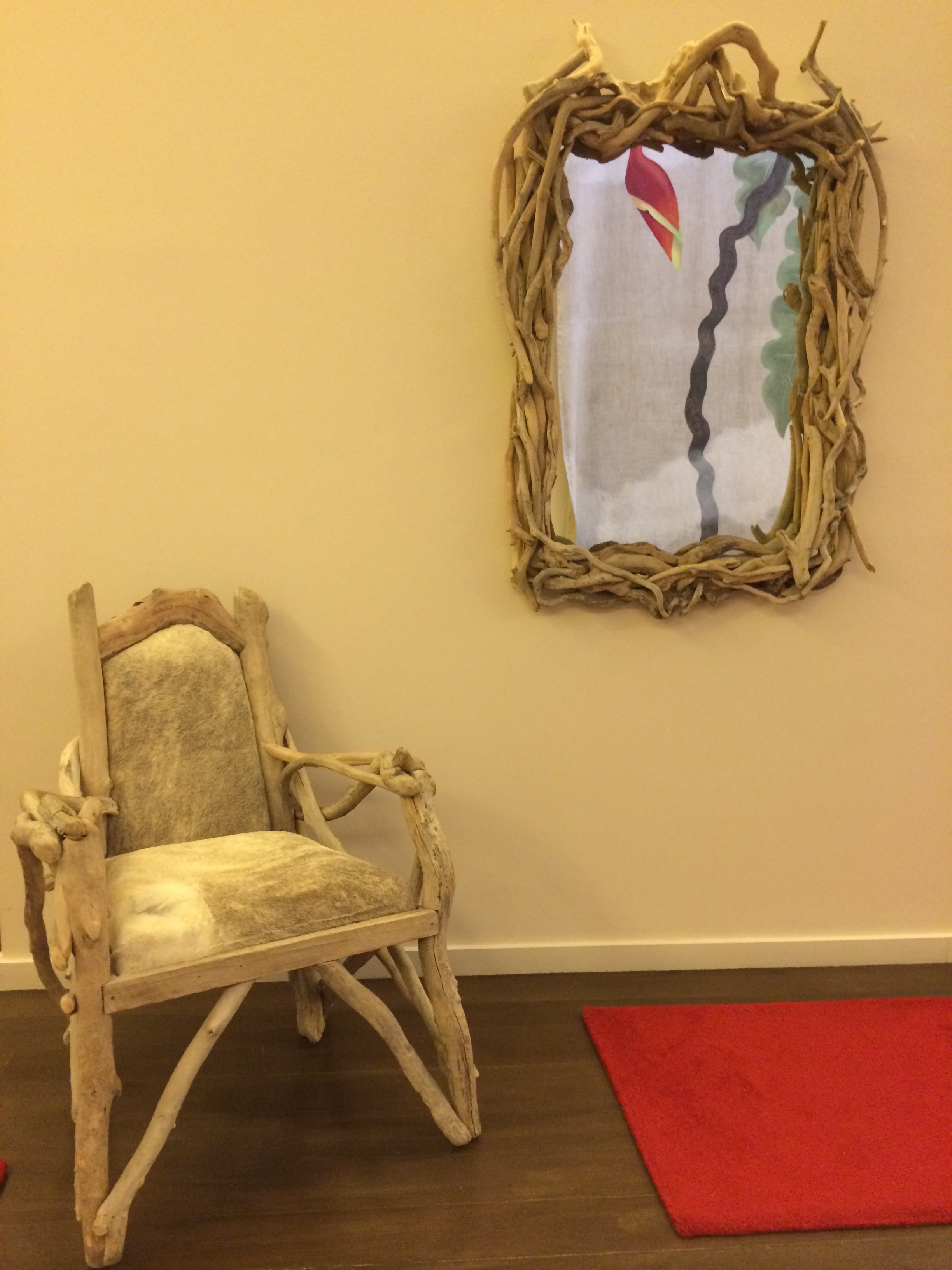
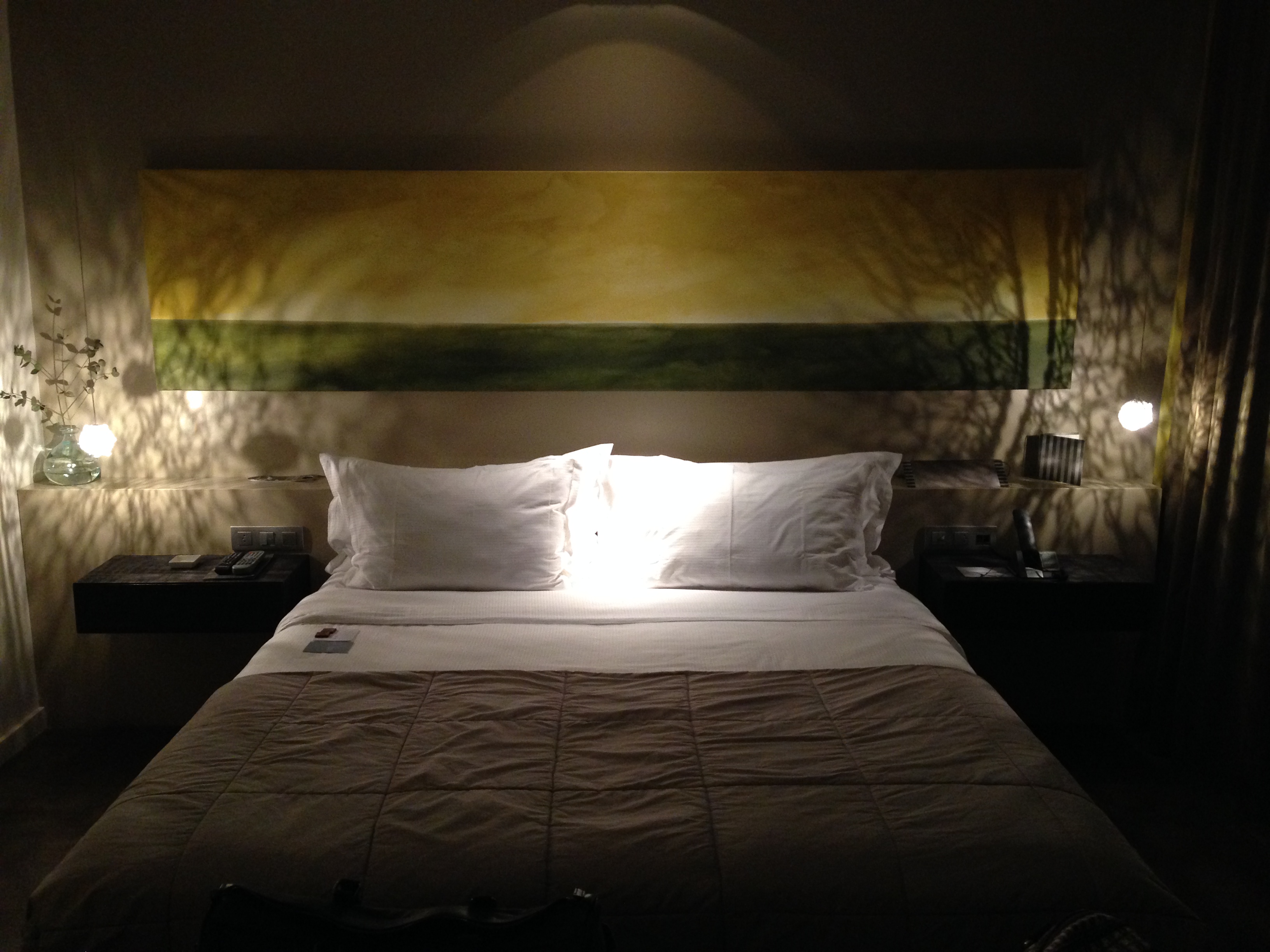
Heading upstairs, past conveniently placed armchairs and cool twig framed mirrors hanging upon the minimalist walls, we were introduced to the room which was to become our own personal piece of Barcelona for the three nights of our stay. Having opted for a junior suite, we were in for a treat. Looking onto the stunning Plaça Sant Felip Neri which featured in my post yesterday, our large spacious room came with its own lounge area, three big windows, and a bathroom which was tiled with rough stone which sparkled in the light – I adored taking a bath in these surroundings, not least amongst all of that rough stone which seemed to have been cut so roughly that I felt as though I was bathing in the middle of a quarry.

Our room

IMG_7700 IMG_7693 DSC02394 IMG_7694

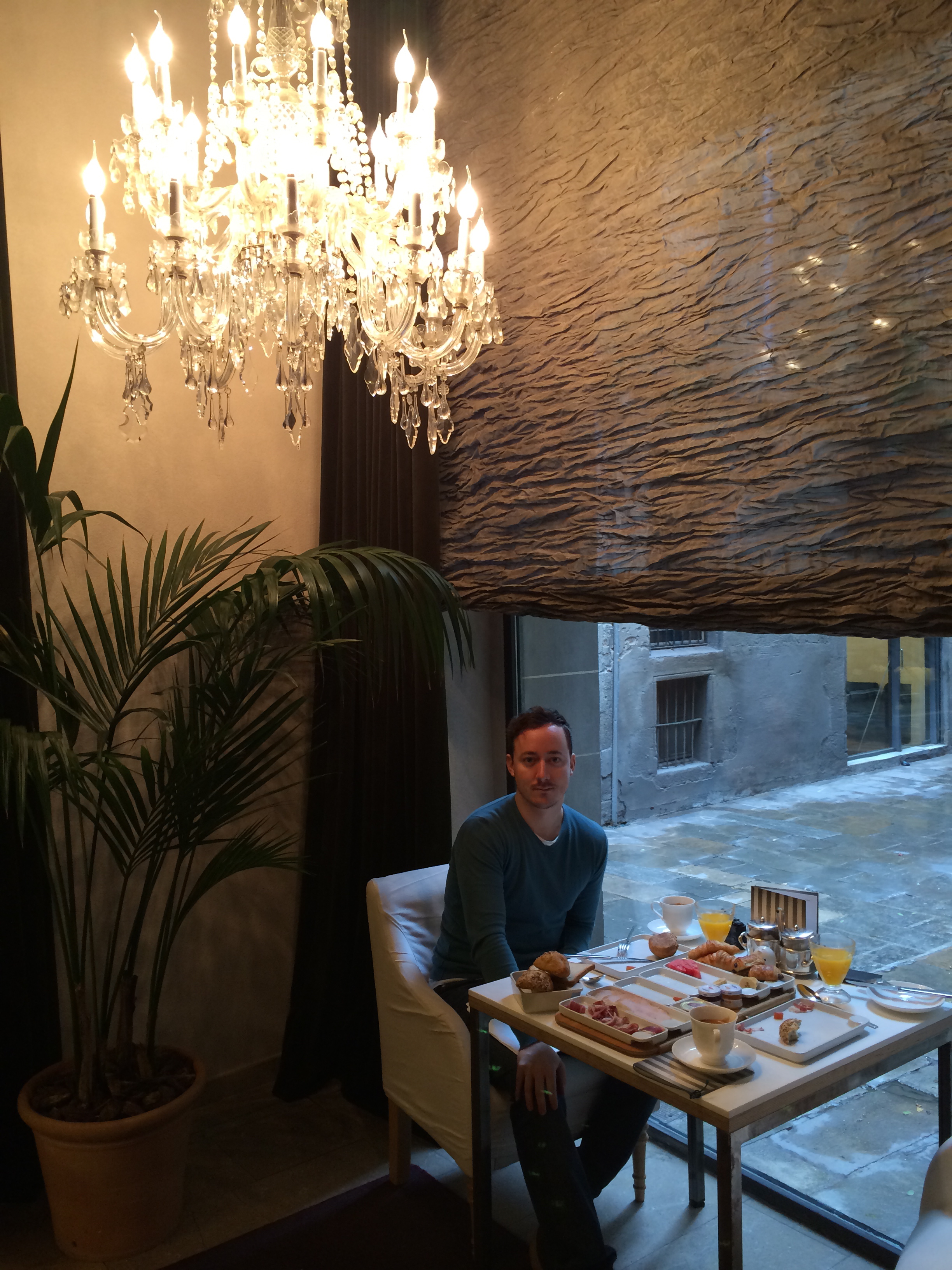
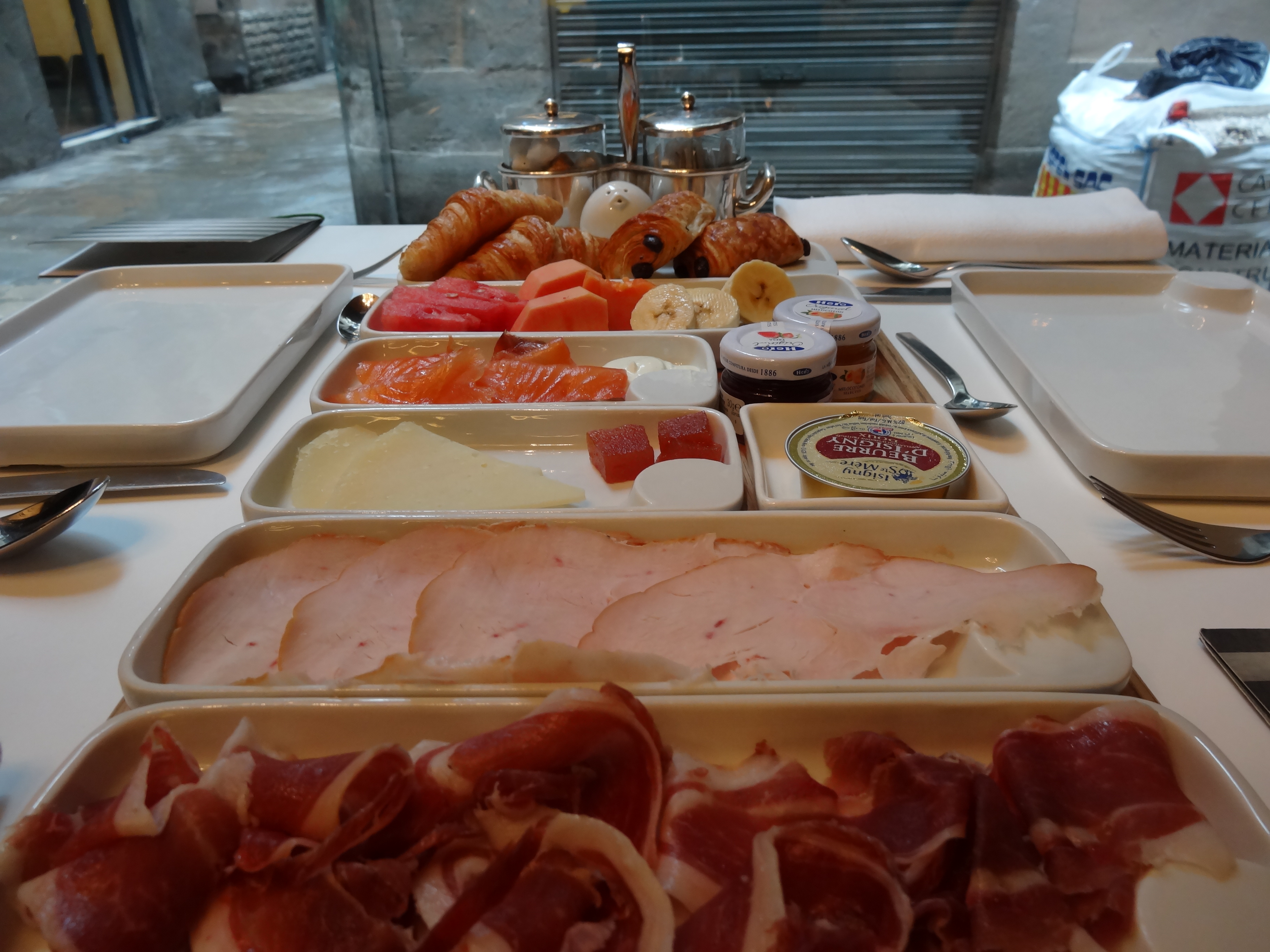
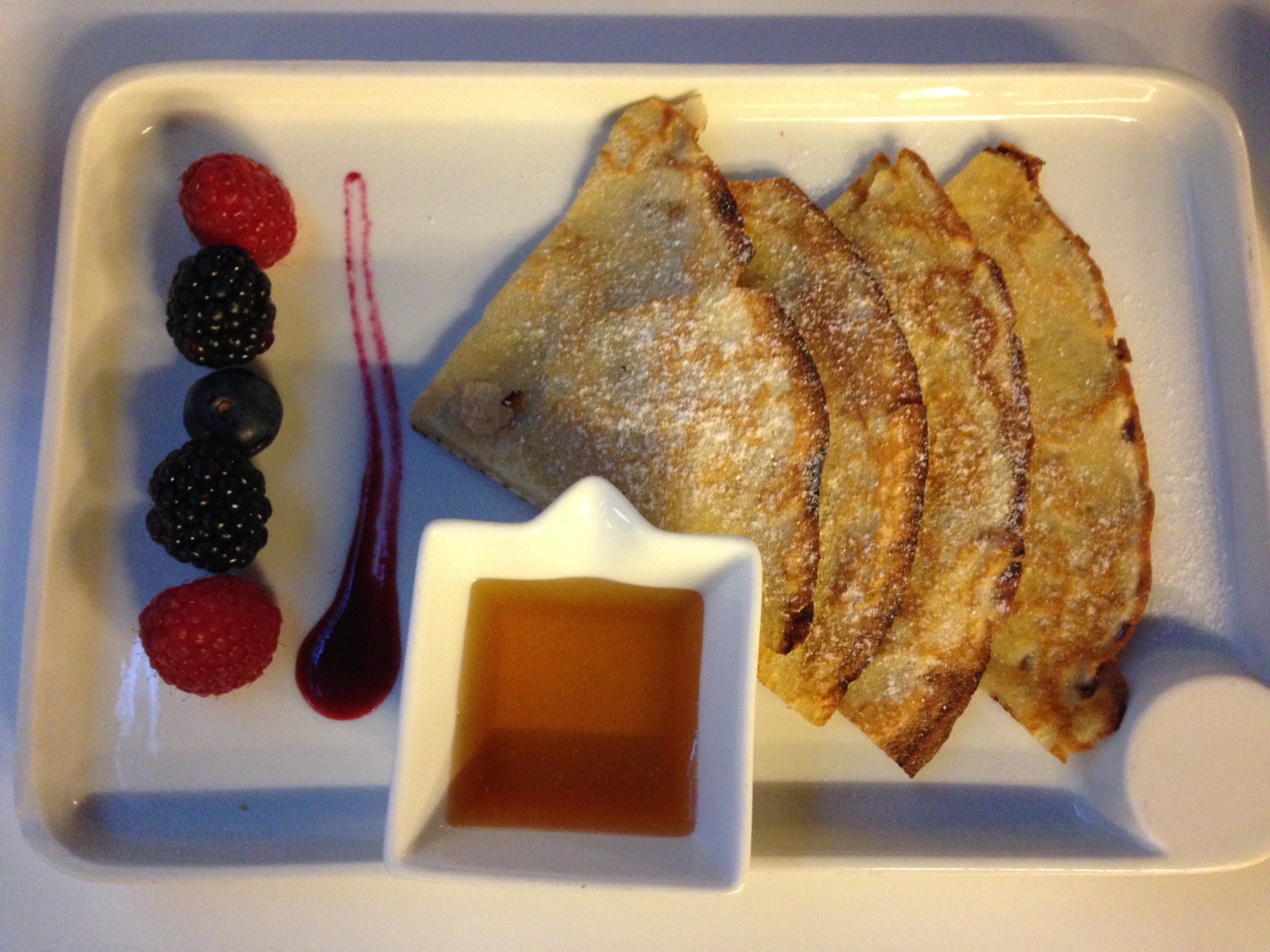
As if further plaudits for the hotel were necessary, there were two further areas which made our stay in the hotel such a memorable pleasure – first, taking a daily breakfast in the hotel’s “library”. For such a small space, breakfast was done in style. With a starting round of cold meats, pastries and fruit brought to the table automatically, this already generous spread was then supplemented by your choice of cooked breakfast from an extensive menu. My particular favourite was the option of fresh pancakes served with syrup and berries – an undoubtedly fine way to start the day, and well timed too – it was, after all, the weekend before Shrove Tuesday.

Breakfast in the library

IMG_3896 DSC02442 IMG_3892 IMG_7731 DSC02446 DSC02439

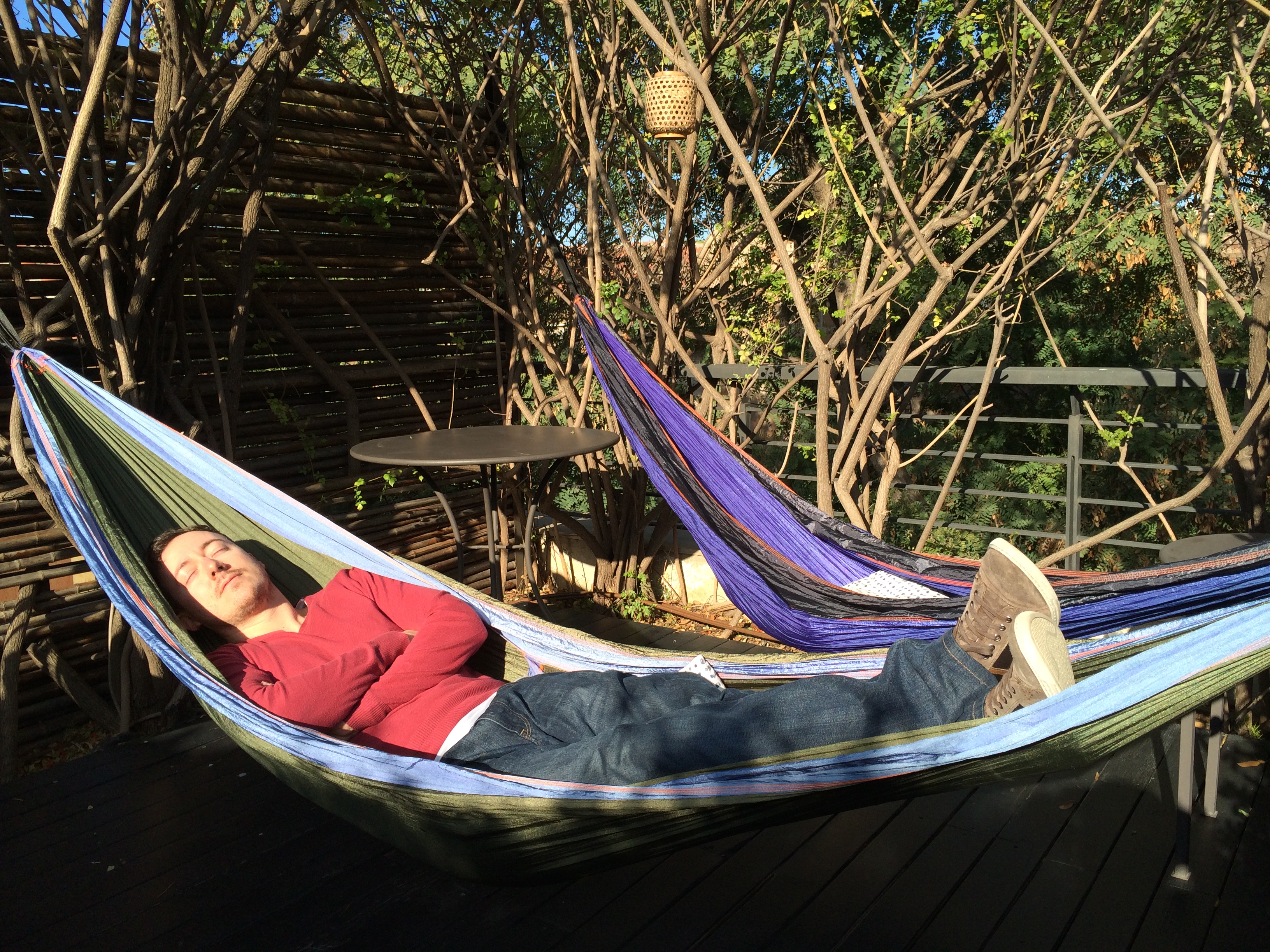
Our second Hotel Neri highlight had to be the little roof terrace. Set up on the fourth floor of the hotel, with views over the rooftops of nearby gothic quarter properties, and with vistas further afield towards Tibidabo possible, the terrace offered both a unique viewpoint onto Barcelona, as well as a perfectly cosy and intimate open space.  Filled with comfortable furnishings (including two very tempting hammocks) and surrounded by walls bursting with climbing flowering plants hung with little lanterns, it really was the ideal as far as garden terraces go, and made for the perfect location to enjoy an afternoon rest over a cup of tea and a bowl of mouth-wateringly good orange ice cream, as we were to discover.

The terrace

DSC02868 DSC02870 DSC02898 IMG_7738 IMG_7704 DSC02888 IMG_4015 IMG_4013 DSC02884 DSC02913 DSC02906

So as if it weren’t obvious from the above, I cannot sing the praises of the Hotel Neri enough. I’m almost loathe to recommend it, for fear that it will become too popular and I will never get to go back there. But how can I do otherwise? For a Barcelona stay, it’s simply the perfect choice – for an unbeatable location, for the very best of quality service, and for a unique and ultimately pleasurable stay from breakfast until bed.

More information on the Hotel Neri can be found here.

All photos and written content are strictly the copyright of Nicholas de Lacy-Brown © 2014 and The Daily Norm. All rights are reserved. Unauthorized use and/or duplication of the material, whether written work, photography or artwork, included within The Daily Norm without express and written permission from The Daily Norm’s author and/or owner is strictly prohibited. 

Saatchi’s positive Body Language

Whenever I visit the Saatchi gallery in Chelsea, I always do so on the assumption that I am going to hate most of the art on show. This reactionary pattern begun some years back, when Saatchi was still on the south bank, and the works included Tracy Emin’s vile “unmade” tip of a filthy bed, and her even viler photographic self portrait surrounded by money shoved up and around her you-know-what. Then, when Saatchi moved to Chelsea, exhibitions included a show of Russian art, which turned out to be even more depressing in its lack of talent than one would have already guessed, and shows which decided that the car wrecks lifted straight out of a (probably tragic) accident scene would somehow make for an enticing art exhibit.

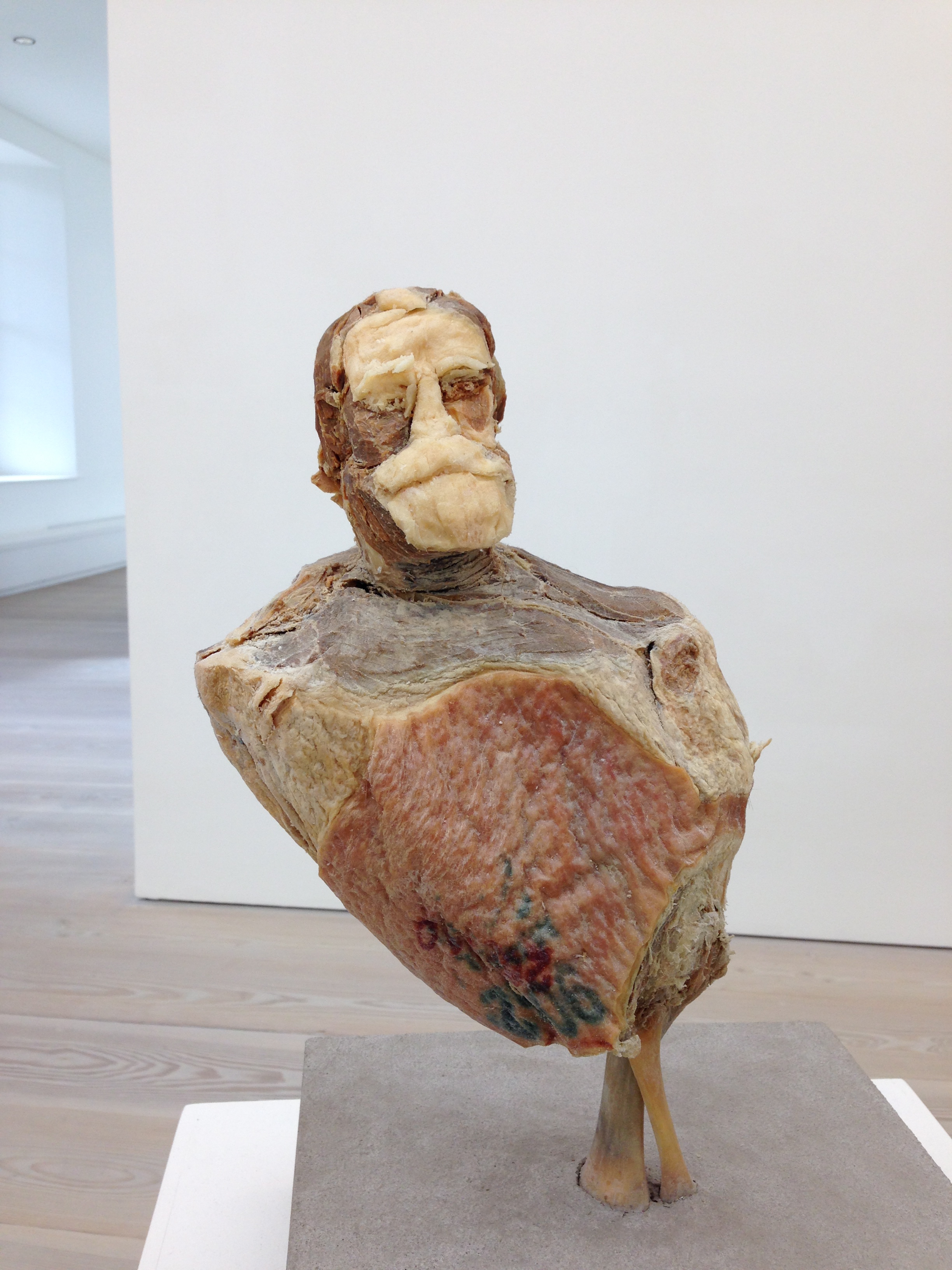
So, when I dropped into Saatchi’s gallery last weekend, I wasn’t expecting the latest offering, Body Language, to be much better than a convenient toilet stop in the midsts of some Chelsea shopping. But when you enter a gallery a see a sculpted portrait made out of Iberico ham, you pretty much know that you are going to be in for a treat. Oh yes, with his brilliantly innovative creation of Spain’s best leg of meat, Kasper Kovitz’ Carnalitos sculptures single handedly opened my eyes to the positives of Saatci’s ever revolving exhibitions of contemporary art works (eyes which had pretty much been sealed shut in opposition following the recent Nigella cafe strangle scandal…).

Carnalitos (Arana) © Kasper Kovitz, 2010

Carnalitos (Arana) © Kasper Kovitz, 2010

Carnalitos (Unamuno) © Kasper Kovitz, 2010

Carnalitos (Unamuno) © Kasper Kovitz, 2010

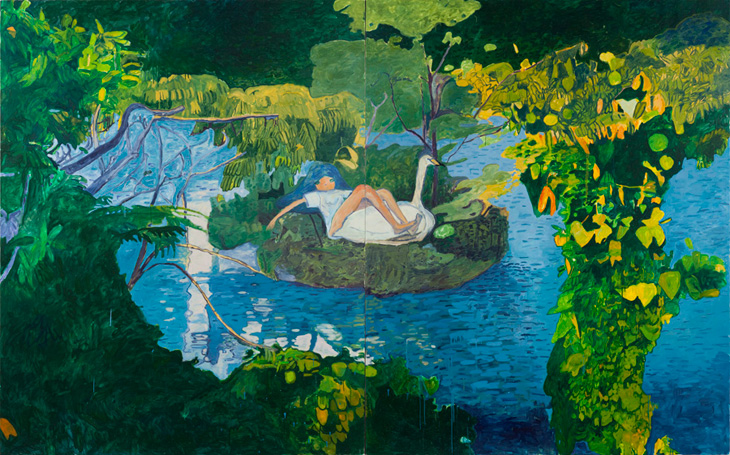
Other favourites from a varied show of contemporary artists include the paintings of Michael Cline, whose somewhat parodied figures reminded me of Stanley Spencer’s Sandham Memorial Chapel paintings which were recently on show at Somerset House. I also loved Nicole Eisenman’s energetic oil paintings such as the Beer Garden at Night (2007) which is full of whimsical figures and amusing social shenanigans which can keep an audience entranced for hours, and Makiko Kudo’s fantastical escapist visions which were in part like a Manga cartoon and at the same time like Monet’s pond bursting with lilies.

That's That © Michael Cline, 2008

That’s That © Michael Cline, 2008

Police Line, © Michael Cline, 2007

Police Line, © Michael Cline, 2007

Floating Island © Makiko Kudo, 2012

Floating Island © Makiko Kudo, 2012

Burning Red © Makiko Kudo, 2012

Burning Red © Makiko Kudo, 2012

Beasley Street, © Nicole Eisenman, 2007

Beasley Street, © Nicole Eisenman, 2007

Beasley Street, © Nicole Eisenman, 2007 (detail)

Beasley Street, © Nicole Eisenman, 2007 (detail)

Beer Garden at NIght, ©  Nicole Eisenman, 2007

Beer Garden at NIght, © Nicole Eisenman, 2007

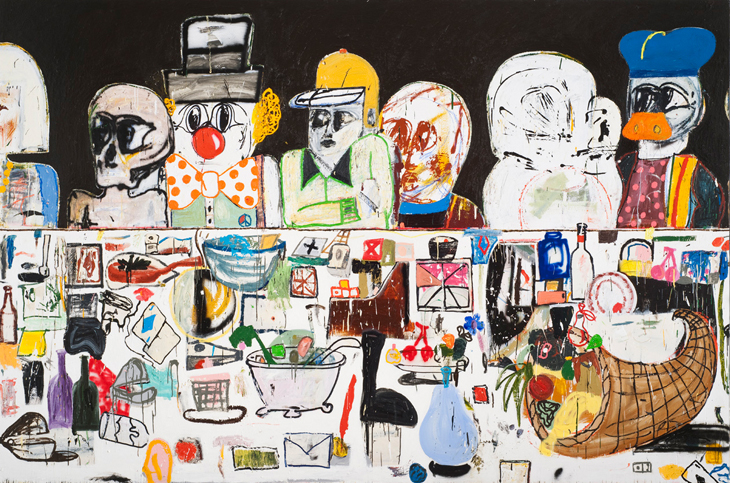
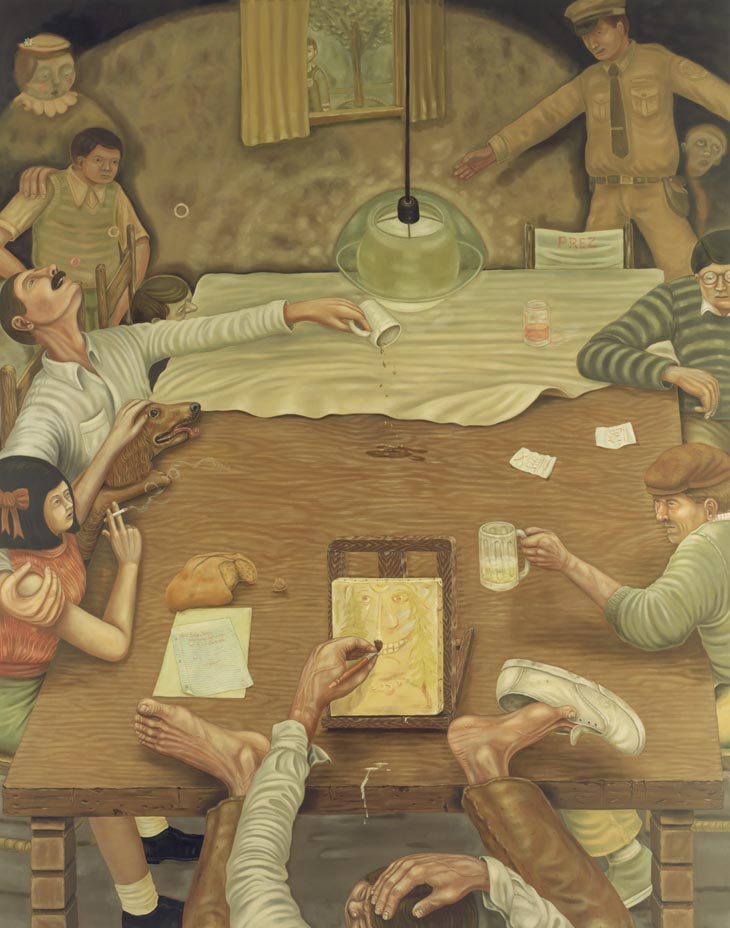
Less convincing were the paintings by Eddie Martinez which were so badly painted as to be derisable. His “Feast” is compared in the gallery brochure to Da Vinci’s historically celebrated Last Supper. I would compare it to the dirty dining table at the end of a meal when my toddler nephews have been to stay. I was equally dismayed by Denis Tarasov’s photographs of tombstones in graveyards in Russia and Ukraine, not because of the photography itself, but because of the hideously tacky gravestone pictures which they captured – huge granite tombs decorated with intricately carved photographic likenesses of the individuals buried beneath them, looking so vulgar that to even place such visions in a freshly painted white gallery in the centre of London’s chelsea felt like dumping a Lidl in the middle of Harrods. That’s not to say they weren’t interesting – one shouldn’t be surprised that this level of vulgarity would come out of a country which has backdated its laws in relation to homosexuality by at least a century of moralistic retardation.

The Feast (detail) © Eddie Martinez, 2010

The Feast (detail) © Eddie Martinez, 2010

Untitled (from the Essence Series)  © Denis Tarasov, 2013

Untitled (from the Essence Series) © Denis Tarasov, 2013

But I digress. From its low points to its very high, Body Language is well worth a visit for its sheer diversity of art – there really is something for everyone, and it’s free too, so what’s to lose? For me, the show demonstrates that painting is very much back in fashion and that the age of nonsense gimmicky installations is largely dead, which can only be good news if the 21st century is ever going to make any kind of decisive mark on art history. Not only that but the Saatchi gallery is, as ever, a brilliant cultural location whose highlights also include a show of emerging British talent, a gallery of limited edition prints which are for sale, a spangly new gift shop which is around 6 times the size of what it used to be (Iberico ham sculptures sadly not for sale – but there’s always Iberica restaurant in Marylebone as a very good consolation prize – and there you even get to eat it).

Body Language is on at the Saatchi Gallery, Chelsea, until the 23 March 2014

Paris | Photography Focus – Campana d’Orsay

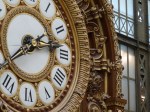
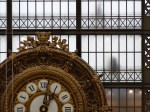
The last post of my recent Parisian adventure, and the fourth set of photographs emanating from the trip pulls something of a sharp focus on a particular place in Paris, and not one that is all that well known either. In the insuperably brilliant Musee d’Orsay, behind one of the two huge round glass windows which double as the prominent clock faces which characterise the building’s impressive riverside façade, is a super chic new café opened following the major renovations of the museum in 2011. The café, which was designed by the Campana brothers, and now carries their name, is very different from the typical bistros and brasseries which are so characteristic of Paris. Ultra modern in its design, throwing diners into something of an undersea aquarium-come-fairy tale palace with its waving lines, bubble like round-patterned chairs, and striking aquamarine backdrop, this café is nothing if not eccentric, but therefore perfectly placed in its location next to the galleries containing France’s foremost collection of impressionist art – after all, these were the artists who challenged all of the art which had gone before them. As a café, the food isn’t all that great, and the selection is even worse, but the design is such a winner that I couldn’t help but give this genius of café design its own little space on The Daily Norm.

DSC09383 DSC09371 DSC09387

The photos which follow focus mainly on the various unique features of the Café Campana, but also include some cheeky shots of fellow diners. I’m not even sure that I’m really allowed to take photos of people without their permission, and still less publish them online. But if that’s the case, it’s a real shame, because there is nothing quite like a voyeuristic glance at fellow dinners to really capture the essence of a place. In fact like the Impressionists before me, these photos represent my way of doing what those artists did best: representing real life, and recognising reality as a thing of beauty in itself. Surely no activity could be more appropriate at the d’Orsay’s café, where only rooms away, Degas’ famous painting of desolate drinkers staring into their glasses of Absinthe in a Paris bar (l’Absinthe) hangs amongst the masterpieces on show.

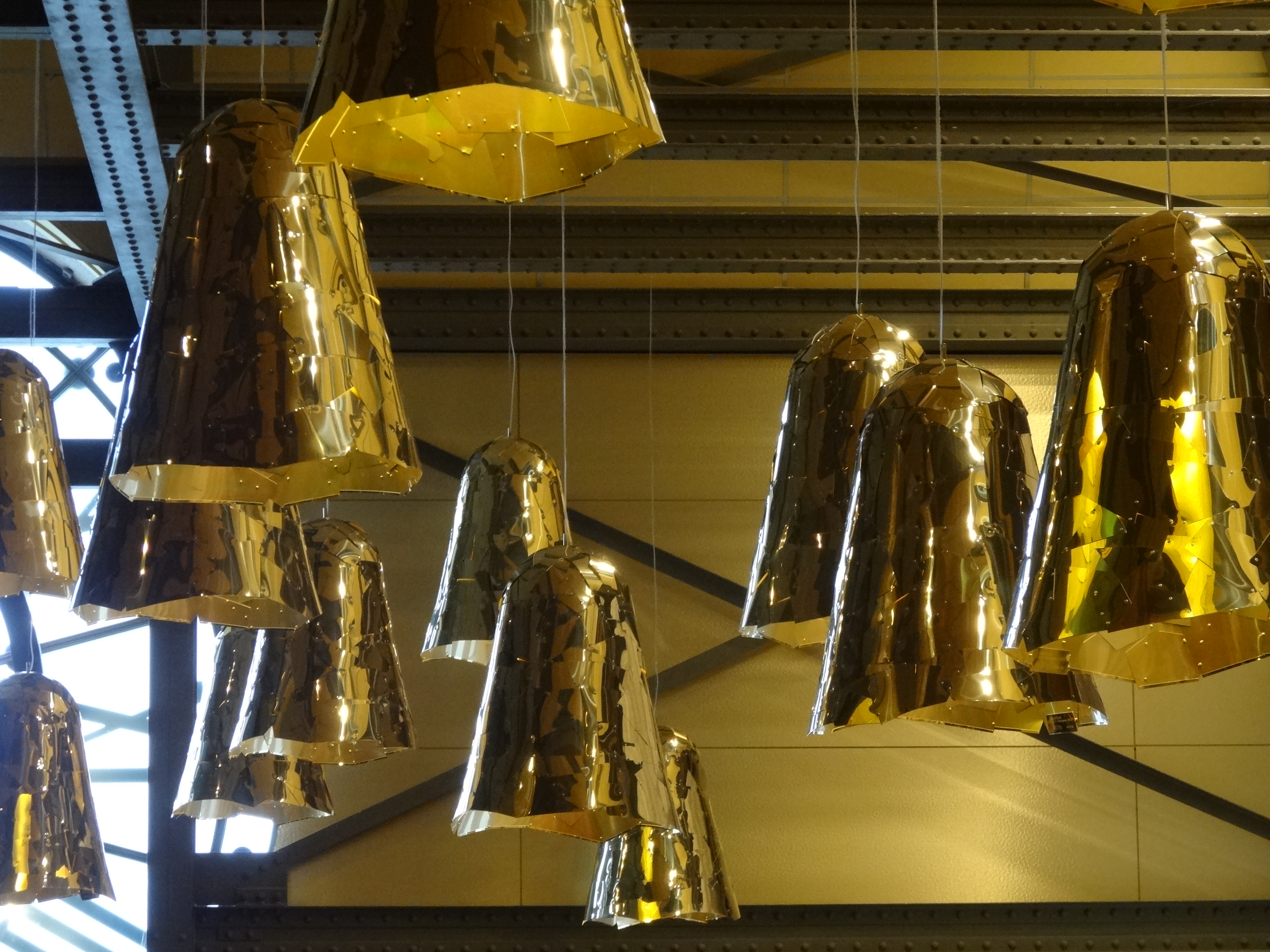
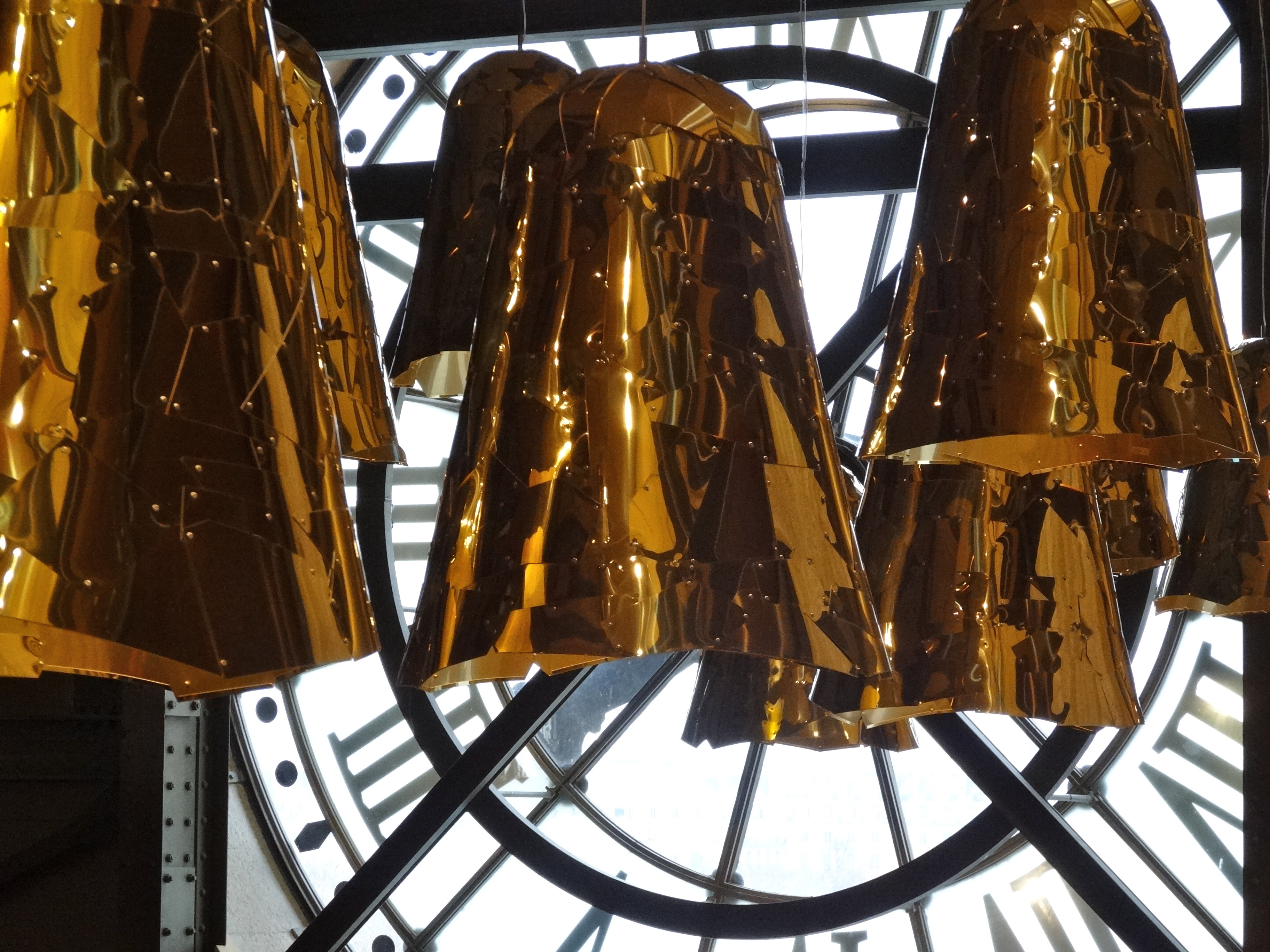
Admittedly the diners in my photos are enhanced by their surroundings, and in particular the glittering gold lights which are by far my favourite aspect of the design. Hanging in their multitudes, these lights give the feeling of being in a kind of Olympian paradise, where over-sized golden blue bells hang abundantly above. Their splendid shiny gold surface, and their installation, hung from great steel joists also painted gold, makes for a lavish spectacle in a way that only gold can; a spectacle which is all the more enhanced by the sheer abundance of it – when you have gold, why not have plenty of it? And hung as they are, all at different lengths, in irregular groupings, these lights seem so unplanned as to be a natural phenomenon; the kind of visionary wonder that makes you appreciate the glory of the world all around.

In short, the Musee d’Orsay is well worth visiting for the Café Campana alone. Not necessarily to anticipate a gastronomic revolution – it is only a café after all, and a museum café at that – but to gaze in wonder at what must be one of the most impressive contemporary restaurant designs in Paris. I leave you with my photos – which include a few inevitable shots of the impressive d’Orsay itself – a former left bank station which has more than found its own as a bastion of 19th and 20th century art. Until next time Paris…

All photos and written content are strictly the copyright of Nicholas de Lacy-Brown © 2013 and The Daily Norm. All rights are reserved. Unauthorized use and/or duplication of the material, whether written work, photography or artwork, included within The Daily Norm without express and written permission from The Daily Norm’s author and/or owner is strictly prohibited. 

Provence Odyssey | Arles: Le Dîner – l’Atelier de Jean-Luc Rabenel

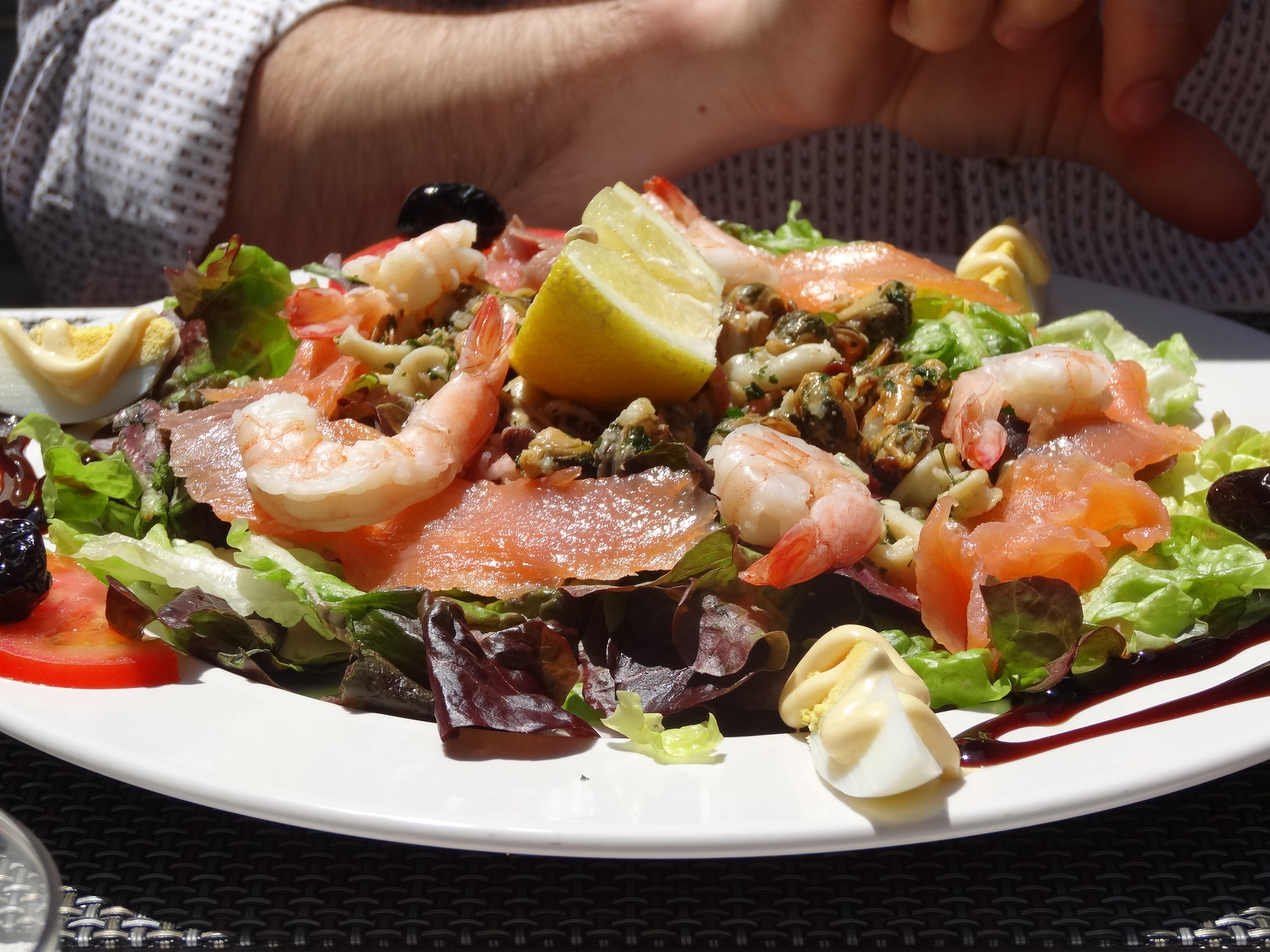
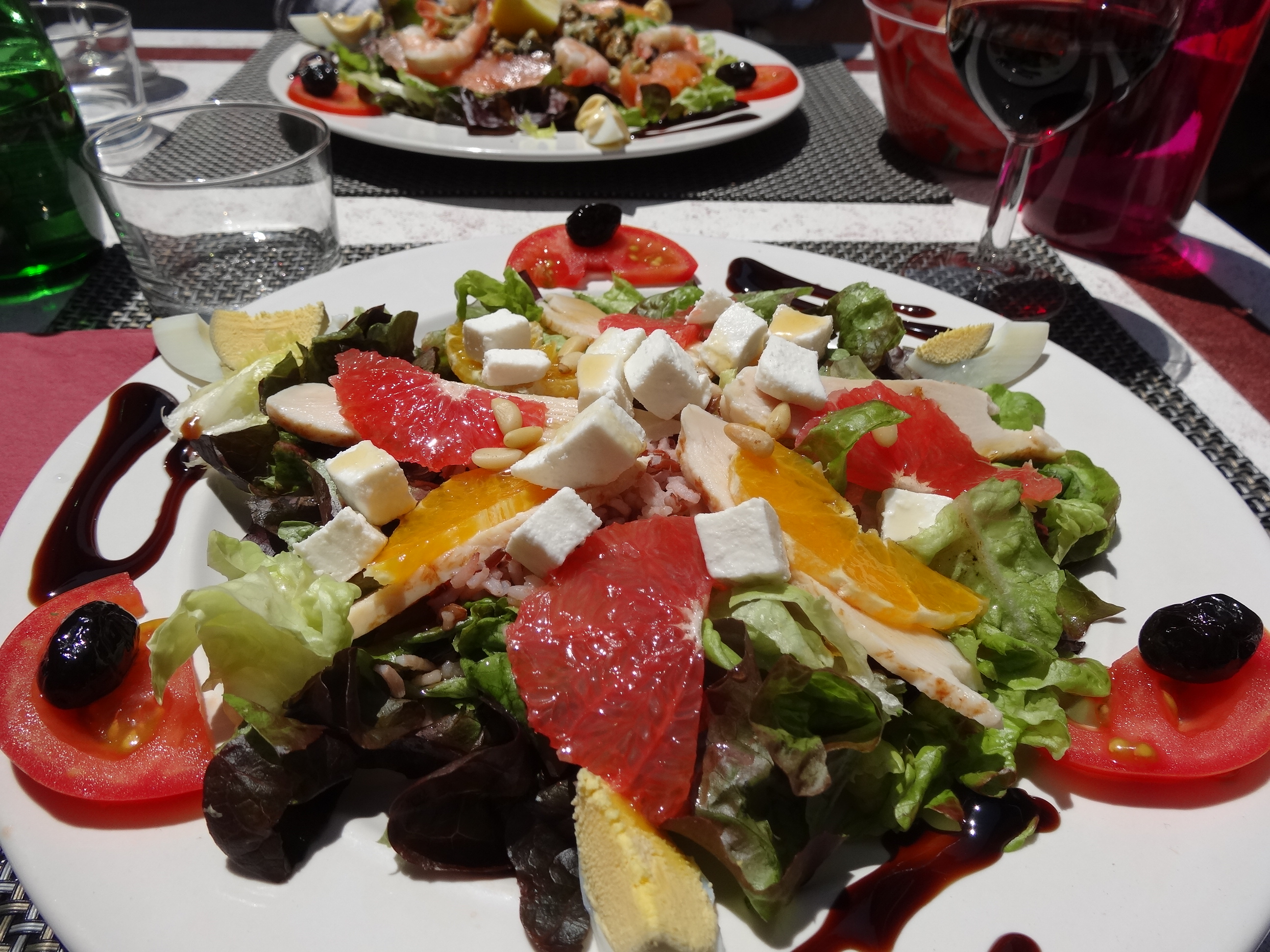
We had one of those rather embarassing moments on our second day in Arles when, eager to escape the vigorous Mistral wind and therefore sitting down at the first restaurant we came across with a sheltered position, we found ourselves, upon being handed the menu, faced with prices which were well in advance of our lunchtime budget. Splashing out in the evenings is one thing (you can barely do otherwise with Provence’s prices), but if we were to spend similarly at lunchtime, we wouldn’t be able to pay for a bed for the night. So when we sat down at a table outside l’Atelier de Jean-Luc Rabenel (otherwise translated as the studio of Jean-Luc Rabenel), we quickly discovered that we couldn’t afford it. So what did we do? We ran away! (We did however settle on a cute little cafe just down the street – check out these delicious salads…)DSC02928 DSC02929

This ever so embarrassing escapade may have been bearable, were it not that come the evening, we struggled to find a single decent restaurant which was not a tourist trap anywhere in town, and so decided to return to said restaurant, with our tales between our legs. Luckily none of the waiting staff who had earlier wasted a sparkling water order on us appeared to notice that we were the absconding duo from earlier in the day. Or if they did, they hid it well. Which is what one comes to expect from a quality restaurant, and with two michelin stars to his name, the restaurant of this self-styled artist-chef does certainly did not lack in quality.

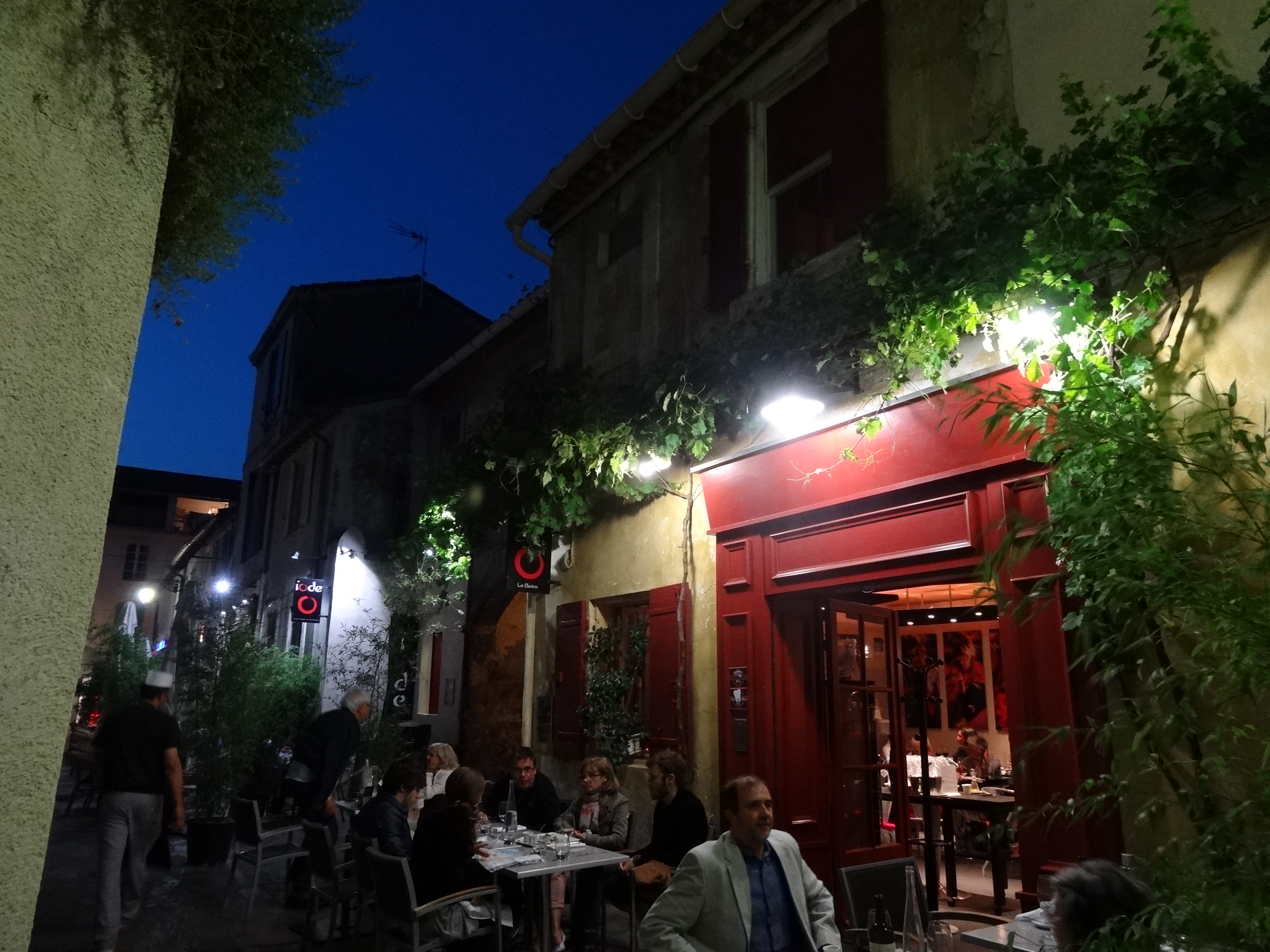
Lucky enough to seize upon the last remaining table in the very cute little street – the Rue des Carmes – where the restaurant is located, we could enjoy charming views of old shuttered buildings and grape vines crawling possessively over building facades before we had even gazed upon the visual delight that was the food coming out of Rabenel’s kitchen. To start, neither of us could resist the ice-cold gazpacho, nor did either of us regret the decision to replicate when the dish, artfully presented as a quasi-cocktail on ice with a sprig of rosemary and complemented by a handy straw, was served, alongside mini bruschetta topped by salty serano ham.

DSC03018

The main course followed swiftly, although for me this disappointed. Sticking to the more economical fixed price menu afforded me less choice for mains, but the fish pie upon which I eventually settled lacked the kind of originality in both presentation and flavour which is to be expected of a michelin star establishment – although the handmade pesto side dish was an indisputable delight. Dominik did better, with a huge pan full of succulent muscles, plunged into a soup-like jus filled with delights such as rustic chorizo sausage and caramalised prawns.

DSC03023 DSC03022

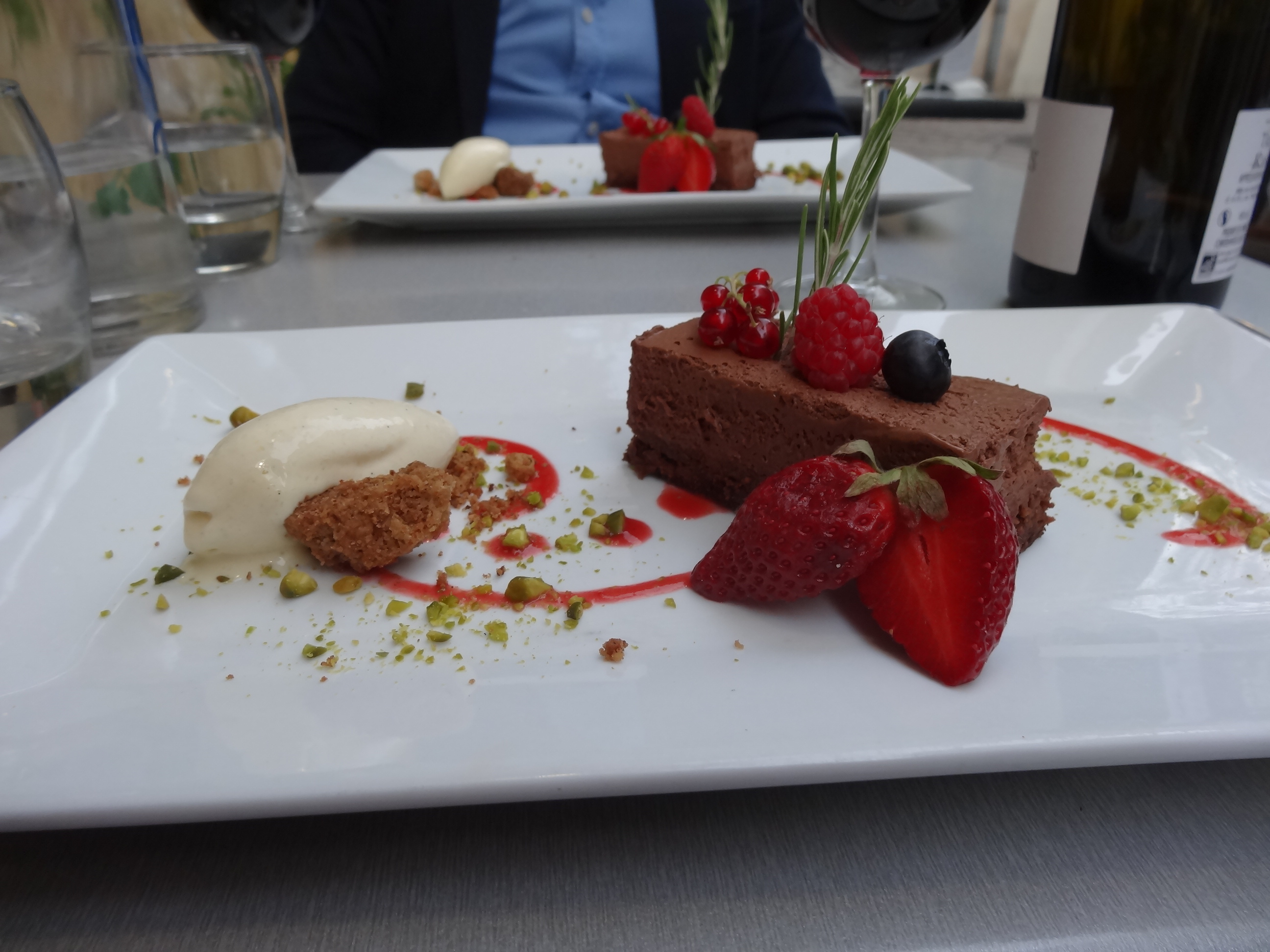
But as mains paved their way to dessert, another duplicated choice for us both – a chocolate cake with a wonderfully strong vanilla cream, pistachios and berries – again exhibited all of the flourish of fine dining, if it lacked slight the originality which we spoilt London diners come to expect of our michelin stars.

DSC03024

But over all, the restaurant was a delight and wonderfully situated in a quite Arlesienne street, suitably off the beaten track to avoid the kind of tourist groups pouring into the tacky restaurants claiming to have a Van Gogh connection, and excitingly modern despite the aged charm of its situation.

L’Atelier is part of group of restaurants all belonging to the “cercle rouge” group and situated on the same street. Next door is the Bistro a Coté – the wonderfully animated website of the Alan Sugar lookalike chef is worth a gander in itself.

DSC03030

George Bellows: Modern American Life

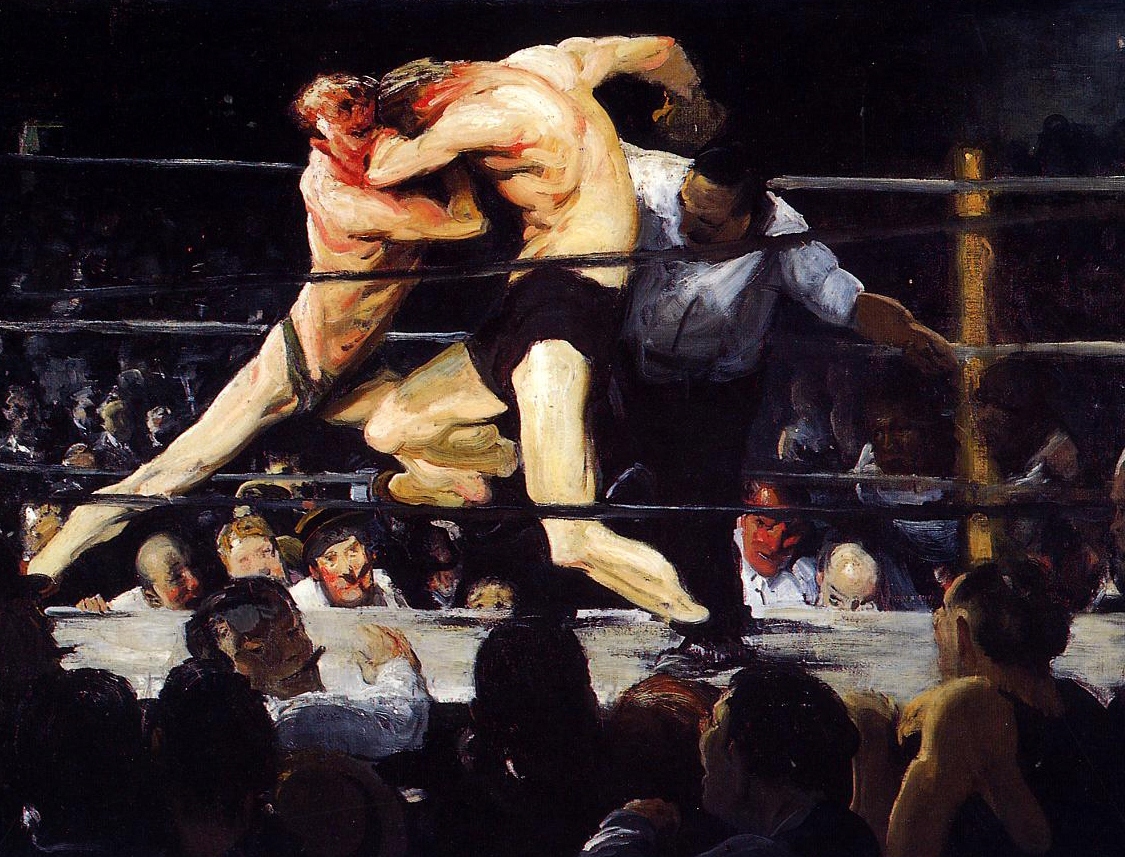
Bulging, twisting angry red bodies reminiscent of Francis Bacon’s cannibalistic, melting forms; great muscular bodies gripped in a violent embrace; long horizontal lines capturing the figures within an illuminated, elevated fighting platform; and a blood-thirsty zealous crowd, their faces hideously disfigured as they vie for blood, sweat and mighty great punches on their night out at the boxing ring – these are the captivating images of the 1900s boxing underworld for which the American artist, George Bellows, is renowned, and which form the focus of the Royal Academy’s new exhibition: George Bellows 1882-1925 Modern American LifeYet as the exhibition attempts to point out, Bellows painted much more than the poignant punches of his most famous images.

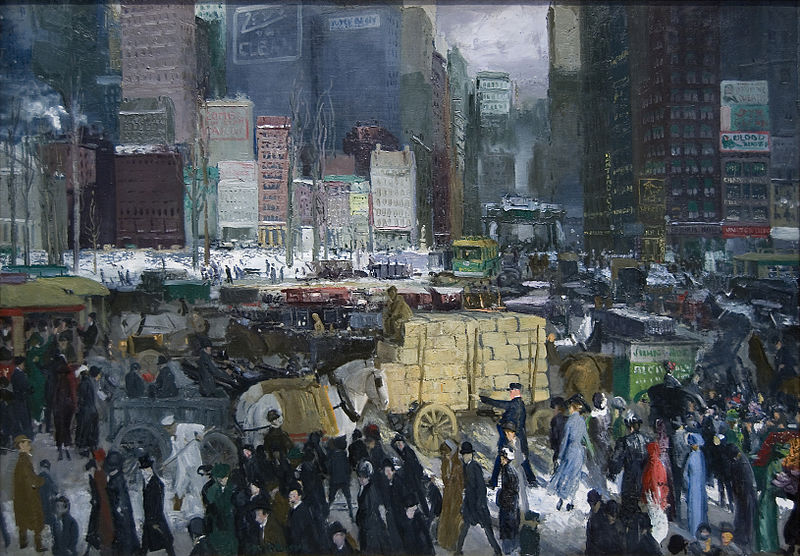
I wasn’t aware of Bellows before this show – and I excuse this gap in my art historical knowledge by virtue of the fact that this is the first Bellows retrospective to ever come to the UK, and because, to my knowledge, no or few Bellows works are held in the UK national collections. Moreover, while Bellows was a classmate of the much celebrated Edward Hopper, his career was much shorter – he died at a poultry 43, barely before he had ever got going. And yet the works which he did complete in his short life present us with an unparalleled view of turn-of-the-20th century New York, focusing on the many facets of a city in flux; from the gritty and sinister sweaty boxing underworld and the bustling expanse of Times Square, to the elegant perambulations of the richer citizens in out of town parks; from traumatic, emotionally intense depictions of war, to almost fantastical, saccharine scenes of picnics and fishermen in the outer countryside surrounding the city.

Club NIght (1907)

Club NIght (1907)

Stag at Sharkey's (1909)

Stag at Sharkey’s (1909)

It’s perhaps no wonder that Bellows was so undyingly fascinated by New York City. Coming from a comfortable middle-class Ohio background, he would have been unprepared for the extremes of the city when he arrived there at just 22 years of age. Yet falling under the influence of artist Robert Henri, who was his teacher at the New York School of Art and who encouraged his students to eject the idealised and sentimental depictions of life favoured by the art scene at that time, and instead pursue a more unique expression of reality, Bellows soon found himself seeking out the more insalubrious, undesirable quarters of the city, and there depicting some of his most renowned works, from groups of naked immigrants bathing in the city’s dirty rivers, and builders clearing vast blocks of the city to construct a huge new homage to the modern railway, to the great bustling, smokey squares of central New York, full of workers and citizens from every spice of life, and of course those wonderfully intense boxing masterpieces.

New York (1911)

New York (1911)

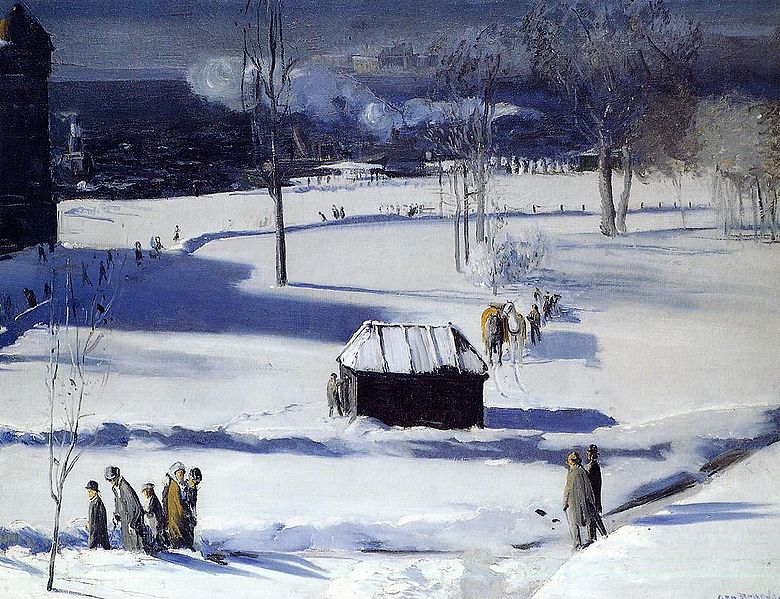
But Bellows did not limit himself to this harsher side of New York. Following his initial trawl through the unsavoury and illegal hangouts of the city, he soon moved onto depictions of a more civilised, elegant facade, with paintings of strolling couples, of elegant groups laden with white parasols and large sunhats picnicking out in the parks like something straight out of Seurat’s paintings of Paris, and of families walking out amongst snowy hills and landscapes. This is a changed side of Bellows, but no less fascinating to behold, not least because it somehow fits uneasily into the common perception of the New York of these times, and because, by comparison with Bellow’s earlier body of work, this happy, idle lifestyle appears almost reckless in its apparent disregard for the hardship of the real gritty city which lay at the heart of the nearby urban sprawl.

A Day in June (1913)

A Day in June (1913)

Summer Night, Riverside Drive (1909)

Summer Night, Riverside Drive (1909)

Blue Snow the Battery (1910)

Blue Snow the Battery (1910)

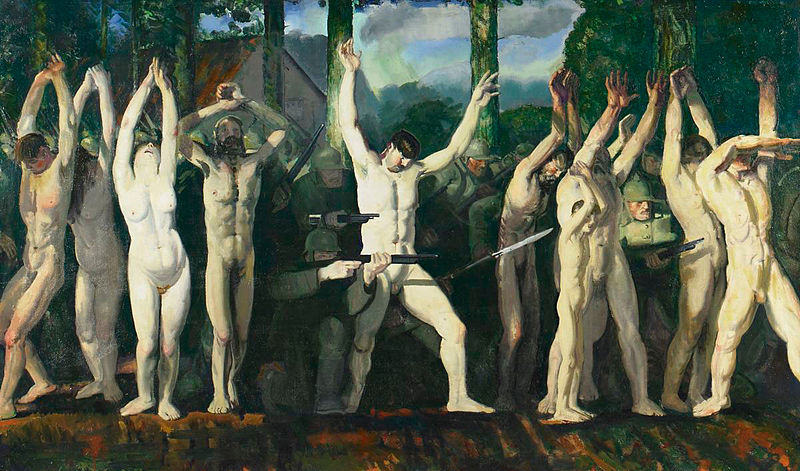
Yet for all his insightful depictions of a modern American life, perhaps the most captivating works of Bellow’s career were those which had no connection to America whatsoever: At the centre of the exhibition are Bellow’s depictions of war, works inspired by the horrors of the First World War in Europe which Bellows had read about in the American press. All five resulting paintings, four of which are on show at the Royal Academy, are conspicuously anti-German, showing the Germans in a devastating light as the perpetrators of previously unseen levels of horrific savagery, such as the Massacre at Dinant which depicts the unprovoked, summary execution of Belgian civilians following the sacking of their town which stood in neutral territory, and The Barricade, which shows the Germans using Belgian innocents as a human shield. The paintings are emotive, powerful and really quite breathtaking.

Massacre at Dinant (1918)

Massacre at Dinant (1918)

The Barricade (1918)

The Barricade (1918)

The Germans Arrive (1918)

The Germans Arrive (1918)

Likewise exceptional was the next room showing Bellows lithography – his brilliant printworks which were likewise used to stunning effect in depicting similarly shocking scenes such as The Law is Too Slow which shows an African American being burnt alive at the stake while surrounded by an apparently calm, even entertained crowd of white Americans. In his print works, Bellows shows himself as a master printer – he uses dark and light to maximum effect, while his faultless illustration of flesh tone in the print version of his later boxing scenes easily outstrips the paintings of the same subject.

The law is too slow (1922)

The law is too slow (1922)

Splinter Beach (1912)

Splinter Beach (1912)

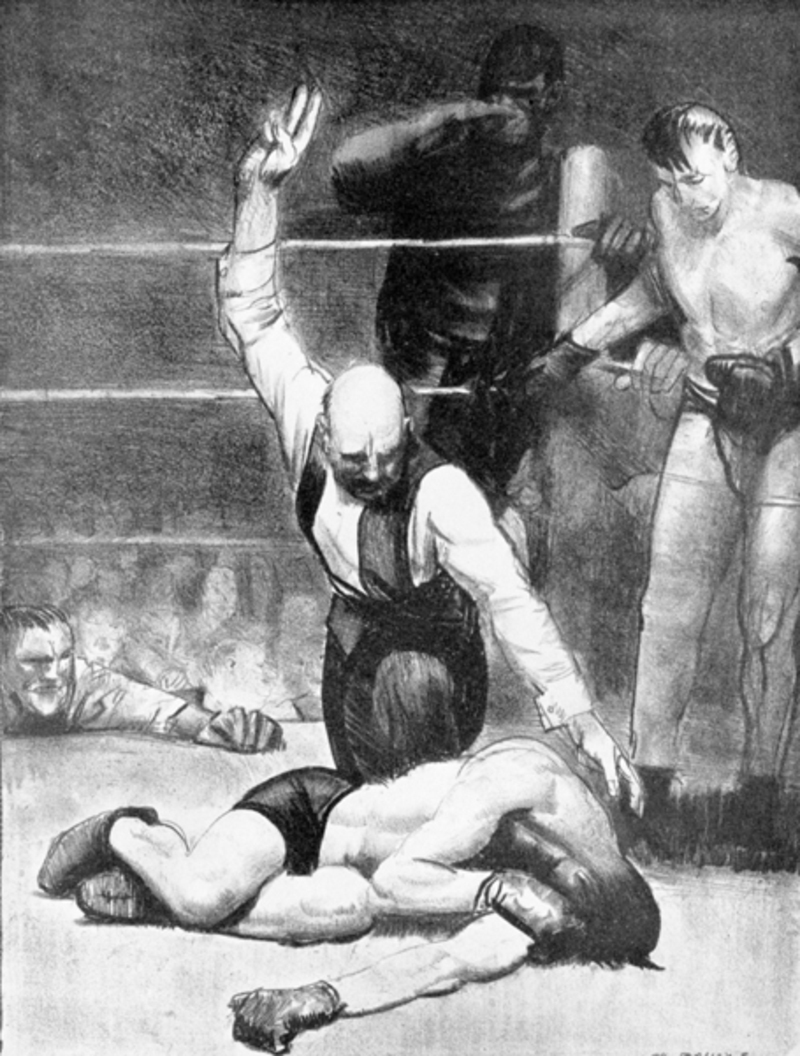
Counted Out No.2 (1921)

Counted Out No.2 (1921)

After this highpoint of the show, the exhibition ends on something of a low in a gallery of overly insipid, saccharine fantastical depictions which look almost Chagall-like in style and appear to represent an uncomfortable diversion from Bellows more intense former work – even his later boxing paintings have nothing like the level of intensity as his boxing works painted 15 years before. The gallery is full of twee and sometimes stiff family portraits which resemble the work of Manet but without anything close to his emotional depth, as well as landscapes which are so excessively sentimental with their white horses and picture-perfect symmetrical mountain landscapes that Bellows’ former teacher, Robert Henri must have been turning in his grave – or at least would have done had he not outlived Bellows.

The Picnic (1924)

The Picnic (1924)

The White Horse (1922)

The White Horse (1922)

A Fisherman's Family (1923)

A Fisherman’s Family (1923)

George Dempsey and Firpo (1924)

George Dempsey and Firpo (1924)

For George Bellows died shortly after depicting these more sugary of his works, suffering from a sudden ruptured appendix and peritonitis. His career was one cut short, but perhaps just in time before his later My Little Pony style of painting threatened to overshadow the truly superb achievements of his former body of work; an oeuvre which now stands out, next to the likes of Edward Hopper, as a truly unique collective depiction of modern American life.

George Bellows: Modern American Life is on at the Royal Academy until 9 June 2013. Details and tickets can be found on the RA website.

Mallorca (Part VI) – Food Focus 2: Simply Fosh

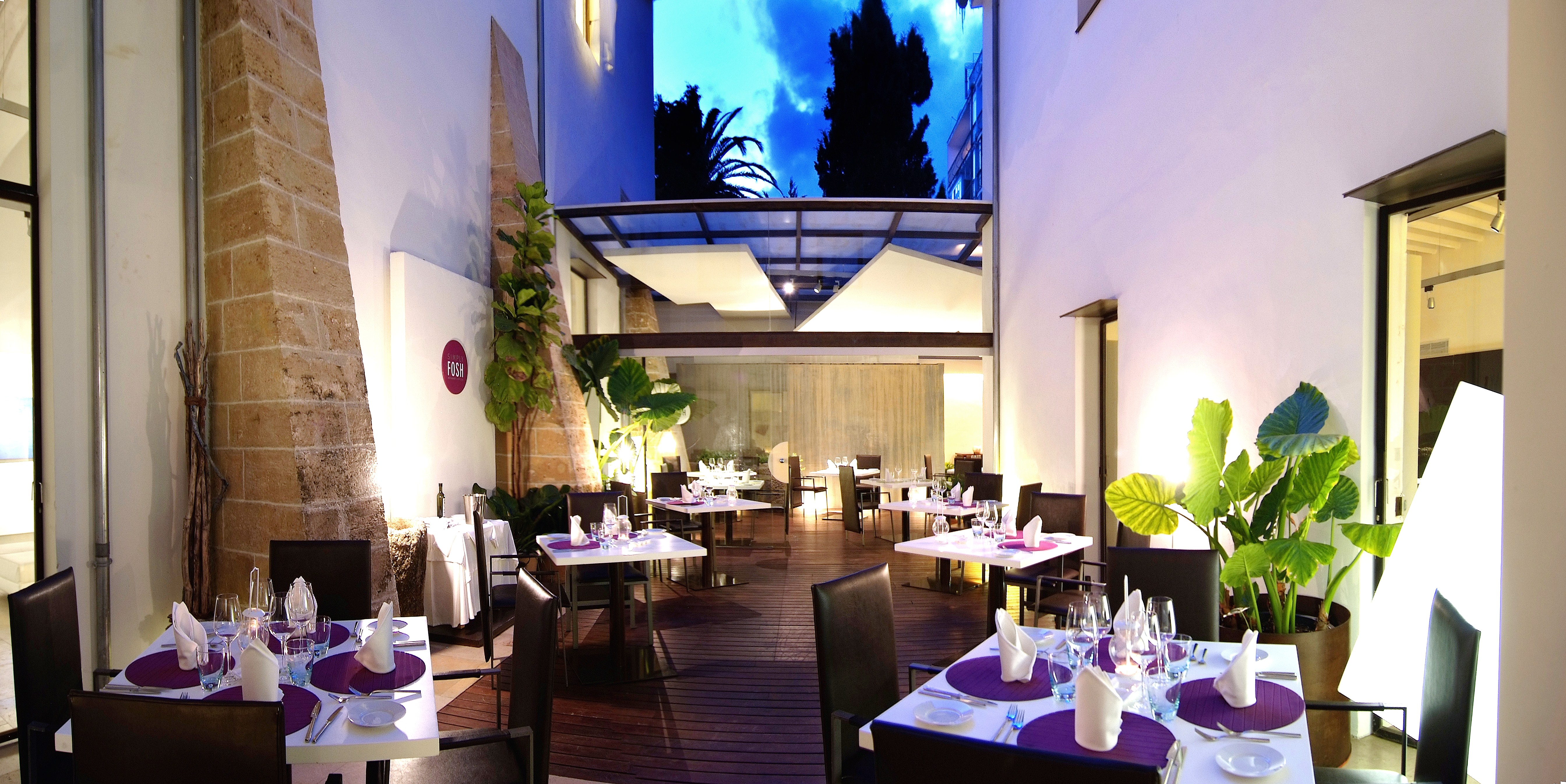
Ranked a cool number 4 of Palma’s best restaurants on TripAdvisor, as rated by the discerning food-loving public themselves (Forn de Sant Joan, I should have said the other day, is number 5, and deservingly so), Simply Fosh is the eponymous creation of chef, Marc Fosh. Housed in the cool, minimalist surroundings of the chic Hotel and converted 17th century Convent de la Missio, and bedecked with moody artwork showing close ups of Mallorcan salt on stark black backgrounds, as well as a cascading wall of water and, at least in the summer, an open-air courtyard, Simply Fosh is a restaurant which sets out to impress.

Whether or not the restaurant name is meant to imply that the restaurant emulates the heart of its chef, pure and simple (it’s one of a chain of 4 restaurants, the remainder of which are perhaps less “Foshy”) or whether its objective is pure simplicity is unclear, but one thing is certain: asides from the minimalist surroundings of the restaurant, the food, impressive in complex flavours and a finely finessed presentation, is far from simple.

simply-fosh-rest-palma-de-mallorca-22

We were delighted with this meal which, from beginning to end was accompanied by smooth, efficient service, and which provided a selection of stimulating dishes which, while not always scintillatingly innovative in flavour excitement, certainly pleased with a consistently high standard of ingredients and an excellent presentation.

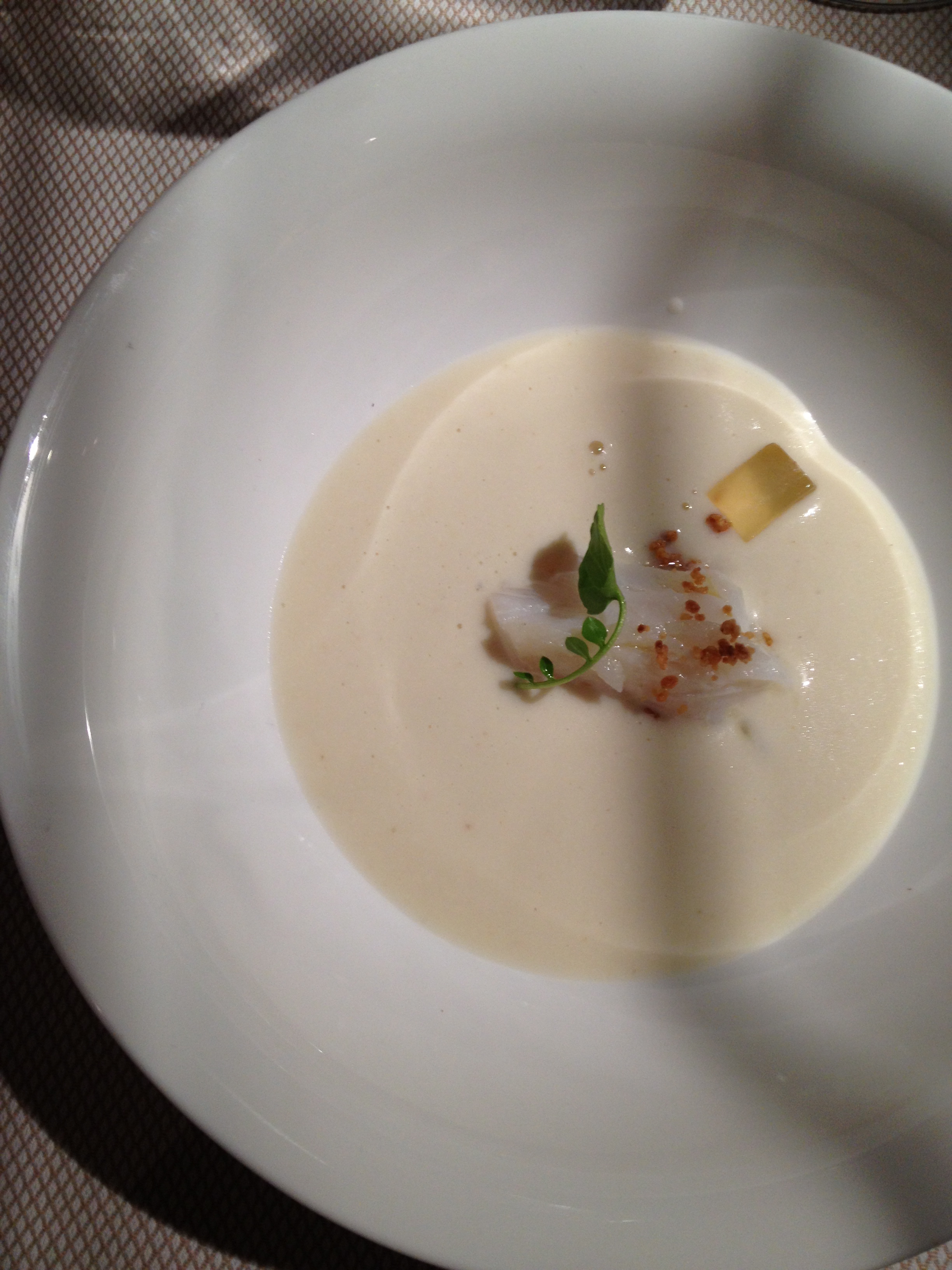
Once settled with a bottle of ice-cold Albariño which the attentive waitress helped us choose, patiently giving us a number of choices to try (I wish I had made a note of the wine – it had an exquisite bouquet) we were first tantilised by an amuse bouche of celery soup, served with a taster of cod with and small cube of lime and vodka jelly and some almond dust for texture. The dust worked like a typical Spanish “picada” to granulate this otherwise velvety soup and work against the cool lime zing. I wasn’t getting the vodka flavour though which, to be fair, was probably a good thing.
Celery soup amuse bouche

Celery soup amuse bouche

Next up we opted for two chilled soups. My partner had the special of the day, which was an exciting yellow gazpacho, served with what appeared to be a dam of super-fresh, almost undercooked langostines, a bank of fluffy cous-cous, and a sweet thai and mango salad. The gazpacho was amazing – my partner even controversially declared it to be better than the authentic gazpacho we had devoured so enthusiastically in Cordoba in 2010, and henceforth declared to be the best in all of Spain. While the yellow gazpacho has now presented itself a keen contender for that crown, I was less impressed with the white version, a chilled Ajo Blanco with Soller prawn & aubergine ravioli and marinated pears. The flavours of the cold garlic weren’t shining through as they should (perhaps catering for the lesser garlic-tolerance of Mallorca’s predominantly English/German clientele?) and the presentation, while initially pretty, became something of a drowned unsightly swamp when the soup was poured over the ravioli, which promptly fell apart and descended into a mush. Still, the flavours weren’t bad, and I completed the dish with moderate relish.

Yellow gazpacho

Yellow gazpacho

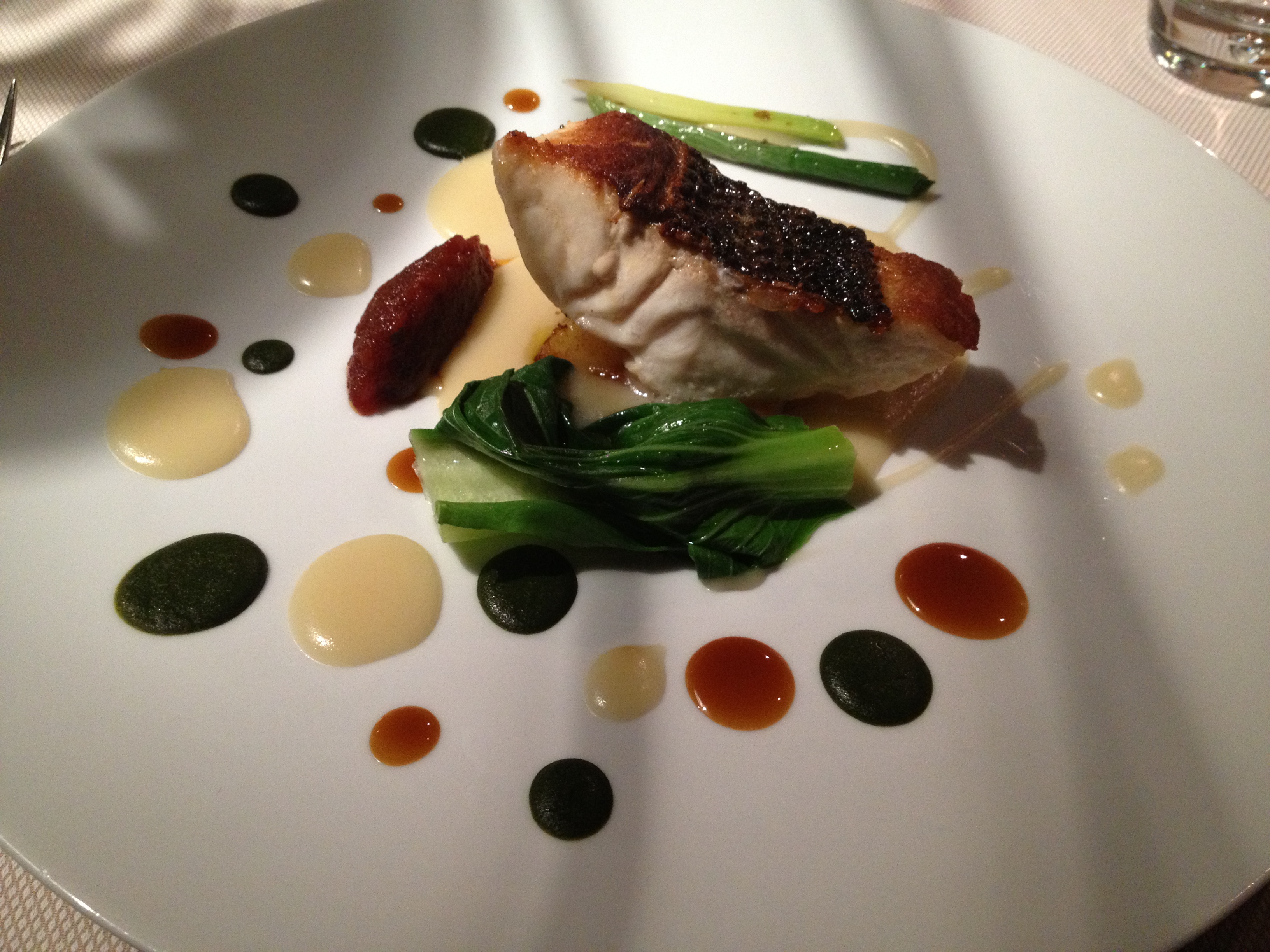
Up next were the mains. My partner struck gold again with wild sea bream with parsley, licorice and parmentier of anchovies – the flavours were beautiful balanced, and the various complex sauces jovially presented in an almost polka-dot formation. My choice, a corn-fed chicken breast with celariac, chestnuts and cranberries, was very well cooked and also beautifully presented, but I think, on reflection, I made a bad choice, because the mixture of chestnuts and cranberries was just too christmassy to be fully enjoyable on what I was at least pretending was a warm summer’s evening, while in the meantime, I found the celeriac sauce a little too cloying.
Sea bream

Sea bream

The Chicken

The Chicken

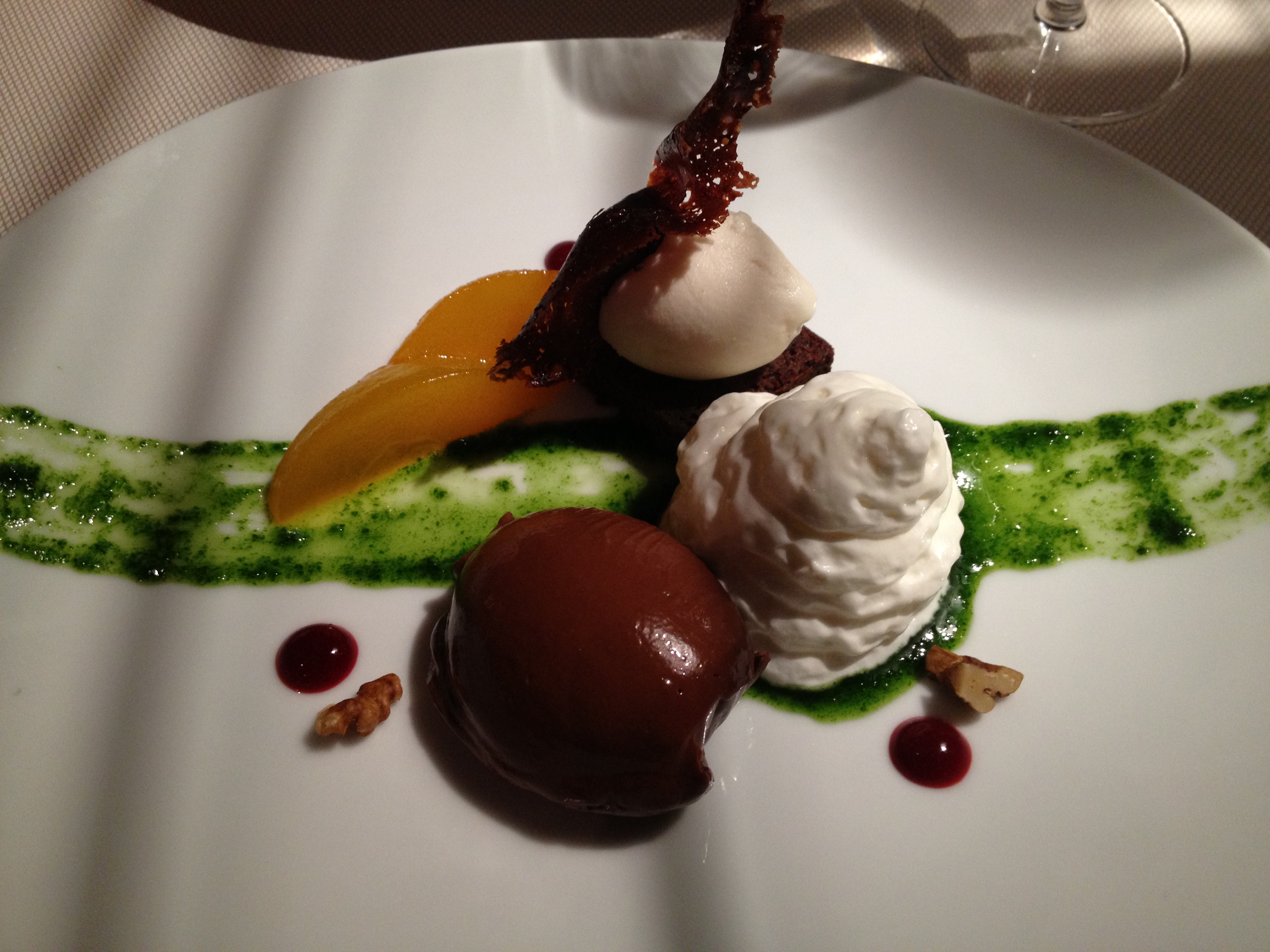
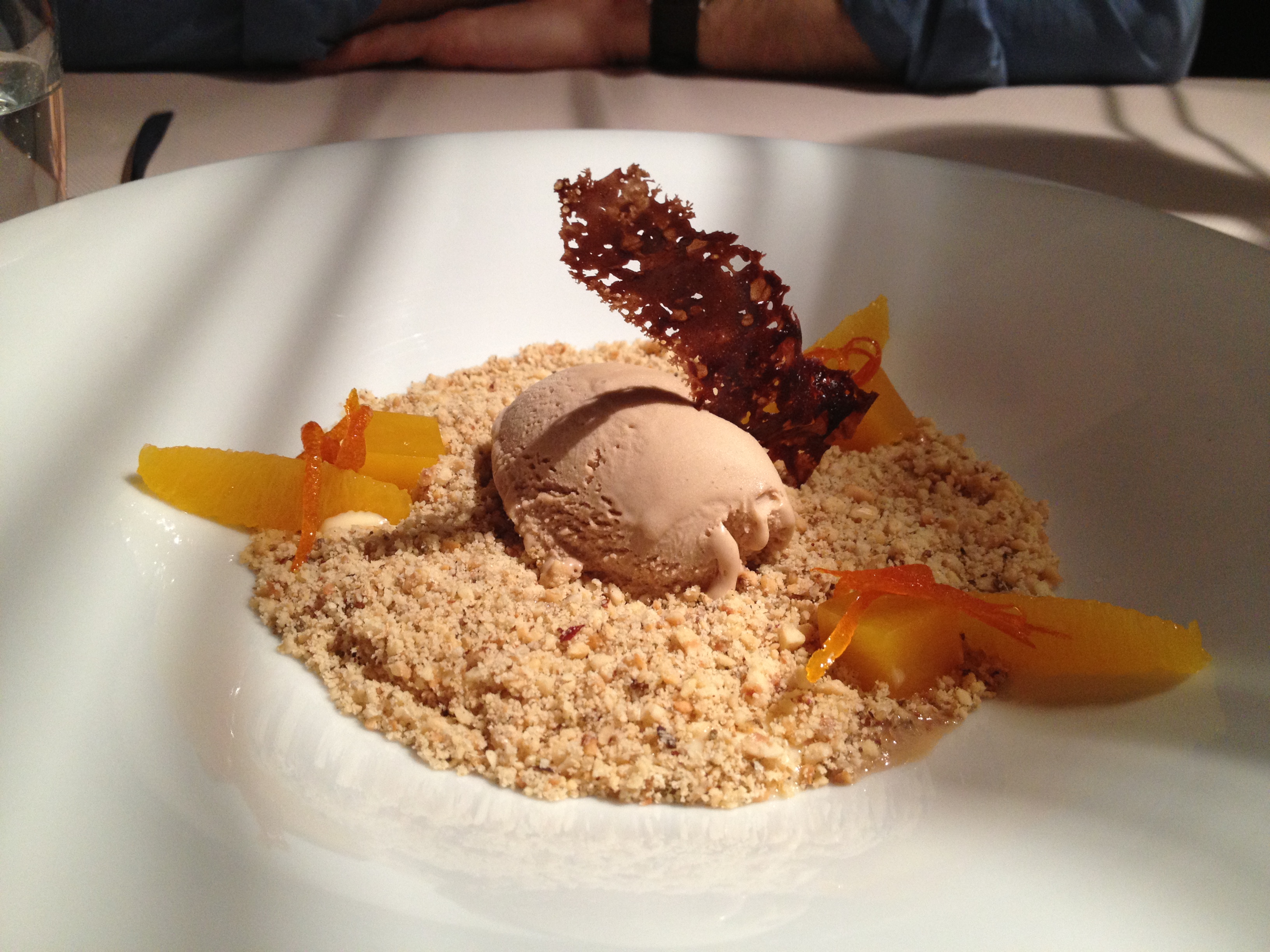
But with dessert, an uninterrupted sugar binge of dynamically indulgent proportions was to follow, with my chocolate “cremoso”, a rich chocolate mousse perfectly balanced alongside marinated pears, a moorish walnut ice cream and light yoghurt mousse, while a coriander reduction made for a very innovative twist. Meanwhile my Partner had equal success with a dessert of almond cream on a sandy bed of spiced hazelnut, littered with a pieces of orange and caramel which resembled seaweed and coral washed upon the hazelnut beach by a current of bergamot flavourings.

Chocolate "cremoso"

Chocolate “cremoso”

Almond cream

Almond cream

And with that gastronomic manifestation of the mediterranean coast, full of its Moorish flavours and citrus undertones, we left the restaurant with a satisfying flavour of Spain lingering on our tongues, and the pleasant intoxication of that chilled Albariño embracing our souls and tugging our eye-lids towards sleep. Another day, another amazing Mallorcan meal, and still two more days to go. La Dolce Vita.

Simply Fosh is on the Carrer de la Missio, in central Palma, close to the Plaça de España. You can call 971720113 or reserve online.

Mallorca (Part IV) – Food Focus 1: Forn de Sant Joan

We were spoilt for choice when it came to Mallorca eateries, and unlike so many European cities, whose central arteries are clogged with tourist-trap restaurants whose superior central locations and extravagant prices are seldom equalled by quality food, it at least appeared as though the majority of Mallorcan restaurants were popular with both locals and tourists alike, attracting both factions with good food and reasonable prices. Frankly, while I would have been happy to dine in Cappuccino Grand Café day and night, I thought it only reasonable that I try to diversify, for the sake of gastronomic exploration.

FornDeSJ_Banner_Bild_03

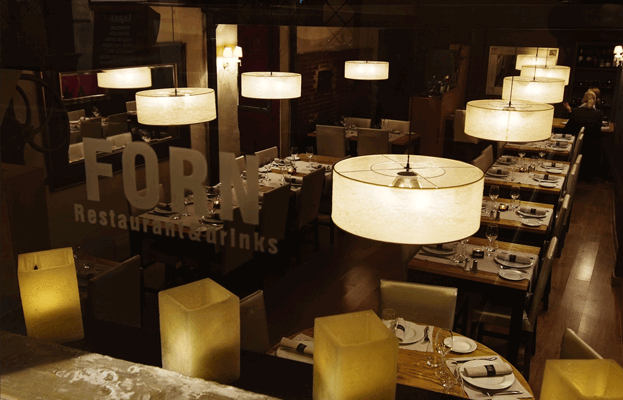
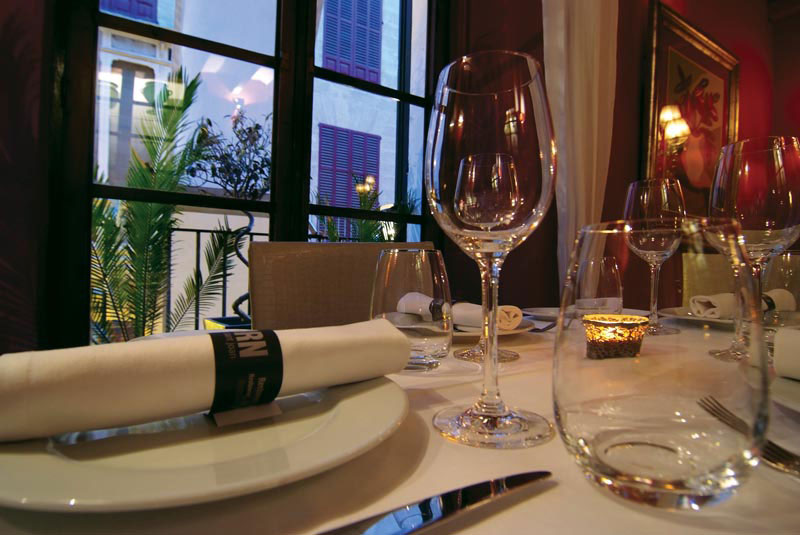
My first choice therefore, on the back of excellent tripadvisor reviews, was Forn de Sant Joan in the c/Sant Joan (bang in the centre, close to the Passeig de Born). Feeling slightly sceptical having had a look at the restaurant’s website and seen that they have an entire tab devoted to their celebrity clientele (thus screaming tacky – although to be fair, we were sat next to the Polish superstar actor Piotr Adamczyk) we could not deny the sheer popularity of the place which more or less overflowed from its rather elegant reception area. Guided into the restaurant by a very welcoming front of house, the place seemed to go on for ever – I think we were sat at least two floors up, although to be honest I got a little lost on the way in and was far too merry on the way out to notice. Nevertheless the restaurant was not uncomfortably big – rather the old building featured a series of small cosy rooms, full of quirky furnishings and bright art works.

We were immediately struck by brilliantly efficient service, which lasted throughout the night. Our waiters, like so many Mallorcans, spoke perfect English (as well as German, it seemed, which comes in even more useful in Mallorca than English), made suggestions, never let our glasses go dry and, most importantly of all, gave us a free dessert to sample, in addition to the two we had already ordered.

Forn-de-Sant-Joan8

But let’s not jump the gun. Before we got to dessert, first there was the small matter of some savoury samplings.

Forn de Sant Joan has a large menu, with a whole range of innovative tapas up for grabs before you even get onto the starters. Wanting to sample both, we went for a tapas of mini cornets filled of a cerviche of sea bass and langoustines with coconut foam, and a starter thai salad with mango, papaya, coriander and grilled prawns. The cerviche was incredible. Served with cones stood up on a mini beach of pebbles, one bite in and the cornet exploded like a tidal wave of sensational flavour running over the tongue – utterly fresh, zinging with citrus acidity, but still allowing the perfumed subtleties of the fish to shine through. Less enticing was the thai salad which, despite being hand-tossed for me at the table by a waiter “so that the dressing is mixed properly” (I’m not overly sure why they didn’t just mix the dressing properly in the first place), was fairly ordinary, rather lacking in the much promised tropical fruits, and including bog standard little prawns the likes of which sit happier in your average supermarket prawn cocktail, and certainly showing no signs of having been grilled.

Cerviche of sea bass

Cerviche of sea bass

Thai salad

Thai salad

Onto the mains – for me a grilled bream with mashed potatoes, lobster cream sauce and herring caviar. While a little light on the caviar for the price, the fish was undoubtedly delicious – the lobster cream sauce rich and flavoursome, and the potato devilishly creamy. My partner had a grilled fillet steak with grilled teriyaki vegetables and potatoes au gratin (I neglected to take a photo, sorry!). I’m not necessarily convinced that the gratin and the teriyaki married naturally together, but on their own, the components were delicious.

Sea Bream in a lobster sauce

Sea Bream in a lobster sauce

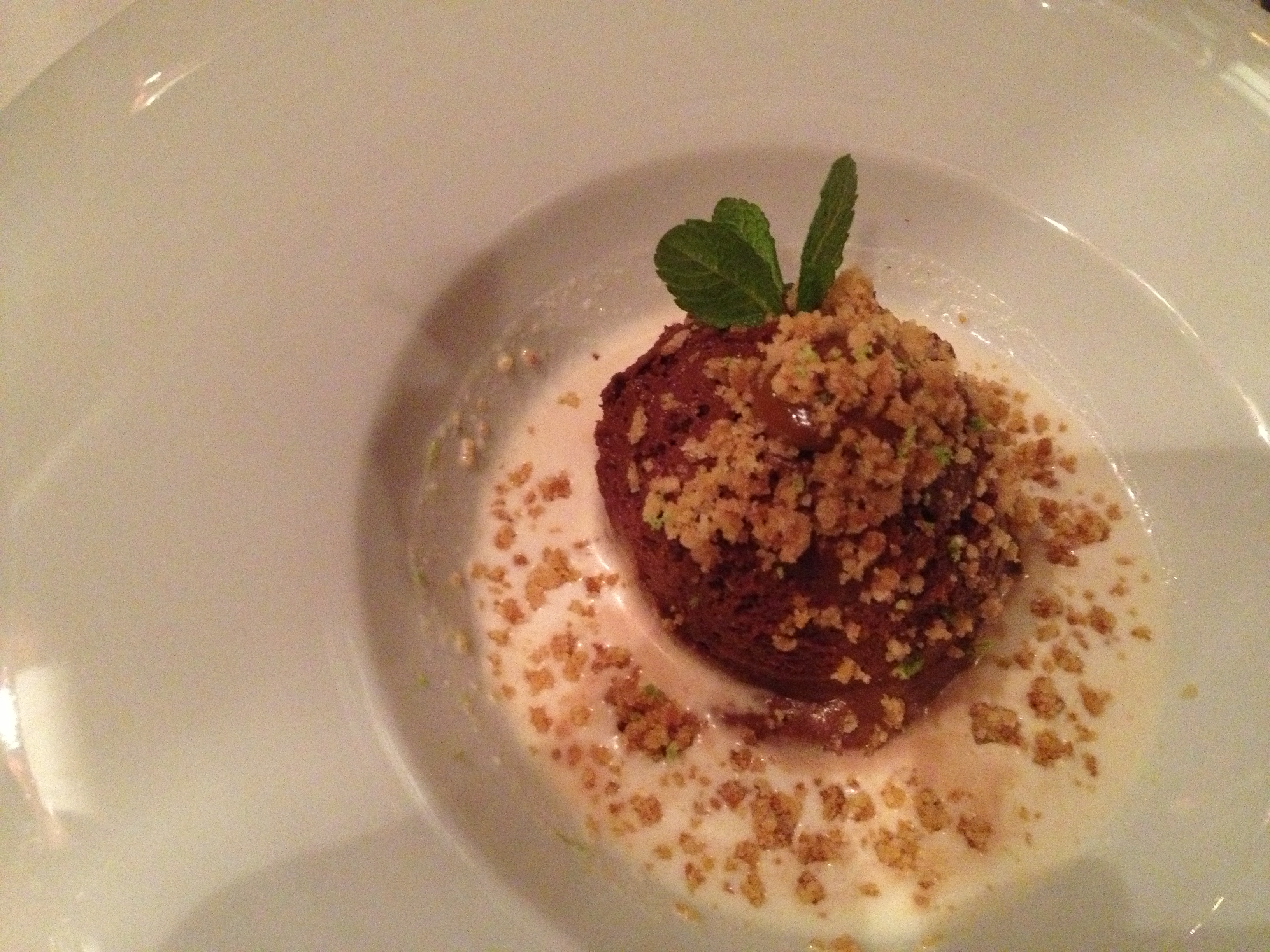
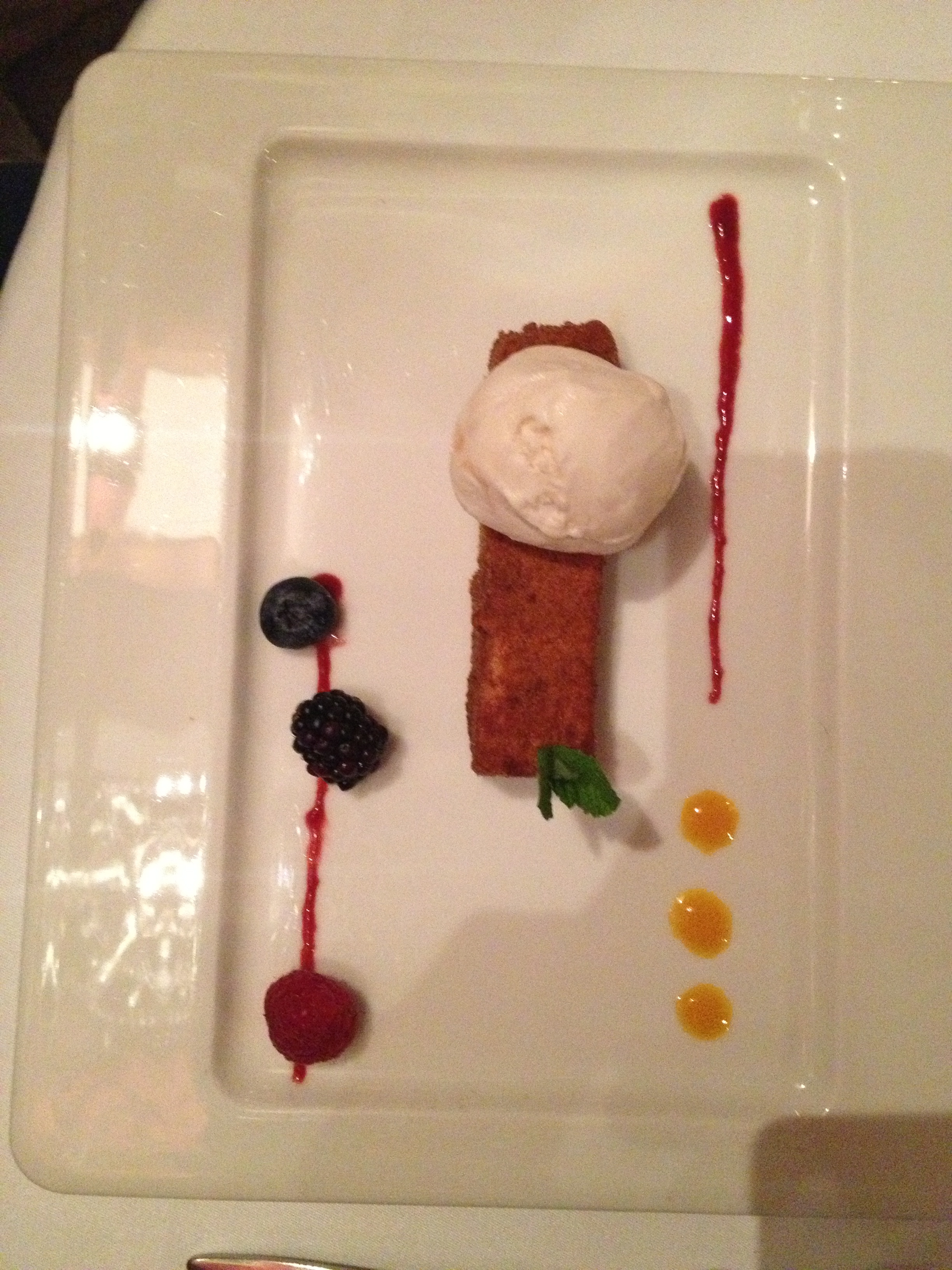
The real stars of the show were those desserts however. We were spoilt for choice, and walking away from the restaurant, I remained tempted to go back in and order one of each of the desserts on offer, such was the temptation engendered by their description in the menu. Luckily, thanks to the generosity of the waiter, we were able to sample a taster of allegedly the most popular dessert of the restaurant, and something of a signature dish – strawberries filled with creme brulée (“baccio di dama”). This bite-sized dessert was a nice idea, but the creme brulée was too subtle in flavour to stand up against the bold natural flavour of the strawberry. However, the desserts we did chose were much more successful – for me “Chocolate looks to Asia” – a moorish grainy chocolate mousse with toffee, lemon grass cream and ginger crumble was a harmony of spice and chocolate which had me secretly transported on a mental magic-carpet ride to some far off spice market, munching upon sumptuous dark chocolate as I went. For my partner, a semifreddo of passion fruit with a praline and chocolate ganache made for another finely balanced, light and elegant combination.

Baccio di dama

Baccio di dama

Chocolate looks to Asia

Chocolate looks to Asia

fqwfqwf

Semifreddo of passion fruit

So while the food wasn’t always perfect, there is no denying the excellent service and great choice of food on Forn’s menu – looking around the room, some of the other tapas dishes on offer looked really quite exciting. And as far as celebrities go, we had a Polish one bang next door to us. So in that respect, the Forn de Sant Joan really were true to their word.

Details of the Forn de Sant Joan can be found on their website, and reservations made online.

La Seu by night

La Seu by night

Valencia (ix) – Food Focus 2: Seu-Xerea

Readers of my blog will know that asides from exploring, photographing and culture-spotting my way around a city, my fourth greatest pleasure of any city trip or holiday is to discover the location’s gastronomic culture. Last year I was lucky enough to sample faultless dinner after faultless dinner in both Spain’s Salamanca and Italy’s Bologna, while in Portugal’s Lisbon, artistically elegant food was served at peasant prices. I would love to follow suit now, in cataloguing my Valencian adventures, and describe dinner after dinner of exciting gastronomic discovery. But I can’t. Why? Not because the food was in any way bad… just because I so rarely got to sample it!

Our great mistake, it appears, is that we stayed in Valencia from Friday to Tuesday. This is a reasonable long-weekend timetable to my mind, but for the restaurants of this city, it’s a no go. So while we had no problem dining out in the fabulous Palo Alto on the Saturday (and would no doubt have dined similarly well on the Friday had our flight not been delayed (*groan*)), Sunday and Monday nights were pretty much a write-off as we found one restaurant after another closed. Now don’t get me wrong, I know that some restaurants like to have a night off (although why they can’t just give their staff alternate nights off and keep the restaurant open daily mystifies me), but two nights in a row?! And this in one of Spain’s largest cities and most popular tourist destinations.

DSC05032 DSC05033

So, on both Sunday and Monday, it was good old Cappuccino Grand Café who cleared up all the diners wandering around Valencia looking lost, the  Mallorcan café chain who clearly have better business brains when it comes to their opening hours. Now don’t get me wrong, Cappuccino are a consistent eat, good service, beautiful atmosphere, even more beautiful staff, but one likes to be adventurous. To do that in Valencia, I had to extend my adventurous spirit one step further than intended, and make my final stab at gastronomic dining on Tuesday lunchtime, just before leaving the city. Luckily for us, this last food experience, decadent in its daytime occurrence, lost nothing for being consumed by day light. Rather, our last hours in the beautiful city of Valencia were spent indulging in a tapas degustacion menu, quaffing upon beautifully selected delicate local wines, and sampling the inexorable delights which come hand in hand with the restaurant Seu-Xerea.

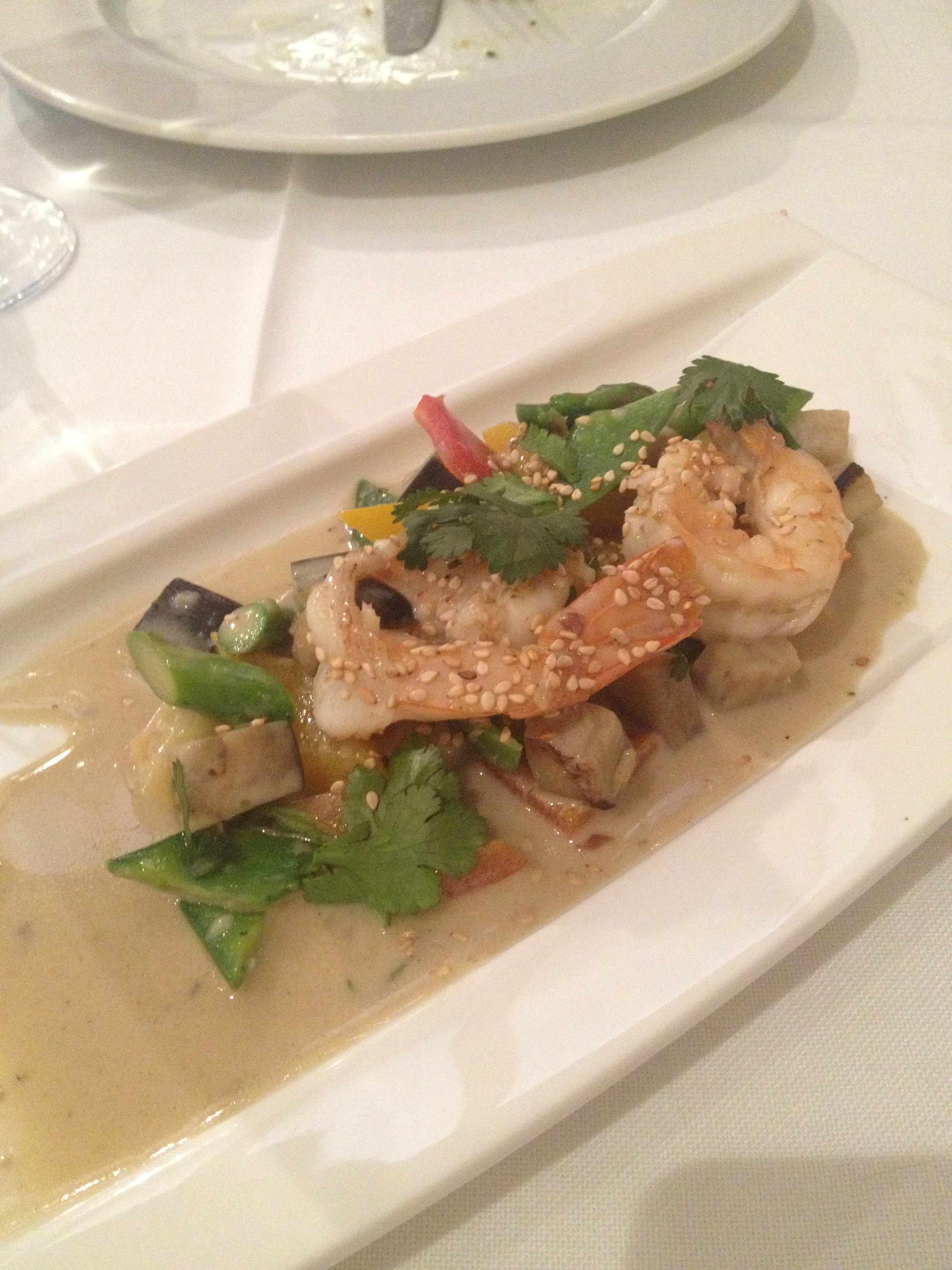
Seu-Xerea is the creation of anglo-burmese chef, Steve Anderson. Favourably reviewed in many a Valencia guidebook, and located in a beautiful old town house just north of the Plaza de la Virgen, the restaurant is a chic, trendy food retreat, which brings to Valenica a fresh, asian twist on Spanish classics, and whose well balanced and elegantly presented food is not overshadowed by an enormous price tag. Rather, for lunch, for 32 euros each plus 8 euros extra for wine (both white and red) plus water and coffee, we were treated to a tasting menu which comprised some 5 starters, a main and a refreshing and indulgent dessert.
The interior...

The interior…

entrada-principal-main

The starters incorporated a panoply of both asian and Spanish flavours in an almost faultless combination of spice, acidity, sweet and sour, all delicately and artistically presented, giving diners visual delights to accompany flavour diversity in every dish. Now don’t get me wrong – Heston Blumenthal this was not, but for a “light” tapas lunch, one couldn’t complain.

Up first was a cream of mussel soup, subtly imbued with saffron, indulgently creamy but not heavy, with a few chives to give oniony balance to the richness of the mussel liquor. Our bouches sufficiently amused, we went on to croquetas of free range chicken. But the name was probably all that was Spanish about these, served with a curry and yuzu mayonnaise, and a kind of pickled shredded cucumber salad, the ingredients of which I couldn’t quite make out, but the freshness of which was undoubtedly welcome amongst the thrilling spicing which the freshly unctuous croquets were duly dipped in.

IMG_3261

The tapas starters were on a roll now, as the next dish of artichokes al la romana presented itself before us, the tender heart of the artichoke being subtly flavoured, not like these pickled kinds one buys so often in the UK, thus allowing the creamy centre of this wonderful vegetable to shine through and compliment the accompanying cardamom and tupinambour purée.

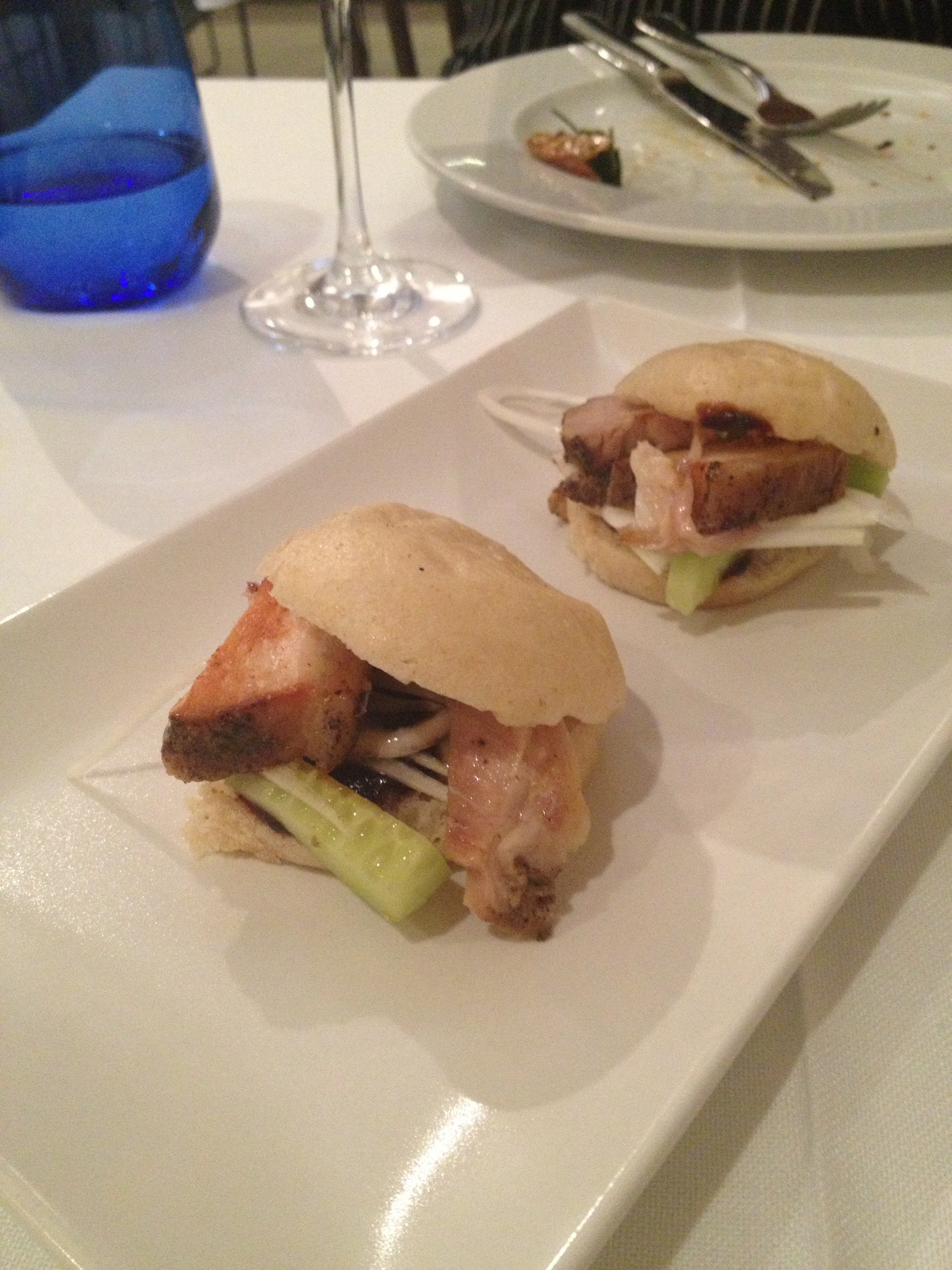
Then, heading full throttle down the modern asian route, a satay of delectable juicy fresh kind prawns in a very subtle peanut sauce with vegetables so fresh that they tasted like they had been plucked from a freshly irrigated farm that very morning, and a steamed bread bun with sio bak-style pork belly and hoisin sauce – basically a posh version of the pork buns one can easily munch upon in a dim sum restaurant, and no less flavoursome for its ascension to the tables of the gourmet world.

IMG_3265 IMG_3266

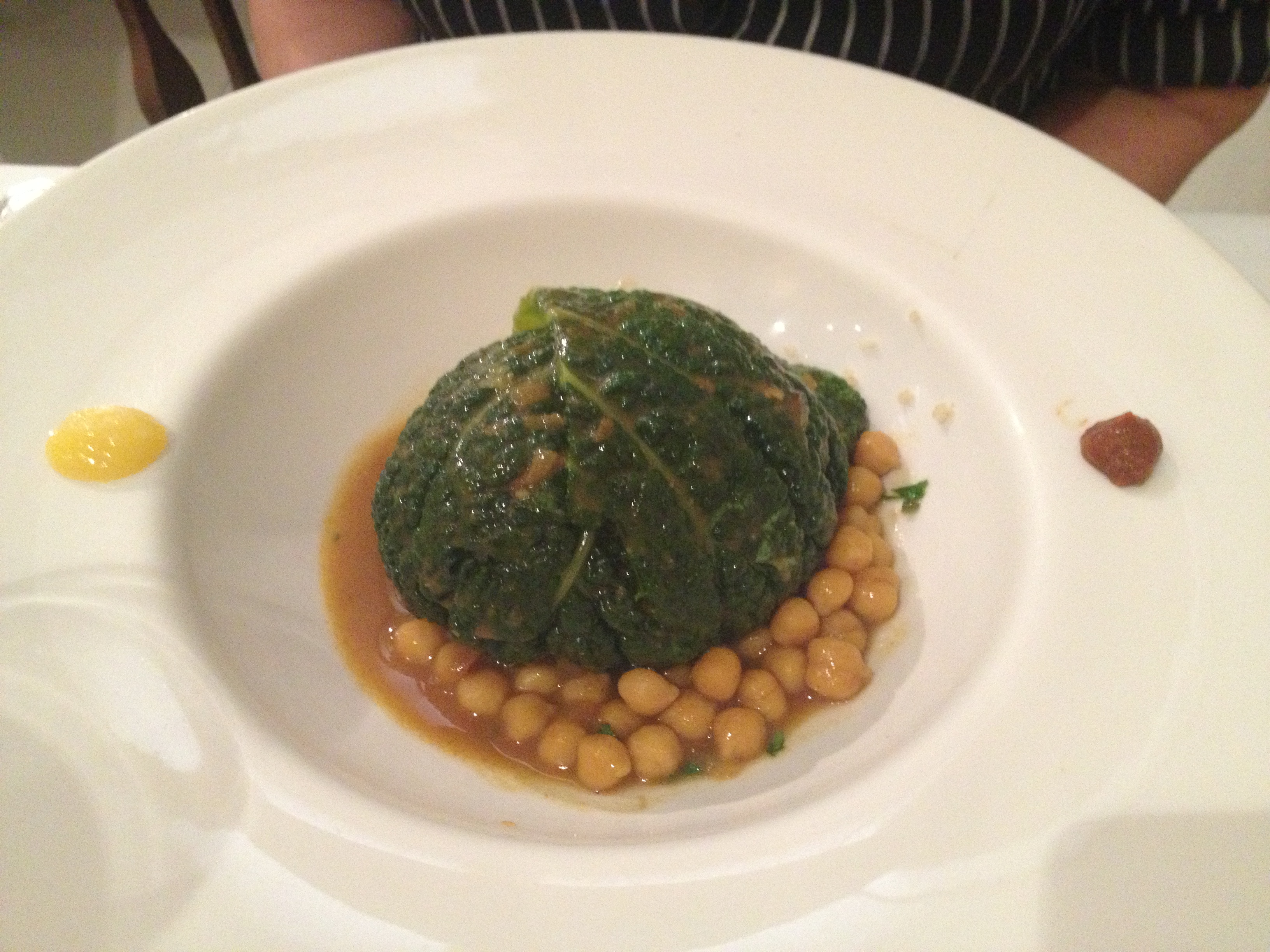
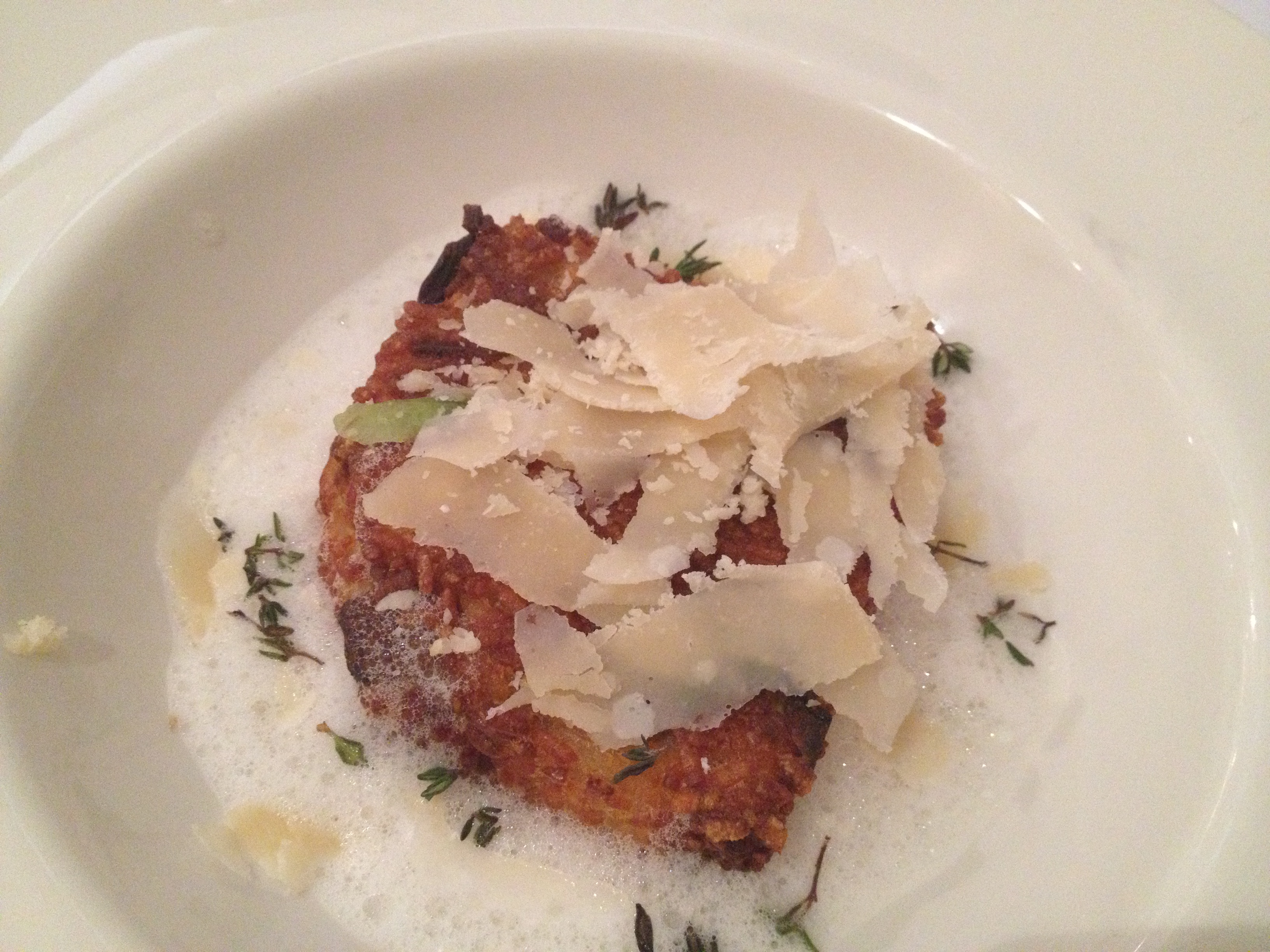
The starters done (and apologies for the lack of/ rubbish photos – I was drinking wine at lunch time after all!) it was onto the mains. There were some three to choose from, and seeking variation on our table, we went for different options. For my mother, a dish of lamb and couscous, artfully concealed within a ball of cabbage and served on a bed of chickpeas. The real winner of her dish was the small but potent helpings of both lemon curd and the super-spicy harissa, the two working in perfect union as a twosome accompaniment to this tender meaty dish. Meanwhile, I had a grilled risotto with mushrooms, Iberian pork and a parmesan cheese broth. This was perhaps the less successful of the two, the grilling of the risotto drying the total dish out somewhat, but I enjoyed the caramelisation which the grilling achieved, as well as the foamy parmesan broth with which the food was lightly fondled.

Outside...

Outside…

...and in

…and in

The grilled risotto

The grilled risotto

Dessert came swiftly (it was by this time mid-afternoon and doubtless the popular restaurant was hoping for a break before the dinner stint) and was pleasing both in appearance, quantity and in its zesty refreshing flavour: a pot of passion fruit and white chocolate, this dish benefitted from a much needed contrasting crunch provided by pistachio and what tasted a bit like aerated and dried white chocolate. Best of all, the tart passion fruit cream was broken up with immersed flakes of white chocolate – exquisite.

IMG_3270

With coffee, our excellent meal came to an end, a few hours of perfect gastronomic sanctuary, with fine Valencian wines helping us to forget the impending return journey back to the UK, and delicious food enabling us to forgive Valencia its almost absurd double-day restaurant closures. But we’ll know for next time…

Seu-Xerea is at C/ del Conde Almodovar, just behind the Plaza de la Virgen. Open for lunch and dinner, but not on Sundays or Mondays!

Valencia (ii) – Food Focus 1: Palo Alto

Review websites such as tripadvisor have easily become the best friend of the tourist, but often the enemy of the hospitality industry, which so easily falls victim to the foul mouths of internet trolls who would never complain to a restaurant’s face (so to speak), but unleash their cowardly fury online to the detriment of the business’s future trade. And yet, when a restaurant knows its stuff and presents a brilliant service, this is more often than not reflected on the said review websites. It is for this reason that before visiting a new city, I tend to check out the top 10 or 20 restaurants as reviewed by visitors on tripadvisor, and more often than not make a few reservations as a result. For Valencia however, I had insufficient time to scan through the various Valencian offerings, and decided to take Valencia like a bull by its horns, and leave my restaurant reservations to chance.

Imagine my surprise then when, after stumbling upon this little neighbourhood gem, Palo Alto C/ Conde de Montornes 30, and enjoying every little expectation-exceeded detail, that I should find said restaurant is only at number 406 of 1266 tripadvisor reviewed restaurants in Valencia! To be fair to them, they only have one review, and that review is a full 5 out of 5 which, while not surprising, should be replicated many times over. I hope therefore that in writing this review, I will play a small part in lifting Palo Alto far up the tripadvisor rankings and into the hearts of Valencia visitors henceforward.

file205_Restaurante_Palo_Alto_08_resize file201_Restaurante_Palo_Alto_03_resize

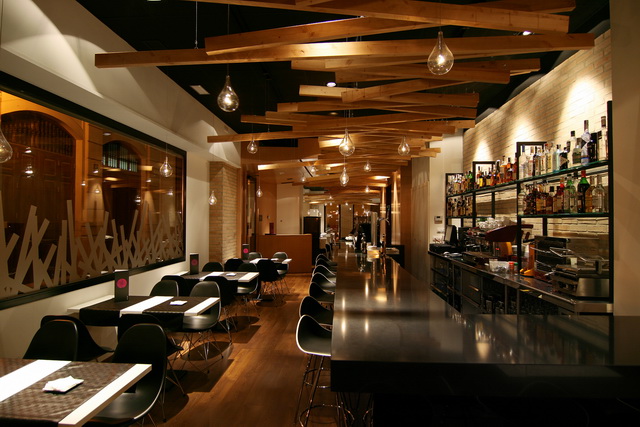
We were quite lucky to chance upon this restaurant. Always on the lookout for something quirky (and always ensuring that I avoid any restaurant which 1. has waiters/ maitre d’s standing outside beckoning/ forcing tourists inside or 2. those whose menu comprises 80s-style yellowing photographs of ideal dishes, to which the actual presentation bears very little resemblance) and heading back to the hotel after our traipse around Valencia’s fine art museum followed by another around the Jardines del Real, I was attracted to this place by the unique interiors (special admiration went for the variously angled wood suspended from the ceiling like a continuous wave rushing along the shore, complete with oversized lightbulbs hanging at differing heights) and the very reasonable menu. For only 44.25 € each, we would get 5 courses, bread, a bottle of wine, water and coffee. Bargain.

Delicious wine, all included

Delicious wine, all included

So turning up later at the allotted time, we found ourselves attentively looked after from the start. Pleasant waitresses asked us whether we would like white or red wine, and on choosing the latter were given an excellent tempranillo rioja “Valdemar, 2011” which far exceeds the normal plonk one may be given as a house wine or as part of a set menu. Smooth and perfectly chilled at the recommended mid-teens centigrade, this wine flowed like liquid velvet upon the tongue, slipping down the throat in perfect unison with the food.

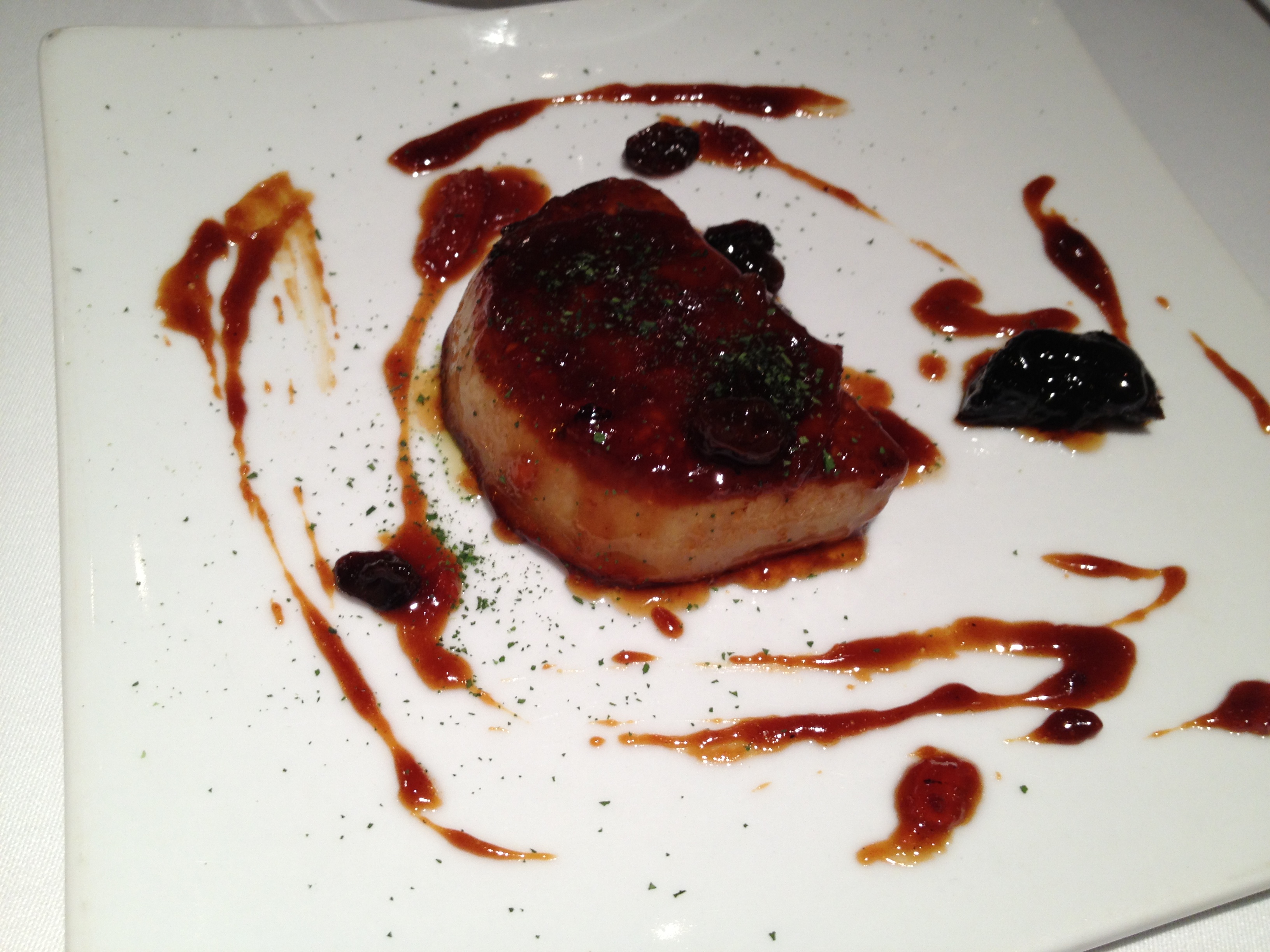
Speaking of which, each and every course of our sampling was delicious, flavourful and each uniquely different. The first, a panfried foie gras with a reduction of pedro ximenez sherry, honey and raisins was a perfectly balanced dish. The reduction had been taken a little too far, with the result that it was a tad sticky in between the teeth, but the sharp sweetness was a beautiful accompaniment to the rich creamy saltiness of the foie.

Foie with a sherry reduction

Foie with a sherry reduction

Onto dish two, a beautifully presented salad of super-fresh scallops, sitting in their little mermaid bikini shells surfing the waves of a verdant salad, dressed in a citrus vinaigrette and topped with that much needed “crunch” supplied by crushed pistachios and crispy iberico ham.

Salade of Scallops with iberico ham and crushed pistachios

Salade of Scallops with iberico ham and crushed pistachios

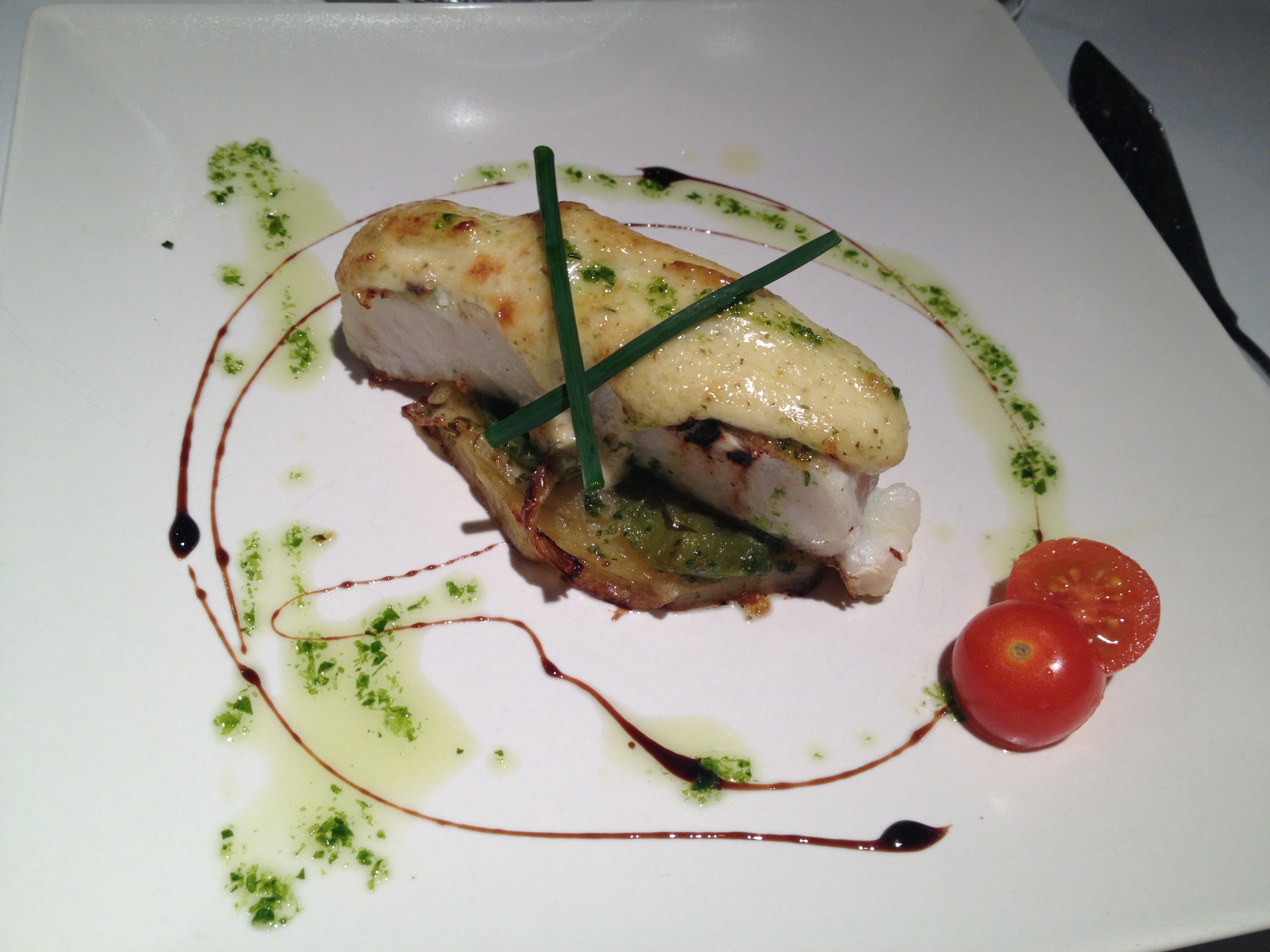
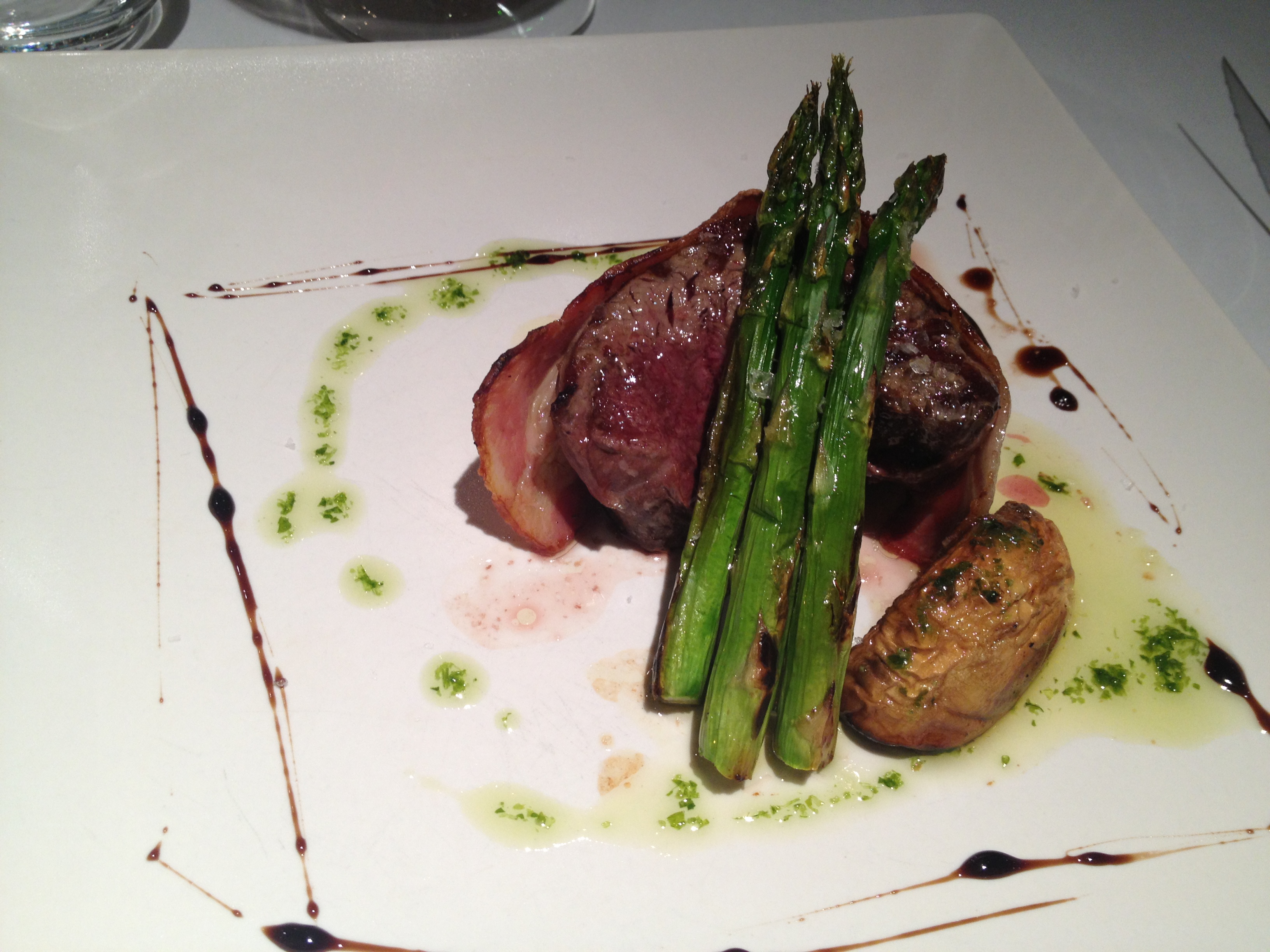
There were two mains, the first a dish of hake  (or “merluza” in Español), served on potatoes with a basil and garlic purée. I could smell the pungent garlic as the dish wafted over from the kitchen (or rather the garlic vapours did) and relished the potent mediterranean flavour. My mother found the garlic a little strong for her more refined anglicised palate and perhaps wisely left a little of the sauce to the side – had I done the same, I may have better appreciated the more delicate flavours of the subsequent main, a tornado of beef wrapped in bacon and served with mushrooms and asparagus. What can I say other than it was delicious, tender and perfectly cooked?

Hake with a garlic and basil sauce

Hake with a garlic and basil sauce

Tournado of beef with bacon

Tournado of beef with bacon

Ok, it's meat juices I know, but the marbling is beautiful

Ok, it’s meat juices I know, but the marbling is beautiful

Finally, onto the unctuous spongey chocolate cake with a strawberry reduction – perfect for the Valentines weekend, although for obvious reasons this was not at the forefront of my mother’s or my mind (!). I can barely remember quite how delicious this cake was, such was my unapologetic embrace of over half of that delicious tempranillo, and my undeniable intoxication by a meal which was, in every detail, on point. Having almost forgotten how reasonably priced this set menu was, the final bill of 88 € came as something of a shock, but was worth every centimos. Palo Alto – may you rise to the altos of tripadvisor. You deserve it.

Chocolate cake with strawberries

Chocolate cake with strawberries

Palo Alto in on the C/ Conde de Montornes 30 which is a few minutes east of the Cathedral and close to the bed of the old Turia River.