Skip to content

Posts from the ‘Art’ Category

Domingo de Ramos

It’s Palm Sunday and all over the world, people will be marking the start of Easter Week. I’m not that religious myself (I went to Catholic school and sung in a church choir throughout my childhood, but that’s probably the extent of it), but there is something undeniably enchanting about the celebrations which are afoot in the Christian church at this time of year, especially in Southern Spain.

In celebrating Semana Santathe Spanish go all out in a devotional show which makes the spine tingle with its emotional impact. Every evening in Spanish towns and cities throughout the country, but particularly in the South, brotherhoods (hermanidades) of various churches dust off the various statues of Jesus and Mary which usually sit in the enclaves and side chapels of their churches, dress them up in flowers and candles, and with great fanfare parade these statues upon gilded tronos around the streets of their respective cities. The hermanidades themselves are likely to parade as nazareños, the slightly sinister masked figures who accompany the floats, with their pointed conical hats carrying candles which sway to the rhythm of the parade. Seeing row upon row of these figures lined up in the street is a moving and dramatic sight.

Grupo de Nazareños (2009 © Nicholas de Lacy-Brown) Oil on canvas

Grupo de Nazareños (2009 © Nicholas de Lacy-Brown) Oil on canvas

My first ever experience of one of the Semana Santa parades was in my (sometimes) hometown of Marbella on palm sunday. Decked in rich velvet costumes of red, green and white, the nazareños carrying their heavily decorated silver and gold crosses and candlesticks completely inspired me, and I painted this quick oil painting named after the day of the parade which inspired it – Domingo de Ramos.

Of course those who know my art will know that this is but one artwork which has been inspired by the moving spectacle of Spanish Semana Santa, but as it depicts Palm Sunday, it seemed only appropriate to share it with you today.

And if you like my artwork, don’t forget that all of my Spain-inspired paintings will be on display at my forthcoming exhibition, When (S)pain became the Norm, starting one month today!

© Nicholas de Lacy-Brown and The Daily Norm, 2001-2014. Unauthorized use and/or duplication of the material, whether written work, photography or artwork, included within The Daily Norm without express and written permission from The Daily Norm’s author and/or owner is strictly prohibited. Excerpts and links may be used, provided that full and clear credit is given to Nicholas de Lacy-Brown and The Daily Norm with appropriate and specific direction to the original content. For more information on the work of Nicholas de Lacy-Brown, head to his art website at www.delacy-brown.com

 Nicholas de Lacy-Brown’s new solo exhibition, When (S)pain became the Norm, will be at London’s Strand Gallery from 13 – 18 May 2014. For more details, click here.


Paolo Veronese – The Martydom of Saint George

London’s National Gallery is celebrating one of the gems of Italy’s and more specifically Venice’s Renaissance age: Paolo Veronese (1528-1588). In its new exhibition, Veronese: Magnificence in Renaissance Venice, the National can’t help but put on a show. In celebrating the work of this artist, whose paintings epitomise the magnificence and theatricality of Renaissance Venice with huge historical and religious canvases, bold colours and a wonderful aptitude for painting figures, classical buildings and sensational drapery, the National Gallery brings us one big hit of a painting after another. It’s almost a problem for the exhibition, which has collected together so many brilliant, vast masterpieces, that the visitor is bamboozled, unable to concentrate on any one painting in particular.

So being the great public service blogger that I am, I decided to solve this problem with a neat solution – to focus on just one of the utterly brilliant paintings on display, and the one which took my breath away over and above all the rest.

Paolo Veronese (c.1565), The Martyrdom of Saint George - on loan from the city of Verona (image source: wikipedia commons)

Paolo Veronese (c.1565), The Martyrdom of Saint George – on loan from the city of Verona (image source: wikipedia commons)

Painted in 1565, The Martyrdom of Saint George was created at the apex of Veronese’s illustrious career. Measuring some 4.2 metres in height, this vast canvas offers us all of the glorious elements that make Veronese’s paintings sing like a grandiose opera almost half a century after they were painted. Depicting the moment when Saint George, a Roman soldier, accepted his martyrdom after refusing to worship pagan idols, this moment of dramatic realisation is captured with skilfully applied light (just look how our eyes are drawn to that perfectly lit torso and the outstretched arms of the martyr), and a brilliant composition, with clouds tumbling upwards into paradise, where the Virgin and Christ child appear with Saints Peter and Paul along with the allegorical figures of virtue: Faith, Hope and Charity.

The balance of the painting is brilliant, with the cerulean blue sky echoed in the drapery beneath Saint George, in the clothing of the turbaned man on the left, and up in the celestial clouds at the top, while the figures are variously placed at different heights, intensifying the feeling of drama and the sense of audience participation in this dramatic moment of religious history.

Of course this painting is but one in an amazing collective celebrating the genius of the often overlooked Venetian master. And at the risk of being quite overcome by it all, you may as well go along and revel in the glory.

Veronese: Magnificence in Renaissance Venice is on at the National Gallery, London until 15 June 2014.

London’s homage to print: Part 2 – David Hockney Printmaker

Last week I told you all about the first of two high profile celebrations to printmaking currently being held in London. The first, Renaissance Impressions at the Royal Academy charts the development of woodcut to create all of the depth and powerful contrast of chiaroscuro in the 1500s. The second unveils a whole new side to celebrated contemporary artist, David Hockney, best known for his colourful Los Angeles Swimming Pools and large scale multi-piece canvases of the Yorkshire countryside, but here shown to be as skillful a printmaker as he is a painter, or, in my opinion, more so.

In presenting this brilliant little exhibition, Dulwich Picture Gallery shows Hockney as a subtler artist; without the distractions of his trademark bold colours, this is Hockney the skilled draftsman; without the almost theatre-scenery sized canvases, here we see Hockney as a man of detail, capturing intimate scenes with a personal aspect, and delivering sometimes simple still lives but with all of the energy of those familiar swimming pool scenes.

David Hockney, Lithographic Water Made Of Lines And Crayon (Pool II-B) 1978-80 © David Hockney / Tyler Graphics Ltd

David Hockney, Lithographic Water Made Of Lines And Crayon (Pool II-B) 1978-80
© David Hockney / Tyler Graphics Ltd

David Hockney, Self Portrait, 1954 © David Hockney

David Hockney, Self Portrait, 1954
© David Hockney

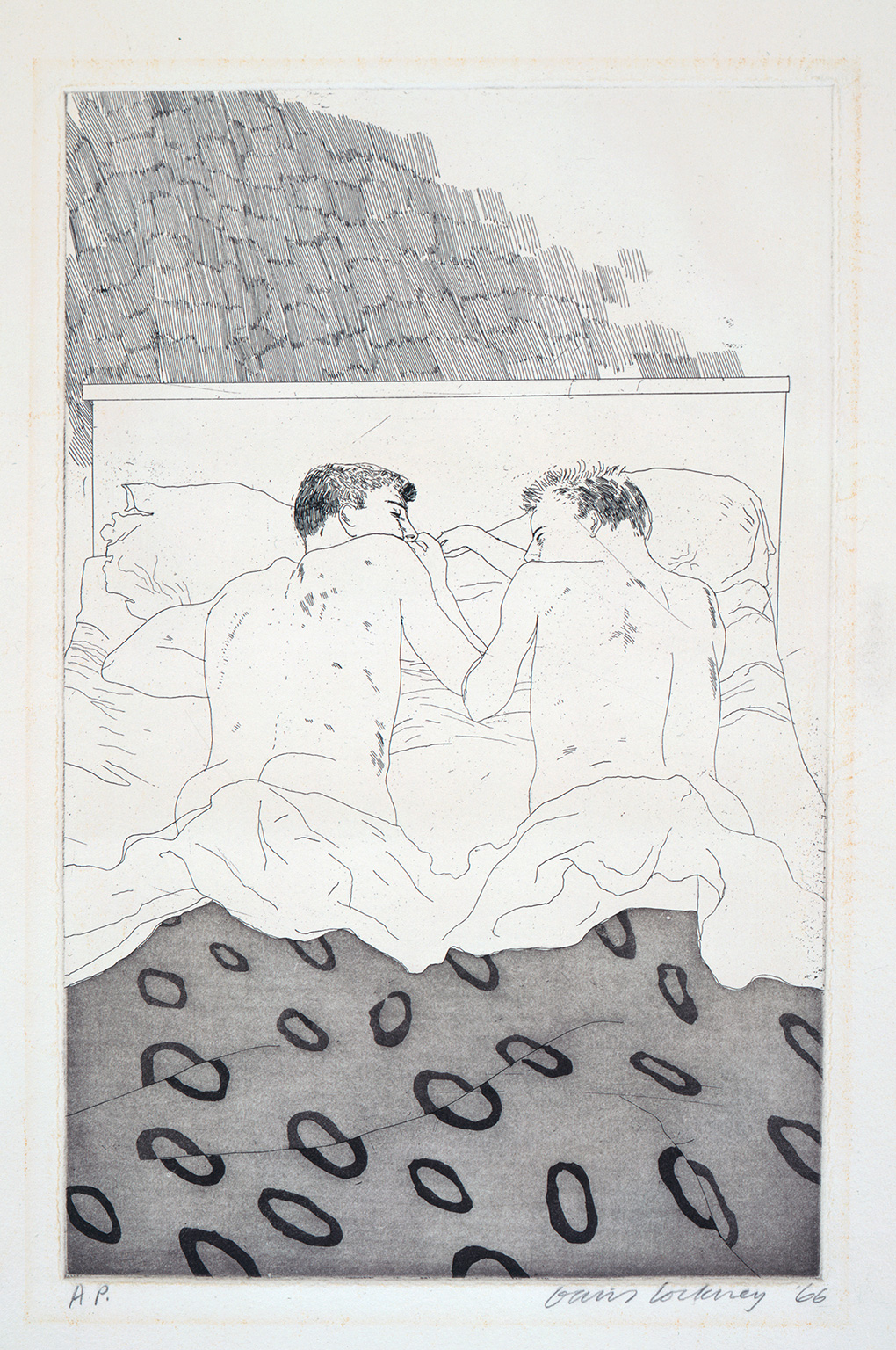
David Hockney, Two Boys Aged 23 or 24 from Illustrations For Fourteen Poems from C.P. Cavafy, 1966-67

David Hockney, Two Boys Aged 23 or 24 from Illustrations For Fourteen Poems from C.P. Cavafy, 1966-67

It is abundantly clear, from the first room of the chronologically hung exhibition, right through to the last, that printmaking has been an important and consistent accompaniment to Hockney’s creative process throughout his career. From his first etchings, amusingly poking fun at his fine art degree (I like the etching which was created using his actual fine art diploma, The Diploma (1962)) and taking a new spin on Hogarth’s The Rake’s Progress, pictorially describing Hockney’s own move to, and development in the US, right through to his recent and renowned use of the iPad as a new digital tool for creating print works, Hockney embraced print and all of the possibilities it provided for artistic expression. His main printmaking stints appear to have been in etching (which lends beautifully to the simple linear illustrations for Cavafy’s Fourteen Poems) and lithography (his print version of his famous swimming pool series being a particularly good example), although Hockney also extended into less traditional print methods – his use of a coloured photocopier to gradually build up a complex image was, for example, particularly effective.

But asides from Hockney’s excellent handling of the medium of print, the images themselves make this show a clear sell-out success. In his Cavafy series, Hockney’s prints exude a wonderful, but always polite intimacy which seems to be characteristic of his somewhat reserved but slightly cheeky persona. With their common place objects and models staring straight out from the print, these images appear to welcome the audience into the works. As viewers, we don’t feel like voyeurs, but more like welcome participants; friends joining in on the happy-go-lucky lifestyle Hockney portrays. In his later Mexico works; Hockney gives us a vivid, energetic lithography whose varying angles and stilted perspective appear to pulsate and dance to the rhythm of that hot Latin country, and remind me a little of the stunningly colourful Grand Canyon works he painted in the late 90s.

David Hockney, Views of Hotel Well III, 1984-85 © David Hockney / Tyler Graphics Ltd., Photo Credit: Richard Schmidt

David Hockney, Views of Hotel Well III, 1984-85
© David Hockney / Tyler Graphics Ltd., Photo Credit: Richard Schmidt

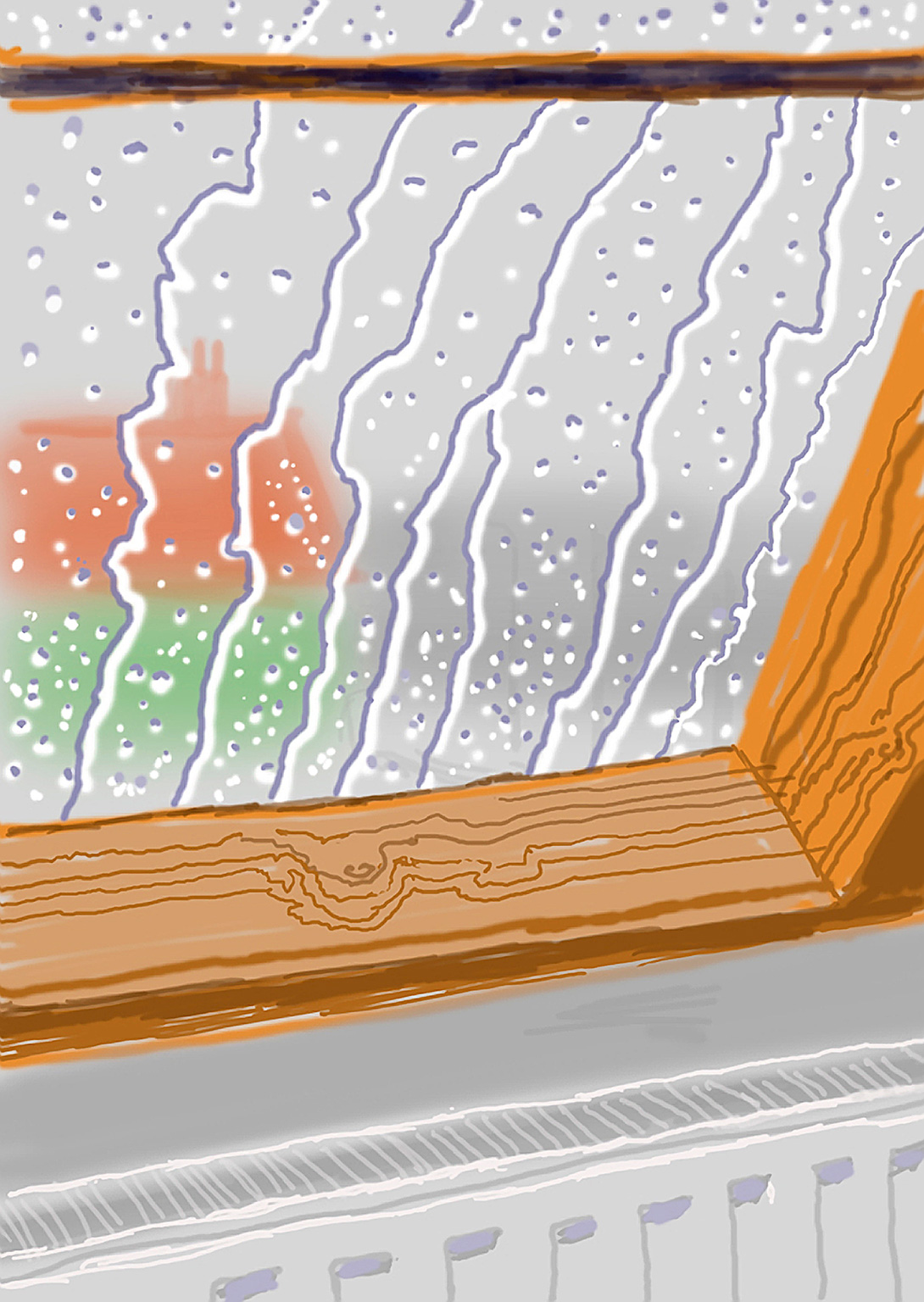
David Hockney, Rain on the Studio Window, From My Yorkshire Deluxe Edition, 2009

David Hockney, Rain on the Studio Window, From My Yorkshire Deluxe Edition, 2009

David Hockney, Artist and Model, 1973-74 © David Hockney

David Hockney, Artist and Model, 1973-74
© David Hockney

David Hockney, Lillies, 1971 © David Hockney

David Hockney, Lillies, 1971
© David Hockney

I also found that some of the best works were the simple ones – a vase of cala lilies, with an accurate and precise cross-hatched background contrasting with the purity of the white flower; a superb iPad image of raindrops running down a window which exudes the cosiness of looking out at rainfall while benefitting from the dryness and comfort of home; and portraits of friends, simply posed, looking straight out at the viewer, prompting interaction, welcoming us in.

It is, therefore, a show with something for everyone, but with an overriding central devotion to the versatile, unique art of printmaking.

Norms: The Saints Collection | St. Peter

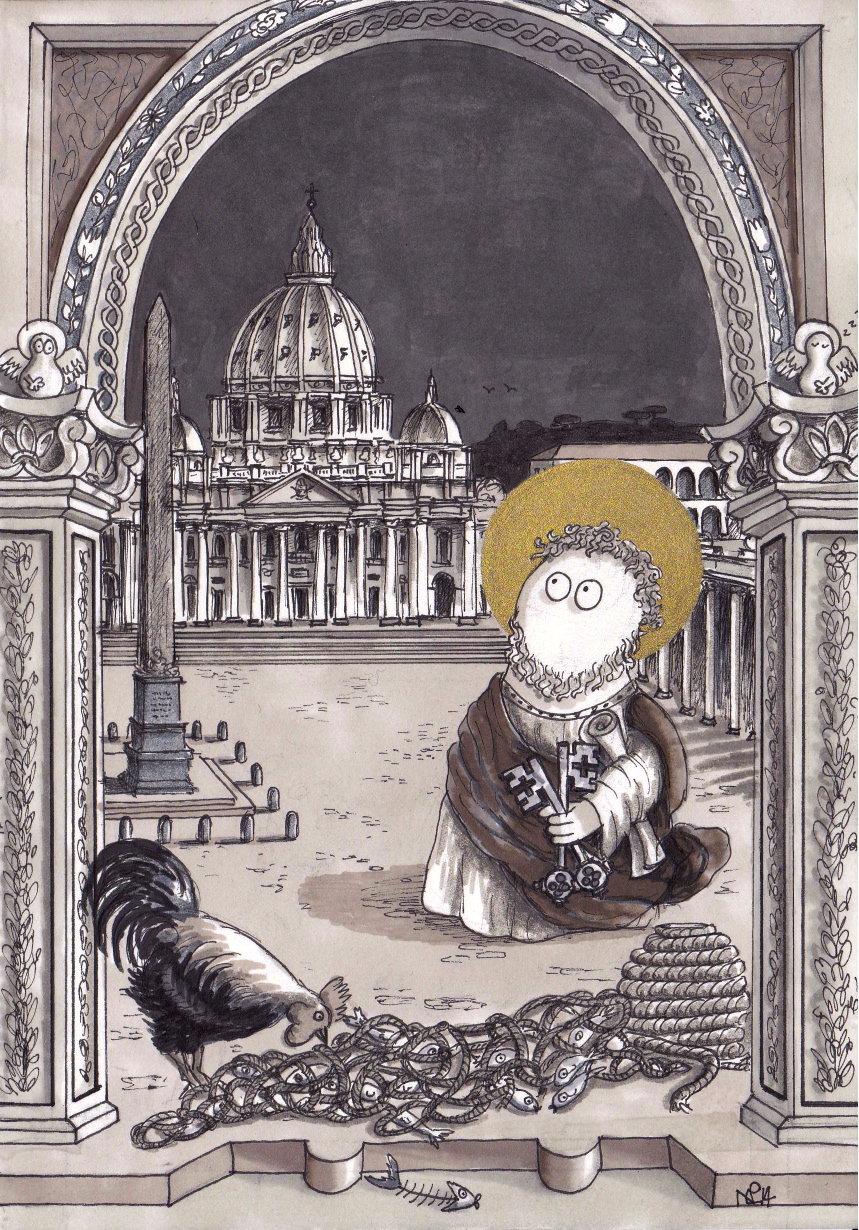
Next up in the continuing Norm Saints Collection is Saint Peter, on whose rock the very foundations of the modern day Catholic church are built. Yes, Saint Peter is the saint we most associate with holding the grand double keys of the Vatican, cloaked elegantly in a Romanesque toga-like getup, with his curly hair and beard all in the Roman vogue. But of course this important Norm Saint was not always so grand. Born “Shimon”, Saint Peter was in fact a fisherman heralding from Galilee. Hence why in so many artistic representations, he is shown with the paraphernalia of his former trade, as is this little Saint norm here.

But later in life, Shimon was to become an integral member of the Twelve Apostles of Christ, and in that role was the apostle who, famously, denied Christ before the cock crowed three times. Hence why in other artistic representations, said cockerel is to be found somewhere round abouts. Sadly for my Saint Peter Norm, the proximity of these representations has made for something of an inevitable conflict, as the recently caught fish spill out of Saint Peter’s net only to be pecked to within an inch of their lives by the rather zealous cockerel standing in wait. Oh well, at least Saint Peter Norm can calm himself in the knowledge that in the background a great church, the Basilica of Saint Peter in Rome, has been built in his honour. Of course historically, the real Saint Peter, who founded the first church of Rome, would never have known to what grandiose extent this church would later develop. But I believe that is the great benefit of artistic license.

St Peter Norm (2014 © Nicholas de Lacy-Brown, pen and gold paint on paper)

St Peter Norm (2014 © Nicholas de Lacy-Brown, pen and gold paint on paper)

I commend to you, Saint Peter Norm. Who’s next?

© Nicholas de Lacy-Brown and The Daily Norm, 2001-2014. Unauthorized use and/or duplication of the material, whether written work, photography or artwork, included within The Daily Norm without express and written permission from The Daily Norm’s author and/or owner is strictly prohibited. Excerpts and links may be used, provided that full and clear credit is given to Nicholas de Lacy-Brown and The Daily Norm with appropriate and specific direction to the original content. For more information on the work of Nicholas de Lacy-Brown, head to his art website at www.delacy-brown.com

 Nicholas de Lacy-Brown’s new solo exhibition, When (S)pain became the Norm, will be at London’s Strand Gallery from 13 – 18 May 2014. For more details, click here.

London’s homage to print: Part 1 – Chiaroscuro woodcuts

Printmaking is seriously in vogue right now. Whether it be etchings, lithography, linocut or woodcut, prints have seen a huge upsurge in popularity in recent years. This is partly down to the financial crash, which for so many middle-income art collectors meant that the 3-figure price-tags attached to prints suddenly became a much more attractive method of collecting quality images. But it’s not just about cost. Printmakings’ return to prominence also recognises the unique quality and character which is inherent in each of the print mediums, whether it be the fine lines of etching, or the watery translucence of lithography.

And as if further confirmation of this renewed popularity were needed, London is currently showing two blockbuster exhibitions which explore the medium of print in all its rich and versatile brilliance: David Hockney: Printmaker, at the Dulwich Picture Gallery (review coming soon!) and at the Royal Academy: Renaissance Impressions – Chiaroscuro Woodcuts.

Hans Burgkmair the Elder, 'St George and the Dragon', c. 1508-10." Chiaroscuro woodcut printed from two blocks, the tone block in beige. 31.9 x 22.5 cm. Collection Georg Baselitz. Photo Albertina, Vienna. Organised by the Royal Academy of Arts, London and the Albertina, Vienn

Hans Burgkmair the Elder, St George and the Dragon, c. 1508-10. Chiaroscuro woodcut printed from two blocks, the tone block in beige. Collection Georg Baselitz. Photo Albertina, Vienna.

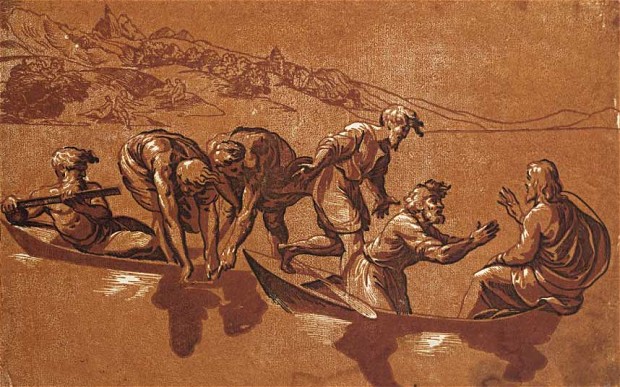
Ugo da Carpi, after Raphael, The Miraculous Draught of Fishes, c. 1523-27. Chiaroscuro woodcut printed from three blocks, the tone blocks in red, 23.4 x 25.7 cm. Albertina, Vienna. Photo: Albertina, Vienna

Ugo da Carpi, after Raphael, The Miraculous Draught of Fishes, c. 1523-27. Chiaroscuro woodcut printed from three blocks, the tone blocks in red. Photo: Albertina, Vienna

Ugo da Carpi, after Raphael; Aeneas and Anchises 1518, Chiaroscuro woodcut printed from four tone blocks, in beige and grey 51 x 37.4 cm Collection Georg Baselitz. Photo Albertina, Vienna. Organised by the Royal Academy of Arts, London and the Albertina, Vienn

Ugo da Carpi, after Raphael; Aeneas and Anchises 1518, Chiaroscuro woodcut printed from four tone blocks, in beige and grey. Collection Georg Baselitz. Photo Albertina, Vienna.

Ugo da Carpi - Diogenes (1527)

Ugo da Carpi – Diogenes (1527)

This exhibition couldn’t be more timely for me. I have only recently started dabbling in woodcutting myself, having been inspired to do so by Felix Vallotton’s exhibition in Paris last year. Likewise, I have been fully immersed in Renaissance art of late, not least in seeking inspiration for my on-going Norm Saints collection which drawn on Renaissance religious imagery for its primary inspiration.

It is that same intense religious flavour, together with the grandiose imagery which was born of the Renaissance, which forms a golden thread through the 150 or so masterful woodcuts which the Royal Academy currently have on exhibition. Formed of the collections of the Albertina in Vienna, and the private haul of contemporary artist, Georg Baselitz (you know, the one who paints upside down portraits), this brilliant show brings together a fine set of prints which explore the birth of the chiaroscuro woodcut, a unique use of wood to express the intensification of light and dark.

Hendrick Goltzius, Hercules Killing Cacus, 1588. Chiaroscuro woodcut printed from three blocks, the tone blocks in yellow and green, 41.1 x 33.3 cm. Collection Georg Baselitz. Photo: Albertina, Vienna

Hendrick Goltzius, Hercules Killing Cacus, 1588. Chiaroscuro woodcut printed from three blocks, the tone blocks in yellow and green, 41.1 x 33.3 cm. Collection Georg Baselitz. Photo: Albertina, Vienna

Andrea Andreani, after Giambologna, Rape of a Sabine Woman, 1584, Collection Georg Baselitz. Photo Albertina, Vienna
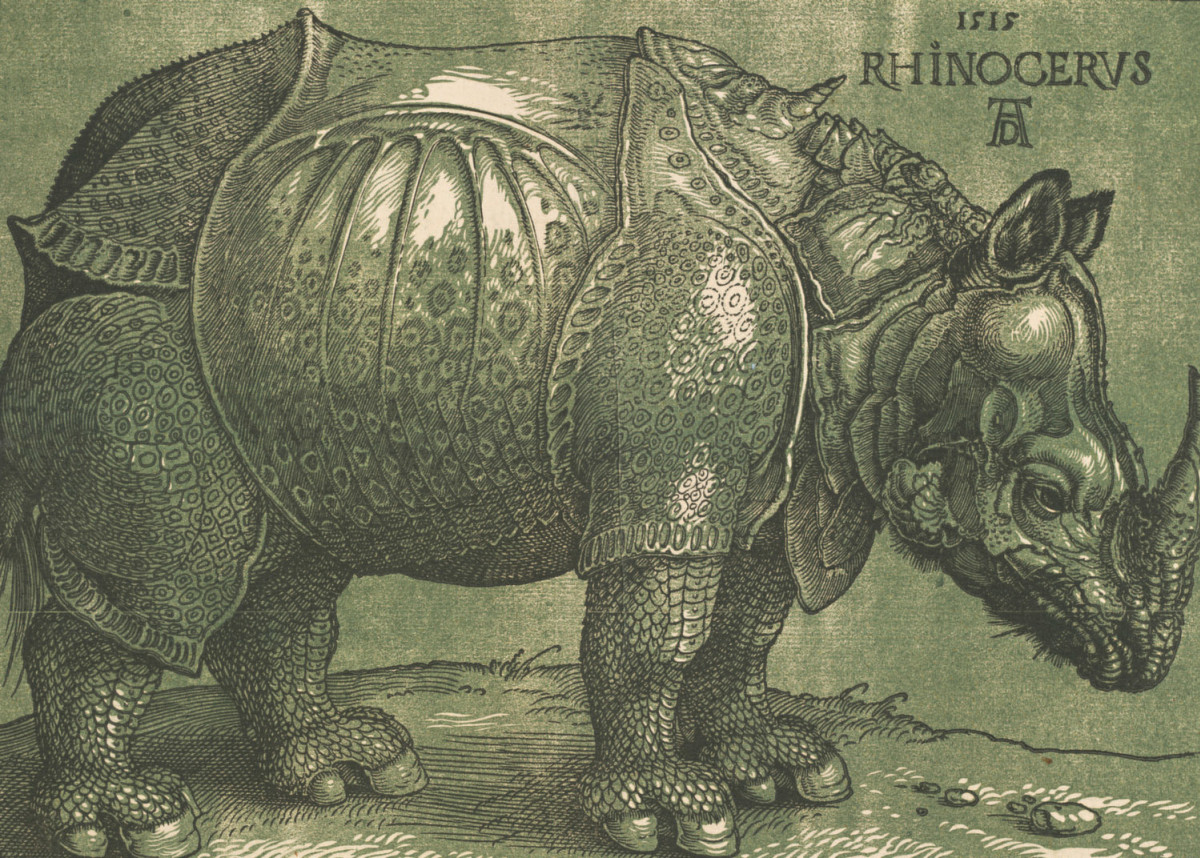
Albrecht Dürer, Rhinoceros (1515 and c.1620 - the highlights)

Albrecht Dürer, Rhinoceros (1515 and c.1620 – the highlights)

Albrecht Dürer, Ulrich Varnbühler (1522 and c.1620 - the highlights)

Albrecht Dürer, Ulrich Varnbühler (1522 and c.1620 – the highlights)

Ugo da Carpi, after Raphael; Aeneas and Anchises 1518, Chiaroscuro woodcut printed from four tone blocks, in beige and grey 51 x 37.4 cm Collection Georg Baselitz. Photo Albertina, Vienna. Organised by the Royal Academy of Arts, London and the Albertina, Vienn

Ugo da Carpi, after Raphael; Aeneas and Anchises 1518, Chiaroscuro woodcut printed from four tone blocks, in beige and grey 51 x 37.4 cm Collection Georg Baselitz. Photo Albertina, Vienna. Organised by the Royal Academy of Arts, London and the Albertina, Vienn

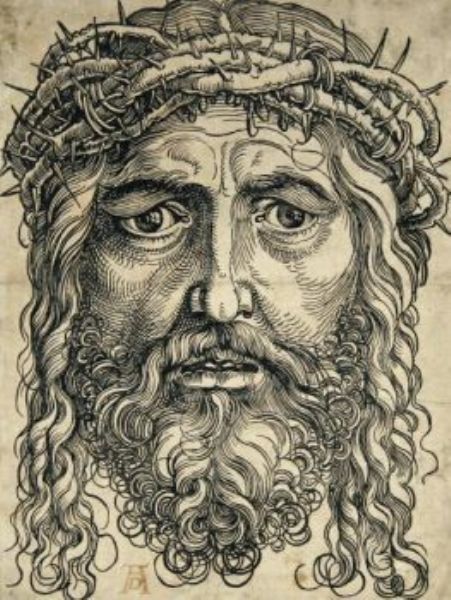
Hans Sebald Beham, Head of Christ Crowned (1520-1) - woodcut from two blocks, tone block in brown.

Hans Sebald Beham, Head of Christ Crowned (1520-1) – woodcut from two blocks, tone block in brown.

From the Italian word meaning light-dark, chiaroscuro is better known to describe the dark and brooding masterpieces of Italian painter, Caravaggio. Just as Caravaggio is famed for utilising the stark contrast of light and shadow to create paintings packed full of drama and intensity, this woodcut technique, invented in the 1500s by Lucas Cranach the Elder and Hans Burgkmair the Elder, provides the same thrill of three-dimensional realism by using different wood plates to layer up light and shadows. It generally involves one plate which contains all of the darkest details (usually the most linear plate), while another provides an overall mid-tone with white highlights cut into it. The effect is one of dramatic contrasts and naturalistic brilliance, as each of the many prints on show in this exhibition demonstrate.

From the work of those inventors, to the development of the medium, mainly by Italian printmakrs such as Ugo da Carpi and Dmenico Beccafumi, we are treated to a period of creativity in which the medium is expertly utilised to create images which, at the time, must have stunned audiences for all of their realism and depth. But just as they may have stunned 1500s audiences for their apparently illusionistic manifestation of light and shadow, so too do they retain the ability to stun the audiences of today – because in their sheer detail and brilliantly perfect execution, these works are a breath of fresh air in a contemporary world where art is so often comprised of some untidy sploshes on a canvas.

Spectator-Royal-Academy

Renaissance Impressions is on at London’s Royal Academy until 8 June 2014.

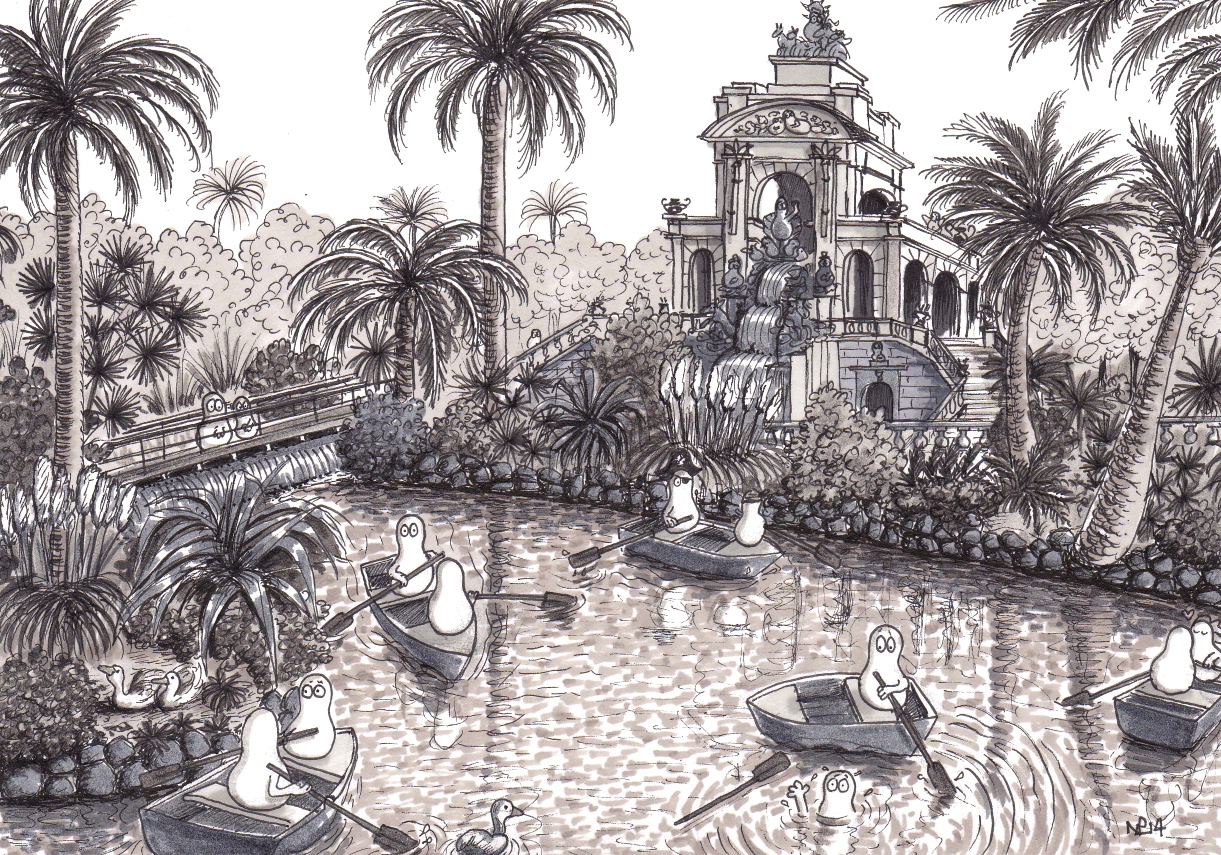
Norms boating at the Parc de la Ciutadella

We join the Norms in Barcelona, where having had their fill of Gaudi after exploring the roof terrace of the Casa Mila and the Norm shaped chimneys which fill it, the Norms have moved to one of the city’s best loved outside spaces – the Parc de la Ciutadella. Asides from being a pretty place to perambulate and play and enjoy the good life out of doors, the park also provides the perfect facility for the Norms to indulge in one of their favourite activities: boating.

Now of course the Norms only have one arm, which might, you will think, have an impact on their ability to row a boat. For Norms’ boats require oars just like any other. And that is precisely why you will always find Norms boating in pairs. So that one can control one oar, and the other a second.

Norms at the Parc de la Ciutadella (2014 © Nicholas de Lacy-Brown, pen and ink on paper)

Norms at the Parc de la Ciutadella (2014 © Nicholas de Lacy-Brown, pen and ink on paper)

That is of course all very well when things are going smoothly. But should the unspeakable actually occur, and one Norm falls out of the boat, just look how difficult it will be to rescue him – with only one oar in action, the other Norm won’t get very far apart from to row in a continuous and never ending circle. Such is the dilemma of being a Norm.

Don’t forget that you can see these Norms and more at my forthcoming solo art exhibition  – When (S)pain became the Norm, at London’s Strand Gallery from 13 – 18 May 2014. For more details, click here

© Nicholas de Lacy-Brown and The Daily Norm, 2001-2014. Unauthorized use and/or duplication of the material, whether written work, photography or artwork, included within The Daily Norm without express and written permission from The Daily Norm’s author and/or owner is strictly prohibited. Excerpts and links may be used, provided that full and clear credit is given to Nicholas de Lacy-Brown and The Daily Norm with appropriate and specific direction to the original content. For more information on the work of Nicholas de Lacy-Brown, head to his art website at www.delacy-brown.com


My Barcelona, on canvas: Separatism

While last week I shared with you one of my more sedate paintings of Barcelona – an oil landscape of the Port Vell – this week, as the tales of my recent Barcelona travels draw to a close, it’s inevitably time to share the second of my two paintings featuring Barcelona – and this time it’s a far more vibrant affair. Part III of my España Volver series, Separatism, explored the fragmentation and political division which is shared by two autonomous regions of Spain, the Basque Country and Catalunya (Catalonia), both of which have a historically fractious relationship with the Spanish nation to whom they are, for some unwittingly, part of a national whole.

By way of demonstration of the political and social fragmentation which means that these two regions sit so uneasily with the rest of Spain, the symbols painted across my painting are framed in the shapes of a jigsaw puzzle which, rather than fitting together easily, is in part broken and displaced. Emerging out of and contained within the pieces of the puzzle are a series of images representing the shared values and passions of the region – food, wine, art and maritime history, as well as icons that are unique to the regions. So out of the Basque Country comes Frank Gehry’s famous Guggenheim building, while in Barcelona, the capital of Catalunya, we have Gehry’s magnificent beachside Peix fish.

Separatism: Catalonia and the Basque Country (2009, Oil on canvas, © Nicholas de Lacy-Brown)

Separatism: Catalonia and the Basque Country (2009, Oil on canvas, © Nicholas de Lacy-Brown)

Representing the Basque town of Saint Sebastian, I have painted a conch shell pierced by arrows (St. Seb’s bay is known as La Concha because of its curving shape), while Gaudi’s iconic Sagrada Familia takes centre stage in this painting, with a dual purpose as a fork on which a juicy salsa drizzled prawn is poised; symbol of the gastronomic prowess of both regions. Meanwhile, further reference to Catalunya’s artistic prowess is made in the broken egg, representing Catalunya born Salvador Dali, while around the canvas, various symbols of Gaudi are represented, from his Passeig de Gracia paving slabs on the left, to the Casa Mila chimney which emerges atop of a bottle of fine Rioja wine.

Of course there’s violence too, with an illustration of the ETA bombings over on the right; symbol of the violent means which some separatist idealist have gone to to make their point, as well as the spiralling energetic core of the painting – a further demonstration of the plethora of cultural, social and historical influences which have made the regions as richly divergent as they are today.

And for those of you who would like to see this painting closer at hand, it will be on exhibition, along with the rest of my España Volver series at London’s Strand Gallery between 13-18 May. More details can be found here.

© Nicholas de Lacy-Brown and The Daily Norm, 2001-2014. Unauthorized use and/or duplication of the material, whether written work, photography or artwork, included within The Daily Norm without express and written permission from The Daily Norm’s author and/or owner is strictly prohibited. Excerpts and links may be used, provided that full and clear credit is given to Nicholas de Lacy-Brown and The Daily Norm with appropriate and specific direction to the original content. For more information on the work of Nicholas de Lacy-Brown, head to his art website at www.delacy-brown.com

 Nicholas de Lacy-Brown’s new solo exhibition, When (S)pain became the Norm, will be at London’s Strand Gallery from 13 – 18 May 2014. For more details, click here

Norms: The Saints Collection | St Patrick

Today the Guinness pumps will be flowing into overdrive, the kicking legs of an Irish jig will get a good showing, and green velvet hats all over the world will be dusted off to celebrate the national day of Ireland, St Patrick’s day. For while this may be the celebration of the Irish nation, its festive effect has a habit of spreading much further afield – to the US, where so much American ancestry can be traced back to the Emerald Isle; to Australia, where the locals are only too happy to swap their mainstay larger for a pint of the black stuff; and of course across the Continent, where Irish bars can be found nestled comfortably between tapas bars, trattorias and bistros alike in almost every European city.

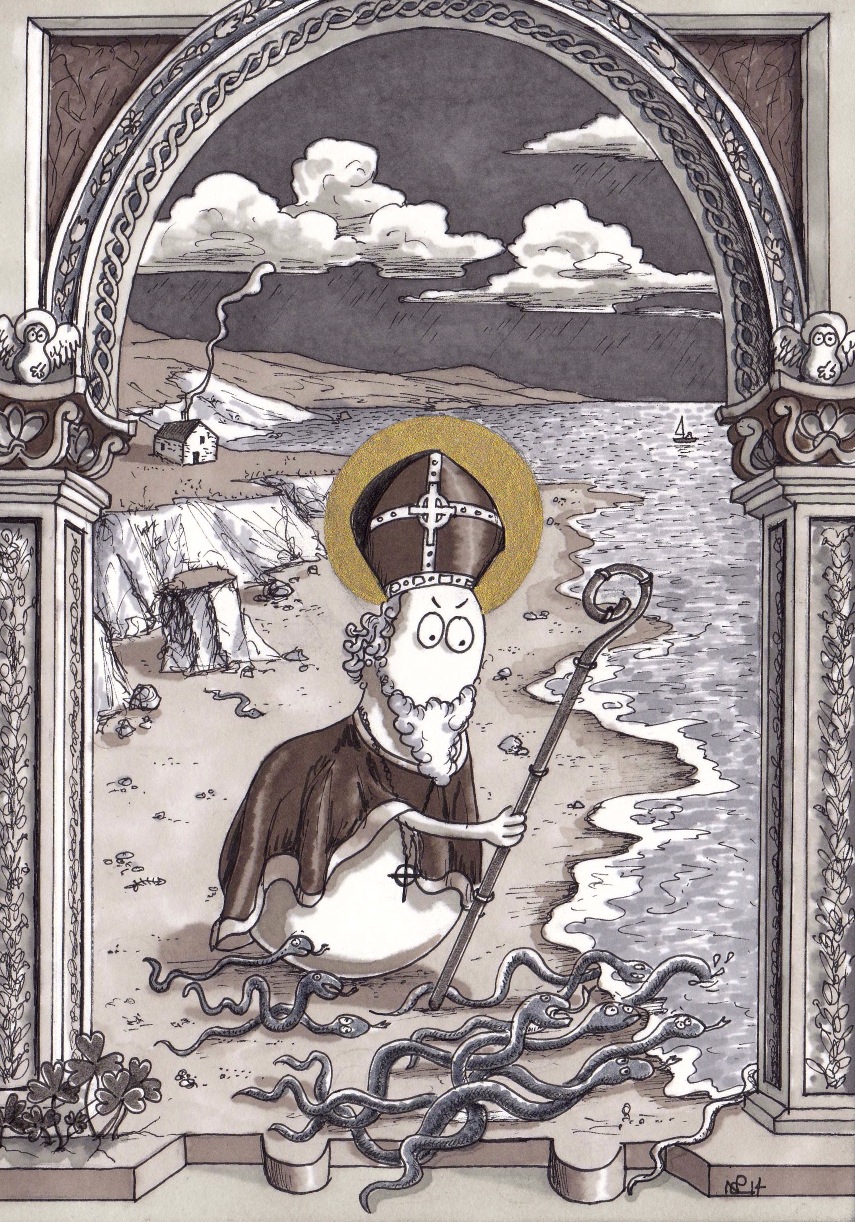
So while revellers everywhere start sipping upon the white creamy froth of their Guinness, there seems to be no better time than now to share the newest Norm of my Norm saints series – St Patrick Norm himself!

St Patrick Norm (2014 © Nicholas de Lacy-Brown, pen and gold paint on paper)

St Patrick Norm (2014 © Nicholas de Lacy-Brown, pen and gold paint on paper)

With its typical Irish coastal landscape, a small growth of shamrocks and even a little rain, the absence of green in this monochrome sketch is the only ingredient missing in what is otherwise a characteristically Irish scene. And most iconic of all is of course St Patrick himself, who, legend has it, helped to rid Ireland of snakes by driving the pesky beasts into the Atlantic sea. Well thank goodness he didn’t opt for the other coast, or we in England may have been none too pleased about the influx of scaly  visitors slipping onto out shores after their trip across the waters.

Happy St Patrick’s Day to all, in Ireland and everywhere!

© Nicholas de Lacy-Brown and The Daily Norm, 2001-2014. Unauthorized use and/or duplication of the material, whether written work, photography or artwork, included within The Daily Norm without express and written permission from The Daily Norm’s author and/or owner is strictly prohibited. Excerpts and links may be used, provided that full and clear credit is given to Nicholas de Lacy-Brown and The Daily Norm with appropriate and specific direction to the original content. For more information on the work of Nicholas de Lacy-Brown, head to his art website at www.delacy-brown.com

Nicholas de Lacy-Brown’s new solo exhibition, When (S)pain became the Norm, will be at London’s Strand Gallery from 13 – 18 May 2014. For more details, click here

My Barcelona, on canvas: Port Vell

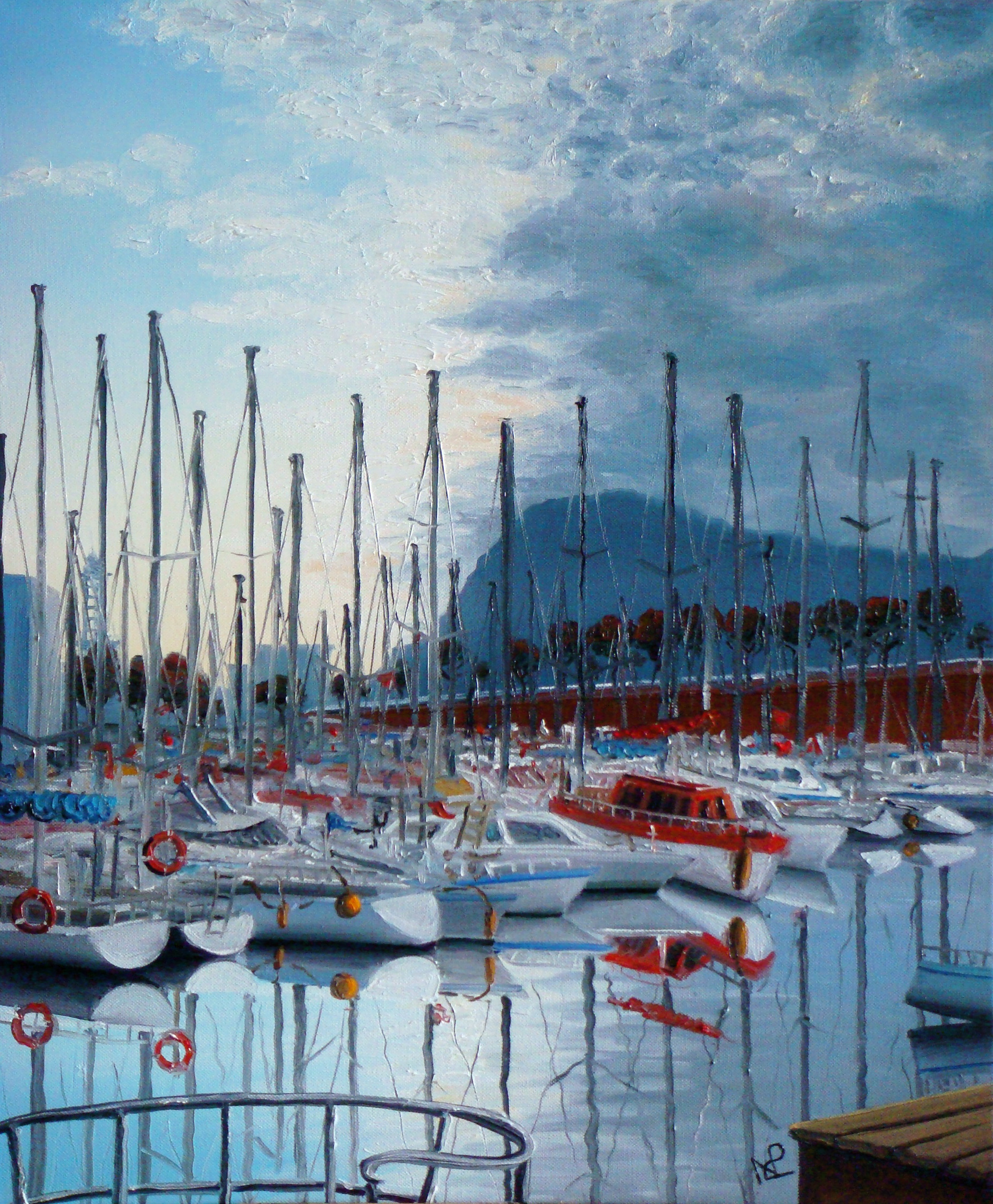
Back in 2007, when I had finished 5 years of full time legal studies and was waiting for my professional training to begin, I decided to take advantage of having a certain amount of time on my hands both to travel as much as possible, and to teach myself how to paint in oils (having thus far painted largely in acrylic). The two things inevitably combined, and having travelled to a few cities in Spain and beyond when venturing to and from my family home in Marbella, I decided to test out the results I could achieve in oil paint by working on a series of cityscapes and landscapes based on those travels. You saw my Venice paintings which I worked on around this time. Having mastered that watery city, I decided to move on to a series of seaside cities, and Barcelona was top of my list.

It was therefore as part of that series that I painted this work of the Port Vell. As yesterday’s post showed, Port Vell is part of the expansive marina and beach which now provides Barcelona with a beautiful Mediterranean facade where previously (pre-1992 Olympics) there was only a heavily industrialised port. Being filled with yachts of many shapes and sizes, this painting would have been a challenge for the most seasoned of oil painters, but for me, a mere beginner, it presented even more of a challenge. I was nevertheless pleased with the resulting work, which captures, I think, something of the compact collection of yachts which fill Barcelona’s marina, as well as illustrating something of a transitional weather effect as the sun begins to shine from under the passage of a thick layer of grey cloud.

Seascape VI: Port Vell, Barcelona (2007 © Nicholas de Lacy-Brown, oil on canvas)

Seascape VI: Port Vell, Barcelona (2007 © Nicholas de Lacy-Brown, oil on canvas)

Strangely, despite making 7 visits to the city, I have only painted Barcelona twice. While I’ll give you a glimpse of the second work sometime soon, I think that further Barcelona creations are somewhat begging. Watch this space.

© Nicholas de Lacy-Brown and The Daily Norm, 2001-2014. Unauthorized use and/or duplication of the material, whether written work, photography or artwork, included within The Daily Norm without express and written permission from The Daily Norm’s author and/or owner is strictly prohibited. Excerpts and links may be used, provided that full and clear credit is given to Nicholas de Lacy-Brown and The Daily Norm with appropriate and specific direction to the original content. For more information on the work of Nicholas de Lacy-Brown, head to his art website at www.delacy-brown.com

Post 500: Norms at La Pedrera, Barcelona

I am celebrating the publication of my 500th post on The Daily Norm! It’s unbelievable to think that I have sat at my computer over the last 2 and a half years, and typed out such a mammoth number of posts for my Daily Norm readers. But writing this blog has become such a naturally occurring, integral accompaniment to my life that frankly, my surprise at seeing 500 posts notched up is on a level with my daily surprise when I realise how quickly a year is passing. Still, there can be no complacency about the achievement of reaching this very significant hallmark in my blogging history, and a huge thanks has to go out to all of my readers and followers – somethings I feel like I really struggle to give back as much thanks and support as you deserve, but your readership really is important to me. As for the blog – well what a life changer it has been. To have this platform to share my thoughts, my creativity, my sketches, prints, photos and paintings – well it has made so much of what I do in my own little world worth the effort. After all, doesn’t every creative always yearn for an audience?

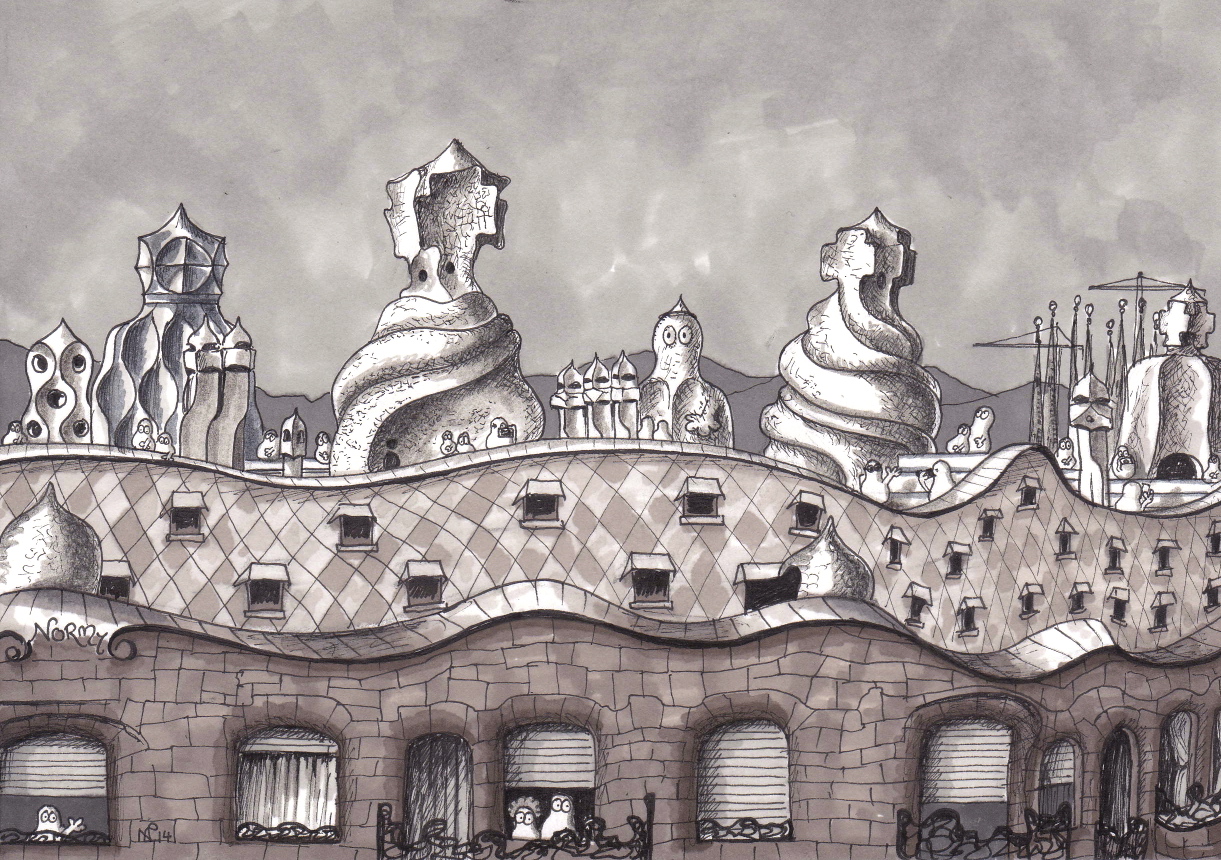
So what better way to celebrate my blogging achievement than to share a brand new insight on the world of “the Norms”, the characters who were the whole reason I set up this blog in the first place. Today we join the Norms in the beautiful Spanish city of Barcelona, which is a coincidence, because of course I have only come back from the city myself. Here we see the Norms visiting one of the most famous buildings created by architect genius Antoni Gaudi, La Pedrera (otherwise known as the Casa Mila). Famed for its quarry like facade and its tiled chimneys which look more like whipped meringue nests, La Pedrera is a masterpiece of modernist architecture and a much loved tourist destination for the Norms, not least because one of the chimneys appears to bear a very striking resemblance to a Norm…

Norms at La Pedrera (2014 © Nicholas de Lacy-Brown, pen and ink on paper)

Norms at La Pedrera (2014 © Nicholas de Lacy-Brown, pen and ink on paper)

So from the Norms in Barcelona, to my own trip to the city, join me later this week on The Daily Norm as I make headway through the next 500 posts of my blog which I cannot wait to write, and share with you. See you then!

© Nicholas de Lacy-Brown and The Daily Norm, 2001-2014. Unauthorized use and/or duplication of the material, whether written work, photography or artwork, included within The Daily Norm without express and written permission from The Daily Norm’s author and/or owner is strictly prohibited. Excerpts and links may be used, provided that full and clear credit is given to Nicholas de Lacy-Brown and The Daily Norm with appropriate and specific direction to the original content. For more information on the work of Nicholas de Lacy-Brown, head to his art website at www.delacy-brown.com